
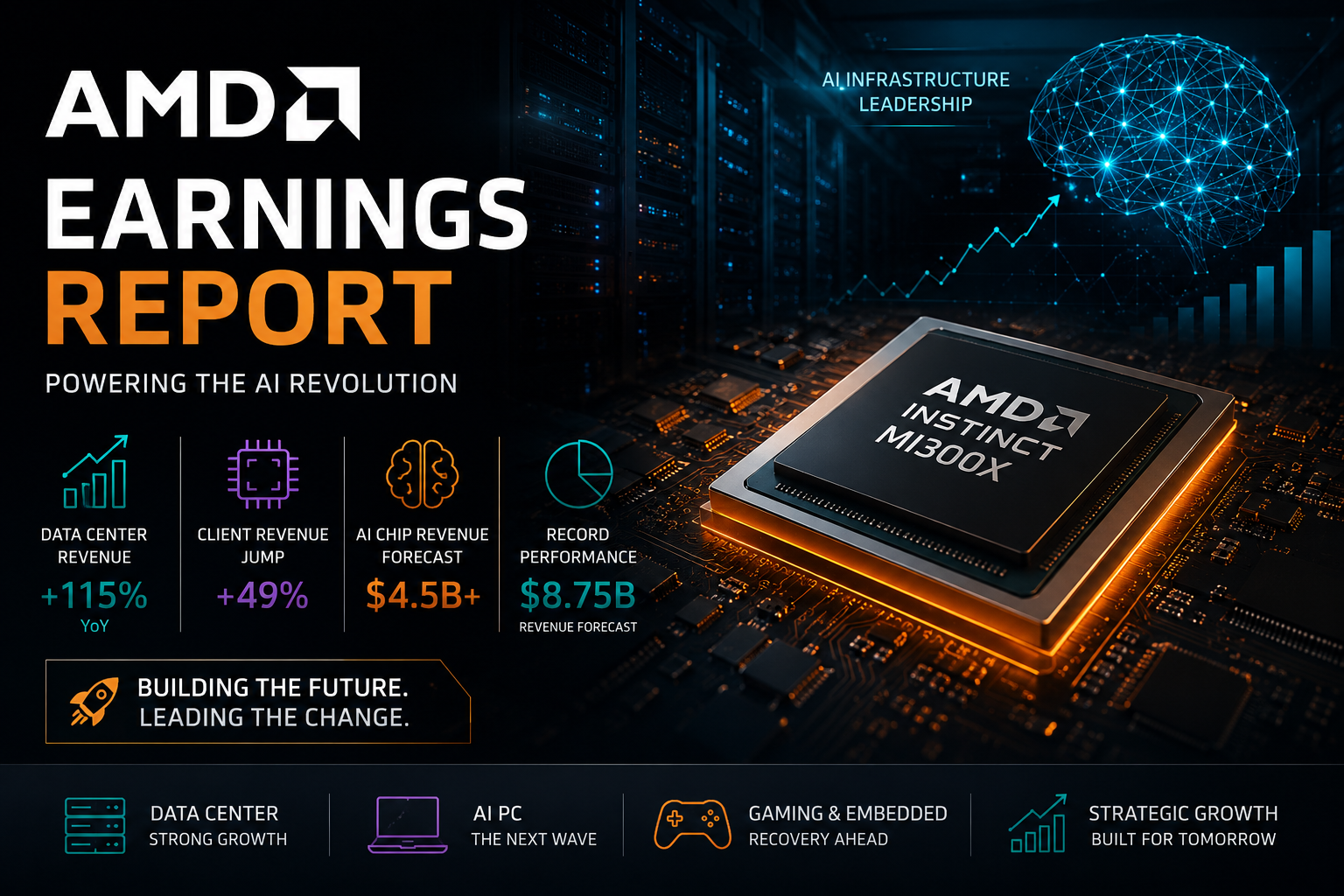
💡 AMD Earnings Report: Strategic Analysis of AI and Market Growth
An authoritative analysis of AMD's latest earnings report, focusing on AI accelerator growth, data center dominance, and competitive positioning against Nvidia and Intel.
Executive Summary
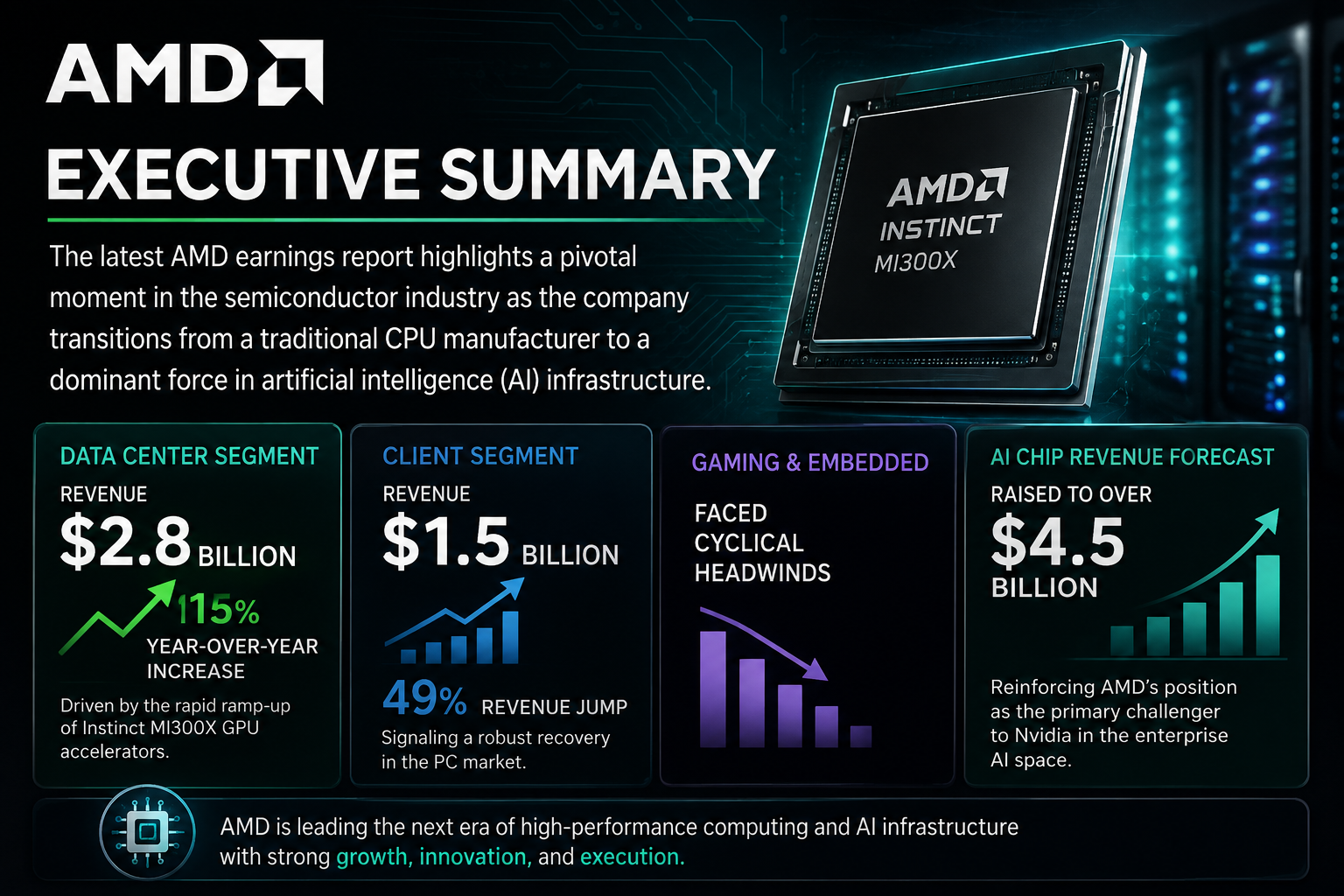
The latest AMD earnings report highlights a pivotal moment in the semiconductor industry as the company transitions from a traditional CPU manufacturer to a dominant force in artificial intelligence (AI) infrastructure. Key data points from the recent fiscal period include a record-breaking Data Center segment revenue of 2.8 billion dollars, representing a 115 percent year-over-year increase. This growth is primarily driven by the rapid ramp-up of the Instinct MI300X GPU accelerators. While the Gaming and Embedded segments faced cyclical headwinds, the Client segment saw a 49 percent revenue jump to 1.5 billion dollars, signaling a robust recovery in the PC market. AMD has successfully raised its annual AI chip revenue forecast to over 4.5 billion dollars, reinforcing its position as the primary challenger to Nvidia in the enterprise AI space.
Introduction: The AI Arms Race and AMD Positioning
The global technology landscape is currently defined by a massive capital expenditure cycle focused on generative AI. Advanced Micro Devices (AMD) has emerged as a critical beneficiary of this shift. Under the leadership of Dr. Lisa Su, the company has executed a multi-year strategy to diversify its portfolio across high-performance computing, adaptive networking, and specialized AI silicon. This earnings report serves as a barometer for the broader tech sector, reflecting how enterprise demand is shifting from general-purpose servers to AI-optimized clusters. As we look toward the 2026 strategic outlook for global technology, AMD's ability to maintain its roadmap execution will determine its long-term valuation and market share.
THE DEEP DIVE: Segment Performance and Strategic Drivers
1. Data Center Dominance and the MI300 Series
The Data Center segment is now the largest contributor to AMD's total revenue, accounting for nearly 50 percent of the company's top line. The success of the Instinct MI300 series is the primary engine of this growth. Unlike previous generations, the MI300X has gained significant traction with Tier-1 cloud service providers like Microsoft, Meta, and Oracle. These firms are seeking alternatives to Nvidia's H100 and H200 chips to lower their total cost of ownership and diversify their supply chains. AMD's advantage lies in its chiplet architecture, which allows for higher memory capacity and bandwidth at competitive price points. Furthermore, the EPYC processor line continues to gain share in the server market, with the 4th Gen EPYC chips delivering superior performance-per-watt compared to legacy Intel Xeon offerings.
2. Client Segment: The Rise of the AI PC
The Client segment, which includes Ryzen desktop and laptop processors, reported revenue of 1.5 billion dollars. This recovery is vital for AMD as it provides the cash flow necessary to fund intensive R&D for AI. The industry is currently entering a refresh cycle driven by the AI PC category. These devices feature integrated Neural Processing Units (NPUs) designed to handle local AI workloads without relying on the cloud. AMD's Ryzen AI 300 series processors are currently leading this transition, offering up to 50 TOPS (Trillions of Operations Per Second) of AI performance. This segment's growth is a positive indicator for the broader banking sector and economic stability, as hardware refreshes often correlate with increased corporate capital investment.
3. Gaming and Embedded: Navigating the Slump
Contrasting the success in AI and PCs, the Gaming segment saw a 59 percent decline in revenue, falling to 648 million dollars. This drop is largely attributed to the late stage of the current console cycle (PlayStation 5 and Xbox Series X/S) and lower sales of Radeon GPUs. Similarly, the Embedded segment, which includes the Xilinx acquisition assets, reported a 41 percent decrease in revenue. This is due to inventory normalization across industrial and automotive sectors. However, management expects the Embedded segment to recover in the second half of the year as customers clear existing stockpiles and begin ordering new adaptive SoC solutions for edge AI applications.
4. Financial Health and Margin Expansion
AMD's non-GAAP gross margin improved to 53 percent, a significant metric that demonstrates the company's pricing power in the high-end server market. Operating income also saw a substantial rise, reflecting better operational efficiency. Investors monitoring stock market futures and global trading trends have focused on AMD's free cash flow, which allows the company to continue its aggressive acquisition strategy, such as the recent 4.9 billion dollar deal to acquire ZT Systems to enhance its AI infrastructure capabilities.
WHAT THIS MEANS FOR YOU
For the average consumer and professional, AMD's performance suggests that AI is no longer a theoretical concept but a tangible feature in upcoming hardware. If you are planning to upgrade your laptop or workstation in the next year, you can expect significantly better battery life and local AI capabilities. For investors, the report indicates that while Nvidia remains the market leader, AMD is the only viable alternative at scale, making it a crucial hedge in any technology-heavy portfolio. The shift toward AI-optimized hardware will likely lead to more personalized computing experiences and faster processing of complex tasks in creative and technical fields.

Expert Verdict / Future Outlook
AMD is successfully navigating a complex transition. The company has moved beyond being a low-cost alternative to Intel and has become a primary innovator in the most valuable segment of the semiconductor industry. The strategic acquisition of ZT Systems will allow AMD to offer full-rack AI solutions, directly competing with Nvidia's GB200 NVL72 systems. The future outlook remains bullish, provided AMD can maintain its execution on the MI350 and MI400 roadmaps. We anticipate that by 2026, AMD will capture approximately 20 to 25 percent of the AI accelerator market, up from its current estimated share of 10 percent. The primary risk remains the potential for a slowdown in cloud capital expenditure, though current signals suggest that the AI investment cycle is still in its early to middle innings.
FAQ: Understanding AMD's Market Position
- Why is the MI300 series so important for AMD? The MI300 series is AMD's first truly competitive AI GPU that matches or exceeds Nvidia's performance in specific large language model (LLM) workloads, allowing AMD to capture a portion of the massive AI infrastructure market.
- Is AMD gaining market share from Intel? Yes, in the server CPU market, AMD's EPYC processors have consistently gained share over Intel's Xeon line due to better energy efficiency and higher core counts.
- What is an AI PC? An AI PC is a computer equipped with a specialized processor (NPU) that can run artificial intelligence tasks, like image generation or real-time translation, locally on the device instead of using the internet.
- Why did the Gaming segment revenue drop? The gaming market is cyclical. The current generation of consoles has been out for several years, leading to a natural decline in demand for the chips that power them.
- How does the ZT Systems acquisition help AMD? ZT Systems specializes in designing the massive server racks used in data centers. By owning this expertise, AMD can sell complete, ready-to-use AI systems to cloud providers, rather than just selling individual chips.
Important Note: Financial Disclaimer: This content is for educational purposes only and does not constitute professional financial advice. Always consult with a certified financial planner before making investment decisions.
Conclusion
AMD's latest earnings report confirms its status as a cornerstone of the AI era. By leveraging its strength in data centers and successfully pivoting its client business toward AI PCs, the company has built a resilient foundation for long-term growth. While challenges in gaming and embedded sectors persist, the explosive 115 percent growth in data center revenue underscores a successful strategic shift. As the industry moves toward more integrated AI solutions, AMD's focus on open ecosystems and high-performance silicon positions it as a vital player in the global technology supply chain.





Comments 0
Leave a Reply
Your email address will not be published. Required fields are marked *
Be the first to share your thoughts!