
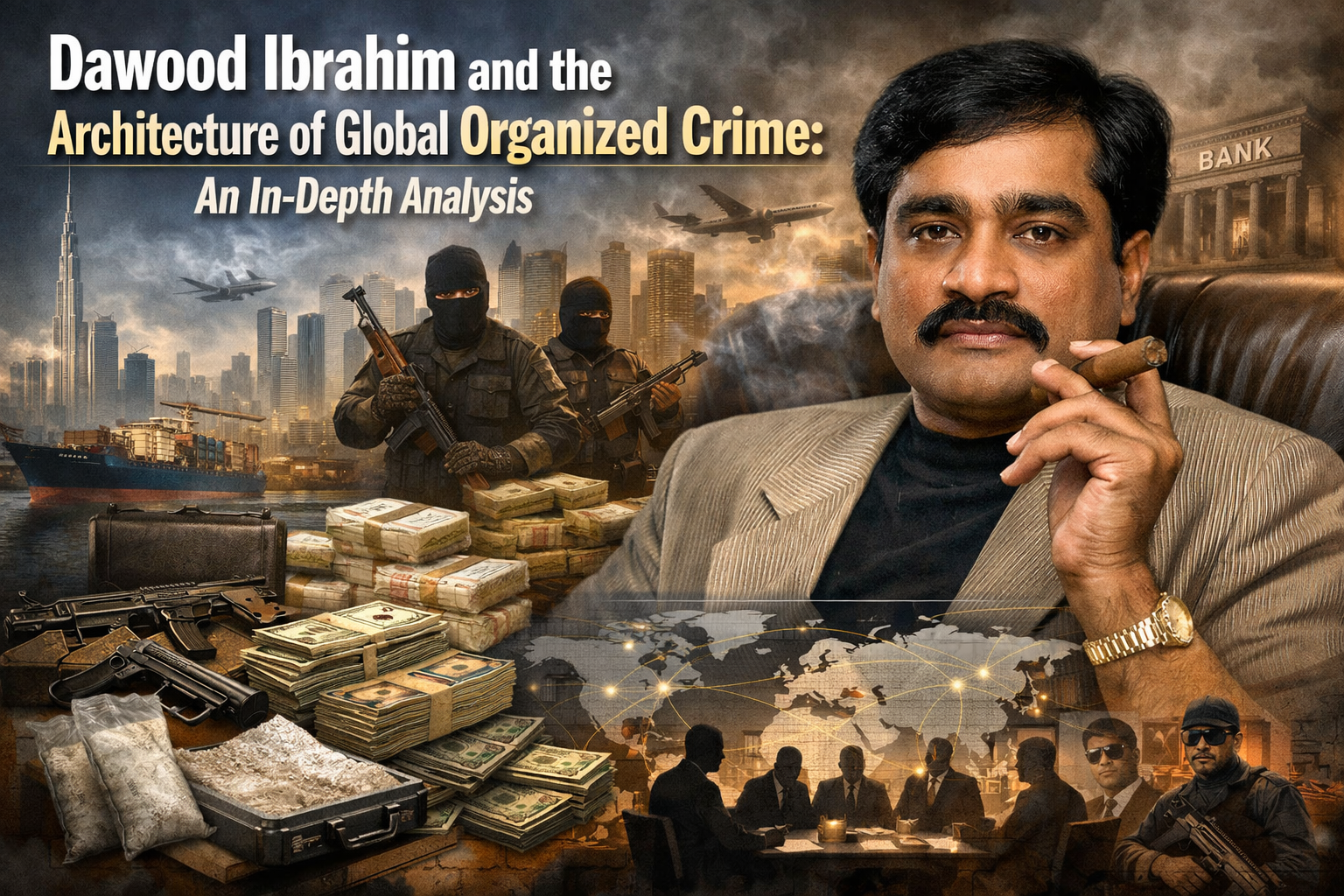
The study of global organized crime often leads researchers to a few central figures who have redefined the boundaries of illicit networks. Among these figures, Dawood Ibrahim stands as a primary subject for criminologists and security analysts worldwide. His evolution from a local operative in Mumbai to the head of a vast transnational criminal organization known as the D-Company offers a unique case study in how crime syndicates adapt to globalized economies. Understanding this trajectory is essential for comprehending the modern landscape of international security and the challenges faced by law enforcement agencies like INTERPOL.
Security studies in organized crime show that, the longevity and resilience of such organizations are not accidental. They are built on complex structures that mimic legitimate corporate entities while operating in the shadows. This article examines the core concepts behind the rise of the D-Company, the mechanics of its financial operations, and the broader implications for global geopolitics. By stripping away the sensationalism often found in media portrayals, we can focus on the structural and functional aspects of one of the world most influential criminal networks.

The Evolution of the D-Company Syndicate
The origins of the D-Company can be traced back to the bustling streets of Mumbai during the 1970s. Initially, the group focused on localized activities such as gold smuggling and extortion. However, as the global economy shifted, so did the group's focus. Experts suggest that the group's ability to diversify its portfolio was the primary driver of its expansion. By the 1980s, the organization had established a firm grip on the city's underworld, successfully neutralizing competitors and consolidating power.
International security reports indicate that, the organization eventually transitioned into a transnational entity. This shift involved establishing operational bases outside of India, particularly in the Middle East and Southeast Asia. The transition was facilitated by the exploitation of gaps in international law enforcement cooperation. By operating across multiple jurisdictions, the syndicate could shield its leadership and assets from the reach of any single national authority. the evolution and historical development of transnational organized crime networks across different regions.
The Mechanics of Transnational Criminal Operations
To understand how an organization like the D-Company functions, one must look at the core concepts of a Transnational Criminal Organization (TCO). These entities operate on a model that prioritizes profit maximization while minimizing risk through a decentralized hierarchy. The D-Company is structured into various specialized cells, each responsible for a specific function such as logistics, finance, or enforcement.
One of the most critical aspects of their operation is the use of the Hawala system. This traditional method of money transfer operates outside of the formal banking sector, making it nearly impossible for authorities to track. Hawala relies on a network of brokers who facilitate the movement of funds based on trust and coded communications. According to financial experts, this system allows the syndicate to move large sums of money across borders without leaving a digital footprint. how informal Hawala-based financial transfer systems operate outside traditional banking channels.

Global Impact and International Security Concerns
The activities of Dawood Ibrahim and his associates have far reaching consequences that extend beyond the realm of traditional crime. Global security agencies have long documented the intersection between organized crime and international terrorism. This nexus is particularly concerning because criminal networks provide the logistical and financial infrastructure that extremist groups require to operate. The group has been referenced in various international security discussions related to organized crime and cross-border illegal activities.
The impact on global trade and economic stability is also significant. By engaging in large scale counterfeiting, narcotics trafficking, and money laundering, these organizations distort local markets and undermine the integrity of the global financial system. As per recent industry reports, the economic drain caused by such syndicates totals billions of dollars annually, affecting everything from property values to the cost of consumer goods in affected regions.
Common Misconceptions and Realities
In the public imagination, figures like Dawood Ibrahim are often shrouded in myth. It is important to distinguish between verified facts and speculative narratives. One common mistake is viewing the syndicate as a monolithic entity controlled entirely by one person. In reality, modern TCOs are highly adaptable and often function through a series of autonomous or semi-autonomous alliances. This means that even if the leadership is incapacitated, the network itself can continue to function through its established infrastructure.
Another misconception is that these organizations only operate in the developing world. In truth, the D-Company and similar groups have a significant presence in major global financial hubs, using legitimate front companies to launder money and invest in real estate. This integration into the legal economy is what makes them so difficult to dismantle. Official specifications regarding the exact number of operatives or the total value of assets are not fully confirmed due to the secretive nature of these operations.

Expert Insights: The Challenges of Law Enforcement
Criminologists and law enforcement experts highlight several challenges in the fight against global syndicates. The primary hurdle is the lack of a unified global legal framework. While INTERPOL facilitates cooperation, different countries have varying laws regarding extradition and financial transparency. This allows high profile fugitives to find safe havens in jurisdictions that do not have active extradition treaties with their home countries.
Pro tips for understanding the future of this struggle include:
- Monitoring the rise of cyber enabled crime within traditional syndicates.
- Observing the shift toward cryptocurrency as a supplement to the Hawala system.
- Analyzing the role of state actors in providing protection to criminal leadership.
Experts suggest that the focus must move away from just capturing individuals and toward dismantling the financial and logistical pipelines that sustain the organization.
Frequently Asked Questions
What is the D-Company?
The D-Company is a transnational criminal organization founded by Dawood Ibrahim. It is involved in a wide range of activities, including narcotics trafficking, extortion, money laundering, and smuggling, with a presence across several continents.
Why is Dawood Ibrahim on the INTERPOL list?
He is on the INTERPOL list due to his alleged involvement in organized crime and international terrorism. He is a high priority target for multiple law enforcement agencies worldwide who seek his arrest for various serious offenses.
How does the syndicate move money without being caught?
The organization primarily uses the Hawala system, an informal method of transferring money based on a network of brokers. This system does not involve physical movement of cash or traditional bank records, making it extremely difficult to monitor.
What are the primary regions of operation for this network?
While its roots are in India, the network has significant operations in the Middle East, Southeast Asia, and parts of Europe and Africa. It uses these regions for logistics, financial sheltering, and as transit points for illicit goods.
Has the organization been linked to other global groups?
Yes, according to global security reports, the D-Company has maintained strategic alliances with various other criminal and extremist organizations to facilitate logistics and expand its operational reach.
Conclusion
The story of Dawood Ibrahim and the D-Company is more than a tale of a single fugitive; it is a blueprint of how organized crime has evolved in the 21st century. By leveraging globalization, traditional financial systems, and geopolitical tensions, the syndicate has managed to survive for decades despite intense international pressure. The ongoing efforts by global law enforcement agencies represent a critical battle for the integrity of international borders and the global economy. As long as the structural foundations of these networks remain intact, the challenge of transnational crime will continue to be a top priority for global security experts.
The legacy of the D-Company serves as a stark reminder that the fight against organized crime requires unprecedented international cooperation and a deep understanding of the financial mechanisms that empower such syndicates.





Comments 0
Leave a Reply
Your email address will not be published. Required fields are marked *
Be the first to share your thoughts!