
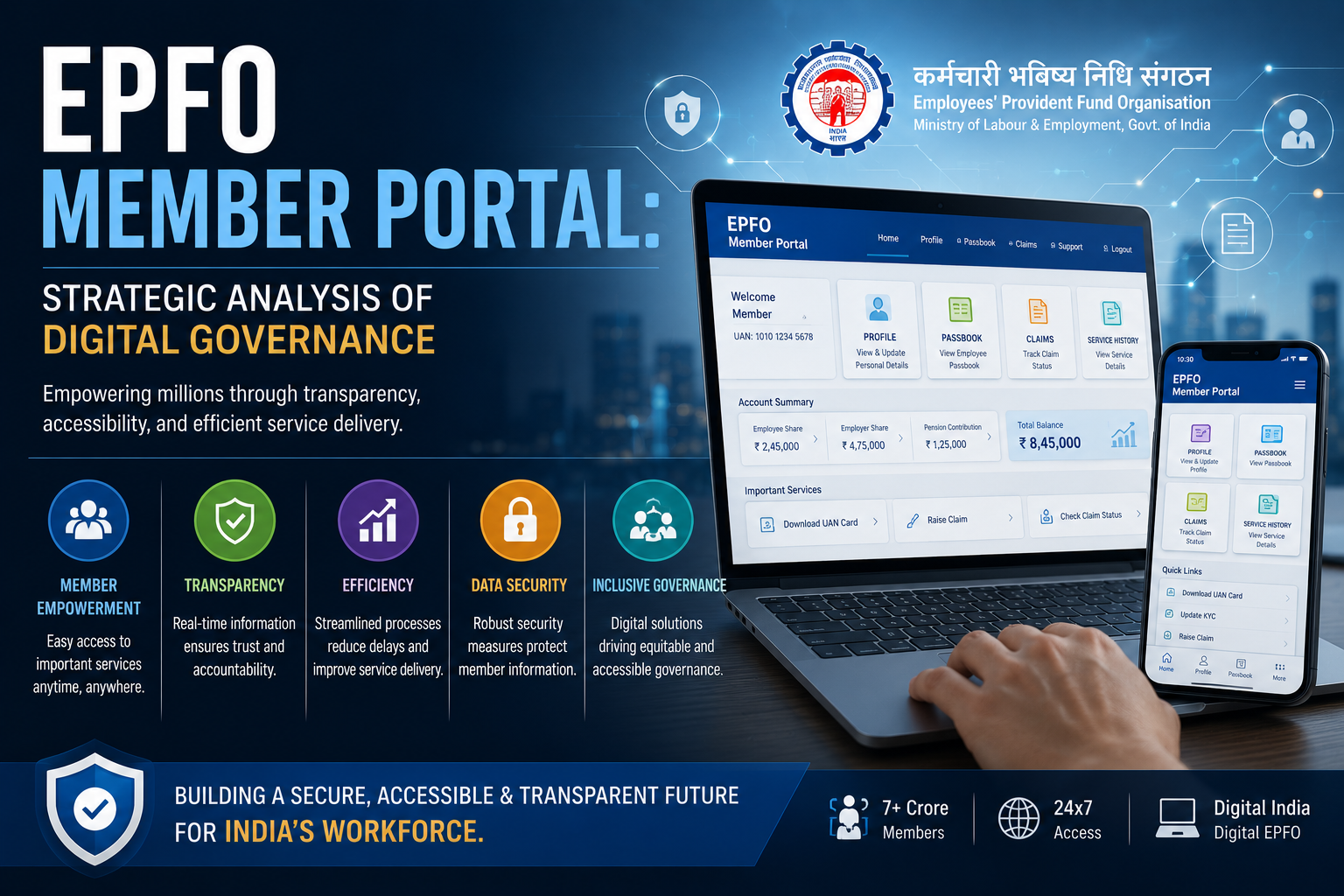
💡 EPFO Member Portal: Strategic Analysis of Digital Governance
A comprehensive analysis of the EPFO Member Portal, exploring its digital infrastructure, strategic importance for social security, and technical evolution for 60 million members.
Executive Summary
The Employees Provident Fund Organisation (EPFO) represents one of the largest social security institutions globally, managing a corpus that exceeds 18 trillion INR. This strategic analysis examines the EPFO Member Portal, the primary digital interface for over 60 million active subscribers. Key findings indicate that the transition to the Universal Account Number (UAN) has reduced claim settlement cycles from 20 days to less than 3 days for many online services. With the interest rate for the financial year 2023-24 set at 8.25 percent, the portal serves as a critical tool for financial planning and retirement security. Data highlights show that over 70 percent of all claims are now processed digitally, reflecting a massive shift in administrative efficiency.
Introduction
The digital transformation of social security in India is anchored by the EPFO Member Portal. As the administrative arm of the Ministry of Labour and Employment, the EPFO is tasked with managing the retirement savings of the organized sector workforce. The portal is not merely a login page; it is a sophisticated financial ecosystem designed to provide transparency, portability, and security. By centralizing member data through the UAN, the system has effectively eliminated the need for physical documentation in many routine processes. Understanding the strategic architecture of this portal is essential for both employees and employers to navigate the complexities of modern labor laws and fiscal compliance.
The Deep Dive: Architectural and Strategic Framework
The EPFO Member Portal operates on a robust backend designed to handle millions of concurrent requests. At its core, the system utilizes the Universal Account Number (UAN) as a permanent identifier that remains constant throughout an employee's career, regardless of changes in employment. This architecture facilitates the seamless transfer of funds and provides a consolidated view of a member's provident fund history.
One of the most significant advancements in the portal's history is the integration of Aadhaar-based KYC. This linkage ensures that the identity of the member is verified against a biometric database, drastically reducing the risk of identity theft and fraudulent withdrawals. According to recent industry reports, the seeding of Aadhaar with UAN has reached nearly 95 percent of the active subscriber base. This level of digital integration is a prerequisite for the automated claim settlement system, which uses rule-based algorithms to process applications without manual intervention.
The reliability of this digital infrastructure is paramount. While users occasionally encounter downtime during peak filing periods, the EPFO has continuously upgraded its server capacity to maintain uptime. Similar to the technical challenges discussed in the Is DoorDash Down? Strategic Analysis of Platform Reliability report, the EPFO must balance high traffic volumes with stringent security protocols. The portal employs multi-factor authentication and encrypted data transmission to protect sensitive financial information.
From a fiscal perspective, the management of the PF corpus involves strategic investments in both government securities and equity-linked instruments. The portal provides members with real-time access to their passbooks, allowing them to monitor employer contributions and interest accruals. This transparency is vital for long-term financial health, much like staying informed about July 2026 Tax Deadlines is necessary for maintaining regulatory compliance. The portal also hosts the Employee Deposit Linked Insurance (EDLI) details, providing a safety net of up to 7 lakh INR for the families of deceased members.
The Role of E-Sewa and Mobile Integration
The E-Sewa module within the portal is the primary engine for employer-employee interactions. For members, this includes the ability to update personal details, manage e-nominations, and apply for advances. The strategic shift toward a mobile-first approach is evident in the integration of EPFO services with the UMANG app. This allows members to access their accounts via smartphones, catering to a workforce that is increasingly mobile-centric.
Key features of the digital service suite include:
- Online Claim Submission: Form 31 (Advance), Form 19 (Final Settlement), and Form 10C (Pension Withdrawal).
- E-Nomination: A critical digital tool that ensures the smooth transfer of funds to legal heirs in the event of a member's demise.
- Passbook Access: A detailed ledger of monthly contributions and annual interest credits.
- KYC Update: A self-service portal for updating bank account details, PAN, and Aadhaar.
The legal framework governing these digital rights is a component of broader social security policies. As explored in the Citizenship: Strategic Analysis of Global Rights and Policy, the provision of digital access to social security is a fundamental aspect of modern governance, ensuring that citizens can exercise their rights with minimal bureaucratic friction.
What This Means For You
For the individual employee, the EPFO Member Portal is the most important tool for monitoring retirement savings. To maximize the benefits of this platform, members should ensure that their UAN is activated and that their KYC details are fully updated. An incomplete KYC can lead to delays in claim processing or rejection of withdrawal requests. Furthermore, completing the e-nomination is no longer an optional task; it is a strategic requirement to ensure family security.
Employers must also recognize their role in this digital ecosystem. Timely filing of Electronic Challan cum Returns (ECR) is mandatory to ensure that member passbooks are updated and interest is credited accurately. Failure to comply with these timelines can result in significant penalties and legal repercussions under the Employees' Provident Funds and Miscellaneous Provisions Act, 1952.
Expert Verdict and Future Outlook
The future of the EPFO Member Portal lies in the implementation of the Centralized IT System. This project aims to consolidate the existing regional databases into a single, unified cloud-based architecture. This will eliminate the need for fund transfers when a member changes jobs, as the account will be truly universal and location-agnostic. We anticipate a greater integration of Artificial Intelligence to detect fraudulent patterns and provide personalized financial advice to members based on their savings trajectory. The goal is to reach a stage where claim settlement is instantaneous, moving from the current 3-day average to a real-time environment.
FAQ: Authoritative Insights
1. What should I do if my UAN is not linked with Aadhaar?
Linking Aadhaar with UAN is mandatory for online claim filing. You can perform this through the Member Portal under the Manage tab by selecting the KYC option. If there is a mismatch in details, you must first correct your data in the EPFO records or the Aadhaar database.
2. How is the interest on the PF balance calculated?
The interest is calculated on a monthly running balance but is credited to the account at the end of the financial year. The rate is determined by the Government of India in consultation with the Central Board of Trustees (CBT) of the EPFO.
3. Can I withdraw my PF balance while still in service?
Yes, you can apply for a non-refundable advance for specific purposes such as medical emergencies, marriage, education, or home purchase. These applications can be submitted through the Online Services tab on the portal.
4. Why is my online claim rejected?
Common reasons for rejection include a mismatch in bank account details, illegible scans of cancelled checks, incomplete KYC, or discrepancies in the reason for leaving employment. Always verify your profile details before submitting a claim.
5. What is the importance of the e-nomination feature?
E-nomination allows the EPFO to process death claims faster and ensures that the funds reach the intended beneficiaries without the need for a succession certificate. It is a vital step for securing your family's financial future.
Important Note: Financial Disclaimer: This content is for educational purposes only and does not constitute professional financial advice. Always consult with a certified financial planner before making investment decisions.
Conclusion
The EPFO Member Portal is a cornerstone of India's digital social security infrastructure. By leveraging the UAN and Aadhaar integration, it has brought unprecedented transparency and efficiency to the management of retirement funds. For the modern professional, active engagement with this portal is not just a matter of compliance but a strategic necessity for long-term financial stability. As the system moves toward a fully centralized and AI-driven model, the ease of managing social security benefits will continue to improve, setting a global benchmark for digital governance.




Comments 0
Leave a Reply
Your email address will not be published. Required fields are marked *
Be the first to share your thoughts!