
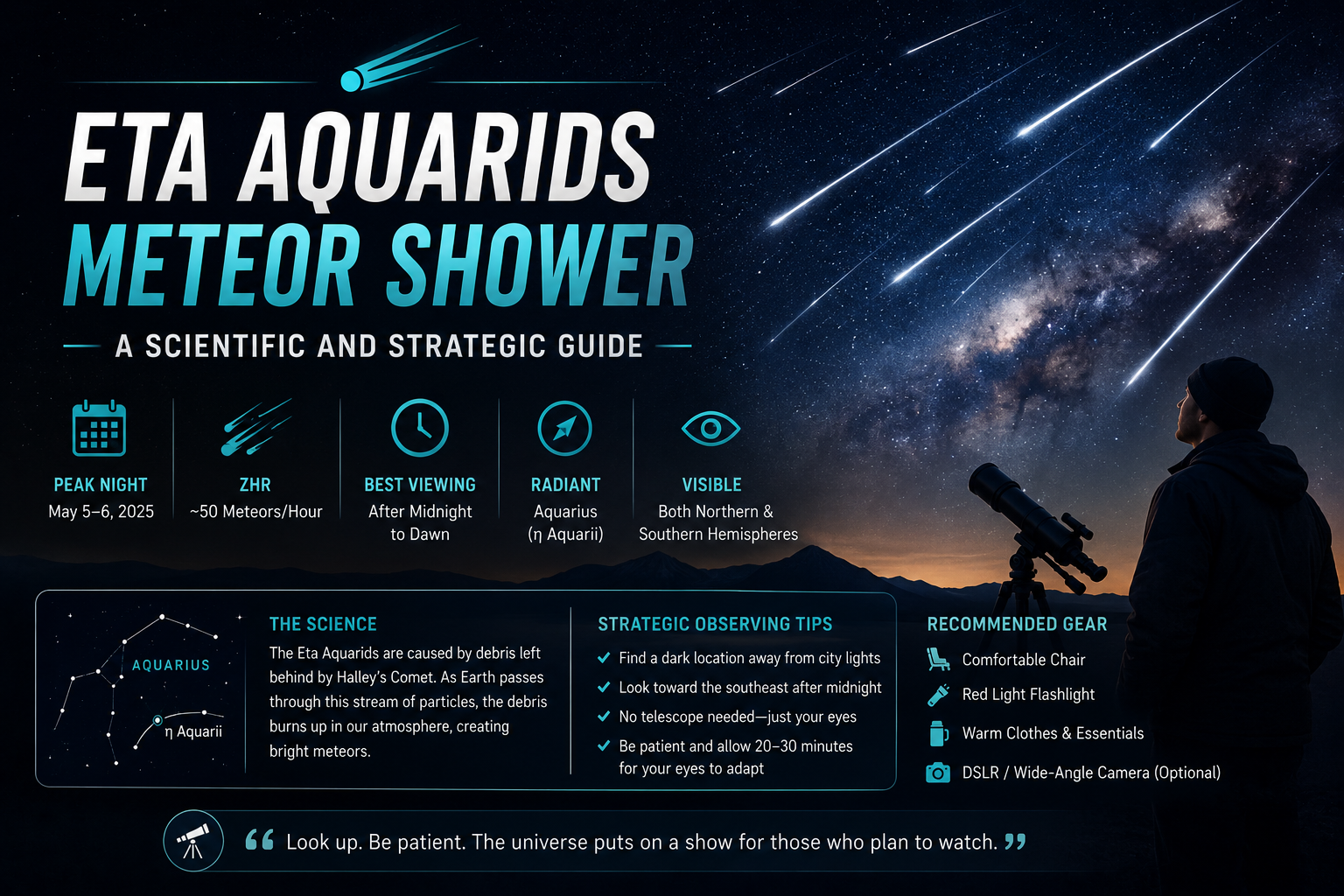
💡 Eta Aquarids Meteor Shower: A Scientific and Strategic Guide
A comprehensive analysis of the Eta Aquarids meteor shower, covering its origins from Halley’s Comet, atmospheric physics, and optimal observation strategies.
Executive Summary
The Eta Aquarids meteor shower represents one of the most significant annual astronomical events, originated from the debris field of Comet 1P/Halley. This analysis highlights key data points for the current cycle: a peak Zenithal Hourly Rate (ZHR) of approximately 50 to 60 meteors per hour in the Southern Hemisphere and 10 to 30 in the Northern Hemisphere. The particles, traveling at a velocity of 66 kilometers per second (148,000 miles per hour), are known for creating persistent trains that last several seconds. This guide provides a strategic framework for understanding the celestial mechanics, historical context, and technical requirements for successful observation.
Introduction
The Eta Aquarids meteor shower is not merely a visual spectacle but a critical data point for astronomers studying the long-term evolution of the solar system. Occurring annually from mid-April through late May, this shower is the result of Earth passing through the orbital path of Halley’s Comet. While the comet itself only visits the inner solar system every 76 years, it leaves behind a vast stream of ice and dust. When these particles collide with Earth’s atmosphere, they undergo intense frictional heating, providing a unique opportunity to study the composition of primordial solar system materials. Understanding the science of thermal energy is crucial when analyzing how these tiny meteoroids vaporize upon atmospheric entry, creating the brilliant streaks of light observed from the ground.
The Deep Dive: Astronomical Mechanics and Data
The Physics of High-Velocity Entry
The Eta Aquarids are characterized by their extreme speed. Entering the atmosphere at 66 km/s, they are among the fastest meteor showers of the year. This velocity is a direct consequence of the retrograde orbit of Halley’s Comet, which moves in the opposite direction to the planets. When Earth intersects this debris stream, the relative velocity is additive, resulting in high-energy collisions. These impacts occur in the thermosphere, typically at altitudes between 70 and 100 kilometers. The kinetic energy is converted into heat and light through a process of ionization, where the meteoroid strips electrons from atmospheric gas molecules, creating a glowing trail of plasma.
The Radiant and the Aquarius Constellation
The radiant point, the area of the sky from which the meteors appear to originate, is located near the star Eta Aquarii in the constellation Aquarius. For observers, the position of the radiant determines the visibility of the shower. In the Southern Hemisphere, the radiant reaches a higher altitude in the sky before dawn, which explains the significantly higher ZHR observed in regions like Australia, South Africa, and South America. In the Northern Hemisphere, the radiant stays closer to the horizon, meaning many meteors are obscured by the thickest layers of the atmosphere or remain below the line of sight.
Historical Density and Debris Stream Evolution
The debris stream of 1P/Halley is not uniform. Research into the 1986 apparition of the comet and subsequent meteor counts suggests that the stream is influenced by the gravitational perturbations of Jupiter. These "resonant" filaments of dust can lead to periodic outbursts. Historical data from the International Meteor Organization (IMO) indicates that the Eta Aquarids have remained relatively stable over the last century, though slight fluctuations in the ZHR are recorded based on Earth's proximity to the core of the debris trail. As we explore the essence of May and its astronomical highlights, the Eta Aquarids stand out as the month's premier event for both professional researchers and amateur observers.
Atmospheric Conditions and Light Pollution
The success of meteor observation is heavily dependent on the Bortle Scale rating of the observation site. A Bortle 1 or 2 site (Excellent Dark Sky) allows for the detection of faint meteors that would be invisible in suburban (Bortle 5-7) environments. Furthermore, the lunar cycle plays a pivotal role. A New Moon or a thin crescent provides the necessary contrast for viewing the persistent trains of the Eta Aquarids. Scientific consensus suggests that even a 50 percent illuminated moon can reduce visible meteor counts by over 60 percent due to sky glow.
What This Means For You
For the average observer or student of science, the Eta Aquarids offer a tangible connection to the most famous comet in history. To maximize your experience, follow these strategic steps:
- Identify the Peak: The shower typically peaks between May 5 and May 6. Plan your observations for the window between 2:00 AM and local sunrise.
- Location Strategy: Move at least 40 miles away from major urban centers to minimize light pollution. High-altitude locations are preferable as they reduce the amount of atmospheric interference.
- Equipment: No specialized equipment like telescopes or binoculars is required. In fact, they are counterproductive because they limit your field of view. The human eye, with its wide-angle capability, is the best tool for spotting fast-moving meteors.
- Acclimatization: Allow at least 30 minutes for your eyes to adjust to the darkness. Avoid looking at mobile phone screens, as the blue light will reset your night vision.
Expert Verdict and Future Outlook
From a strategic astronomical perspective, the Eta Aquarids remain a high-priority target for automated meteor camera networks. By tracking the trajectories of these meteors, scientists can refine the orbital model of Halley’s Comet and predict future encounters with its debris. The long-term outlook for the Eta Aquarids is one of stability. Unlike younger meteor showers that may vanish as their parent bodies move away, the Halley-produced streams (including the Orionids in October) are well-established and will continue to provide significant data for centuries. Future missions to intercept and sample cometary dust will likely use the data gathered from these annual atmospheric entries to calibrate their instruments.
FAQ: Authoritative Answers
Why are they called the Eta Aquarids?
Meteor showers are named after the constellation containing their radiant point. In this case, the meteors appear to radiate from the vicinity of Eta Aquarii, a star in the Aquarius constellation.
How do Eta Aquarids differ from the Perseids?
The primary differences are the parent body and velocity. The Perseids originate from Comet Swift-Tuttle and peak in August, while the Eta Aquarids originate from Halley’s Comet and peak in May. The Eta Aquarids are generally faster, creating more persistent trains.
Do I need a telescope to see the meteor shower?
No. Telescopes have a narrow field of view. To see the most meteors, you need to view as much of the sky as possible with the naked eye.
What is a persistent train?
A persistent train is a glowing trail of ionized gas left in the wake of a meteor. Because Eta Aquarids are so fast, they often leave these trails which can last from several seconds to a few minutes.
Is the Southern Hemisphere really better for viewing?
Yes. Due to the tilt of the Earth and the position of the radiant in the sky, observers in the Southern Hemisphere see the radiant at a much higher angle, leading to a higher frequency of visible meteors per hour.
Conclusion
The Eta Aquarids meteor shower is a predictable yet profound astronomical event that bridges the gap between complex orbital mechanics and public scientific engagement. By understanding the velocity, origin, and optimal viewing conditions, observers can gain a deeper appreciation for the debris left by Halley’s Comet. As a strategic asset for atmospheric and cometary research, the Eta Aquarids continue to provide invaluable data on the composition and behavior of our solar system's most famous wanderer.





Comments 0
Leave a Reply
Your email address will not be published. Required fields are marked *
Be the first to share your thoughts!