
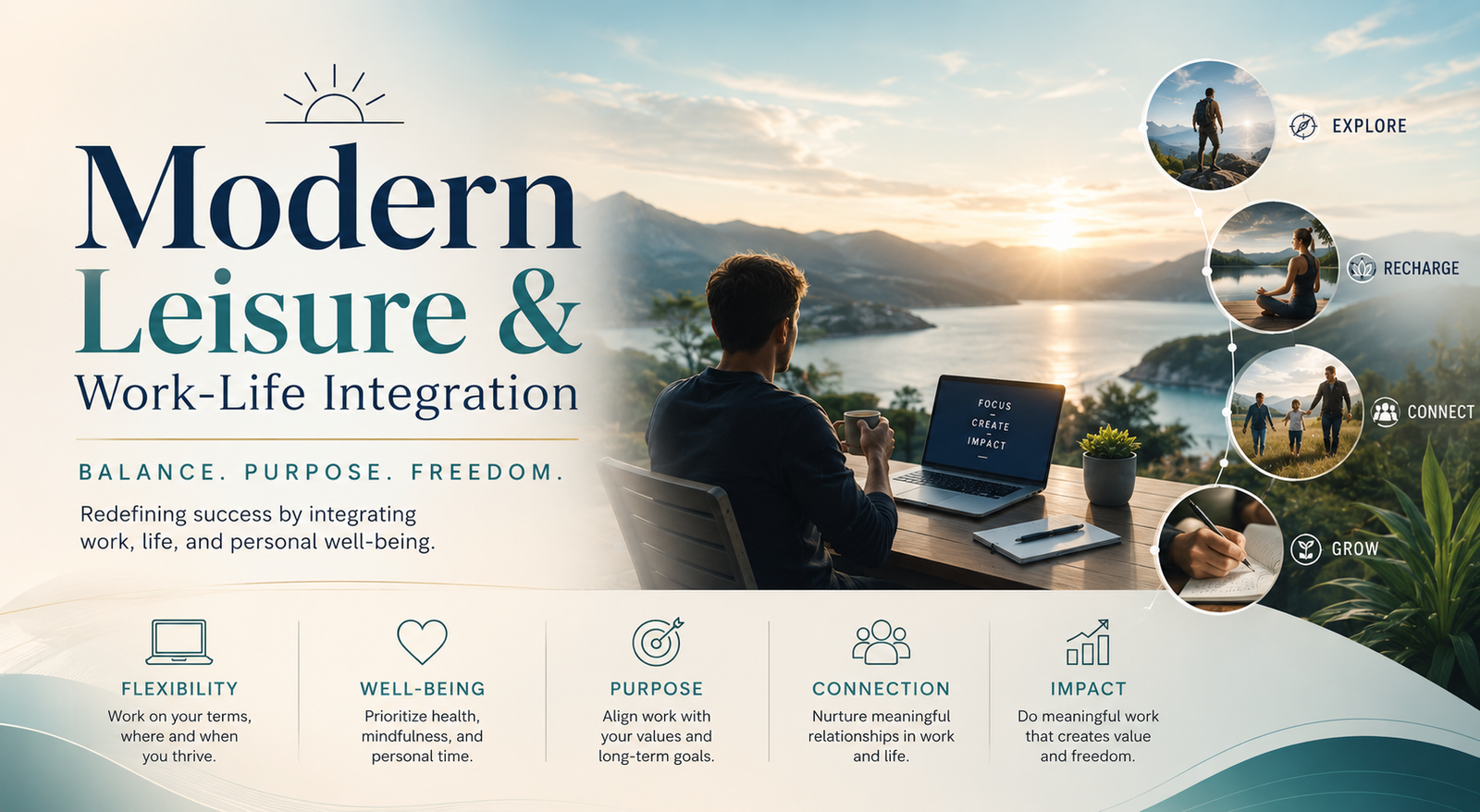
💡 Modern Leisure & Work-Life Integration
A strategic analysis of how modern work cultures are evolving beyond balance toward integration, backed by global productivity data and economic trends.
Executive Summary
The traditional concept of work-life balance has undergone a radical transformation into what industry experts now term work-life integration. Recent data from the 2023 Microsoft Work Trend Index indicates that 68 percent of employees struggle with a lack of uninterrupted focus time, while 57 percent of their time is spent on communication rather than deep work. Key findings in this analysis reveal that companies adopting flexible, asynchronous models see a 20 percent increase in employee retention. Furthermore, the 4 Day Week Global pilot program reported that 92 percent of participating firms decided to continue the shorter work week indefinitely due to stabilized productivity and improved mental health outcomes. This report examines the shift from rigid scheduling to outcome-based performance and the strategic role of leisure in maintaining a competitive edge.
Introduction
The boundary between professional obligations and personal time has become increasingly porous. This shift is not merely a byproduct of remote work but a fundamental change in the global economic landscape. In the current landscape, the ability to manage this integration determines the long-term viability of both individual careers and corporate entities. The rigid 9-to-5 structure, a relic of the industrial age, is being replaced by a more fluid model that prioritizes results over presence. As we analyze these shifts, it becomes clear that leisure is no longer an absence of work, but a strategic necessity for cognitive recovery and innovation. This evolution requires a new framework for leadership and personal management to avoid the pitfalls of burnout and digital fatigue.

THE DEEP DIVE: The Mechanics of Modern Integration
To understand the current state of work-life integration, we must look at the data driving corporate policy. The World Health Organization officially recognized burnout as an occupational phenomenon in 2019, characterized by feelings of energy depletion and increased mental distance from one's job. Since then, the economic impact of productivity loss due to poor mental health has been estimated at 1 trillion USD annually on a global scale. This has forced a reassessment of how leisure time is structured.
The Asynchronous Revolution
Asynchronous work is the cornerstone of modern integration. By decoupling work from a specific time frame, organizations allow employees to align their peak cognitive hours with their professional tasks. This model mirrors the efficiency found in a Sweden strategic analysis of innovation leadership, where a focus on social welfare and flexible structures has led to high levels of per-capita innovation. In Sweden, the cultural emphasis on lagom, or just the right amount, serves as a blueprint for sustainable productivity. Organizations that adopt these principles often report lower turnover rates and higher employee satisfaction scores.
The Economics of Leisure and Performance
Leisure is increasingly viewed as a high-performance tool. High-achievers are moving away from the grind culture that dominated the early 2010s. Instead, they are adopting a disciplined approach to recovery. This discipline is comparable to the rigorous standards seen in military officer strategic leadership, where operational success depends on the physical and mental readiness of the unit. In a professional context, this means setting hard boundaries on digital communication. Data from the Harvard Business Review suggests that the simple act of checking work emails during dinner increases cortisol levels and inhibits the brain's ability to enter the default mode network, which is essential for creative problem-solving.
Market Implications and Human Capital
The shift toward integration is also visible in financial markets. Investors are increasingly looking at human capital metrics as a predictor of long-term stock performance. As noted in a recent stock market strategic analysis, companies with high ESG (Environmental, Social, and Governance) scores, particularly in the social category, tend to outperform their peers during periods of economic volatility. This is because these companies are better at attracting and retaining talent in a competitive labor market. When employees feel their personal time is respected, they are more likely to contribute at a higher level during their working hours.
The Role of Technology and AI
Artificial Intelligence is playing a dual role in this integration. On one hand, AI tools can automate routine tasks, potentially freeing up hours each week for leisure or deep work. On the other hand, the constant connectivity enabled by smartphones creates a digital leash. The 2024 Global Talent Trends report indicates that 45 percent of workers feel they must be available 24/7 to succeed. To combat this, several European nations have implemented Right to Disconnect laws, which legally protect employees from being penalized for not responding to communications outside of their contracted hours. This legislative trend is a direct response to the erosion of leisure time.
WHAT THIS MEANS FOR YOU
For the individual professional, the transition to work-life integration requires a proactive strategy rather than a reactive stance. You should consider the following actionable steps:
- Establish Non-Negotiable Windows: Define specific times in your day where work is strictly prohibited. This is not about balance but about creating a rhythm that supports your biological needs.
- Prioritize High-Quality Leisure: Distinguish between passive leisure, such as scrolling through social media, and active leisure, such as exercise or hobbies. Active leisure is significantly more effective at reducing stress.
- Adopt Outcome-Based Metrics: If you are in a leadership position, focus on the quality and impact of work rather than the number of hours logged. This builds trust and encourages efficiency.
- Digital Hygiene: Use technology to your advantage by setting automated do-not-disturb schedules on your devices.

Expert Verdict / Future Outlook
The future of work-life integration will be defined by personalization. We are moving away from one-size-fits-all corporate policies toward individualized work agreements. As AI continues to handle more cognitive labor, the value of human creativity and emotional intelligence will rise. These qualities are nurtured in the space provided by leisure. I predict that within the next five years, the 32-hour work week will become a standard offering for top-tier talent in the technology and finance sectors. Companies that fail to adapt to this demand for flexibility will face a significant talent drain, as the modern workforce prioritizes autonomy over traditional perks.
FAQ
What is the main difference between work-life balance and work-life integration?
Work-life balance seeks a strict separation between work and life, often viewed as a zero-sum game. Work-life integration focuses on blending the two in a way that allows for flexibility, such as working from a different location or adjusting hours to accommodate personal responsibilities.
Does work-life integration lead to more burnout?
It can if boundaries are not clearly defined. Without discipline, integration can turn into work-life blur, where an individual never truly stops working. However, with proper management, it typically reduces stress by providing more control over one's schedule.
How do Right to Disconnect laws work?
These laws vary by country but generally prohibit employers from contacting employees during their time off and protect employees from any negative repercussions for staying offline during non-working hours.
Can small businesses afford to implement these flexible models?
Yes. In many cases, small businesses can implement these models more easily than large corporations. The key is to focus on clear communication and accountability rather than physical presence.
What role does leisure play in professional success?
Leisure is essential for cognitive recovery. Studies show that regular breaks and time away from work tasks improve focus, creativity, and decision-making abilities, which are critical for long-term career success.
Conclusion
The shift toward modern work-life integration is an inevitable response to a digital, globalized economy. By viewing leisure as a strategic asset rather than a luxury, both individuals and organizations can achieve higher levels of sustainable performance. The data is clear: flexibility, autonomy, and disciplined recovery are the new hallmarks of a high-functioning society.




Comments 0
Leave a Reply
Your email address will not be published. Required fields are marked *
Be the first to share your thoughts!