
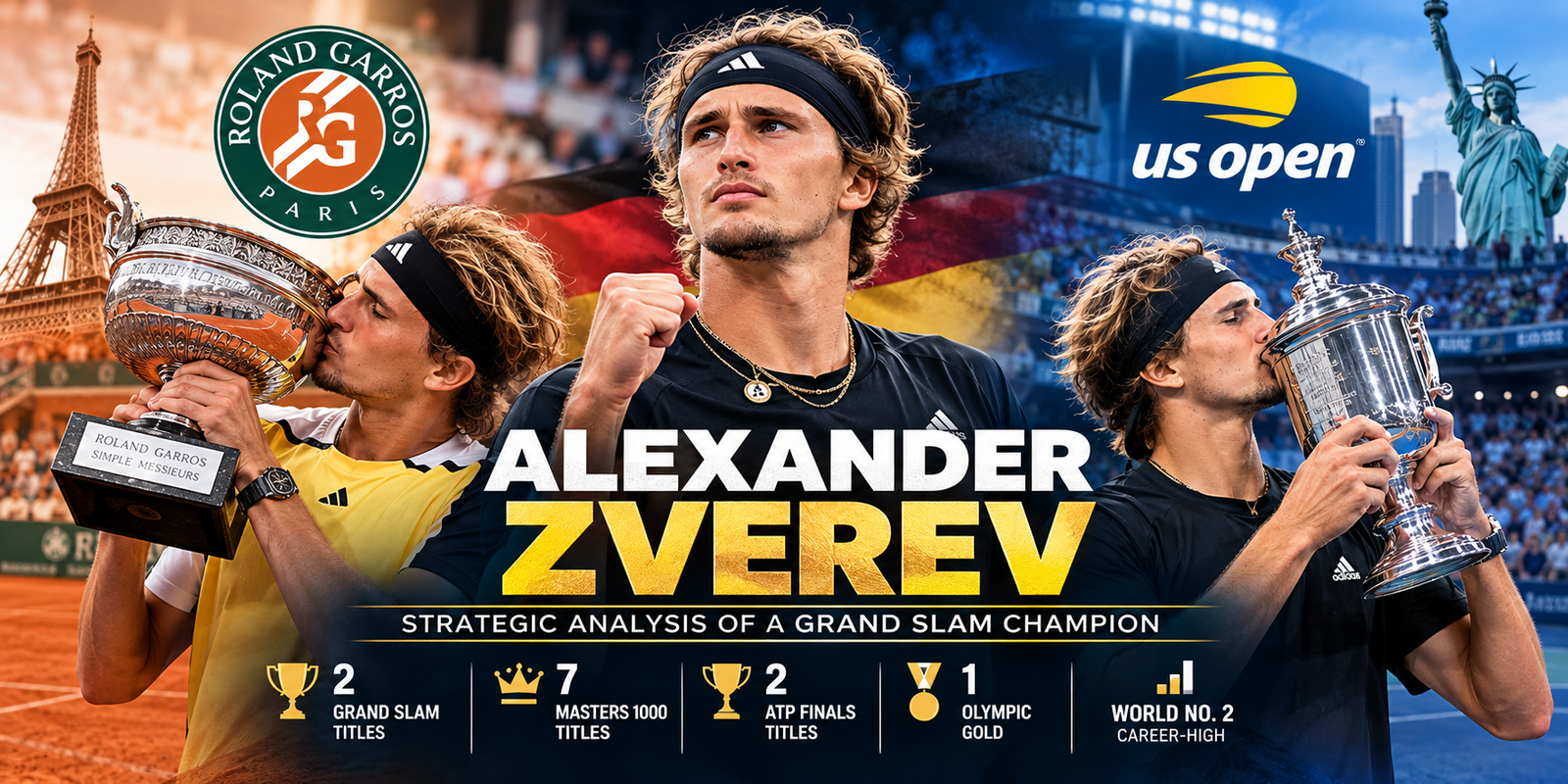
💡 Alexander Zverev: Strategic Analysis of Athletic Authority
A comprehensive strategic analysis of Alexander Zverev's career, technical dominance, and his evolving role in professional tennis.
Executive Summary
Alexander Zverev’s career entered a new phase in 2026. After years of reaching the highest levels of professional tennis without winning a Grand Slam, the German finally broke through at Roland Garros 2026, defeating Flavio Cobolli in a five-set final. Just three months later, he captured his second Grand Slam title at the 2026 US Open, defeating Ben Shelton in four sets.
Zverev’s achievements now include two Grand Slam titles, seven ATP Masters 1000 titles, two Nitto ATP Finals titles, an Olympic singles gold medal, and a career-high World No. 2 ranking. He has also finished inside the Top 10 in eight of the last nine seasons, highlighting the consistency of his career at the highest level.
His development has been built around a powerful serve, elite baseline ability, a world-class two-handed backhand, physical durability and an increasingly effective ability to handle pressure in major matches.
Introduction
Alexander Zverev emerged as one of the leading players of his generation during the second half of the 2010s. Standing at approximately 6 feet 6 inches (1.98 metres), he combines unusual height for a baseline player with considerable movement, court coverage and a technically strong two-handed backhand.
His rise was rapid. He became a Top-3 player at a young age, won the ATP Finals in 2018, added another title at the season-ending event in 2021 and collected multiple Masters 1000 championships.
However, his career was defined for several years by one missing achievement: a Grand Slam title.
That changed in 2026.
After losing three previous Grand Slam finals, Zverev defeated Flavio Cobolli at Roland Garros and then defeated Ben Shelton at the US Open. The two victories transformed the narrative around his career from that of an elite player still searching for a major breakthrough into that of an established Grand Slam champion.
Deep Dive: The Strategic Foundation of Zverev’s Game
1. The Serve: One of His Biggest Competitive Advantages
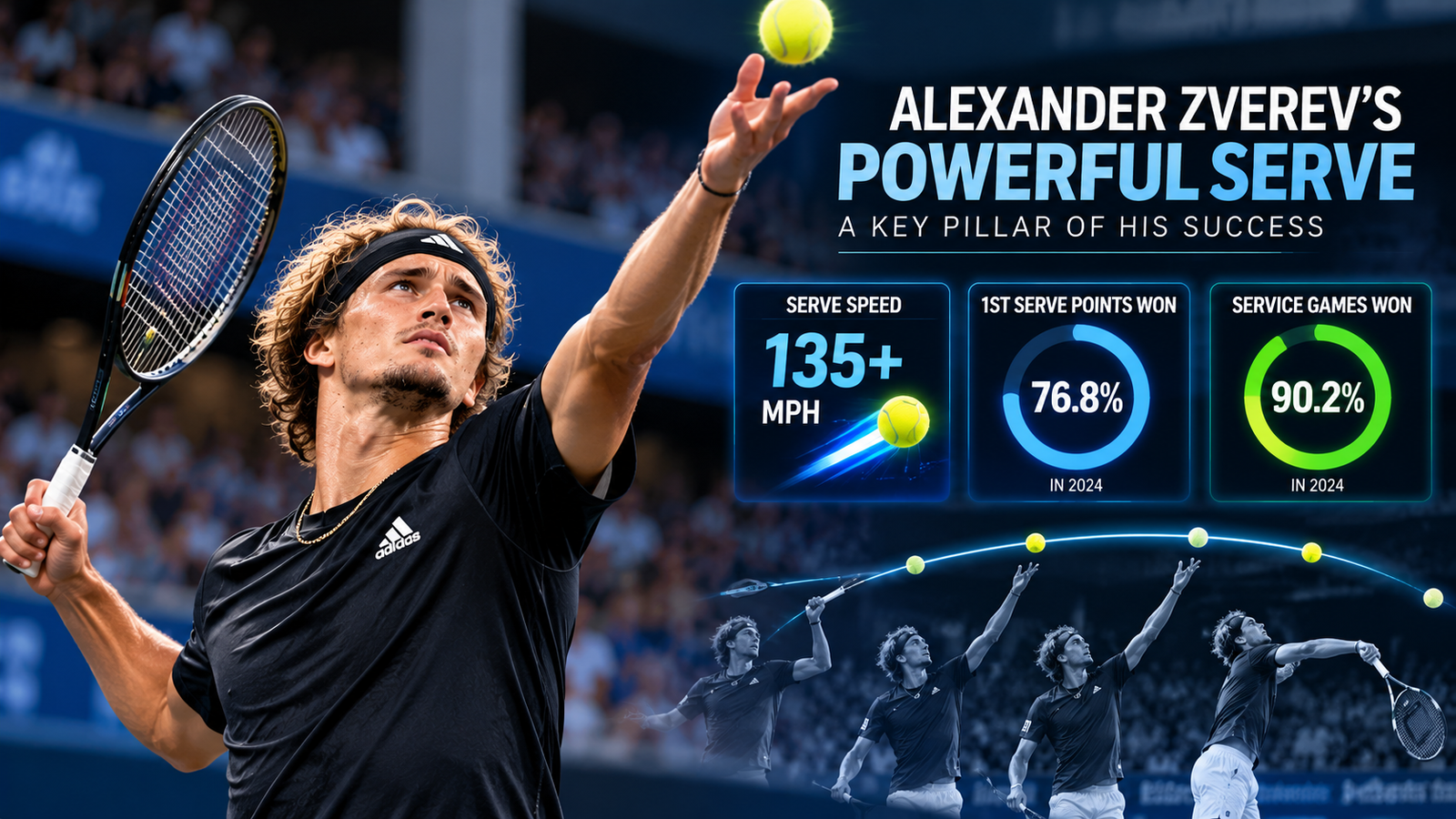
Zverev’s serve has developed into one of the strongest parts of his game.
His height allows him to generate a high contact point, while his speed and placement make the first serve difficult to attack. The improvement became particularly visible during the 2024 season.
According to ATP analysis, Zverev won 90.2% of his service games in 2024, ranking second on the ATP Tour. He also won 76.8% of first-serve points, while making 71.2% of his first serves.
His serving performance was particularly impressive at the 2024 Rome Masters. In the final against Nicolas Jarry, Zverev won 37 of 39 points behind his first serve, lost only five service points in the entire match and did not face a break point.
This matters strategically because a reliable serve reduces the amount of pressure Zverev must absorb in long rallies. When he protects his service games effectively, opponents are forced to take greater risks on return and during baseline exchanges.
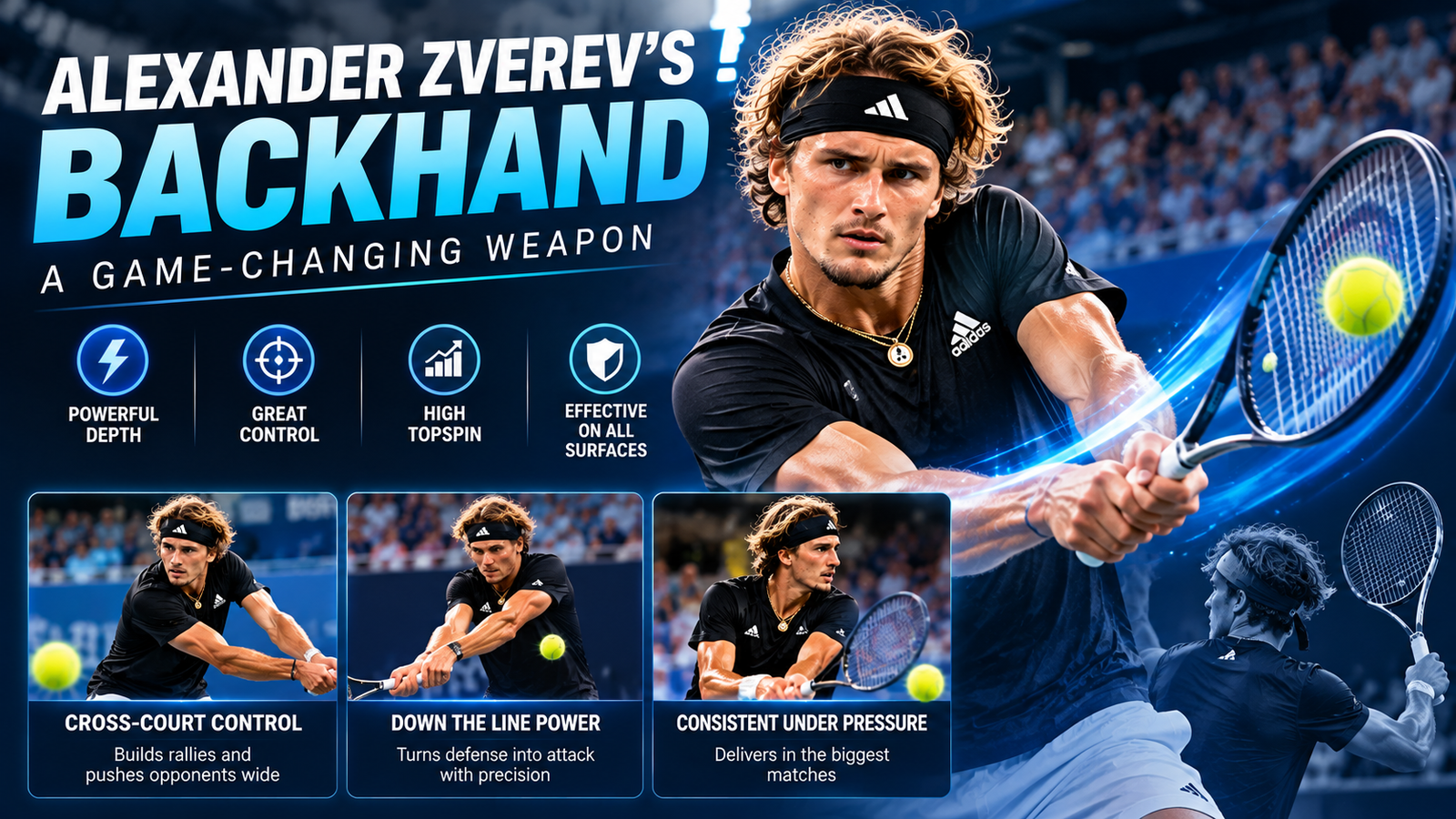
2. The Two-Handed Backhand
Zverev’s backhand is another defining element of his game.
His two-handed backhand allows him to hit with depth and control from both the baseline and defensive positions. It is particularly effective when he establishes a cross-court rally and then changes direction down the line.
Rather than depending entirely on short points, Zverev can use the backhand to control the geometry of the rally and gradually push opponents away from their preferred positions.
This combination of serve plus baseline control has been central to his success throughout his career.
3. Baseline Control and Physical Leverage
At 1.98 metres, Zverev possesses significant reach. However, his success cannot be explained by height alone.
His game depends on the combination of:
-
A powerful first serve
-
Strong two-handed backhand
-
Deep groundstrokes
-
Court coverage
-
Ability to absorb pace
-
Patience during long rallies
-
Improved performance under pressure
This makes him especially dangerous when rallies become physically demanding.
His best tennis often comes when he is able to establish a rhythm from the baseline rather than being forced into constant improvisation.
Injury, Recovery and Career Resilience
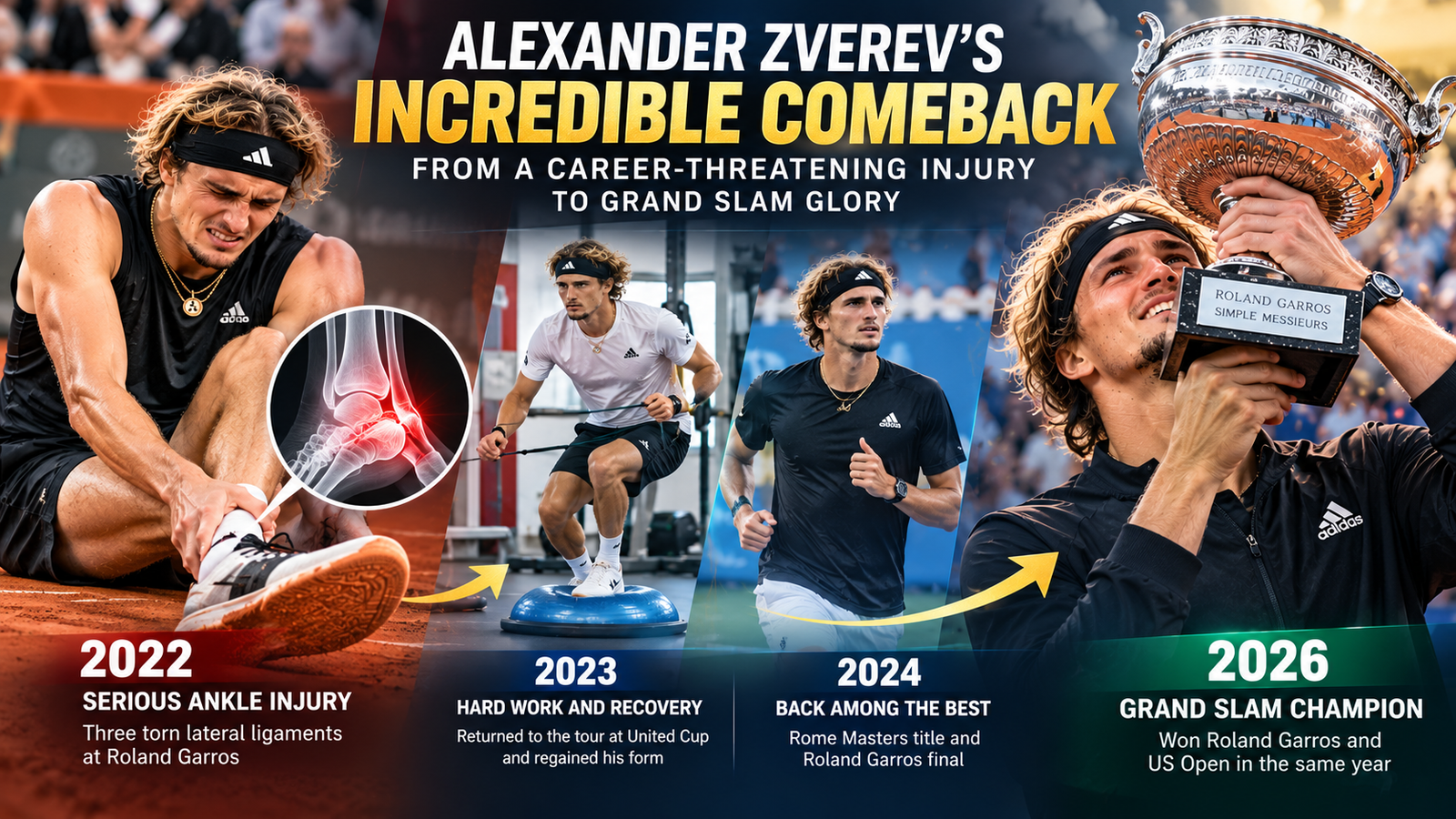
One of the most important chapters of Zverev’s career came at the 2022 Roland Garros semifinal against Rafael Nadal.
While attempting to chase down a forehand, Zverev severely injured his right ankle and tore all three lateral ligaments. He subsequently underwent surgery and later dealt with a bone-edema problem, preventing him from competing for the remainder of the 2022 season.
His comeback began at the United Cup at the end of 2022/start of 2023.
The early stages were difficult. Zverev later explained that he was still managing pain and did not initially have the same movement and confidence on court. However, his level improved as the season progressed.
In 2023, he won titles in Hamburg and Chengdu, returning to the winner’s circle and reaching the Nitto ATP Finals for the sixth time.
The recovery became an important part of his long-term development because it forced him to rebuild not only his physical condition but also his confidence in movement.
From Grand Slam Heartbreak to Grand Slam Champion
Before 2026, Zverev had already reached three Grand Slam finals.
He lost the 2020 US Open final to Dominic Thiem after leading by two sets and serving for the championship.
He then lost the 2024 Roland Garros final to Carlos Alcaraz.
In 2025, he reached another Grand Slam final at the Australian Open, where Jannik Sinner defeated him.
These defeats created a reputation of Zverev as an elite player who repeatedly came close to major success without finishing the job.
That narrative changed dramatically in 2026.
Roland Garros 2026: The Breakthrough
On 7 June 2026, Zverev defeated Italy’s Flavio Cobolli 6-1, 4-6, 6-4, 6-7(5), 6-1 in the Roland Garros final.
The victory gave him his first Grand Slam championship and made him the first German man to win Roland Garros in the Open Era.
The significance of the victory went beyond the trophy.
Zverev had previously lost three Grand Slam finals. In Paris, he managed to reset after losing the fourth-set tiebreak and dominated the deciding set.
That mental response was one of the defining aspects of his breakthrough.
Wimbledon 2026: Another Major Final
Zverev did not stop after winning Roland Garros.
He followed his first Grand Slam victory by reaching his first Wimbledon final in 2026.
In the championship match, he faced defending champion Jannik Sinner. Sinner eventually won 6-7(7), 7-6(2), 6-3, 6-4, denying Zverev a third consecutive Grand Slam title of the season.
Although he lost the final, reaching the Wimbledon championship match demonstrated that his Roland Garros victory was not an isolated breakthrough.
He had become a consistent contender across different surfaces.
US Open 2026: The Second Grand Slam
Zverev entered the 2026 US Open as the No. 1 seed, marking the first time he had been the top seed at a Grand Slam.
His tournament did not begin smoothly. In the opening round, Lorenzo Sonego pushed him to the limit in a match lasting 4 hours and 53 minutes, with Zverev surviving after being two points from defeat in the fourth set.
But Zverev improved as the tournament progressed.
In the final, he faced American Ben Shelton and won 6-3, 7-6(2), 5-7, 6-2.
The victory gave Zverev his second Grand Slam title of 2026 and made him only the fourth man in the Open Era to win his first two Grand Slam titles in the same season.
It also completed a remarkable turnaround from his 2020 US Open heartbreak.
Six years earlier, he had been two sets ahead against Dominic Thiem before losing the final. In 2026, he returned to New York and finally lifted the trophy.
What Makes Zverev’s 2026 Season Significant?
The biggest change is not simply the number of trophies.
It is the change in his performance under Grand Slam pressure.
Before 2026, Zverev had repeatedly demonstrated that he had the game to reach major finals. The question was whether he could close the biggest matches.
In 2026, he answered that question.
He won a five-set Roland Garros final, reached another major final at Wimbledon and then won the US Open.
That sequence suggests a major shift in his ability to manage the emotional and tactical demands of Grand Slam tennis.
Consistency at the Elite Level
Zverev's Grand Slam breakthrough did not come from nowhere.
ATP records show that he finished inside the Top 10 in eight of the last nine seasons, with his best year-end ranking being No. 2 in 2024. In that 2024 season, he also recorded a personal-best 69 match wins.
His career résumé already included:
-
Two Grand Slam titles
-
Seven ATP Masters 1000 titles
-
Two Nitto ATP Finals titles
-
Olympic singles gold
-
Career-high World No. 2 ranking
-
Multiple Grand Slam finals
-
Long-term Top-10 consistency
These achievements place him firmly among the leading players of his generation.
Leadership, Team and Career Structure
Zverev has worked with several prominent coaches during his career, including Ivan Lendl and David Ferrer.
His father, Alexander Zverev Sr., has also played a central coaching role and remains part of his team. ATP documentation lists Zverev Sr. as his coach.
The long-term structure around Zverev has been important because his career has involved both technical development and major physical setbacks.
His 2026 results suggest that this combination of coaching experience and personal maturity has helped him turn previous disappointments into competitive experience.
Beyond Tennis
Zverev has also developed a public identity beyond his results on court.
The Alexander Zverev Foundation focuses on supporting children with Type 1 diabetes and related medical needs.
This gives his public profile another dimension beyond tournament results and commercial partnerships.
From a career perspective, his growing Grand Slam success also strengthens his international marketability. His two major titles in 2026 significantly increase his position as one of the leading German players of his era.
What This Means Strategically
Zverev’s career offers several important lessons about elite performance.
1. Consistency Creates the Foundation
Winning Grand Slams generally requires more than a short period of exceptional form. Zverev spent years competing at the highest level before finally converting that consistency into major championships.
2. Technical Strength Must Be Supported by Mental Strength
His serve and baseline game were already strong enough to reach Grand Slam finals.
The missing component was often the ability to finish the biggest moments.
His 2026 victories demonstrate how important psychological resilience can be when technical ability is already established.
3. Injury Can Change a Career
The 2022 ankle injury temporarily interrupted Zverev's progress.
Instead of ending his trajectory, the recovery became another chapter in his development.
4. Experience Can Become an Advantage
Zverev's previous Grand Slam losses gave him experience in situations that many younger players had never encountered.
In 2026, that experience became part of his advantage rather than simply a source of disappointment.
Expert Verdict
Alexander Zverev should now be evaluated differently from the player who entered 2026.
For years, the central question was:
Could Zverev finally win a Grand Slam?
That question has been answered.
He won Roland Garros and the US Open in the same season, reached the Wimbledon final and established himself as a two-time Grand Slam champion.
The next phase of his career is therefore not about proving that he belongs among the elite.
It is about determining how many more major championships he can add and how consistently he can remain at the top of men's tennis.
His serve, baseline game, physical size, experience and improved Grand Slam mentality provide a strong foundation for that challenge.
FAQ
Has Alexander Zverev won a Grand Slam?
Yes. Zverev won his first Grand Slam at Roland Garros 2026, defeating Flavio Cobolli in the final. He then won his second Grand Slam at the 2026 US Open, defeating Ben Shelton.
How many Grand Slam titles does Zverev have?
As of October 2026, Zverev has two Grand Slam singles titles: Roland Garros 2026 and US Open 2026.
What is Alexander Zverev's highest ATP ranking?
His career-high ranking is World No. 2, which he first reached in June 2022 and later achieved again at the end of the 2024 season.
What happened to Zverev's ankle?
During the 2022 Roland Garros semifinal against Rafael Nadal, Zverev tore all three lateral ligaments in his right ankle. He underwent surgery and later dealt with a bone-edema issue, which kept him out for the rest of the 2022 season.
What is Zverev's biggest weapon?
His serve is one of his biggest weapons. In 2024, he won 90.2% of his service games and 76.8% of points behind his first serve, according to ATP statistics.
Who is Alexander Zverev's coach?
His father, Alexander Zverev Sr., remains part of his coaching team.
How many ATP Finals has Zverev won?
Zverev has won the Nitto ATP Finals twice, in 2018 and 2021.
Did Zverev win an Olympic gold medal?
Yes. He won the men's singles gold medal at the Tokyo Olympics in 2021.
Conclusion
Alexander Zverev's career is a strong example of how elite performance can evolve through setbacks, experience and persistence.
He already possessed the physical tools, serve, backhand and baseline game required to compete with the world's best. His 2022 ankle injury created a major interruption, while three Grand Slam final defeats created another psychological challenge.
But 2026 changed the story.
Zverev won Roland Garros and the US Open, reached the Wimbledon final and became a two-time Grand Slam champion in the same season.
His journey is no longer about chasing a first major trophy.
It is now about building a Grand Slam legacy.
The strategic lesson from Zverev's career is clear: long-term consistency creates the platform, physical and technical development creates the opportunity, and the ability to perform under pressure converts opportunity into championships.





Comments 0
Leave a Reply
Your email address will not be published. Required fields are marked *
Be the first to share your thoughts!