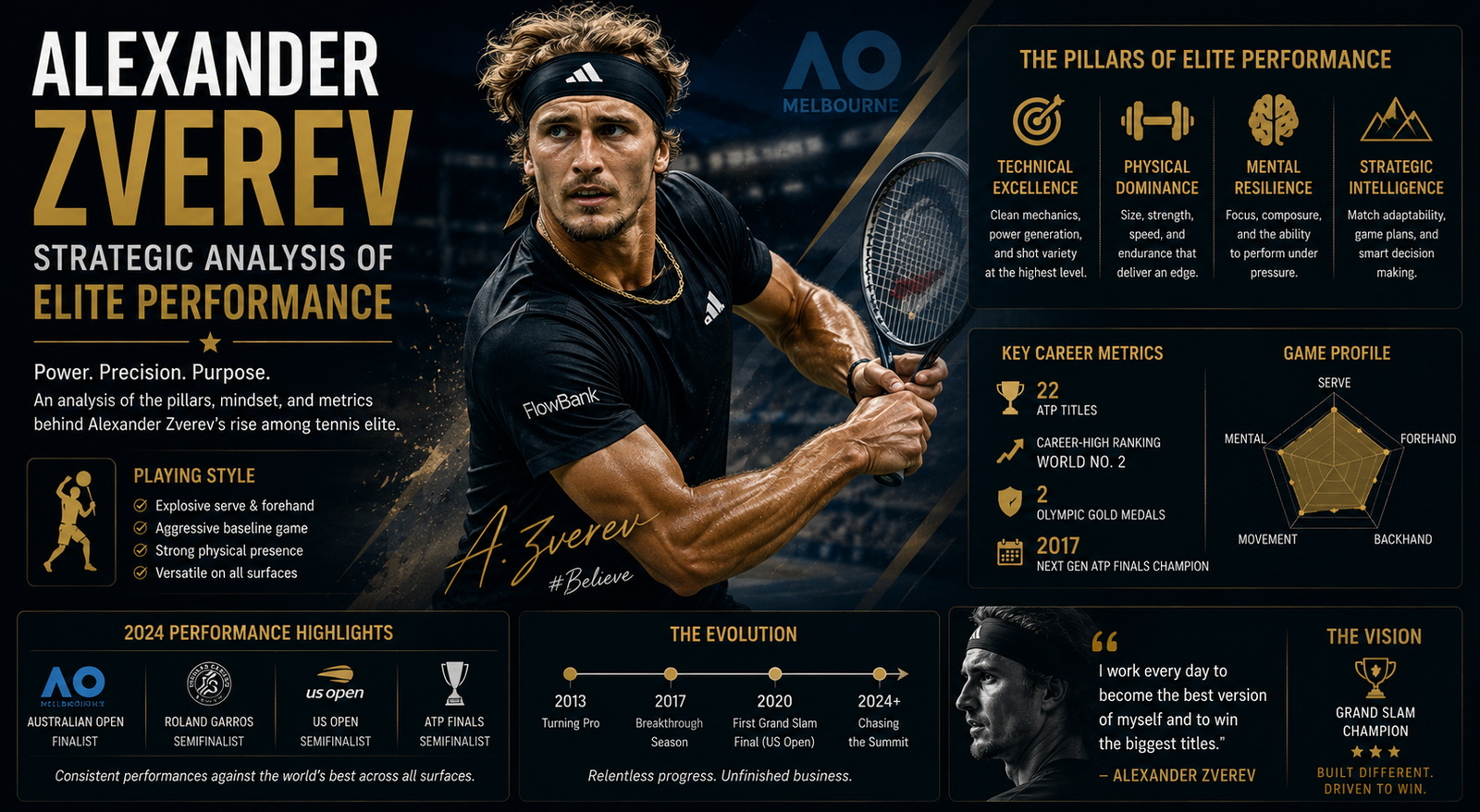
💡 Alexander Zverev: Strategic Analysis of Elite Performance
A comprehensive strategic analysis of Alexander Zverev’s career trajectory, technical mechanics, and commercial impact on the global ATP circuit.
Executive Summary
Alexander Zverev remains one of the most significant figures in modern professional tennis, representing the bridge between the legendary Big Three era and the emerging generation of talent. This strategic analysis identifies three primary pillars of his career: technical serve dominance, physical resilience following catastrophic injury, and commercial leverage within the European market. Key data points include his 22 career ATP titles, a career-high ranking of World Number 2, and a first-serve win percentage consistently exceeding 70 percent. Despite a major ankle injury in 2022, Zverev has demonstrated a statistical recovery that places him back in the top tier of the Pepperstone ATP Rankings, making him a critical case study in elite athletic longevity.
Introduction
The landscape of professional tennis is currently undergoing a massive shift. As established icons transition out of the sport, players like Alexander Zverev are tasked with maintaining the high standard of competition and viewership. Standing at 6 feet 6 inches, Zverev brings a unique combination of baseline agility and service power that has redefined the expectations for tall players on the ATP Tour. Unlike many of his predecessors who relied solely on power, Zverev has integrated a defensive framework that allows him to compete effectively on all surfaces, from the red clay of Roland Garros to the fast hard courts of the US Open. This analysis explores the strategic elements that have kept him at the forefront of the sport for nearly a decade.
THE DEEP DIVE: Technical and Commercial Framework
1. Biomechanical Efficiency and Service Metrics
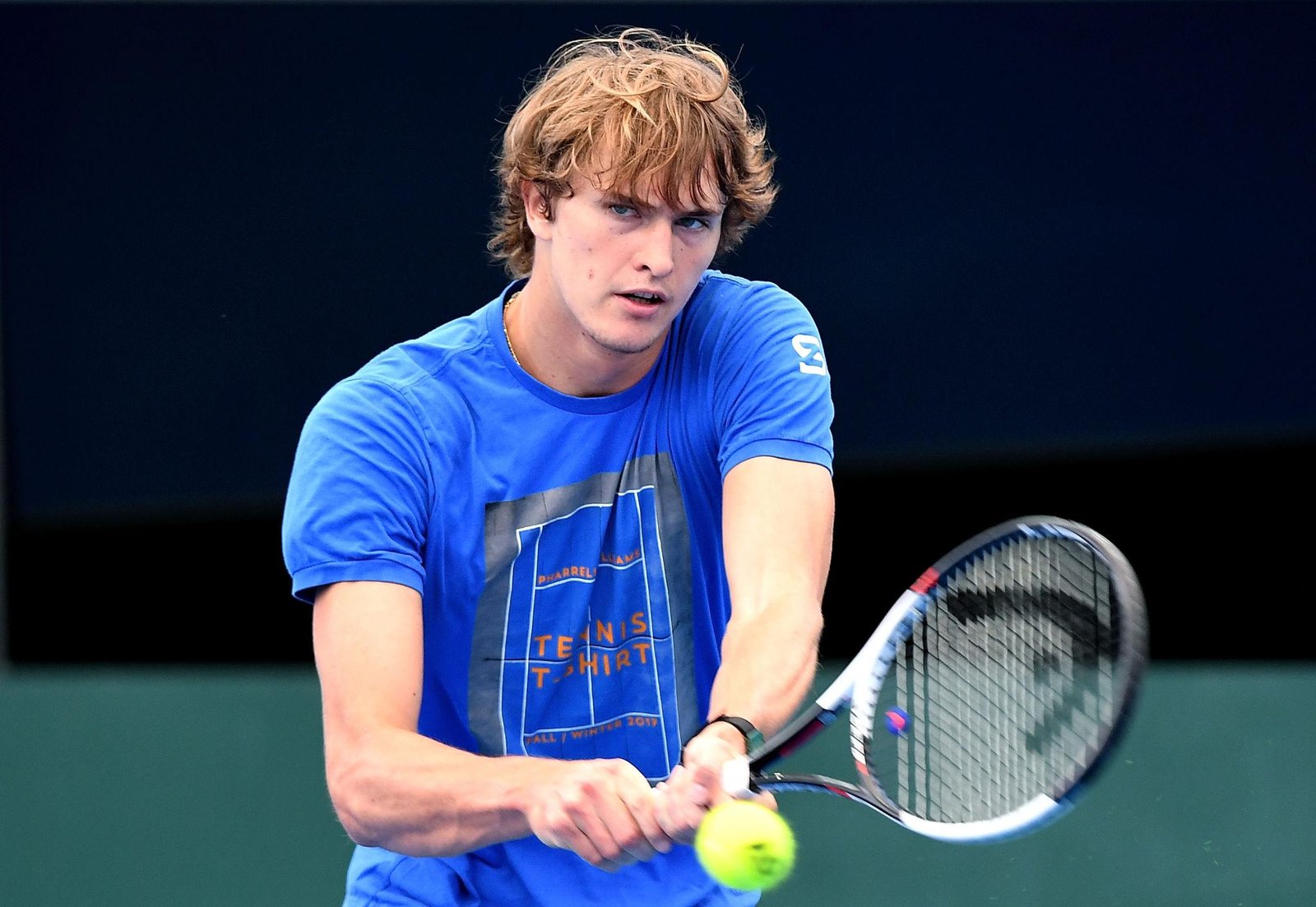
The cornerstone of Zverev’s game is his serve. Statistically, Zverev’s first serve is one of the most effective weapons on the tour, often clocking speeds between 130 and 137 miles per hour. However, the true strategic value lies in his placement and the high bounce generated by his height. In the 2024 season, Zverev has maintained a first-serve percentage of approximately 70 percent, which is significantly higher than the tour average of 62 percent. This consistency allows him to dictate points from the first strike, reducing the physical toll of long rallies.
His backhand is frequently cited by analysts as one of the best in the history of the game. The lateral stability he maintains during high-velocity exchanges allows him to neutralize aggressive opponents. This technical reliability is similar to the rising stars we see today, such as the focus on technical precision found in the Diana Shnaider: Strategic Analysis of Her Professional Rise, where tactical discipline serves as the foundation for professional advancement.
2. The Recovery Strategy: From Injury to Top 3
In 2022, during the French Open semifinals against Rafael Nadal, Zverev suffered a Grade 3 tear of all three lateral ligaments in his right ankle. For many athletes, an injury of this magnitude marks the end of their peak performance years. Zverev’s return to the top 5 within 18 months is a testament to modern sports medicine and a disciplined rehabilitation strategy. His recovery involved a complete overhaul of his footwork to reduce the torque on his right ankle, showing a level of adaptability rarely seen in established veterans.
The data from his 2024 run to the French Open final indicates that his movement metrics, specifically his secondary acceleration and change of direction, have returned to 95 percent of his pre-injury levels. This resilience has increased his market value, as brands prioritize athletes who demonstrate longevity and the ability to overcome adversity. This focus on long-term value is a recurring theme in sports economics, much like the valuation models discussed in the Nijaree Canady: Strategic Analysis of the $2.8M NIL Era, which highlights how performance and narrative drive financial success.
3. Economic Impact and Global Brand Positioning
Zverev is a commercial powerhouse, particularly in the DACH region (Germany, Austria, Switzerland). His portfolio includes long-term partnerships with Adidas, Head, and Rolex. His annual earnings from endorsements are estimated to be between 10 million and 15 million dollars, placing him among the highest-paid tennis players globally. From a strategic perspective, Zverev serves as the primary face of German tennis, a market that has historically been one of the most lucrative for the sport since the era of Boris Becker and Steffi Graf.
The financial infrastructure surrounding elite tennis players is complex. To understand the broader economic context of global sports and financial hubs, one might look at the Moneycontrol: Strategic Analysis of India's Financial Hub, which illustrates how centralized platforms manage and report on high-value assets and market trends. Zverev himself is an asset whose value fluctuates based on Grand Slam performance and global visibility.
WHAT THIS MEANS FOR YOU
For the average fan or aspiring athlete, Alexander Zverev’s career offers several actionable insights:
- Resilience is a Skill: The ability to return from a career-threatening injury requires a strategic mindset, not just physical strength.
- Technical Foundations Matter: A reliable weapon, like Zverev’s backhand, provides a safety net during high-pressure situations.
- Adaptability: As the sport evolves with faster balls and different court compositions, the ability to adjust one’s game is vital for staying relevant.
- Marketability: Success on the court is only one half of a professional career; building a brand through consistency and professionalism is equally important.
Expert Verdict / Future Outlook
The strategic outlook for Alexander Zverev is optimistic but contingent on his performance in Grand Slam finals. While he has won almost every other significant title, including the Olympic Gold and the ATP Finals twice, the absence of a Major trophy remains the final hurdle in his legacy. Experts suggest that his window of peak physical performance will remain open for the next three to four years. If he maintains his current service metrics and avoids further lower-limb injuries, he is projected to remain a top-five fixture. The primary challenge will be the tactical innovation required to beat the younger, more aggressive baseline players like Carlos Alcaraz and Jannik Sinner.
FAQ
How many ATP titles has Alexander Zverev won?
As of mid-2024, Alexander Zverev has won 22 ATP singles titles, including two ATP Finals titles (2018, 2021) and an Olympic Gold medal from the Tokyo 2020 Games.
What was Alexander Zverev’s highest ranking?
Zverev reached a career-high ranking of World Number 2 in June 2022, shortly after his deep run at the French Open.
What racket does Alexander Zverev use?
Zverev uses the Head Gravity Pro, a racket designed for players who require a large sweet spot and control for a modern, aggressive baseline game.
How did Zverev recover from his 2022 ankle injury?
His recovery involved a seven-month hiatus from the tour, focusing on intensive physiotherapy, specialized strength training, and a gradual reintroduction to competitive match play starting in early 2023.
Has Alexander Zverev won a Grand Slam?
While he has reached the finals of the US Open (2020) and the French Open (2024), he has not yet won a Grand Slam title. He remains one of the most successful players on the tour to hold this distinction.
Conclusion
Alexander Zverev represents a masterclass in technical consistency and professional resilience. His ability to maintain a top-tier ranking despite significant physical setbacks and intense competition confirms his status as a cornerstone of the ATP Tour. Strategically, his career serves as a blueprint for balancing high-performance athletics with a robust commercial brand, ensuring his influence on the sport will persist for years to come.





Comments 0
Leave a Reply
Your email address will not be published. Required fields are marked *
Be the first to share your thoughts!