
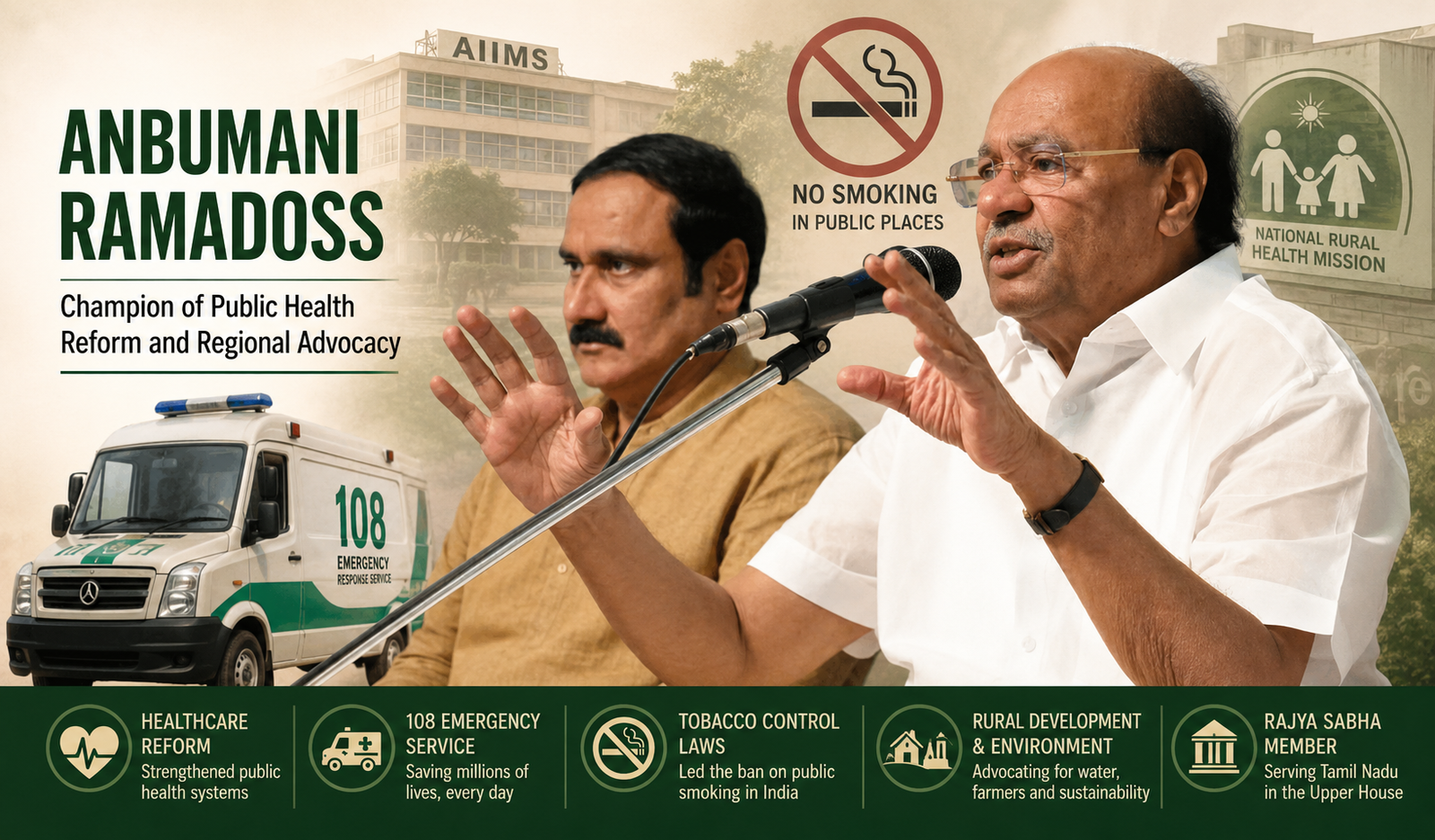
💡 Anbumani Ramadoss: Strategic Analysis of Political Legacy
An in-depth strategic analysis of Anbumani Ramadoss, his impact on Indian public health policy, and his role in the shifting landscape of Tamil Nadu politics.
Executive Summary
Anbumani Ramadoss stands as a pivotal figure in Indian politics, specifically within the intersection of healthcare reform and regional advocacy. As a former Union Minister of Health and Family Welfare, his tenure from 2004 to 2009 was marked by aggressive legislative actions against tobacco consumption and the conceptualization of the National Rural Health Mission (NRHM). Data from the World Health Organization and Indian Ministry of Health reports indicate that his policies laid the groundwork for a significant reduction in public smoking and the expansion of tertiary healthcare through the AIIMS model. This analysis explores his strategic influence on public health, his leadership within the Pattali Makkal Katchi (PMK), and his ongoing role as a Rajya Sabha Member of Parliament.
Introduction
The trajectory of Anbumani Ramadoss is unique in the Indian political landscape, combining medical expertise with high-level administrative governance. Born into a politically active family, he chose to pursue a medical degree (MBBS) before transitioning into full-time politics. His entry into the Union Cabinet as the youngest minister at the time signaled a shift toward professionalized leadership in specialized sectors like health. Unlike many career politicians, Ramadoss leveraged his medical background to push for data-driven policies, often clashing with powerful industrial lobbies in the tobacco and alcohol sectors. This strategic analysis examines how his legacy continues to shape contemporary health discussions and the political dynamics of Tamil Nadu.
THE DEEP DIVE: Public Health Reform and Political Strategy
The core of Anbumani Ramadoss’s legacy is rooted in his transformative approach to the Ministry of Health and Family Welfare. His strategy focused on two primary pillars: preventive healthcare and the decentralization of medical services. During his tenure, the National Rural Health Mission (NRHM) was launched in 2005, which aimed to provide accessible and affordable healthcare to the poorest sections of society. According to historical data from the Ministry of Health, the NRHM led to a measurable increase in institutional deliveries, which contributed to a decline in the Maternal Mortality Ratio (MMR) and Infant Mortality Rate (IMR) across several high-focus states.
One of his most significant strategic moves was the implementation of the ban on smoking in public places, which came into effect on October 2, 2008. This policy was met with intense resistance from the tobacco industry, yet Ramadoss utilized global health statistics to justify the necessity of the ban. The World Health Organization (WHO) has frequently cited India’s tobacco control measures during this period as a model for other developing nations. His commitment to public health parallels the efforts seen in other global health leaders, as detailed in the Dr. Anthony Fauci Strategic Analysis: Public Health Legacy, where institutional reform and science-led policy take center stage.
Beyond health, Ramadoss has been a vocal advocate for environmental protection and sustainable development. Within his home state of Tamil Nadu, he has pushed for the implementation of the Mettur-Sarabanga lift irrigation project and has consistently campaigned against the expansion of coal mining in fertile agricultural lands. His political party, the PMK, operates on a platform of social justice, specifically advocating for the rights of the Vanniyar community while attempting to broaden its appeal through a focus on development and administrative transparency.
However, his career has not been without controversy. Strategic analysts often point to the legal challenges he faced regarding the grant of recognition to certain medical colleges during his ministerial term. While he was eventually discharged in several cases, these incidents highlight the complex intersection of regulatory oversight and political pressure in the Indian medical education sector. Despite these hurdles, his influence on the August Strategic Analysis: Economic Trends and Industry Shifts remains relevant, as his policies regarding health insurance and public-private partnerships in medicine continue to influence modern Indian economic thought.
Administrative Innovation and the 108 Emergency Service
Perhaps the most visible success of the Ramadoss era was the institutionalization of the 108 Emergency Response Service. Recognizing the lack of a centralized emergency system in India, he facilitated the rollout of this service, which has since saved millions of lives across multiple states. This was a masterclass in logistical strategy, integrating telecommunications with decentralized ambulance fleets. It represents a shift from passive healthcare to active, rapid-response systems. This level of systemic thinking is essential when looking toward the 2026 Strategic Outlook: Global Shifts in Technology and Finance, where infrastructure and technology must converge to serve growing populations.
WHAT THIS MEANS FOR YOU
- Policy Awareness: Understanding the origins of current health laws, such as public smoking bans and pictorial warnings on tobacco products, helps citizens navigate the regulatory environment.
- Healthcare Access: The expansion of AIIMS-like institutions, a project accelerated during his tenure, directly impacts the availability of high-quality, subsidized medical care for the middle and lower-income classes.
- Political Literacy: For voters in Tamil Nadu and observers of Indian federalism, his career provides a case study on how regional parties can leverage ministerial positions to enact national-level changes.
- Environmental Advocacy: His focus on water management and anti-mining initiatives offers a blueprint for grassroots environmental activism in agrarian economies.
Expert Verdict / Future Outlook
Anbumani Ramadoss remains a significant intellectual force in the Rajya Sabha. While the PMK has faced challenges in securing a dominant majority in the Tamil Nadu State Assembly, his personal credibility as a policy expert remains high. The future outlook for his political career involves a balancing act between traditional caste-based mobilization and a modern, development-oriented narrative. As India moves toward a more centralized healthcare model with the Ayushman Bharat scheme, the foundational work laid by Ramadoss through the NRHM will continue to serve as the structural backbone of the nation’s public health strategy. His ability to adapt to the changing digital landscape of governance will determine his relevance in the coming decade.
FAQ
What is Anbumani Ramadoss's most significant achievement?
His most significant achievement is widely considered to be the implementation of the National Rural Health Mission (NRHM) and the 2008 ban on smoking in public places, both of which fundamentally altered the landscape of Indian public health.
Which political party does he represent?
He is a senior leader and the President of the Pattali Makkal Katchi (PMK), a regional political party primarily active in the state of Tamil Nadu.
What is his educational background?
He holds an MBBS degree from Madras Medical College, which has informed much of his policy work in the healthcare sector.
How did he influence the tobacco industry in India?
He introduced stringent regulations, including the Cigarettes and Other Tobacco Products Act (COTPA) enforcement, mandatory pictorial warnings, and higher taxation, which significantly impacted tobacco consumption trends.
What is his current role in the Indian government?
As of the current term, he serves as a Member of Parliament in the Rajya Sabha, representing the state of Tamil Nadu and participating in various parliamentary committees related to health and environment.
Conclusion
The strategic legacy of Anbumani Ramadoss is defined by a rare combination of clinical knowledge and political willpower. By prioritizing public health over industrial interests and advocating for rural healthcare infrastructure, he shifted the national discourse toward preventive medicine. While the political fortunes of the PMK fluctuate, the institutional changes he introduced, from the 108 emergency services to the expansion of AIIMS, remain integral to India’s social fabric. His career serves as a vital case study in how specialized expertise can be leveraged within a democratic framework to produce long-term, measurable societal benefits.





Comments 0
Leave a Reply
Your email address will not be published. Required fields are marked *
Be the first to share your thoughts!