
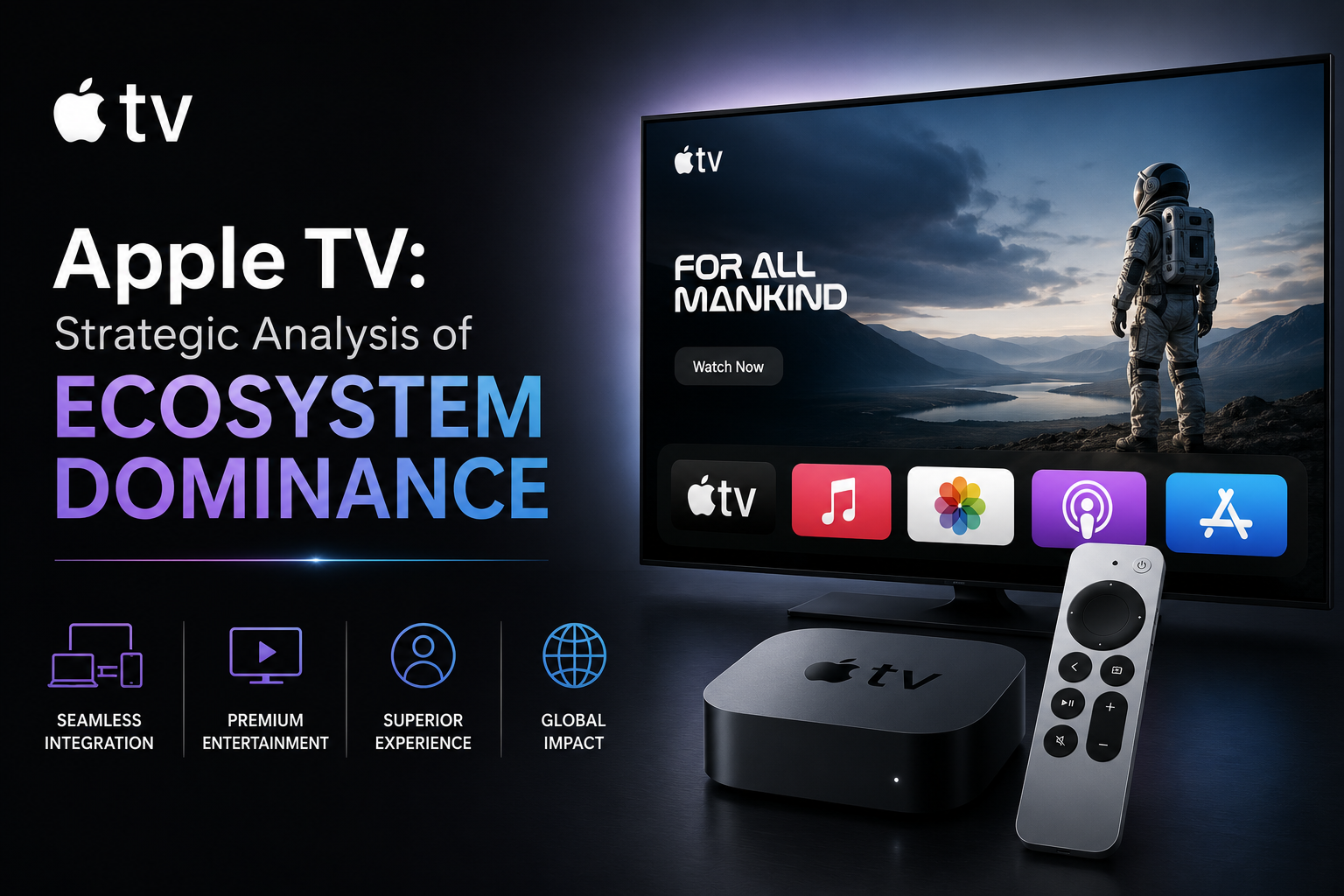
💡 Apple TV: Strategic Analysis of Ecosystem Dominance
A comprehensive strategic analysis of Apple TV hardware and Apple TV+ services, focusing on market share, sports rights, and ecosystem integration.
Executive Summary
Apple TV has transitioned from a hobby project into a cornerstone of Apple’s Services division, which generated over 85 billion dollars in revenue during the 2023 fiscal year. This analysis identifies three primary pillars of Apple’s strategy: high-performance hardware, a curated content library, and aggressive expansion into live sports. Data from market research firms indicates that Apple TV+ now holds a 9 percent share of the United States streaming market. Key findings suggest that while hardware sales provide a premium entry point, the integration of services like MLS Season Pass and high-fidelity technical standards like Dolby Vision are the primary drivers of long-term user retention.
Introduction
The digital media landscape is currently undergoing a period of intense consolidation and shifting consumer priorities. Within this environment, Apple TV stands out as a unique hybrid of hardware excellence and software integration. Unlike competitors who focus solely on software or low-cost hardware, Apple utilizes its proprietary silicon to offer a premium experience. The device serves as a hub for the smart home, a gaming console for casual players, and a cinematic gateway for audiophiles. By examining the technical specifications and the strategic content acquisitions, we can understand how Apple intends to dominate the living room in the coming decade.

The Deep Dive: Hardware and Technical Superiority
The Apple TV 4K (3rd Generation) is powered by the A15 Bionic chip, the same processor found in the iPhone 13 and iPhone 14 series. This inclusion is not merely for marketing; it provides the computational overhead necessary for advanced features like Quick Media Switching (QMS) VRR and HDR10+ support. The hardware supports 4K resolution at 60 frames per second, ensuring that high-motion content remains fluid and clear.
From a connectivity standpoint, the device includes Wi-Fi 6 and Thread networking support, making it a central controller for the Matter smart home standard. This strategic positioning ensures that the Apple TV is more than a media player; it is the brain of the connected home. The move to a USB-C charging port for the Siri Remote further aligns the product with global regulatory standards and the broader Apple ecosystem. In the context of workplace productivity, the integration of tvOS 17 brought FaceTime to the big screen, a move that mirrors the growth seen in Google Meet & Collaboration Tools: A Strategic Industry Analysis, highlighting a shift toward professional-grade communication in residential settings.
Content Strategy: Quality Over Quantity
Apple TV+ follows a distinct strategy compared to Netflix or Disney+. Rather than maintaining a massive library of licensed content, Apple focuses on original productions with high production values. This strategy has resulted in over 450 award wins and 1,600 nominations since its launch in 2019. Shows like Ted Lasso and Severance have become cultural touchstones, while films like Killers of the Flower Moon demonstrate Apple’s willingness to fund auteur-driven cinema with budgets exceeding 200 million dollars.
The financial model for Apple TV+ relies on the Apple One bundle, which encourages users to subscribe to multiple services including iCloud, Apple Music, and Apple Arcade. Industry reports suggest that bundling significantly reduces churn rates, as users find it more difficult to leave an ecosystem where their data, music, and entertainment are interconnected. This ecosystem lock-in is a primary driver of the Services segment’s 20 percent year-over-year growth rate.
![How to Use a Web Browser on Apple TV [2026]](https://trendkut.com/uploads/blogs/blog_6a66e84bbbd662.00078798.jpg)
The Sports Pivot: A New Era of Broadcasting
Perhaps the most significant shift in Apple’s strategy is its aggressive entry into live sports. The 10-year, 2.5 billion dollar deal with Major League Soccer (MLS) represents a paradigm shift in how sports are consumed globally. Unlike traditional regional sports networks, MLS Season Pass on Apple TV offers a global, no-blackout experience. This aligns with the broader trends identified in the MLS Strategic Analysis: The Future of North American Soccer, where digital accessibility is paramount for league growth.
Furthermore, Apple’s Friday Night Baseball deal with the MLB serves as a testing ground for interactive features and high-bitrate streaming. By controlling the entire stack from the camera to the screen, Apple can offer a visual fidelity that traditional cable providers cannot match. This expansion into live events is a key component of the Global Sports Industry: Strategic Analysis of Economic Growth, as tech giants increasingly outbid traditional broadcasters for premium rights.
Market Competition and Economic Impact
Apple TV faces stiff competition from Roku, Amazon Fire TV, and Google TV. While Roku leads in total active accounts in the United States, Apple leads in average revenue per user (ARPU). The high price point of Apple TV hardware (starting at 129 dollars) acts as a filter, attracting a demographic with higher disposable income. This demographic is highly attractive to advertisers, although Apple TV+ remains largely ad-free, with the exception of live sports broadcasts.
The economic impact of Apple’s media strategy extends to the hardware supply chain. The demand for high-end displays and sound systems is driven by the capabilities of the Apple TV 4K. Support for Dolby Atmos and Spatial Audio has pushed consumers to invest in premium audio equipment, benefiting the wider consumer electronics industry. As Apple continues to integrate its Vision Pro headset with the Apple TV ecosystem, we expect to see a surge in spatial video content, further differentiating Apple from its competitors.

What This Means For You
For the average consumer, the choice of a streaming device is no longer just about which apps are available. It is about which ecosystem provides the most seamless experience. If you are already an iPhone or Mac user, the Apple TV offers unparalleled benefits such as AirPlay, shared clipboards, and the ability to use your iPhone as a remote or a calibration tool for your television’s color balance.
For sports fans, the Apple TV app is becoming an essential destination. The integration of live scores, play-by-play updates, and multi-view capabilities makes it a superior platform for following multiple games simultaneously. However, users should be aware of the cost of the ecosystem; while the hardware is durable and long-lasting, the cumulative cost of subscriptions can be significant. Evaluating your needs for high-fidelity audio and video will determine if the premium price of Apple TV is a justifiable investment for your home theater setup.
Expert Verdict / Future Outlook
The future of Apple TV lies in the convergence of entertainment, gaming, and artificial intelligence. With the A15 chip and subsequent iterations, Apple has the hardware capability to turn the Apple TV into a more serious gaming console, potentially leveraging its Apple Arcade library to compete with Nintendo. We also anticipate a deeper integration of AI-driven content discovery, where the system learns viewing habits across all apps to provide a truly unified interface. As 8K resolution begins to enter the consumer market, Apple is well-positioned to lead the transition, provided they maintain their focus on high-bitrate streaming and technical excellence.
FAQ
- Does Apple TV 4K require a subscription? No, the hardware itself does not require a subscription. You can use it to access free apps or other paid services like Netflix and YouTube. However, the Apple TV+ streaming service requires a monthly fee.
- Can I use Apple TV with an Android phone? While the Apple TV hardware works with any television with an HDMI port, many of the best features like AirPlay and easy setup require an iOS device. Android users can still use the physical remote for navigation.
- What is the difference between Apple TV and Apple TV+? Apple TV refers to the physical set-top box hardware and the app available on various devices. Apple TV+ is the specific subscription service that hosts Apple’s original movies and shows.
- Does Apple TV support gaming? Yes, through Apple Arcade and the App Store. It supports major game controllers including those from PlayStation and Xbox, making it a capable casual gaming machine.
- Is the MLS Season Pass included with Apple TV+? No, MLS Season Pass is a separate subscription, though Apple TV+ subscribers often receive a discounted rate for the season.
Conclusion
Apple TV has evolved into a strategic powerhouse that combines cutting-edge hardware with premium, exclusive content. By securing high-value sports rights and maintaining a focus on technical superiority, Apple has created a platform that is difficult for competitors to replicate. As the boundary between traditional television and interactive media continues to blur, Apple’s ecosystem-first approach ensures its relevance in the modern living room. For consumers and investors alike, Apple TV represents the gold standard of integrated media delivery.





Comments 0
Leave a Reply
Your email address will not be published. Required fields are marked *
Be the first to share your thoughts!