
💡 CTET 2026 Education Policy: A Strategic Analysis
A comprehensive strategic analysis of the CTET 2026 Education Policy, covering NEP 2020 alignment, secondary level expansion, and teacher quality benchmarks.
Executive Summary
The Central Teacher Eligibility Test (CTET) for 2026 continues to play an important role in India's teacher eligibility framework, within the broader vision of the National Education Policy (NEP) 2020. This analysis examines key policy priorities associated with teacher quality, competency-based education, and the growing importance of digital literacy in education. The National Council for Teacher Education (NCTE) has an important role in establishing standards for teacher education and professional development across India. The broader policy objective is to strengthen teaching quality by placing greater emphasis on pedagogical knowledge, professional competencies, and effective teaching practices. This report evaluates the strategic implications of these policy priorities for educators, institutions, and India's broader human capital development goals.

Introduction
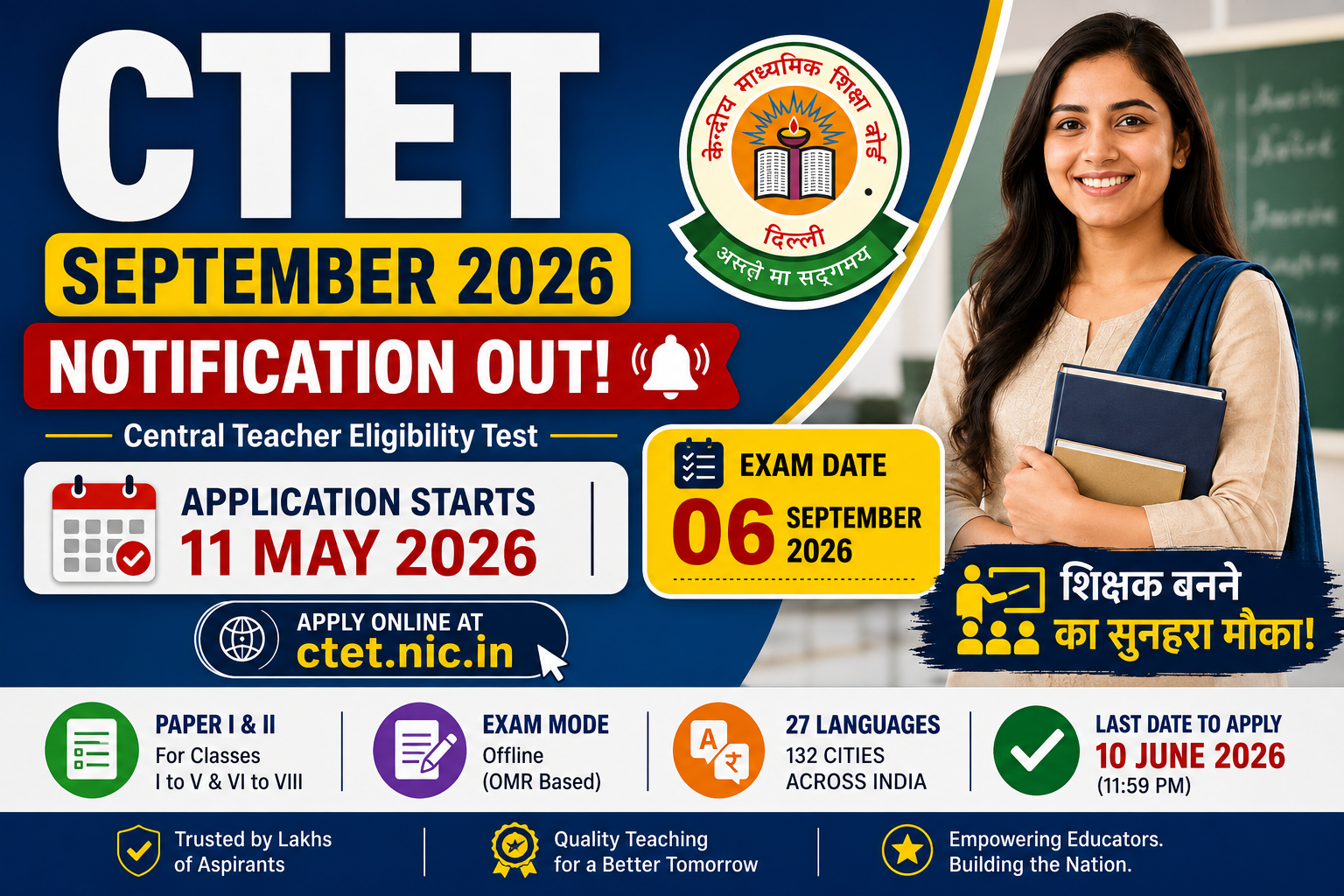
The transformation of the Indian education system is no longer a theoretical objective but a structural reality. As the National Education Policy 2020 moves through its implementation phase, CTET continues to play an important role in the teacher eligibility framework. Historically, teacher eligibility testing through CTET has focused on the foundational and middle stages of schooling. The CTET framework currently covers teachers for Classes 1 to 5 through Paper I and Classes 6 to 8 through Paper II. By establishing a national eligibility benchmark, the examination contributes to the broader objective of strengthening teacher quality and professional standards in school education.
THE DEEP DIVE: Strategic Shifts in CTET 2026
The CTET framework continues to consist of two papers: Paper I for candidates intending to teach Classes 1 to 5 and Paper II for candidates intending to teach Classes 6 to 8. The examination focuses on areas such as child development and pedagogy, language, mathematics, environmental studies, and subject-specific knowledge, depending on the paper selected. The broader policy direction under NEP 2020 places greater emphasis on improving teacher quality, pedagogical understanding, and competency-based learning.
A critical component of this broader evolution is the focus on competency-based education. Rather than relying only on factual knowledge, modern teacher preparation places importance on understanding learners, classroom processes, inclusive education, and effective teaching practices. This aligns with the wider educational reforms promoted under NEP 2020. When analyzing the fiscal impact of these professional standards, one must consider Salary and Remuneration Trends: A Strategic Global Analysis, which shows a direct correlation between standardized qualification benchmarks and long-term wage growth for the public sector workforce.

Furthermore, the 2026 policy emphasizes the National Professional Standards for Teachers (NPST). This framework categorizes teachers into four career stages: Beginner, Proficient, Expert, and Lead. The CTET 2026 will serve as the entry-level validation for the 'Beginner' stage. The strategic intent is to create a continuous professional development (CPD) loop where teachers must renew or upgrade their certifications periodically. This move is supported by the Ministerial Leadership: A Strategic Analysis of Governance, which highlights how centralized policy reforms are essential for maintaining democratic integrity and institutional trust within the education sector.
Digital transformation is another pillar of the 2026 policy. The examination will remain a Computer Based Test (CBT), but with enhanced security protocols to prevent malpractice. The NCTE is also considering the introduction of a 'Pedagogical Aptitude' section that specifically tests a candidate's ability to use digital tools for hybrid learning environments. This is particularly relevant as schools across India transition to smart classrooms. Statistics from the Unified District Information System for Education (UDISE+) show that while 80 percent of schools have access to some form of digital infrastructure, only 35 percent of teachers feel confident in utilizing these tools for instruction. CTET 2026 aims to bridge this 45 percent confidence gap through mandatory testing of digital pedagogy.
WHAT THIS MEANS FOR YOU
For aspiring educators and current teaching professionals, the CTET 2026 Education Policy necessitates a complete overhaul of preparation strategies. It is no longer sufficient to memorize textbooks; candidates must now demonstrate a deep understanding of child psychology and adaptive teaching methods. The inclusion of secondary level testing means that thousands of subject experts who previously bypassed the CTET must now prepare for a rigorous certification process. For schools, this policy ensures a higher quality of recruitment, reducing the training costs associated with onboarding new staff. For parents and students, it guarantees that the individuals leading the classroom have met a national standard of professional competence, regardless of their geographic location or the type of school they attend.

Expert Verdict and Future Outlook
Industry experts view the continued strengthening of teacher quality and professional standards as an important part of India's education reforms. The long-term outlook suggests that the professionalization of teaching can contribute to greater recognition of the teaching profession and stronger standards for educators. However, the implementation of education reforms can present challenges, particularly in ensuring adequate training resources and effective professional development. The broader success of these reforms will depend on the government's ability to provide appropriate support, maintain transparency in the examination process, and strengthen teacher preparation in line with the objectives of NEP 2020.
FAQ: Authoritative Guidance
-
Will CTET 2026 be mandatory for private school teachers? CTET is primarily a teacher eligibility test for Classes 1 to 8. Its applicability depends on the relevant rules and requirements of the school and education system. It should not be described as a blanket mandatory requirement for all private school teachers.
-
What are the new levels introduced in CTET 2026? CTET continues to have two papers: Paper I for candidates intending to teach Classes 1 to 5 and Paper II for candidates intending to teach Classes 6 to 8. A separate Class 9–12 paper should not be presented as an officially introduced CTET 2026 level without an official notification.
-
How does the competency-based format differ from previous exams? Competency-based education places greater emphasis on applying knowledge, understanding learners, and addressing practical educational situations rather than relying solely on factual recall. However, claims that CTET 2026 has introduced a completely new case-study-based examination format should not be presented as confirmed without an official notification.
-
Is there a limit on the number of attempts for CTET 2026? There is currently no restriction on the number of attempts a candidate can make to acquire or improve their CTET score. The CTET certificate is valid for a lifetime.
-
What is the qualifying percentage for CTET 2026? The qualifying benchmark for the general category is 60 percent. Individual recruiting authorities or schools may apply their own recruitment criteria in addition to CTET qualification.
Conclusion
The CTET 2026 framework continues to form an important part of India's teacher eligibility system and the broader objectives of improving teacher quality under NEP 2020. By maintaining national eligibility standards and emphasizing pedagogical understanding and professional competence, CTET contributes to the wider goal of strengthening school education. The broader movement toward competency-based education and professional development is intended to equip teachers with the skills required for the changing needs of 21st-century education. For stakeholders, the strategic takeaway is clear: strengthening teacher quality requires a combination of appropriate eligibility standards, effective preparation, continuous professional development, and transparent assessment.





Comments 0
Leave a Reply
Your email address will not be published. Required fields are marked *
Be the first to share your thoughts!