
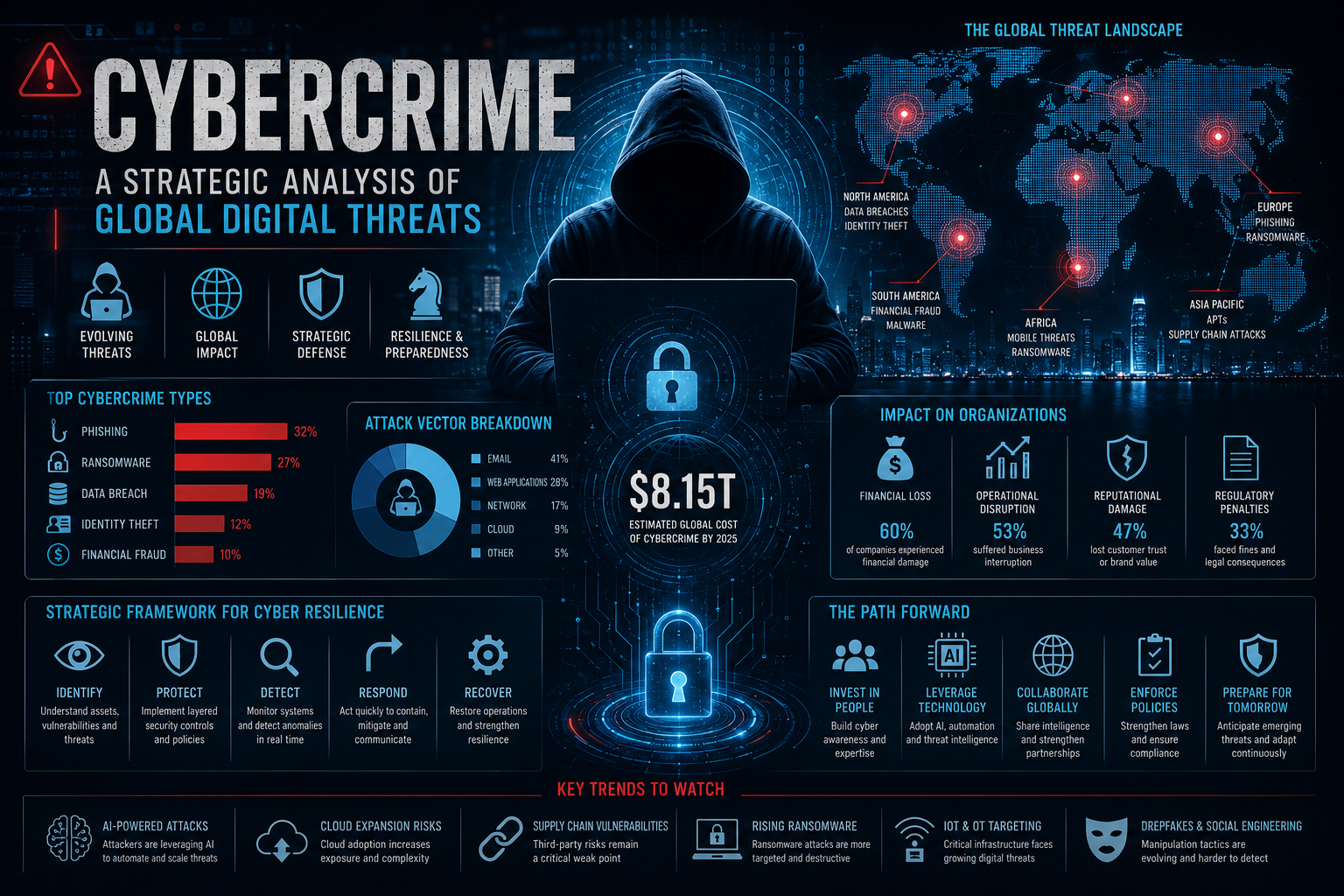
💡 Cybercrime: A Strategic Analysis of Global Digital Threats
An authoritative analysis of the global cybercrime landscape, exploring economic impacts, emerging AI threats, and strategic defense frameworks for 2024.
Executive Summary
Cybercrime has transitioned from a fragmented collection of independent actors into a sophisticated, industrialized global economy. Recent data from Cybersecurity Ventures indicates that cybercrime costs are projected to reach 10.5 trillion USD annually by 2025, up from 3 trillion USD in 2015. This represents the greatest transfer of economic wealth in history. Key findings in this analysis highlight a 72 percent increase in ransomware attacks year-over-year and a significant shift toward business email compromise (BEC), which accounted for over 2.9 billion USD in adjusted losses in 2023 according to the FBI Internet Crime Complaint Center (IC3). Organizations must move beyond traditional perimeter defense toward a zero-trust architecture to mitigate these systemic risks.
Introduction
The digital landscape is currently facing a crisis of integrity. As global commerce becomes inextricably linked with cloud computing and interconnected data streams, the surface area for malicious exploitation has expanded exponentially. Cybercrime is no longer merely a technical hurdle for IT departments; it is a primary macroeconomic risk that threatens the stability of financial institutions, sovereign infrastructure, and consumer privacy. To understand the gravity of this threat, one must view it through the lens of a professionalized industry equipped with research and development departments, customer support, and sophisticated supply chains. This analysis examines the mechanics of modern digital threats and the strategic imperatives required to navigate this high-risk environment.

The Deep Dive: The Industrialization of Digital Theft
The primary driver behind the surge in cybercrime is the professionalization of the ecosystem. Ransomware-as-a-Service (RaaS) models allow low-skill actors to deploy high-grade encryption tools developed by elite developers in exchange for a percentage of the ransom. This democratization of high-level malware has led to a volume of attacks that traditional security measures struggle to contain. In 2023, the average cost of a data breach reached an all-time high of 4.45 million USD, a 15 percent increase over three years. These costs are not limited to immediate recovery but extend to regulatory fines, lost business opportunity, and long-term brand erosion.
Financial markets are particularly sensitive to these disruptions. Just as analysts track the Rupee Performance and Valuation: A 2024 Economic Analysis to understand market stability, cybersecurity experts monitor the flow of illicit cryptocurrency to predict emerging threat vectors. The intersection of decentralized finance and cybercrime has created a liquid environment for money laundering, making it increasingly difficult for law enforcement to track and seize stolen assets.
Furthermore, the geopolitical dimension of cybercrime cannot be ignored. State-sponsored actors frequently utilize cyber operations to achieve strategic objectives without engaging in kinetic warfare. These operations often target critical infrastructure, such as energy grids and communication networks. The strategic complexity of these interactions mirrors the tensions seen in physical maritime corridors, such as those discussed in the analysis of Trump, Iran, and the Strait of Hormuz. In both domains, the goal is the assertion of power through the control of vital pathways, whether they are physical shipping lanes or digital data pipelines.
Artificial Intelligence (AI) has introduced a new layer of complexity. Threat actors are now using Generative AI to create hyper-realistic phishing emails and deepfake audio or video to bypass biometric authentication. This evolution requires a shift in defensive strategy. Traditional signature-based detection is becoming obsolete, replaced by behavioral analytics and AI-driven threat hunting. The scale of this technological arms race is comparable to the massive shifts seen in other global sectors, where the Strategic Analysis of Global Lending and Debt Markets shows how technology is fundamentally restructuring how value is managed and protected.

What This Means For You: Actionable Strategic Defense
For the individual and the enterprise leader, the prevalence of cybercrime necessitates a proactive rather than reactive stance. The following steps are essential for modern digital hygiene:
- Implementation of Phishing-Resistant MFA: Standard SMS-based multi-factor authentication is vulnerable to SIM swapping. Utilizing hardware security keys or authenticator apps provides a significantly higher level of protection.
- Adoption of Zero Trust Architecture: The principle of never trust, always verify ensures that every access request is fully authenticated, authorized, and encrypted before granting access.
- Regular Incident Response Testing: Technical defenses will eventually fail. The difference between a minor disruption and a catastrophic loss is the speed and efficiency of the response plan.
- Data Minimization: Reducing the amount of sensitive data stored decreases the potential impact of a breach. If data is not held, it cannot be stolen.
Expert Verdict and Future Outlook
The future of cybercrime will be defined by the battle over data integrity and the speed of automated response. We are entering an era where human intervention alone is insufficient to counter machine-speed attacks. The strategic focus must shift from prevention to resilience. This means building systems that can operate in a degraded state during an attack and recover rapidly. Regulatory frameworks like the SEC’s new disclosure rules and the EU’s NIS2 Directive are forcing transparency, which will ultimately lead to better collective security. However, until the cost of conducting an attack exceeds the potential reward, cybercrime will remain a dominant force in the global economy.

FAQ: Authoritative Insights on Cybercrime
What is the most common entry point for cyberattacks?
Phishing remains the primary vector, accounting for approximately 41 percent of initial access in successful breaches. Human error continues to be the weakest link in the security chain.
How has AI changed the threat of ransomware?
AI allows attackers to automate the reconnaissance phase, identifying vulnerabilities in software and network configurations much faster than manual scanning, while also personalizing extortion messages to increase the likelihood of payment.
Should companies pay the ransom in a ransomware attack?
Most law enforcement agencies, including the FBI, discourage paying ransoms. Payment does not guarantee data recovery and encourages future attacks. Furthermore, it may violate OFAC sanctions if the attacker is a designated entity.
What is a Supply Chain Attack?
A supply chain attack occurs when a threat actor infiltrates a third-party vendor or software provider to gain access to their customers. The SolarWinds and MoveIt breaches are prime examples of this highly effective strategy.
How can small businesses protect themselves with limited budgets?
Prioritizing basic hygiene is the most cost-effective strategy. This includes keeping software updated, using strong password managers, and educating employees on how to spot social engineering attempts.
Conclusion
Cybercrime has evolved into a permanent feature of the modern economic landscape. Its growth is fueled by professionalization, geopolitical friction, and rapid technological advancement. Success in this environment requires a strategic pivot from viewing security as a cost center to seeing it as a foundational element of business continuity and trust. By implementing rigorous defense frameworks and staying informed on emerging trends, organizations can protect their assets and maintain stability in an increasingly volatile digital world.




Comments 0
Leave a Reply
Your email address will not be published. Required fields are marked *
Be the first to share your thoughts!