
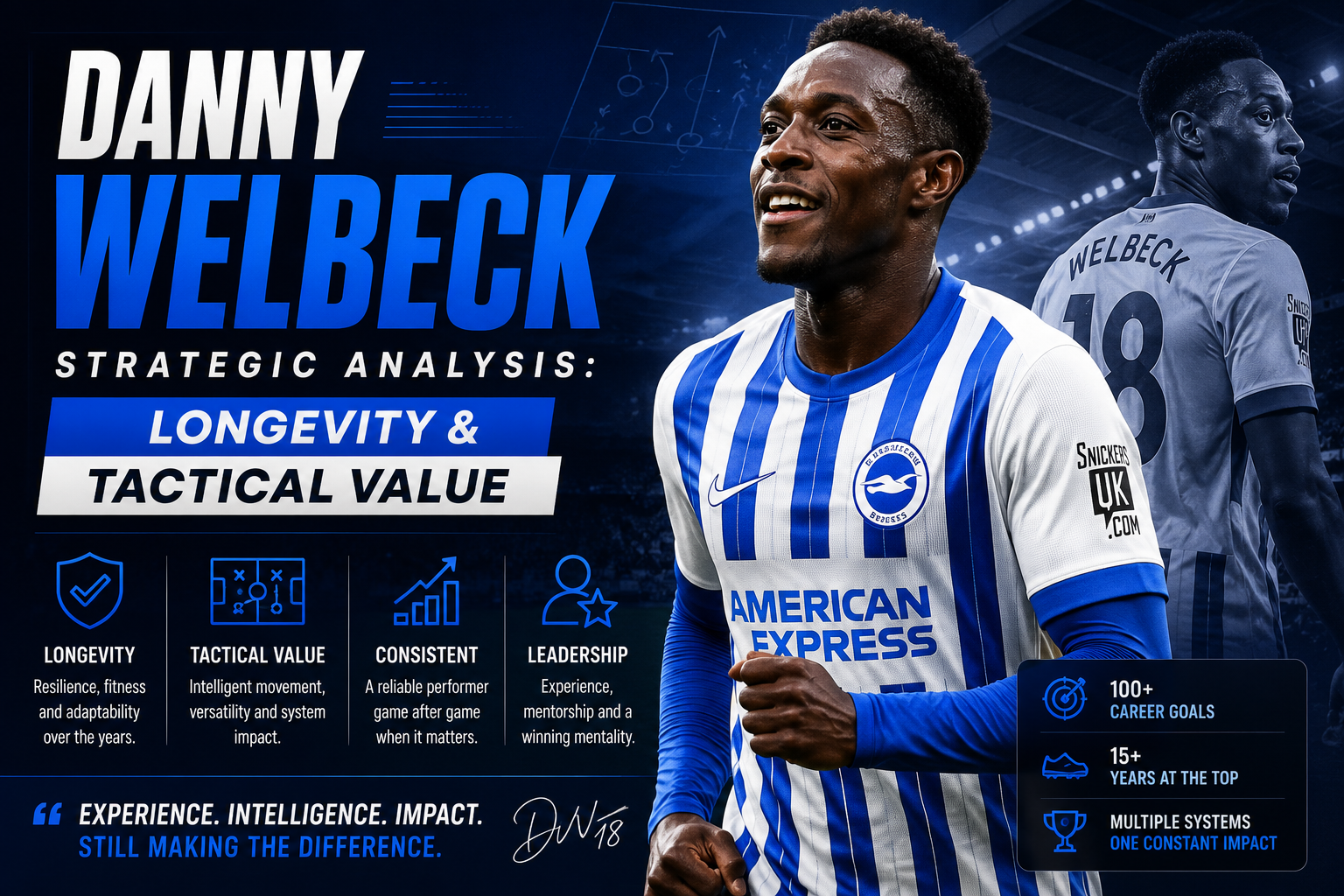
💡 Danny Welbeck Strategic Analysis: Longevity & Tactical Value
An in-depth strategic analysis of Danny Welbeck’s evolution from a Manchester United prospect to a tactical cornerstone at Brighton & Hove Albion.
Executive Summary
Danny Welbeck remains one of the most intellectually sophisticated forwards in the Premier League. While traditional strikers are measured solely by goal output, Welbeck’s value is calculated through tactical facilitation, pressing triggers, and spatial creation. With over 300 Premier League appearances and a career spanning Manchester United, Arsenal, and Brighton, his longevity is a testament to professional adaptability. Data indicates that Welbeck consistently ranks in the top 20 percent of European forwards for progressive passes received and defensive actions in the final third, making him a blueprint for the modern professional.

Introduction: The Evolution of a Tactical Asset
The trajectory of Danny Welbeck’s career serves as a masterclass in professional evolution. Emerging from the Manchester United academy as a high-pace explosive forward, Welbeck has successfully transitioned into a nuanced tactical asset. In the framework of TrendKut, he represents the Modern Professional: an individual who maintains relevance by diversifying their skill set as physical peak shifts. At Brighton & Hove Albion, Welbeck has become the foundational element of a system that prioritizes fluid movement over static positioning.
Analyzing Welbeck requires moving beyond the scoresheet. His ability to interpret the game allows him to function as a bridge between the midfield and the attack. This transition is not dissimilar to the trends observed in the MLS Strategic Analysis, where veteran profiles are increasingly valued for their organizational intelligence and ability to stabilize high-growth team environments rather than just their raw athletic output.
Practical Explanation: The Welbeck Effect
The Welbeck Effect is defined by three core pillars: off-the-ball movement, pressing triggers, and link-up play. Unlike traditional strikers who occupy the center-backs, Welbeck frequently drops into the half-spaces. This movement pulls defenders out of position, creating lanes for inverted wingers and late-arriving midfielders.
- Pressing Triggers: Welbeck is often the primary initiator of the team’s defensive shape. His sprint distance in the first 15 minutes of matches sets the defensive tempo for the entire squad.
- Spatial Intelligence: By occupying the channel between the fullback and center-back, he forces the opposition into a defensive dilemma, often resulting in numerical advantages for his teammates.
- Link-up Efficiency: His pass completion rate in the final third consistently exceeds 75 percent, a high figure for a forward operating in congested areas.

Real-life Use Cases: Brighton’s Tactical Blueprint
Under the management of Roberto De Zerbi and subsequently Fabian Hürzeler, Welbeck’s role has been refined into that of a facilitator. In specific match-day scenarios against high-pressing teams like Manchester City or Liverpool, Welbeck serves as the primary escape valve. His ability to shield the ball and distribute under pressure allows Brighton to bypass the initial press.
For instance, in Brighton’s tactical build-up, Welbeck often occupies a deep position to receive the ball with his back to goal. This attracts the opposition’s central defenders, leaving the space behind them vulnerable to the pace of players like Kaoru Mitoma. His spatial awareness was pivotal in Brighton’s historic European qualification, proving that tactical intelligence can compensate for a decline in raw sprinting speed.
Actionable Insights: What This Means for You
Welbeck’s career offers significant lessons for professionals across all industries. The focus is on two strategic concepts: The Pivot and Value Beyond Output.
- The Pivot: Welbeck did not resist his changing physical profile. Instead, he pivoted to become a tactical specialist. Professionals should regularly audit their skills and adapt to new organizational needs before their primary function becomes obsolete.
- Value Beyond Output: In any organization, primary KPIs (like goals) are important, but secondary contributions (like team cohesion and tactical execution) often determine long-term job security and authority.
- Resilience Management: Despite significant injury setbacks, Welbeck’s commitment to rehabilitation and physical maintenance has extended his career at the highest level.
Comparison Table: Danny Welbeck vs. Traditional Target Men
This matrix compares Welbeck’s tactical profile against the standard Premier League target man archetype.
| Metric | Danny Welbeck | Traditional Target Man |
|---|---|---|
| Pressing Efficiency | High (Top 15% of Forwards) | Low to Moderate |
| Pass Completion (Final Third) | 78% - 82% | 60% - 65% |
| Tactical Versatility | Can play LW, RW, CF, SS | Strictly Central |
| Aerial Duel Success | Moderate (45%) | High (60%+) |
| Progressive Carries | 4.2 per 90 mins | 1.8 per 90 mins |

Expert Tips: Sustaining High Performance
Sustaining elite performance into one's mid-thirties requires a holistic approach to wellness. Welbeck’s longevity is attributed to a rigorous discipline in physical maintenance and load management. This intersection of elite athletic performance and wellness is a growing field of study, much like the insights found in the Suman Pahuja Net Worth: Strategic Analysis of Wellness Authority, which highlights how strategic wellness investments lead to professional longevity.
Key tips for sustaining high performance include:
- Prioritizing active recovery over total rest to maintain muscle elasticity.
- Utilizing data analytics to monitor workload and prevent over-exertion.
- Focusing on cognitive training to improve decision-making speed as physical speed plateaus.
Advantages vs. Limitations: The Strategic Trade-off
The strategic analysis of Danny Welbeck must acknowledge the trade-offs inherent in his profile. His tactical intelligence is world-class, but his career has been punctuated by a documented injury record. This creates a risk-reward scenario for managers. Much like the analysis of Patrick Kane: Strategic Analysis of an NHL Icon, Welbeck represents a veteran whose impact is measured in high-leverage moments rather than cumulative seasonal volume.
The limitation of finishing consistency has often been the primary critique of Welbeck. However, his ability to improve the performance of the ten players around him often outweighs the deficit in individual goal tally. For a club like Brighton, the trade-off is clear: Welbeck provides the structure that allows the entire offensive system to function.
FAQ: Understanding the Welbeck Legacy
1. Why is Welbeck considered a manager's favorite?
Managers value his tactical discipline. He follows instructions to the letter, especially regarding defensive positioning and pressing triggers, which provides a level of reliability that more volatile strikers lack.
2. How has his role changed since leaving Arsenal?
At Arsenal, he was often used as a secondary scoring threat or a wide outlet. At Brighton, he has become a focal point of the build-up play, acting more as a False 9 who facilitates the movement of others.
3. What are his key statistical contributions at Brighton?
Beyond goals, his key stats include high rankings in 'Shot-Creating Actions' and 'Successful Pressures per 90 minutes,' where he often leads the Brighton forward line.
4. How does he influence younger squad members?
Welbeck is frequently cited by younger players like Evan Ferguson as a mentor. His professional conduct and understanding of the game serve as a live textbook for academy graduates.
5. What is his projected career trajectory post-2025?
Given his tactical IQ, Welbeck is widely expected to transition into coaching or technical recruitment. His ability to read the game suggests he would be a highly effective tactical analyst or manager.
Conclusion: The Blueprint for the Modern Professional
Danny Welbeck is the definitive example of an undervalued asset whose worth is revealed through deep strategic analysis. By evolving from a speed-reliant prospect into a tactical facilitator, he has maintained a decade-long presence in the world’s most competitive league. His career serves as a masterclass in professional adaptability, proving that longevity is not merely about physical survival but about strategic relevance. For any professional, the lesson is clear: your value is not just what you do, but what you enable others to achieve.





Comments 0
Leave a Reply
Your email address will not be published. Required fields are marked *
Be the first to share your thoughts!