
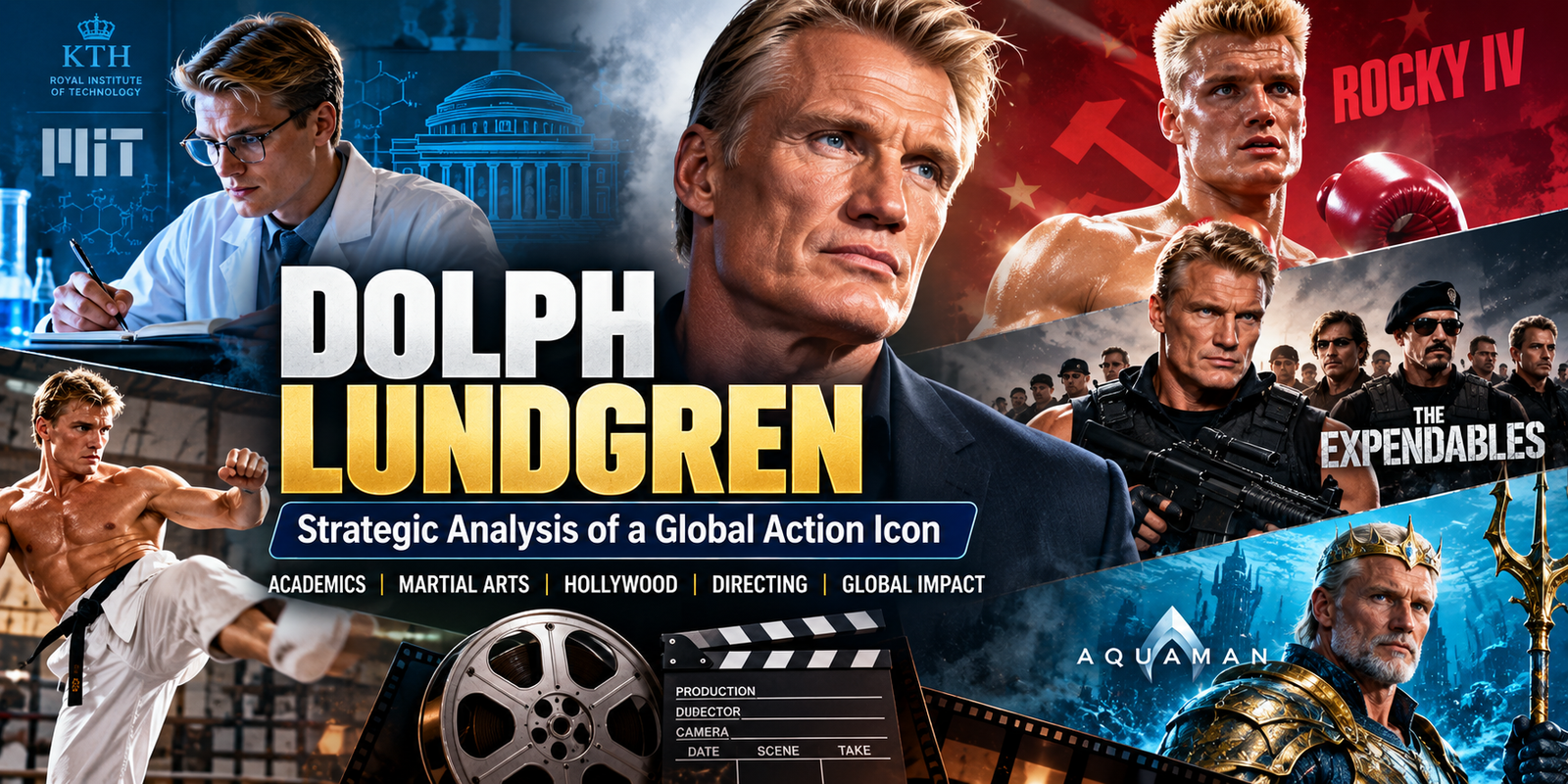
💡 Dolph Lundgren: Strategic Analysis of a Global Action Icon
A high-authority strategic analysis of Dolph Lundgren’s career, examining his transition from chemical engineering to global action cinema and brand longevity.
Executive Summary
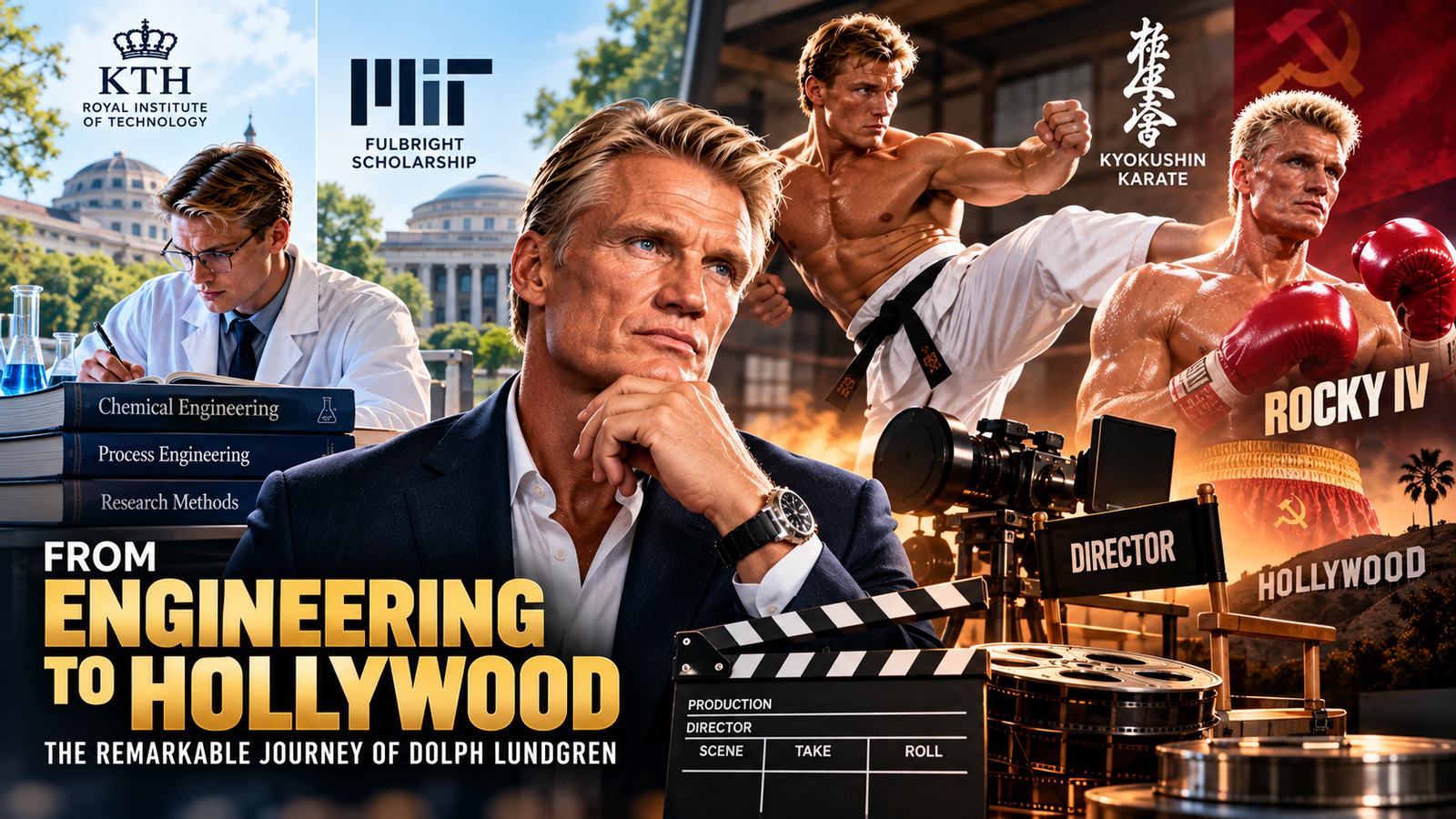
Dolph Lundgren represents a distinctive case study in career adaptability and long-term brand development. Before becoming internationally recognized as an action-film star, the Swedish actor, filmmaker, and martial artist built an academic background in chemical engineering, earning a degree from the Royal Institute of Technology in Stockholm and a master's degree from the University of Sydney. He was also awarded a Fulbright Scholarship to MIT in 1983 before ultimately pursuing a career in entertainment.
Lundgren's breakthrough came in 1985, when he portrayed Ivan Drago in Rocky IV. The role established him as a recognizable international action performer and was followed by appearances in films including Masters of the Universe, Red Scorpion, The Punisher, Universal Soldier, and numerous other action productions.
His career subsequently expanded beyond acting. Lundgren moved into directing and writing, beginning with The Defender in 2004 and later directing projects such as The Russian Specialist, Missionary Man, Command Performance, Icarus, Castle Falls, and Wanted Man.
His later career included major franchise appearances in The Expendables, Aquaman, Creed II, and Aquaman and the Lost Kingdom. Aquaman alone generated approximately $1.15 billion worldwide, demonstrating the scale of the franchises in which Lundgren has participated.
Lundgren's professional journey demonstrates several themes relevant to career strategy: developing transferable skills, adapting to changing market conditions, expanding beyond a single professional role, and maintaining relevance across multiple generations of audiences.
Introduction: The Polymath of Hollywood
In international cinema, Dolph Lundgren occupies a distinctive position.
Audiences recognize him most prominently as Ivan Drago from Rocky IV and Gunner Jensen from The Expendables, but his professional background extends well beyond acting.
Born Hans Lundgren in Sweden, he developed an early interest in academics and engineering while simultaneously pursuing Kyokushin karate. He earned a chemical-engineering degree from the Royal Institute of Technology in Stockholm and later completed a master's degree in chemical engineering at the University of Sydney in 1982.
His academic path was followed by a Fulbright Scholarship to MIT in 1983. However, his career ultimately moved in a completely different direction when he entered the entertainment industry.
That transition—from engineering and academic study to martial arts, modeling, acting, filmmaking, and production—makes Lundgren's career particularly interesting from a professional strategy perspective.
Rather than remaining dependent on a single role or a single period of Hollywood success, he gradually expanded his professional identity.
This article examines that evolution and the factors that have contributed to his long-term presence in international cinema.

1. The Academic Foundation: Engineering Before Hollywood
Before becoming a recognizable Hollywood action star, Lundgren developed a strong academic background.
He studied chemical engineering at the Royal Institute of Technology in Stockholm before completing a master's degree in the same field at the University of Sydney in 1982.
During his time in Australia, Lundgren also developed his martial-arts career and became involved in professional work that eventually brought him closer to the entertainment industry.
In 1983, he received a Fulbright Scholarship to MIT. The scholarship was an important academic opportunity, but Lundgren did not ultimately build a career in engineering or research. Instead, he moved toward acting and entertainment.
This transition illustrates an important career principle: professional education does not necessarily determine the industry in which someone will ultimately work.
An engineering background may not directly explain a person's success as an actor or director, but it demonstrates that Lundgren entered Hollywood with a background that was considerably different from the conventional path associated with action cinema.
2. Martial Arts and the Development of an Action Persona
Lundgren's martial-arts background became one of the defining elements of his early professional identity.
He trained extensively in Kyokushin karate and became a member and captain of the Swedish Kyokushin karate team. He won the European championships in 1980 and 1981 and later competed internationally. Modern biographical sources list him as holding a 4th dan black belt in Kyokushin karate.
This background was highly compatible with the requirements of the action-film genre.
Unlike performers whose action roles depended primarily on choreography and stunt doubles, Lundgren had an established competitive martial-arts background that contributed to his physical screen presence.
His height, athletic build, martial-arts experience, and disciplined training became recognizable elements of his early screen identity.
These characteristics helped differentiate him in an increasingly competitive action-film market during the 1980s and 1990s.
3. The Rocky IV Breakthrough
The most important early turning point in Lundgren's career came in 1985, when he was cast as Ivan Drago in Rocky IV.
The character became one of the most recognizable antagonists of the Rocky franchise.
Rocky IV was a major commercial success and generated approximately $300 million worldwide during its original theatrical run.
The importance of the role went beyond its box-office performance.
Ivan Drago gave Lundgren an internationally recognizable character and established an association between his image and large-scale action cinema.
Following Rocky IV, he appeared in films including:
- Masters of the Universe (1987)
- Red Scorpion (1988)
- The Punisher (1989)
- I Come in Peace (1990)
- Showdown in Little Tokyo (1991)
- Universal Soldier (1992)
His early career therefore established a recognizable professional niche around physical action, martial arts, international settings, and larger-than-life characters.
4. Expanding Beyond a Single Franchise
A potential challenge for any actor associated with one highly recognizable role is becoming permanently identified with that character.
Lundgren addressed this by continuing to work across a wide range of action productions.
During the 1990s and early 2000s, he appeared in numerous films that were distributed internationally, including Joshua Tree, Men of War, Johnny Mnemonic, Silent Trigger, The Peacekeeper, and Blackjack.
This period was important because it allowed him to maintain a continuous screen presence even when the theatrical market for large solo action films was changing.
Rather than measuring this period only by theatrical box-office results, it is more useful to view it as a period of continued professional activity and audience recognition.
The strategy was relatively straightforward: remain active, work across international productions, and continue developing a recognizable identity within the action genre.
5. The Move From Actor to Filmmaker
One of the most significant developments in Lundgren's career was his transition from acting into filmmaking.
He directed his first feature film, The Defender, in 2004. He subsequently directed The Russian Specialist in 2005 and Missionary Man in 2007. His later directing work included Command Performance, Icarus, Castle Falls, and Wanted Man.
Filmography databases differ slightly in how they count his directing credits, particularly around Diamond Dogs, but his clearly documented directing work includes the films listed above.
This transition expanded his professional role.
Instead of remaining exclusively in front of the camera, Lundgren became involved in areas such as:
- Directing
- Screenwriting
- Producing
- Action choreography and performance
- Character development
- Production decisions
This diversification reduced his dependence on one type of acting role and gave him greater involvement in the filmmaking process.
6. The Expendables and the Return to Major Franchises
A major later-career milestone arrived with The Expendables in 2010.
The film brought together several established action stars, including Sylvester Stallone, Jason Statham, Jet Li, Dolph Lundgren, and other well-known performers.
Lundgren's return to a major theatrical action franchise demonstrated how recognizable characters and established audience associations could remain commercially valuable decades after an actor's initial breakthrough.
He subsequently appeared in The Expendables 2, The Expendables 3, and Expend4bles. The franchise became an important part of his modern screen identity.
Rather than attempting to recreate his 1980s career exactly, Lundgren became part of an ensemble model in which established action performers could contribute recognizable characters to large franchise productions.
This represented a different form of career positioning: moving from being primarily the central physical attraction of an action film to becoming an established franchise performer.
7. Aquaman and Mainstream Franchise Expansion
Lundgren's career expanded again when he joined the DC film universe.
In 2018, he portrayed King Nereus in Aquaman. The film became a major worldwide box-office success, generating approximately $1.15 billion globally.
The significance of Aquaman was not that Lundgren personally generated the film's box office. Rather, his participation demonstrated that an actor strongly associated with 1980s and 1990s action cinema could continue appearing in major modern franchise productions.
He later returned as King Nereus in Aquaman and the Lost Kingdom.
He also reprised the role of Ivan Drago in Creed II, connecting his modern career to the franchise that originally established him internationally.
This pattern demonstrates a recurring element of Lundgren's career: established characters can create opportunities for performers long after their original appearances.

8. Career Longevity and Professional Adaptability
Lundgren's screen career began in the mid-1980s, meaning that by 2026 his professional presence in film spans roughly four decades.
During this period, the entertainment industry changed dramatically.
Theatrical distribution evolved, home video became DVD and Blu-ray, streaming platforms expanded, international co-productions became increasingly common, and established franchises became an increasingly important part of Hollywood's commercial strategy.
Lundgren worked across many of these changing environments.
His career included:
1980s: Breakthrough and major action roles
1990s: International action films and franchise work
2000s: Direct-to-video productions and transition into directing
2010s: Major franchise revival through The Expendables and Aquaman
2020s: Continued acting, directing, producing, franchise appearances, and documentary work
This timeline illustrates adaptability rather than dependence on a single period of popularity.
9. Health, Resilience and a New Chapter
Lundgren's personal health journey has also become an important part of his recent public story, but it should be described carefully and separately from his professional achievements.
According to Lundgren's recent account, a tumor was discovered in one of his kidneys in 2015, and he was initially diagnosed with kidney cancer. His condition later became more serious, and in 2022 a second medical opinion identified a different and more treatable cancer diagnosis. His subsequent treatment led to significant improvement, and he was reported to be cancer-free in 2024.
His experience has since become part of his public discussions about resilience and his personal outlook.
Rather than treating illness as a career advantage, the more appropriate professional takeaway is that his recent story demonstrates how a public figure can openly discuss major personal challenges while continuing to work.
His documentary and memoir-related projects have also added a more personal dimension to his public profile.
10. What This Means for Career Strategy
Lundgren's career provides several broader professional lessons.
Leverage Existing Skills
Lundgren entered entertainment with an unusual combination of engineering education, martial-arts experience, physical training, and international exposure.
The lesson is that skills developed in one field can become differentiators in another.
Adapt to Market Changes
The entertainment industry changed significantly during Lundgren's career.
Instead of relying exclusively on theatrical action leads, he continued working in international productions, franchise films, television and filmmaking.
Diversify Your Professional Role
Moving from actor to director, writer and producer allowed Lundgren to expand the range of projects in which he could participate.
Professional longevity can sometimes depend on having multiple ways to create value.
Build Recognizable Intellectual Property
Characters such as Ivan Drago and Gunner Jensen became important parts of Lundgren's public identity.
Returning to recognizable characters through Creed II and The Expendables demonstrates how established fictional identities can continue to create opportunities.
Maintain Professional Discipline
Lundgren's martial-arts background and long-term involvement in physical training have been consistent elements of his public identity.
In physically demanding entertainment roles, maintaining fitness and preparation can support the ability to continue performing over a long career.
Career Outlook
Lundgren's career has moved through several distinct phases: academic training, martial arts, Hollywood breakthrough, international action cinema, directing, franchise revival, and modern legacy roles.
His recent work shows that his career is no longer dependent solely on the type of leading action role that defined his earliest years.
Instead, his professional identity now encompasses acting, directing, producing, writing, franchise appearances, and personal storytelling.
His career therefore provides an example of how professional identity can evolve over time without abandoning the strengths that originally created recognition.
The broader lesson is not simply about Hollywood.
In many industries, professionals who develop transferable skills and remain open to changing roles can create additional career pathways as markets evolve.
Frequently Asked Questions
What is Dolph Lundgren's educational background?
Dolph Lundgren studied chemical engineering at the Royal Institute of Technology in Stockholm and later earned a master's degree in chemical engineering from the University of Sydney in 1982. He was also awarded a Fulbright Scholarship to MIT in 1983.
Did Dolph Lundgren actually attend MIT?
He received a Fulbright Scholarship to MIT in 1983, but he did not complete an MIT degree. His career direction changed as he moved from academia toward entertainment.
Is Dolph Lundgren a real martial artist?
Yes. Lundgren has a long competitive Kyokushin karate background, won European championships in 1980 and 1981, and current biographical sources list him as a 4th dan black belt.
What was Dolph Lundgren's breakthrough movie?
His major international breakthrough came with Rocky IV in 1985, in which he played Ivan Drago.
How many films has Dolph Lundgren directed?
Filmography databases differ slightly in how they count his directing credits, but his documented directing work includes The Defender, The Russian Specialist, Missionary Man, Command Performance, Icarus, Castle Falls, and Wanted Man. Some databases also include Diamond Dogs as a directing entry.
What is Dolph Lundgren's most famous character?
Ivan Drago from Rocky IV is one of his most internationally recognized characters. He later returned to the character in Creed II.
Was Aquaman a major commercial success?
Yes. Aquaman earned approximately $1.15 billion worldwide. Lundgren played King Nereus in the film and later reprised the role in Aquaman and the Lost Kingdom.
Did Dolph Lundgren have cancer?
Lundgren has publicly discussed a serious cancer diagnosis that began with a kidney tumor discovered in 2015. He later received a second opinion in 2022 that identified a different and more treatable cancer diagnosis, and he was reported cancer-free in 2024.
Is Dolph Lundgren's IQ 160?
The frequently repeated 160 IQ figure should not be presented as a verified fact. There is no reliable basis in the available sources to state that number as his officially confirmed IQ.
What is Dolph Lundgren's net worth?
Celebrity net-worth figures published online are generally estimates rather than audited financial information. Because there is no sufficiently authoritative public figure to verify a specific number, a precise net-worth figure should not be presented as fact.
Conclusion
Dolph Lundgren's career demonstrates how professional identity can evolve across multiple industries and generations.
His journey began with chemical-engineering studies and competitive martial arts before moving into international entertainment. His breakthrough as Ivan Drago in Rocky IV established a powerful action-film identity, while later work in international productions helped him maintain a continuous presence in cinema.
The next stage of his career involved diversification. Lundgren moved into directing, writing and producing while continuing to act. His later participation in franchises such as The Expendables, Creed, and Aquaman demonstrated how an established screen identity can remain relevant as the entertainment market changes.
His recent personal health journey has added another dimension to his public story, while his continued work demonstrates a career that has extended far beyond the era in which he first became famous.
The broader strategic lesson from Lundgren's career is adaptability.
A long professional career does not necessarily require remaining in the same role forever. Education, physical skills, creative abilities, recognizable intellectual property, and willingness to take on new responsibilities can combine to create multiple pathways for continued relevance.
Dolph Lundgren's transition from chemical engineering student and martial artist to actor, director, producer, and international action-film icon remains an unusual example of professional reinvention in global entertainment.





Comments 0
Leave a Reply
Your email address will not be published. Required fields are marked *
Be the first to share your thoughts!