
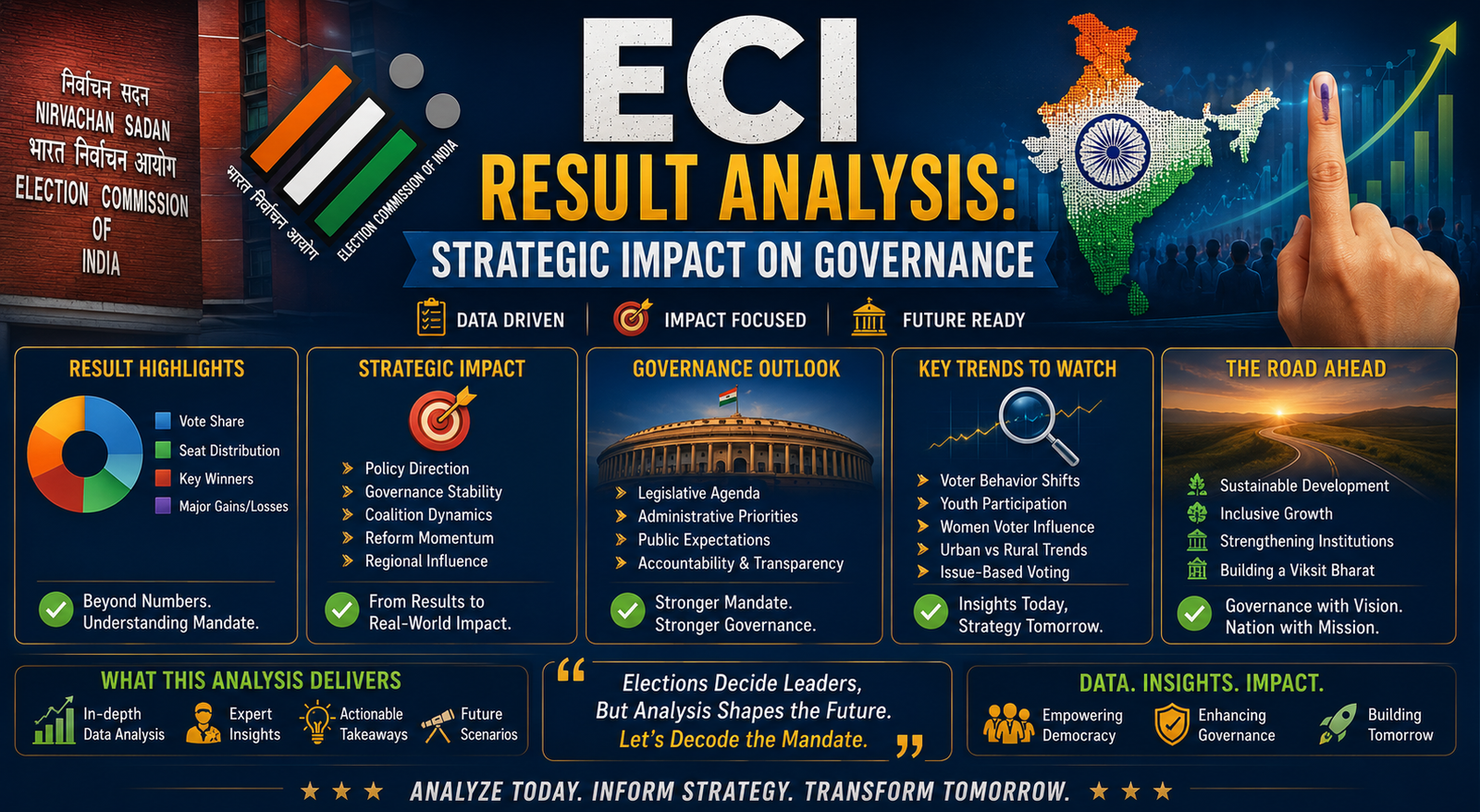
💡 ECI Result Analysis: Strategic Impact on Governance
A comprehensive analysis of the Election Commission of India (ECI) results, examining seat distributions, coalition dynamics, and the strategic economic implications for the nation.
Executive Summary
The Election Commission of India (ECI) results for the 2024 General Elections and subsequent state assembly polls mark a significant shift in the Indian political landscape. Key data highlights include a total voter turnout of approximately 66.4 percent across 543 constituencies, involving 642 million voters. The emergence of a robust coalition government, with the National Democratic Alliance (NDA) securing 293 seats and the I.N.D.I.A. bloc attaining 234 seats, has redefined the legislative process. From an economic perspective, the results influenced a 6 percent intraday volatility in the Nifty 50 on counting day, followed by a rapid stabilization as policy continuity was signaled. This analysis examines the data-driven realities of these results and their long-term impact on governance and market stability.
Introduction
The announcement of an ECI result is more than a mere tally of votes; it is the definitive pulse of the world's largest democracy. In the 2024 cycle, the ECI managed a mammoth operation involving 1.5 million polling stations and nearly 15 million personnel. The transition from a single-party majority to a coalition-dependent administration represents a paradigm shift in how federal and economic policies are negotiated. Understanding these results requires a look beyond the surface-level wins and losses, focusing instead on the structural changes in voter behavior, regional party resurgence, and the institutional resilience of the ECI itself.
THE DEEP DIVE: Analyzing the 2024 ECI Results
The 2024 ECI result provided several data points that surprised seasoned analysts and exit pollsters alike. While exit polls predicted a landslide for the incumbent Bharatiya Janata Party (BJP), the final tally saw the party stopping at 240 seats, 32 seats short of a simple majority. This necessitated the support of key allies like the Telugu Desam Party (TDP) and the Janata Dal (United) (JD-U).
One of the most critical aspects of this result was the regional performance in high-stakes states. In Uttar Pradesh, the seat share for the incumbent dropped from 62 in 2019 to 33 in 2024, a statistical swing that fundamentally altered the national power balance. This shift in power dynamics is a critical component of India's strategic evolution toward a more collaborative federal structure. Furthermore, the performance of regional parties, particularly in the south, mirrors the data seen in Tamil Nadu's strategic economic analysis, where local governance significantly influences industrial outcomes and voter loyalty.
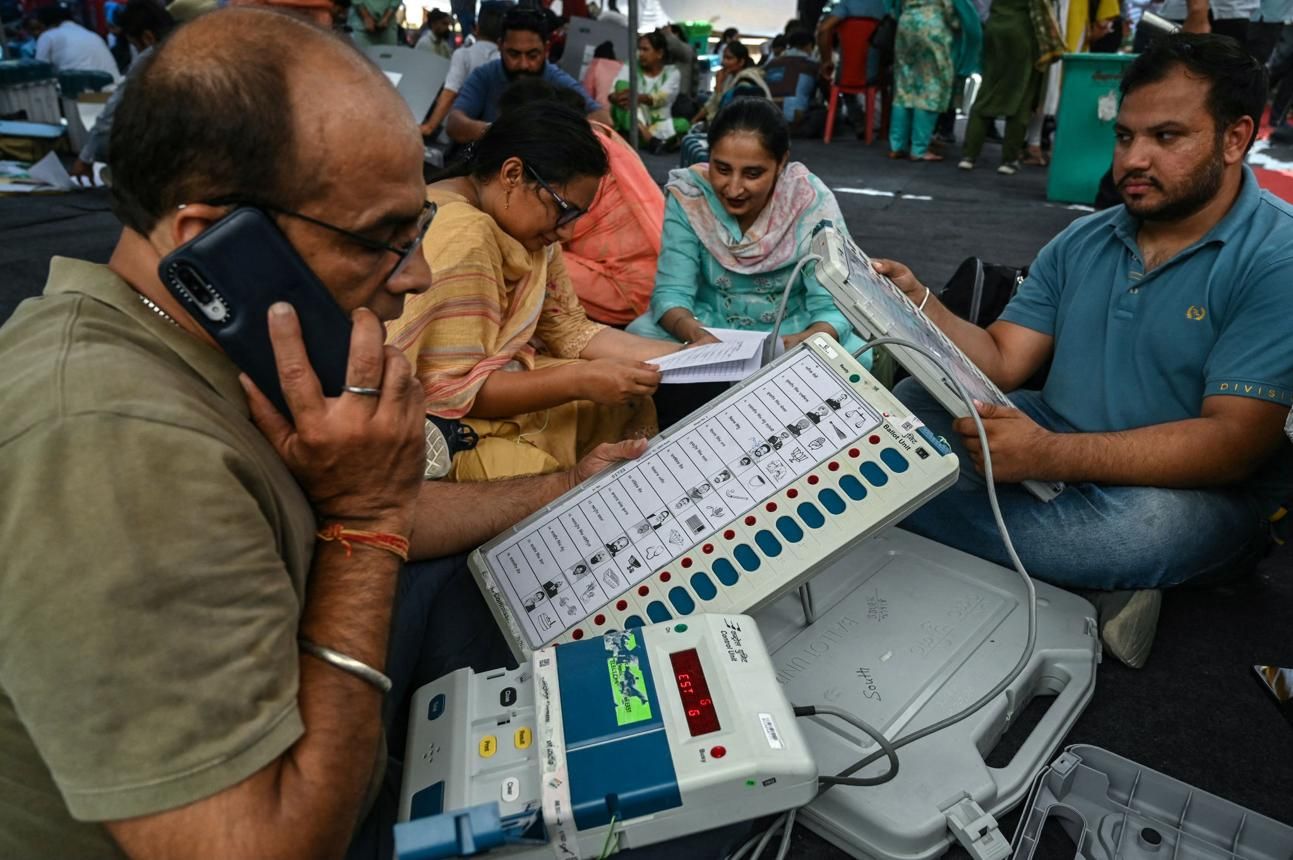
The ECI also faced rigorous scrutiny regarding the Electronic Voting Machine (EVM) and Voter Verifiable Paper Audit Trail (VVPAT) systems. Data from the ECI confirms that in 100 percent of the cases where VVPAT slips were matched with EVM counts, no discrepancies were found. This technical validation is essential for maintaining investor confidence and social stability. Institutional integrity remains the bedrock of the Indian growth story, as political stability is directly correlated with Foreign Direct Investment (FDI) inflows.
Economic Implications and Market Reaction
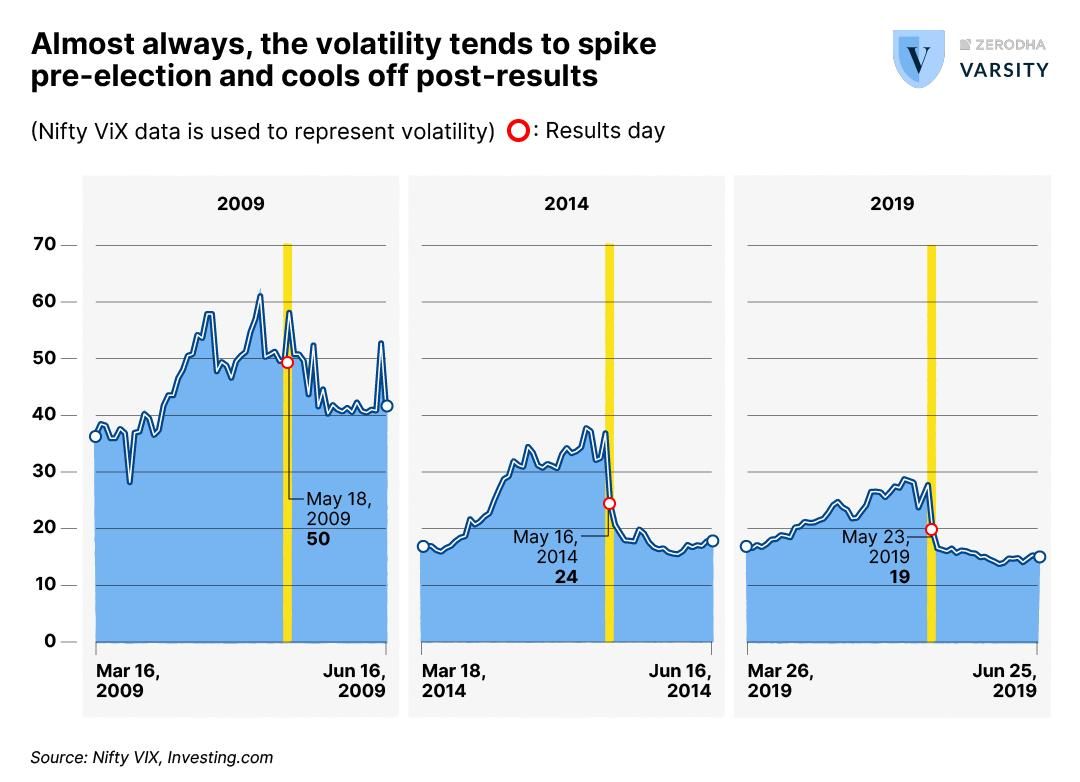
The immediate reaction to the ECI result was visible in the financial markets. On June 4, 2024, the Sensex plummeted by over 4,000 points before recovering as the coalition structure became clear. Investors often look for stability following an ECI result, which directly impacts corporate outlooks such as ITC dividend projections and broader market liquidity. The consensus among economists is that while the coalition may slow down some aggressive land and labor reforms, the focus on infrastructure, digital public goods, and manufacturing (PLI schemes) will remain intact.
- Infrastructure Spending: The government is expected to maintain its capital expenditure target of 11.11 lakh crore INR.
- Fiscal Deficit: The target remains at 5.1 percent for FY25, moving toward 4.5 percent by FY26.
- Rural Consumption: A shift toward populist measures or direct benefit transfers may be seen to address rural distress highlighted in the voting patterns.
WHAT THIS MEANS FOR YOU
For the average citizen and the professional investor, the ECI result translates to a more consultative form of governance. Here is a breakdown of the actionable implications:
- Policy Stability: Major shifts in taxation (like GST) or digital infrastructure (Aadhaar/UPI) are unlikely to be reversed, providing a stable environment for businesses.
- Social Welfare: Expect an increase in localized welfare schemes as the central government balances the demands of regional allies.
- Market Opportunities: Volatility surrounding election results often provides entry points for long-term investors in sectors like defense, renewables, and banking.
- Civic Awareness: The close margins in many constituencies (some less than 2,000 votes) highlight the increasing value of individual participation in the democratic process.
Expert Verdict and Future Outlook
The 2024 ECI result has successfully stress-tested the Indian democratic framework. The return to coalition politics is not necessarily a sign of weakness but rather an indicator of a maturing democracy where diverse regional interests find a seat at the national table. Looking ahead to 2025 and 2026, the focus will shift to state assembly elections in Delhi and Bihar. These will serve as mid-term referendums on the central coalition's performance. Experts anticipate that the ECI will continue to integrate more advanced technology in the counting process, potentially reducing the window between the close of polls and the declaration of results.
FAQ: Authoritative Answers on ECI Results
1. How does the ECI ensure the accuracy of the final result?
The ECI uses a multi-tier verification process involving polling agents from all candidates. The VVPAT slips from five randomly selected polling stations per assembly segment are physically counted and matched with the EVM totals to ensure 100 percent accuracy.
2. What happens if a candidate is unhappy with the ECI result?
Candidates can file an Election Petition in the High Court of the respective state within 45 days of the result declaration. The ECI preserves all voting records and EVMs for this period to facilitate legal review.
3. Why do exit polls sometimes differ significantly from the actual ECI result?
Exit polls rely on sampling techniques and voter testimony, which can be subject to social desirability bias or inadequate sample sizes in diverse constituencies. The ECI result is based on the actual physical count of every valid vote cast.
4. How does a coalition government impact economic policy?
A coalition government typically requires a Common Minimum Programme (CMP). While this may lead to slower decision-making on controversial reforms, it often results in more thoroughly debated and sustainable policies that have wider political buy-in.
5. What is the role of the Model Code of Conduct (MCC) after the results?
The MCC ceases to be in effect immediately after the ECI issues the notification constituting the new house. This allows the newly formed government to resume administrative decisions and policy announcements.
Conclusion
The ECI result of 2024 serves as a definitive roadmap for India's governance over the next five years. By balancing national ambition with regional necessity, the current political configuration ensures a system of checks and balances that is vital for long-term stability. For stakeholders ranging from global investors to local citizens, the data confirms that India's institutional machinery remains robust, providing a secure foundation for continued economic and social evolution.





Comments 0
Leave a Reply
Your email address will not be published. Required fields are marked *
Be the first to share your thoughts!