
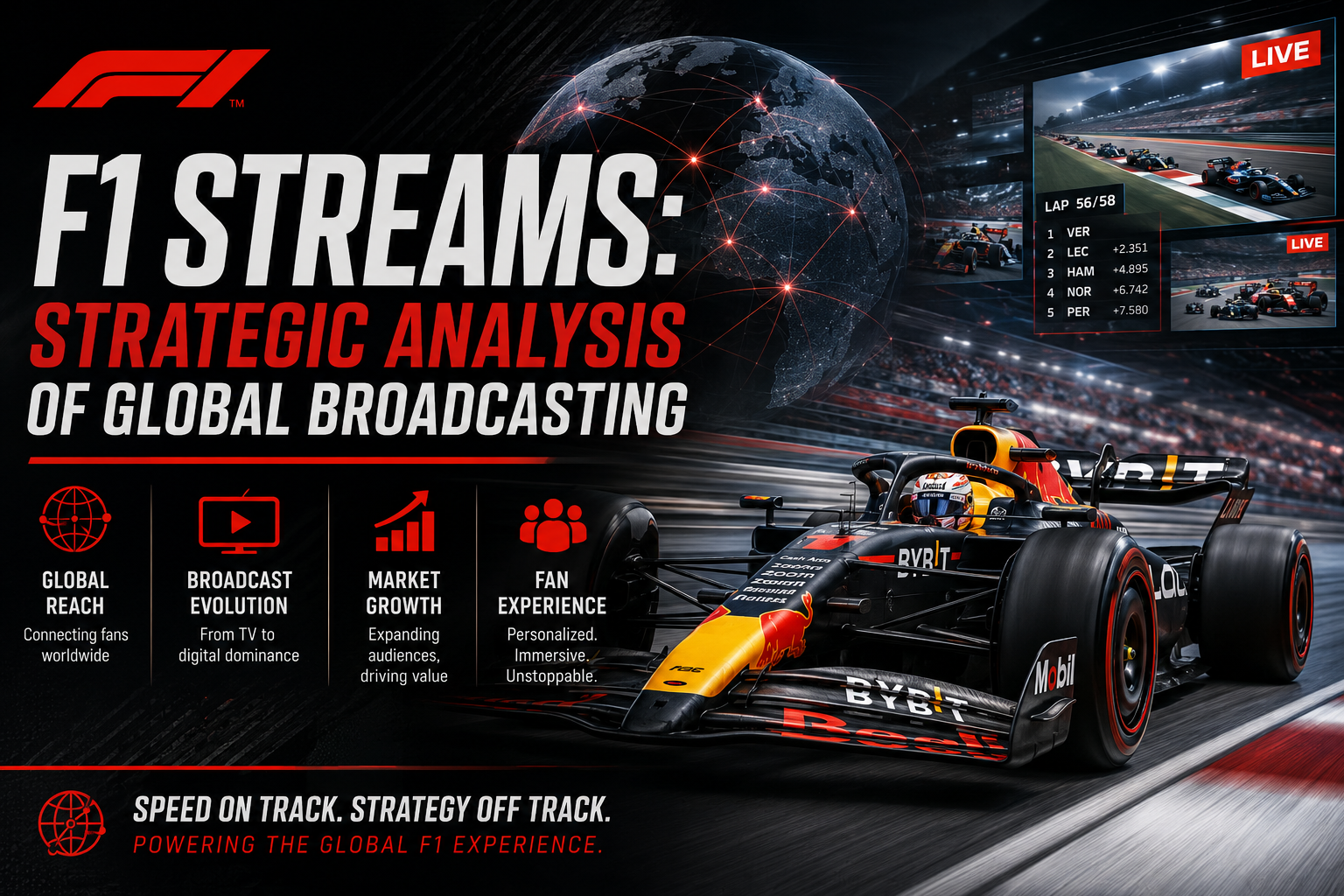
💡 F1 Streams: Strategic Analysis of Global Broadcasting
A comprehensive analysis of the Formula 1 streaming landscape, including rights acquisition, F1 TV Pro growth, and the shift from linear to digital media.
Executive Summary
The landscape of Formula 1 broadcasting has undergone a radical transformation over the last decade, shifting from a traditional linear television model to a sophisticated digital ecosystem. Current data indicates that Formula 1 reached a cumulative global television audience of 1.54 billion in recent seasons. This growth is driven by the strategic expansion of F1 TV, the sport's proprietary Direct-to-Consumer (DTC) platform, which is now available in over 80 territories. Strategic analysis reveals that media rights now account for approximately 36 percent of the total revenue for Liberty Media, the sport's commercial rights holder. This report examines the technical infrastructure, regional market dynamics, and the economic impact of the transition to high-definition digital streaming.
Introduction
Formula 1 represents the pinnacle of automotive engineering and global sports marketing. As the sport expands its footprint, particularly in the North American market, the method by which fans consume content has become a primary driver of valuation. The demand for F1 streams is no longer just about viewing a race; it is about accessing a data-rich environment that includes telemetry, driver microphones, and multiple camera angles. This evolution is a core component of the broader Global Sports Industry: Strategic Analysis of Economic Growth, where digital accessibility determines the longevity of a brand. Understanding the mechanics of F1 streaming requires a look at both the official platforms and the regional broadcast partnerships that define the viewing experience for millions.
The Deep Dive: The Economics and Tech of F1 Streaming
The primary engine behind the sport's digital success is F1 TV. Launched in 2018, the service was designed to bypass traditional gatekeepers in markets where broadcast deals were either undervalued or non-existent. Today, it serves as a benchmark for other sports leagues. In the United States, the partnership with ESPN and Disney has seen average viewership per race rise to over 1.1 million, a significant increase from previous decades. This success is often compared to the broadcasting strategies seen in the Premier League: Strategic Analysis of Global Football Dominance, where exclusive rights are sold at a premium to balance reach and revenue.
Technical Infrastructure and Latency
Streaming a live sporting event at 300 kilometers per hour presents unique technical hurdles. Formula 1 utilizes Amazon Web Services (AWS) to process over 1.1 million data points per second from the cars to the fans. The challenge for streaming providers is latency. While traditional satellite broadcasts have a delay of approximately 2 to 5 seconds, digital streams can lag by up to 30 or 60 seconds. To combat this, F1 has invested heavily in Content Delivery Networks (CDNs) to reduce the buffer and provide a real-time experience. The integration of 4K Ultra HD at 50 frames per second has become the standard for premium subscriptions, ensuring that the high-speed motion is captured without blur.
Regional Rights and Market Fragmentation
The availability of F1 streams is strictly governed by regional contracts. In the United Kingdom, Sky Sports holds an exclusive contract through 2029, valued at an estimated 250 million pounds per year. This exclusivity means F1 TV Pro, the live streaming tier, is not available as a standalone product in the UK, forcing fans to use the Sky Go or NOW platforms. Conversely, in markets like the USA and much of Latin America, fans can choose between traditional cable and the F1 TV Pro app. This fragmentation creates a complex landscape for the consumer, who must navigate varying price points and feature sets depending on their geographic location.
The Rise of Interactive Viewing
Modern F1 streams offer more than a single video feed. The Pit Lane Channel, for example, provides a split-screen view with expert commentary, real-time timing data, and dedicated tracking of tire degradation. This level of detail has attracted a younger, more tech-savvy demographic. Data suggests that the average age of an F1 fan has dropped from 36 to 32 in the last five years, largely due to the accessibility of these digital platforms and the influence of documentary series like Drive to Survive. This shift has forced broadcasters to move away from static commentary toward a more dynamic, data-driven narrative.
What This Means For You
For the average viewer, the shift to digital streaming offers both opportunities and challenges. To maximize the viewing experience, consider the following points:
- Internet Requirements: A stable connection of at least 25 Mbps is recommended for consistent 4K streaming without buffering.
- Device Compatibility: Most modern F1 streams are compatible with Apple TV, Chromecast, and Roku, but always check for native app support to ensure the lowest latency.
- Subscription Tiers: Evaluate whether you need live racing (Pro) or if race replays and historical archives (Access) are sufficient for your needs.
- Regional Restrictions: Use official tools to check which services are licensed in your country to avoid the security risks associated with illegal third-party streams.
Expert Verdict and Future Outlook
The future of F1 streaming lies in hyper-personalization. We are moving toward an era where fans can customize their own broadcast, choosing specific driver feeds and audio tracks. Industry analysts predict that the next round of media rights negotiations will see aggressive bidding from tech giants like Apple and Amazon, who are looking to integrate live sports into their broader service ecosystems. The goal is to turn the stream into a platform for e-commerce and interactive gaming. As 5G technology becomes more prevalent, the latency gap between digital and satellite will close, eventually making streaming the primary, and perhaps only, way the sport is consumed.
Frequently Asked Questions
1. Is F1 TV Pro available in every country?
No, F1 TV Pro is available in approximately 80 countries. It is notably absent in territories where exclusive broadcast rights are held by local networks, such as the UK (Sky Sports) and Germany (Sky Deutschland).
2. What is the difference between F1 TV Pro and F1 TV Access?
F1 TV Pro includes live streaming of every track session, including practice, qualifying, and the race. F1 TV Access only provides on-demand race replays, historical archives, and live timing data.
3. Can I stream F1 in 4K resolution?
4K streaming is available through certain broadcasters like Sky Sports UHD in the UK and through specific 4K-enabled set-top boxes. The standard F1 TV Pro stream currently maxes out at 1080p at 50fps, though 4K infrastructure is being developed.
4. How many devices can I use with one subscription?
Most official F1 streaming services allow for one primary live race stream per account, though you can often have multiple devices open for timing data and driver trackers simultaneously.
5. Are there legal ways to watch F1 for free?
In most regions, F1 is a premium product. However, some countries like Austria and Belgium occasionally offer free-to-air broadcasts of their local Grand Prix on national networks. Highlights are also available for free on the official F1 YouTube channel shortly after each race.
Conclusion
The strategic evolution of F1 streams reflects a broader trend in global media toward digital sovereignty and data-rich content. By balancing lucrative traditional broadcast deals with their own Direct-to-Consumer platform, Formula 1 has secured a resilient financial future. For fans, this means more choices, better data, and a more immersive experience, provided they navigate the regional licensing landscape effectively.





Comments 0
Leave a Reply
Your email address will not be published. Required fields are marked *
Be the first to share your thoughts!