
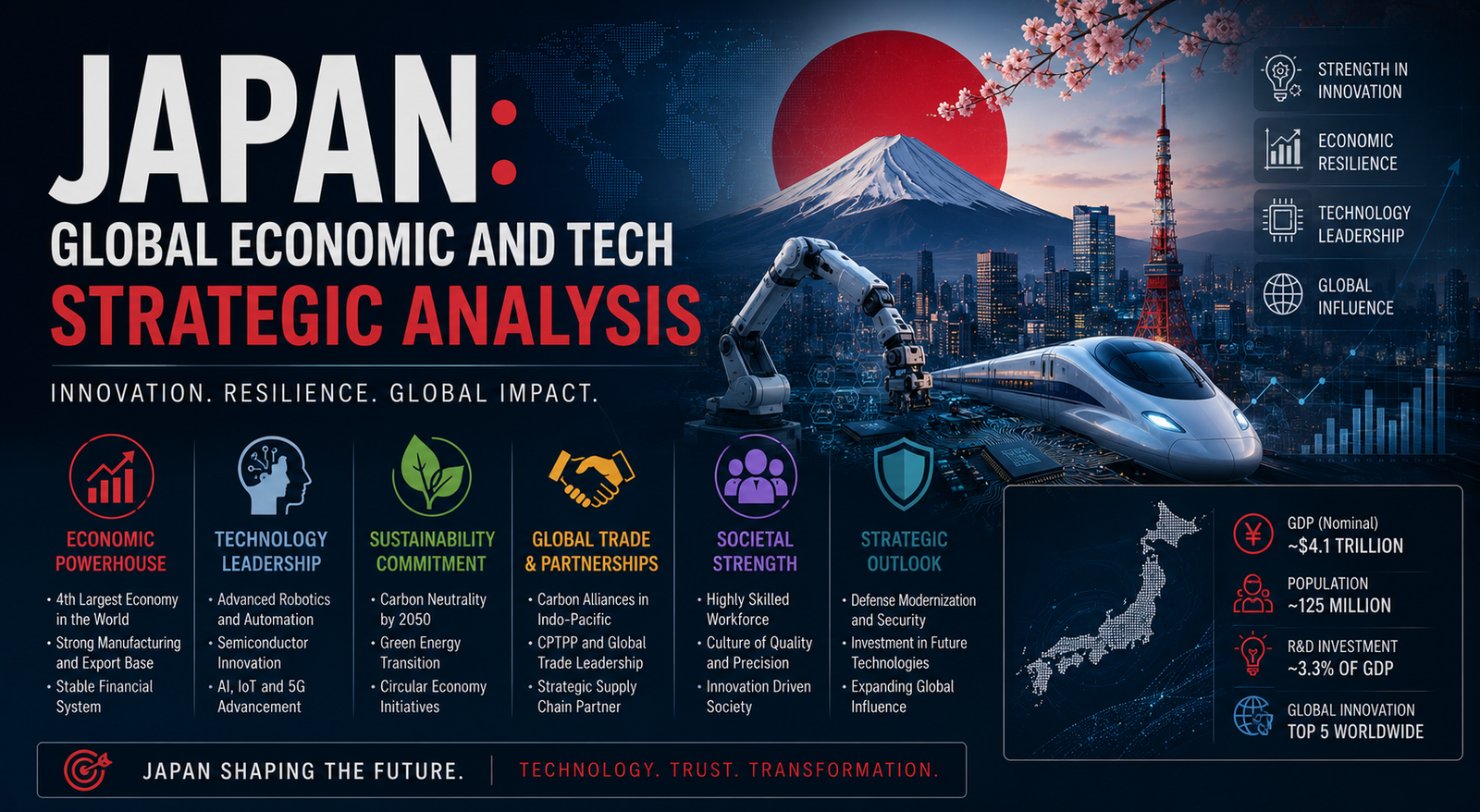
💡 Japan: Global Economic and Tech Strategic Analysis
A comprehensive analysis of Japan's economic resurgence, semiconductor leadership, and global trade strategy. Explore data-driven insights on the Nikkei 225 and tech innovation.
Executive Summary
Japan is currently undergoing its most significant economic and technological transformation since the post-war era. Following decades of deflationary pressure, the nation has successfully transitioned into a period of strategic growth, characterized by the Nikkei 225 reaching historic highs in 2024. Key findings indicate that the Japanese government has committed over 67 billion USD toward semiconductor domestic production through 2030. Furthermore, the Bank of Japan has officially ended its negative interest rate policy, signaling a return to conventional monetary mechanics. This analysis highlights Japan's pivot toward becoming a global hub for high-end manufacturing, artificial intelligence integration, and energy security through diversified international partnerships.
Introduction
The global geopolitical landscape is shifting, and Japan has emerged as a central pillar of stability and innovation. No longer defined solely by the lost decades of the 1990s and 2000s, the Japanese economy is leveraging its traditional strengths in precision engineering to dominate the next generation of critical technologies. Under the framework of New Capitalism, Japan is focusing on human capital investment, digital transformation, and green energy. This strategy is not just about domestic recovery; it is a calculated effort to secure Japan's role as an indispensable node in the global supply chain, particularly as nations look to diversify away from over-reliance on single-source manufacturing hubs.
The Deep Dive: Semiconductors and the Rapidus Initiative
At the heart of Japan's technological resurgence is the semiconductor sector. The Ministry of Economy, Trade and Industry (METI) has identified semiconductors as the lifeblood of modern industry. To reclaim its 1980s glory, when Japan held 50 percent of the global chip market, the government has backed Rapidus Corp. This joint venture aims to mass-produce 2-nanometer logic chips by 2027, a feat that would place Japan at the absolute cutting edge of silicon technology. This push for hardware sovereignty mirrors global trends in the electronics manufacturing services sector, similar to the growth seen in Kaynes Technology: A Strategic Analysis of India's ESDM Leader, where regional leaders are localizing complex component production.
Data from the Semiconductor Equipment and Materials International (SEMI) organization suggests that Japan's investment in fab equipment is expected to grow by 15 percent annually through 2026. The arrival of TSMC in Kumamoto, with its JASM (Japan Advanced Semiconductor Manufacturing) plant, has already created a localized economic boom, attracting hundreds of supplier firms and generating thousands of high-tech jobs. This strategy ensures that Japan remains vital to the automotive and robotics industries, which require increasingly sophisticated chips.
Energy Security and Global Market Integration
Japan's economic strategy is inextricably linked to its energy policy. As a nation with limited natural resources, Japan has become a master of energy efficiency. However, global volatility remains a concern. The strategic management of energy imports is crucial for maintaining industrial output. For instance, fluctuations in Oil Prices: Strategic Analysis of Global Energy Markets directly impact Japan's trade balance and the operational costs of its manufacturing giants like Toyota and Mitsubishi. To mitigate this, Japan is investing heavily in the hydrogen economy and restarting its nuclear fleet to provide a stable, carbon-neutral baseline for its power grid.

Monetary Policy and the Financial Resurgence
The financial world watched closely as the Bank of Japan (BoJ) raised interest rates for the first time in 17 years in March 2024. This move ended the era of negative interest rates and Yield Curve Control. The goal is to achieve a virtuous cycle where moderate inflation leads to higher wages, which in turn drives domestic consumption. Corporate governance reforms have also played a pivotal role. The Tokyo Stock Exchange (TSE) has pressured companies to improve capital efficiency and return value to shareholders, leading to record levels of stock buybacks and dividends. This has made the Japanese market a primary destination for global institutional investors seeking stability and value.
Industrial Materials and the Tech Supply Chain
Beyond chips, Japan maintains a stranglehold on specialized industrial materials. From photoresists used in lithography to high-purity chemicals, Japanese firms like JSR and Shin-Etsu Chemical are the gatekeepers of the global tech industry. The demand for these materials is also linked to the broader commodities market, including precious metals used in high-end electronics. Analysts often look at the performance of industrial metals, such as those tracked in Silver MCX: Strategic Analysis of Industrial and Market Trends, to gauge the health of the global manufacturing sector, where Japan plays a leading role in processing and application.
What This Means For You
- For Investors: Japan offers a unique blend of value and growth. The focus on corporate governance means companies are more shareholder-friendly than ever before.
- For Tech Professionals: The massive investment in semiconductors and AI creates a high demand for specialized talent, offering global career opportunities in cities like Tokyo, Osaka, and Kumamoto.
- For Global Businesses: Japan is a reliable partner for supply chain diversification. Its Economic Security Promotion Act provides a framework for secure, high-tech collaboration.
- For Consumers: Expect continued innovation in robotics and green tech, as Japanese firms lead the way in integrating AI into physical hardware (the Internet of Things).

Expert Verdict and Future Outlook
The expert consensus is that Japan has successfully reinvented its economic identity. By focusing on deep tech, semiconductors, and financial transparency, Japan is no longer just a legacy economy but a forward-looking powerhouse. The future outlook for the next five years remains bullish, provided the nation can navigate its demographic challenges. The integration of AI and automation is not just a luxury for Japan; it is a demographic necessity to maintain productivity as the workforce shrinks. If Japan succeeds in its 2-nanometer chip ambitions through Rapidus, it will cement its position as the technological leader of the 21st century.
FAQ
Q1: Why is the Japanese Yen so volatile despite economic growth?
The Yen is influenced by the interest rate differential between the Bank of Japan and the US Federal Reserve. Even as Japan raises rates, the gap remains significant, leading to carry trades that impact currency value.
Q2: What is the significance of the Rapidus project?
Rapidus is Japan's attempt to leapfrog current semiconductor technology and move straight to 2-nanometer production, securing a future in AI and high-performance computing.
Q3: How is Japan addressing its aging population in the workforce?
Japan is a world leader in service robotics and industrial automation, using technology to supplement the labor force and maintain high GDP per capita.
Q4: Is Japan a safe haven for investors in 2025?
Many analysts view Japan as a strategic hedge against volatility in other markets due to its political stability, strong rule of law, and improving corporate governance.
Q5: What role does Japan play in the global green energy transition?
Japan is pioneering the use of ammonia and hydrogen as clean fuels for heavy industry and shipping, aiming for a carbon-neutral society by 2050.
Important Note: Financial Disclaimer: This content is for educational purposes only and does not constitute professional financial advice. Always consult with a certified financial planner before making investment decisions.
Conclusion
Japan's global economic and tech strategy is a masterclass in resilience and strategic pivot. By aligning government subsidies with private sector innovation and financial reform, Japan has positioned itself as a critical leader in the global tech ecosystem. The move toward advanced semiconductors and energy independence ensures that the nation will remain a dominant force in the global economy for decades to come.





Comments 0
Leave a Reply
Your email address will not be published. Required fields are marked *
Be the first to share your thoughts!