
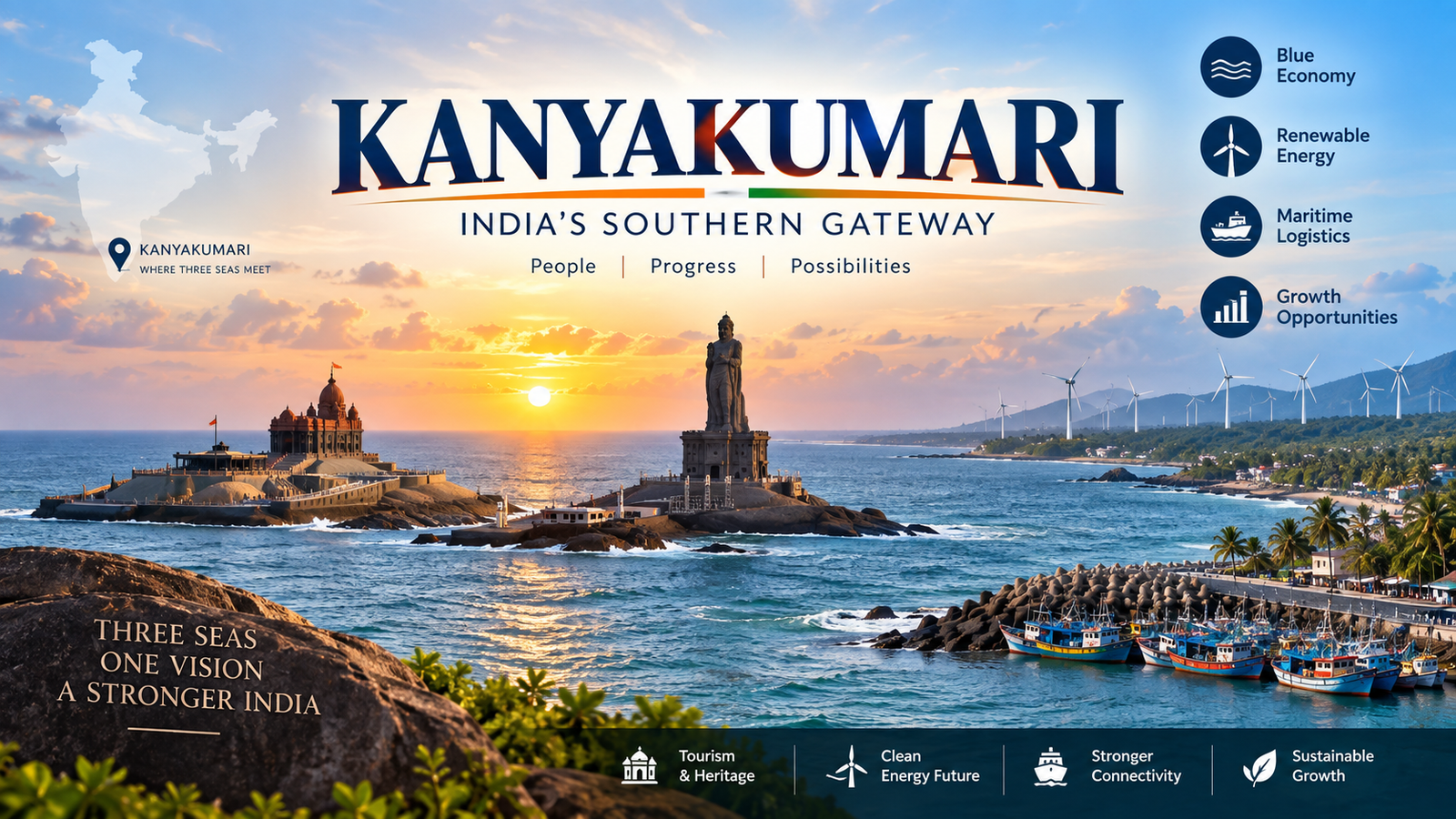
💡 Kanyakumari: Strategic Analysis of India's Southern Gateway
An in-depth strategic analysis of Kanyakumari's role in the Blue Economy, renewable energy sector, and maritime logistics within India's global economic framework.
Quick Take: The Strategic Significance of Kanyakumari
Kanyakumari represents far more than a geographical terminus. It is an important location for India's maritime and economic interests. Situated at the confluence of the Arabian Sea, the Bay of Bengal, and the Indian Ocean, the region holds strategic significance for maritime activity and regional sea routes. Strategically, Kanyakumari is an important part of India's Blue Economy, with a significant renewable energy presence through the Muppandal wind farm and ongoing interest in coastal and maritime development. Its high literacy rate, exceeding 91 percent, also provides a strong human-resource base for the region's economic development.

Introduction: Geopolitical and Cultural Significance at the Confluence
The strategic importance of Kanyakumari is rooted in its unique geographical location. As the southernmost tip of mainland India, it overlooks the meeting point of the Arabian Sea, the Bay of Bengal, and the Indian Ocean, giving the region considerable maritime significance. The cultural importance of the region, anchored by landmarks such as the Vivekananda Rock Memorial and the Thiruvalluvar Statue, also makes tourism an important part of the local economy. However, Kanyakumari's strategic importance extends beyond tourism and cultural heritage. The region is connected to the Sagarmala programme through projects involving coastal and port-related infrastructure, including facilities at Chinnamuttom and Kanyakumari Port.
Practical Explanation: The Blue Economy, Renewable Energy, and Maritime Logistics
The strategic value of Kanyakumari can be understood through three primary pillars: the Blue Economy, renewable energy production, and maritime activity.
The Blue Economy refers to the sustainable use of ocean resources for economic growth. Kanyakumari's coastal economy includes fishing and other marine activities that contribute to the region's economic development. In terms of renewable energy, the Aralvaimozhi–Muppandal region is well known for its strong wind-energy potential. The Muppandal Wind Farm has historically been reported with an installed capacity of approximately 1,500 MW, making it an important part of the region's renewable-energy landscape. India's broader national target is to achieve 500 GW of non-fossil-fuel energy capacity by 2030.
Maritime activity in the region is also receiving attention through coastal infrastructure and port-related development. However, Kanyakumari should not be described as an established transshipment hub or as being exactly 10 nautical miles from an international shipping lane without a specific source. Current Sagarmala-linked projects in the district include the modernisation of Chinnamuttom Fishing Harbour and development of berthing facilities associated with Kanyakumari's coastal activities.
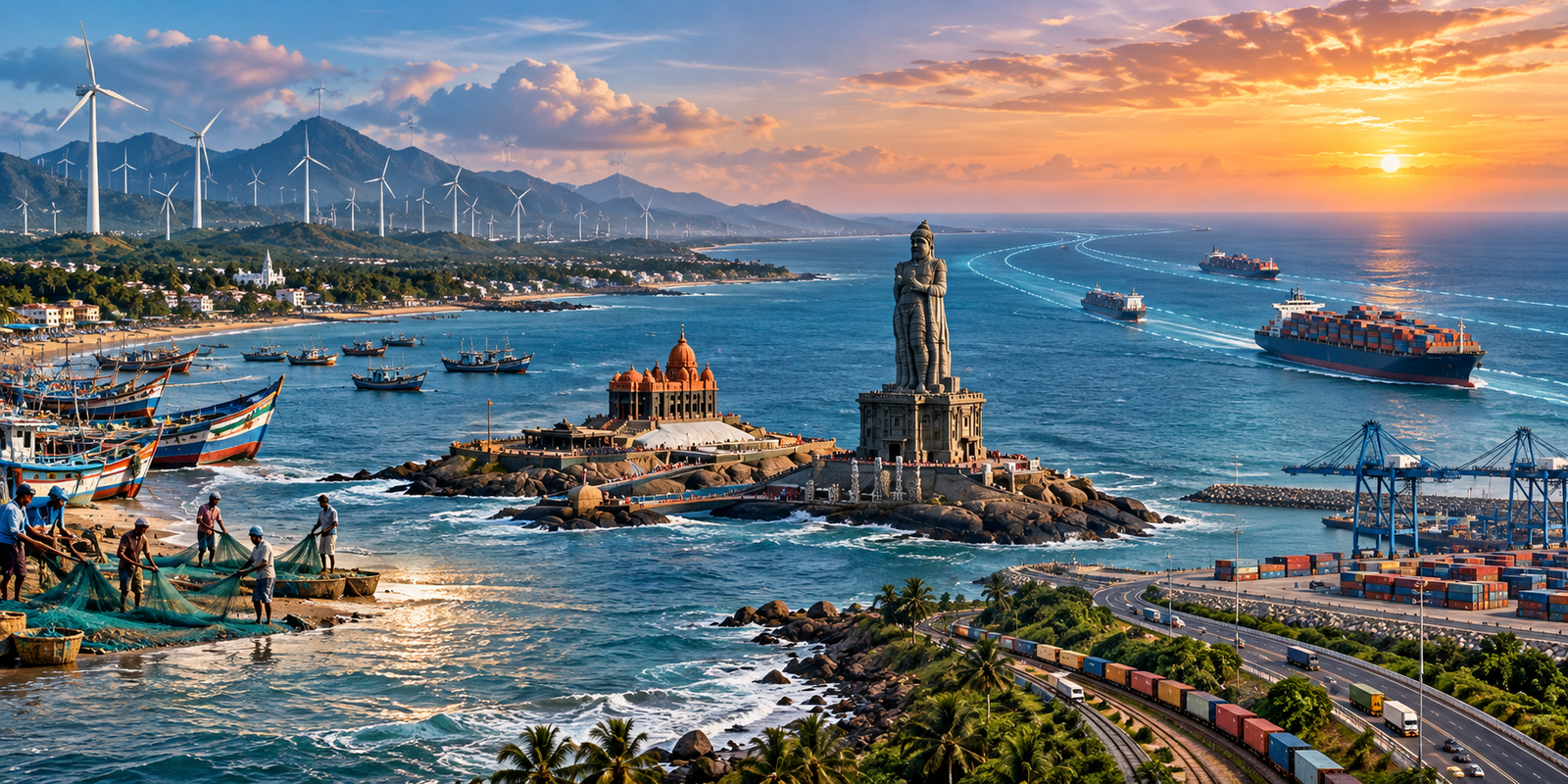
Real-life Use Cases: Tourism Infrastructure and the Wind Energy Sector
The tourism sector in Kanyakumari has evolved beyond basic sightseeing, with increasing attention to tourism infrastructure, hospitality, and eco-tourism. Government-backed tourism initiatives have included the development of the Chennai–Mamallapuram–Rameshwaram–Manpadu–Kanyakumari coastal tourism circuit, while more recent initiatives have also focused on tourism infrastructure and new tourism facilities in the district.
However, there is no reliable evidence for a “Kanyakumari-Kashmir corridor” or for a “Sunrise to Sunset” circuit increasing average tourist stays from 1.2 days to 2.5 days. These specific claims should therefore be removed. Kanyakumari does have established eco-tourism facilities, including the government-managed Eco Park, which was established in 2018.
In the wind energy sector, Kanyakumari has an established renewable-energy ecosystem, particularly around the Aralvaimozhi region. Wind-energy companies operating in the district provide services such as turbine installation, operation and maintenance, repowering, and component repair. Training opportunities related to wind-energy skills also exist in the region.
Actionable Insights: What This Means for You (Professional and Investment Perspective)
For professionals and investors, Kanyakumari offers opportunities connected to tourism infrastructure, renewable energy, and supporting services. The district's established wind-energy ecosystem creates demand for technical and maintenance-related skills, while tourism development continues to create opportunities in hospitality and related services.
- Investment in Hospitality: Tourism infrastructure and hospitality projects represent potential opportunities, particularly where development is aligned with the district's established tourist destinations and sustainable tourism initiatives.
- Renewable Energy Services: SMEs providing wind-turbine operation, maintenance, component repair, and related technical services can participate in the established renewable-energy ecosystem.
- Real Estate: Areas benefiting from tourism and infrastructure development may present investment opportunities, but future land-value appreciation should be treated as a market expectation rather than a guaranteed outcome.
Comparison Table: Economic Drivers — Tourism vs. Renewable Energy vs. Maritime Trade
| Feature | Tourism | Renewable Energy | Maritime Trade |
|---|---|---|---|
| Revenue Stability | Seasonal/Moderate | Relatively Stable/Long-term | Potentially High/Cyclical |
| Job Creation | High (Hospitality/Services) | Moderate (Technical/Operations) | High (Logistics/Operations) |
| Environmental Impact | Low to Moderate | Generally Low/Green | Higher (Requires Mitigation) |
| Capital Requirement | Low to Moderate | Very High | Very High |

Expert Tips: Strategic Navigation of the Southern Indian Market
Navigating the Kanyakumari market requires an understanding of both state-level policies and local environmental regulations. Industrial and infrastructure projects in the region need to consider environmental sustainability and the interests of local communities, particularly those dependent on coastal resources. While corporate social responsibility and community-focused initiatives can support local development, it should not be stated that every industrial project must include a specific CSR programme for marine conservation.
Furthermore, Kanyakumari's high literacy rate provides a strong foundation for developing a skilled local workforce. Regional training and skill-development initiatives could help businesses build local capabilities and reduce dependence on workers from outside the region.
Advantages vs. Limitations: A Balanced Strategic View of Regional Growth
The advantages of Kanyakumari include its distinctive geographical location, established renewable-energy ecosystem, and strong cultural and tourism appeal. However, limitations also exist. The region contains environmentally sensitive coastal areas, and large-scale development can face challenges related to environmental protection and the interests of local fishing communities. Additionally, Kanyakumari district does not have a major international airport. Thiruvananthapuram International Airport is the nearest major international airport, located about 110 km from Kanniyakumari, while Tuticorin Airport is also accessible from the district. This can create additional considerations for international business connectivity.
Strategic growth must therefore balance economic development with environmental sustainability and local socio-economic needs.
FAQ: Navigating Kanyakumari’s Strategic Landscape
What makes Kanyakumari strategically important for India's maritime interests?
Its location at the southern tip of mainland India, at the meeting point of the Arabian Sea, the Bay of Bengal, and the Indian Ocean, gives the region important maritime significance. However, it should not be described as having direct control over international sea lanes.
How does the Muppandal wind farm impact the local economy?
The Muppandal area has an established wind-energy ecosystem that contributes to renewable-energy generation and supports technical and maintenance-related economic activity in the region. Claims about specific tax revenues or employment figures should be supported by local data.
What are the primary investment opportunities in Kanyakumari for 2026?
Potential areas include eco-friendly hospitality, tourism-related services, logistics and supporting infrastructure, and technical services connected to the renewable-energy sector. Actual investment decisions should be based on current market conditions and project feasibility.
How is the government improving connectivity to Kanyakumari?
Connectivity is being supported through road and railway infrastructure development, along with tourism and port-related projects. Kanyakumari also has railway connectivity to major cities, while the nearest major international airport is Thiruvananthapuram International Airport.
What role does the Blue Economy play in the region's future?
The Blue Economy can contribute through sustainable fishing, coastal activities, marine tourism, and other responsible uses of ocean resources. Any future marine-resource development should take environmental sustainability and local coastal communities into account.
Conclusion
Kanyakumari is more than a symbolic landmark and has an important role in the economic, tourism, renewable-energy, and coastal development of southern India. Its established wind-energy ecosystem, strong tourism appeal, and strategic coastal location provide opportunities for future regional development. However, Kanyakumari should not be described as a primary driver of India's national Blue Economy or as an established major transshipment hub without stronger evidence. For stakeholders, the strategic takeaway is clear: Kanyakumari offers meaningful growth potential, provided that development remains aligned with environmental sustainability, infrastructure capacity, and local socio-economic needs.





Comments 0
Leave a Reply
Your email address will not be published. Required fields are marked *
Be the first to share your thoughts!