
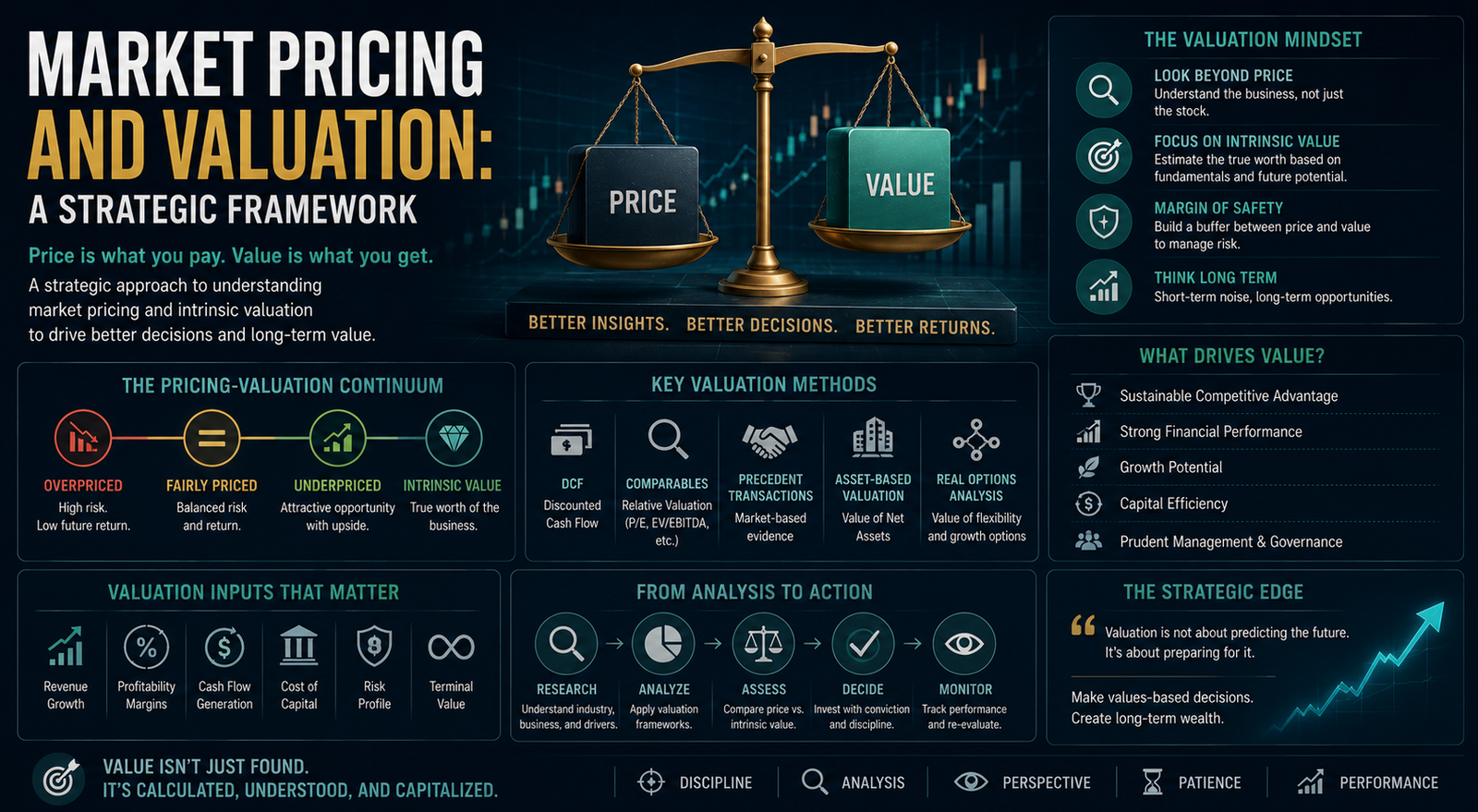
💡 Market Pricing and Valuation: A Strategic Framework
An authoritative guide to understanding market pricing mechanisms and valuation methodologies for modern investors and corporate leaders.
Executive Summary
Market pricing and valuation represent the cornerstone of financial literacy and corporate strategy. This analysis highlights the critical divergence between price and intrinsic value, a gap often exploited by institutional investors. Key findings include the rising dominance of intangible assets, which now account for approximately 90 percent of the S&P 500 market value. Furthermore, current data indicates that the forward Price-to-Earnings (P/E) ratio for the S&P 500 has recently fluctuated between 19x and 21x, significantly higher than the 25-year historical average of 15.7x. This report provides a structured framework for evaluating assets in a high-interest-rate environment, focusing on Discounted Cash Flow (DCF) precision and the strategic use of market multiples.
Introduction
The distinction between price and value is often summarized by the adage that price is what you pay, while value is what you get. In the current global economy, market pricing is influenced by a complex interplay of algorithmic trading, macroeconomic shifts, and investor psychology. Understanding the mechanics of valuation is no longer reserved for Wall Street analysts; it is a vital skill for anyone navigating the financial landscape. Whether analyzing bonus shares or assessing a startup IPO, the ability to determine a fair price is the ultimate competitive advantage. This guide examines the rigorous methodologies used to quantify worth and the strategic factors that drive market fluctuations.
The Deep Dive: Methodologies of Valuation
Valuation is both a science and an art, relying on quantitative data and qualitative judgment. There are three primary pillars used by industry experts to arrive at an asset's worth: the Income Approach, the Market Approach, and the Asset-Based Approach.
1. The Income Approach: Discounted Cash Flow (DCF)
The DCF model is widely considered the most accurate method for intrinsic valuation. It calculates the present value of expected future cash flows using a discount rate, typically the Weighted Average Cost of Capital (WACC). In a landscape where interest rates have risen, the discount rate increases, which naturally lowers the present value of future earnings. This explains why high-growth tech stocks often see price corrections when central banks hike rates. Experts focus on the Terminal Value, which often represents 60 to 80 percent of the total DCF valuation, making the long-term growth rate assumption a critical variable.
2. The Market Approach: Comparable Company Analysis
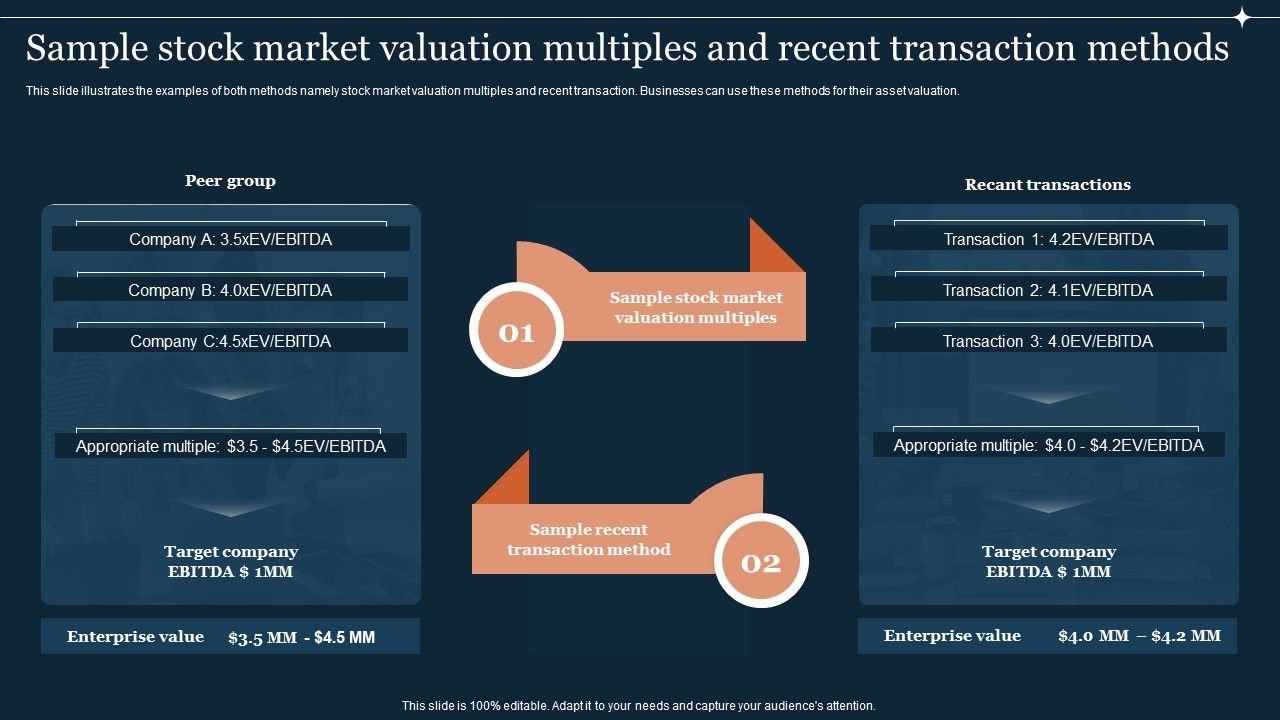
The Market Approach relies on the principle of substitution, suggesting that an asset is worth what similar assets are currently selling for. Common metrics include the P/E ratio, EV/EBITDA (Enterprise Value to Earnings Before Interest, Taxes, Depreciation, and Amortization), and Price-to-Sales. For instance, when using platforms like Moneycontrol to gather real-time financial data, analysts look for peer groups within the same industry to establish a benchmark multiple. If the industry average P/E is 15x and a specific company is trading at 25x, the analyst must determine if the premium is justified by superior growth or if the stock is overvalued.
3. The Role of Intangible Assets
In the digital age, traditional book value is often misleading. Intellectual property, brand equity, and proprietary algorithms drive the bulk of modern corporate value. According to industry reports, the shift from physical to digital assets has accelerated. Companies with high research and development (R&D) spend often show lower immediate profits, but their long-term valuation remains high due to the potential of their intangible pipeline. Evaluating these requires a deep understanding of market positioning and competitive moats.

Macroeconomic Drivers of Market Pricing
Market pricing does not exist in a vacuum. It is heavily dictated by the cost of capital and liquidity. The Federal Reserve's monetary policy serves as the primary driver of market sentiment. When liquidity is abundant, valuation multiples expand. Conversely, quantitative tightening leads to multiple compression. Inflation also plays a dual role: while it can increase nominal revenues, it often leads to higher input costs and compressed margins, forcing a revaluation of equity risk premiums.
The Psychology of Pricing
Behavioral finance suggests that markets are not always efficient. Phenomena such as herding, loss aversion, and FOMO (Fear Of Missing Out) create price bubbles and crashes. Modern digital trading tools, such as those provided by Upstox, have democratized access to markets but have also increased volatility. Retail participation can cause prices to deviate from fundamentals for extended periods, a trend particularly visible in the meme stock era and the rapid fluctuations of the cryptocurrency market.
What This Means For You
For the individual investor or business owner, understanding valuation is about risk management. It provides a safety net against market exuberance. To apply these concepts, you should follow these steps:
- Focus on Free Cash Flow: Look beyond net income. Real cash generation is the only sustainable way to support a high valuation.
- Check the Yield: Compare the earnings yield of a stock (the inverse of the P/E ratio) to the yield on a 10-year Treasury bond. If the stock yield is lower, you are not being compensated for the equity risk.
- Evaluate the Moat: Determine if the company has a sustainable competitive advantage that allows it to maintain high margins over time.
- Maintain a Margin of Safety: Never pay full price for the estimated value. Professional investors often wait for a 20 to 30 percent discount to their calculated intrinsic value before entering a position.
Expert Verdict and Future Outlook
The future of market pricing will likely be defined by the integration of Artificial Intelligence in financial modeling. AI can process vast datasets to identify pricing anomalies faster than any human analyst. However, the core principles of valuation remain unchanged. As we move into a period of normalized interest rates, the era of free money is over. This shift will favor companies with strong balance sheets and proven profitability over those relying solely on narrative-driven growth. We expect a return to fundamentalism, where cash flow becomes the primary metric of success once again.
FAQ
What is the difference between market price and market value?
Market price is the current price at which an asset can be bought or sold in the open market. Market value, or intrinsic value, is the calculated worth of an asset based on its underlying fundamentals, such as earnings, assets, and growth potential.
Why do interest rates affect stock valuations?
Interest rates act as the gravity for valuations. Higher rates increase the discount rate used in DCF models, which reduces the present value of future cash flows. Additionally, higher rates make fixed-income investments like bonds more attractive relative to stocks.
What is a good P/E ratio?
There is no single good P/E ratio, as it varies by industry. A P/E of 10 might be high for a declining utility company, while a P/E of 40 might be low for a high-growth tech firm. It must always be compared against industry peers and historical averages.
How do you value a company with no earnings?
Companies with no earnings are typically valued using the Price-to-Sales (P/S) ratio or by forecasting future cash flows once the company reaches maturity. Analysts also look at user growth, market share, and the path to profitability.
What is Enterprise Value (EV)?
Enterprise Value is a more comprehensive measure than market capitalization. It is calculated as Market Cap plus Total Debt minus Cash and Cash Equivalents. It represents the total price that would be paid to acquire the entire business.
Important Note: Financial Disclaimer: This content is for educational purposes only and does not constitute professional financial advice. Always consult with a certified financial planner before making investment decisions.
Conclusion
Market pricing and valuation are the fundamental tools for navigating the financial world. By mastering the balance between quantitative models and market psychology, stakeholders can make informed decisions that transcend short-term volatility. The strategic takeaway is clear: price is a temporary consensus, but value is a permanent reality. Success in the markets requires the discipline to distinguish between the two and the patience to wait for the right entry point.





Comments 0
Leave a Reply
Your email address will not be published. Required fields are marked *
Be the first to share your thoughts!