
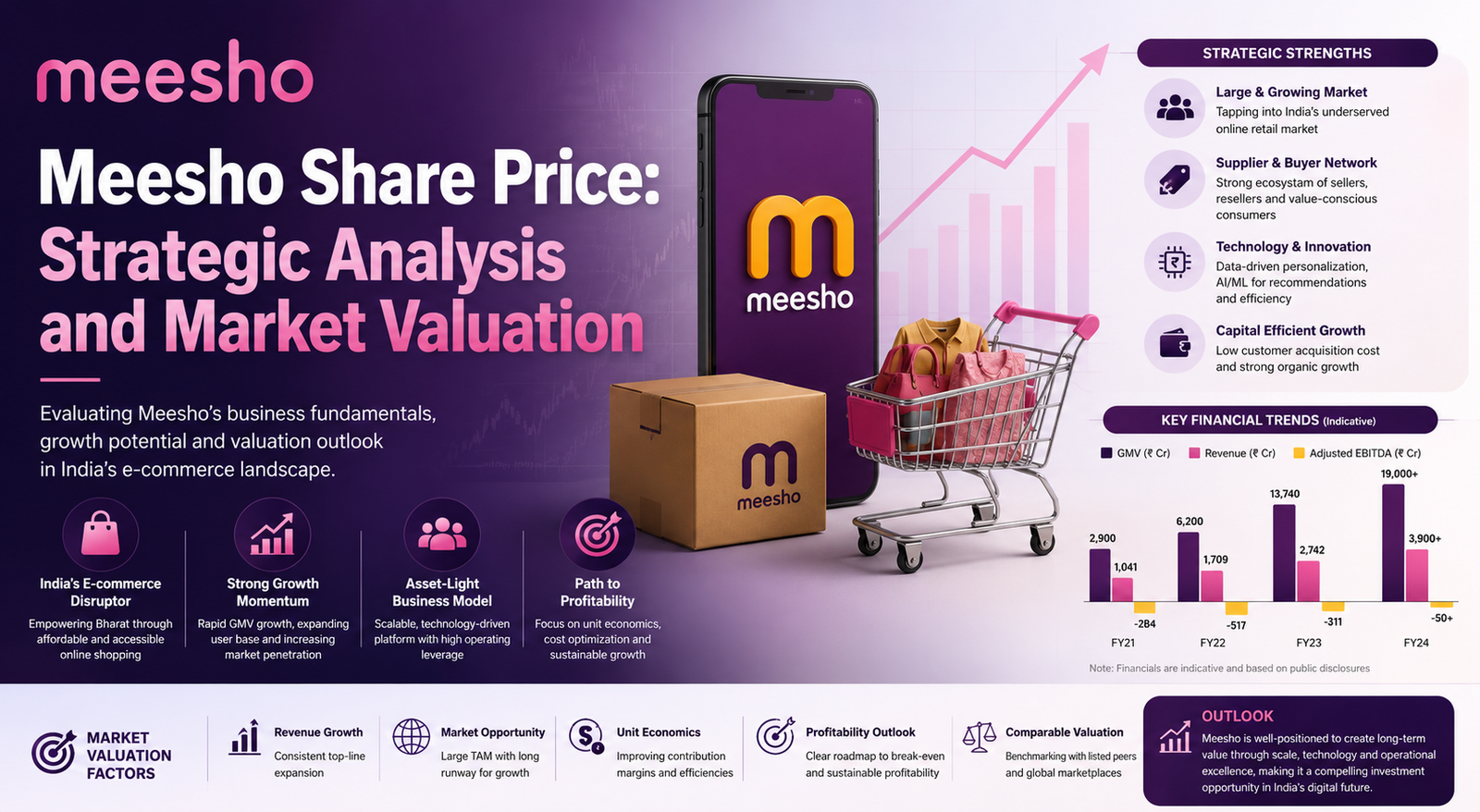
💡 Meesho Share Price: Strategic Analysis and Market Valuation
A comprehensive analysis of Meesho's private market valuation, financial performance, and future IPO prospects in the Indian e-commerce sector.
Executive Summary
Meesho has emerged as a disruptive force in India's e-commerce sector, specifically targeting the value-conscious segment in Tier 2 and Tier 3 cities. As of late 2024, Meesho remains a private company, meaning there is no publicly traded meesho share price on the NSE or BSE. However, secondary market transactions and recent funding rounds have pegged the company's valuation at approximately $3.9 billion. This is a strategic recalibration from its 2021 peak of $4.9 billion, reflecting broader global tech corrections. Key data highlights include the company achieving EBITDA breakeven in July 2023 and a 77 percent year-on-year reduction in losses, signaling a path toward a successful Initial Public Offering (IPO) anticipated in 2025 or 2026.

Introduction
The Indian e-commerce landscape is dominated by giants, yet Meesho has carved a significant niche by focusing on unbranded fashion, home, and kitchen products. Investors tracking the tech sector often look for the next big listing, frequently comparing potential entries to existing players. Much like the Coforge Share Price provides insight into the IT services momentum, Meesho’s private valuation serves as a barometer for the health of the Indian consumer internet economy. By eliminating commissions for sellers and leveraging a lean third-party logistics model, Meesho has challenged the duopoly of Amazon and Flipkart. This analysis examines the financial metrics, investor sentiment, and strategic hurdles that define Meesho's current market standing.
The Deep Dive: Financial Performance and Valuation Drivers
To understand the intrinsic value of Meesho, one must look beyond the lack of a public ticker. The company's financial health has seen a dramatic turnaround. In the fiscal year 2023, Meesho reported revenue from operations of 5,735 crore INR, representing a 77 percent increase from the previous year. More importantly, the company slashed its net losses by 48 percent, dropping from 3,248 crore INR to 1,675 crore INR. This fiscal discipline is a prerequisite for any firm aiming for a public listing.
The valuation of $3.9 billion is supported by a robust cap table. Major investors include SoftBank Vision Fund 2, Prosus Ventures, Peak XV Partners (formerly Sequoia Capital India), and Meta. In early 2024, reports indicated that Tiger Global and Peak XV were looking to sell stakes in secondary markets, which often provides the most accurate 'current' price for unlisted shares. These secondary sales are influenced by the broader Rupee Performance and Valuation, as foreign institutional investors calculate their exits based on currency stability and local market multiples.
- Zero Commission Model: Unlike competitors who charge 5 to 20 percent per sale, Meesho’s zero-commission approach attracts small-scale sellers, increasing the platform's product variety.
- Logistics Efficiency: By outsourcing delivery to third-party providers like Delhivery and Ecom Express, Meesho maintains a light balance sheet.
- User Acquisition: With over 140 million annual active users, Meesho has one of the lowest customer acquisition costs (CAC) in the industry, driven by organic growth in rural India.

The IPO Pipeline and Regulatory Landscape
The path to a public meesho share price involves navigating the Securities and Exchange Board of India (SEBI) regulations. The company has reportedly deferred its IPO plans to ensure its financial statements show consistent profitability. Industry experts suggest that Meesho is aiming for a 'clean' listing, avoiding the volatility seen by other tech startups like Paytm or Zomato during their initial months. The strategic goal is to reach a consolidated profit after tax (PAT) before filing the Draft Red Herring Prospectus (DRHP).
Market sentiment remains cautiously optimistic. The shift from social commerce (reselling) to a direct-to-consumer marketplace has stabilized its revenue streams. However, competition is intensifying as Flipkart Shopsy and Amazon Bazaar enter the low-ticket size segment. Meesho must defend its 60 percent market share in the sub-500 INR price category to maintain its valuation premiums.
What This Means For You
For the average observer or potential retail investor, the current status of Meesho offers several lessons in market dynamics. Since you cannot buy shares on the open market yet, your focus should be on the indicators of the company's readiness for an IPO. If you are an institutional investor or a high-net-worth individual, the secondary market offers entry points, but these come with high liquidity risks and require a long-term horizon.
Monitoring the company's quarterly 'transparency reports' is essential. Look for growth in the 'Monthly Transacting Users' (MTU) metric and any expansion into high-margin categories like branded beauty or electronics. These moves would signal an attempt to increase the Average Order Value (AOV), which currently sits lower than the industry average due to the focus on value products.

Expert Verdict and Future Outlook
The consensus among equity analysts is that Meesho is the 'dark horse' of Indian e-commerce. While it lacks the deep pockets of a global parent like Amazon, its localized strategy is superior for the Indian hinterland. The future outlook depends on two factors: maintaining growth without increasing marketing spend and successfully navigating the competitive pressure from 'Quick Commerce' players like Zepto and Blinkit, which are beginning to offer non-grocery items.
If Meesho maintains its current trajectory of narrowing losses and expanding its seller base, the eventual IPO could be one of the most significant tech events in the Indian markets. Investors should expect a valuation range of $4.5 billion to $5.5 billion at the time of listing, provided the macroeconomic environment remains favorable.
Frequently Asked Questions
1. Can I buy Meesho shares on the stock market today?
No, Meesho is currently a private unlisted company. You cannot purchase its shares through standard brokerage accounts like Zerodha or Upstox. Shares are only available through secondary market platforms for accredited investors or during the eventual IPO.
2. What is the current valuation of Meesho?
As of the most recent funding and secondary share sales in 2024, Meesho is valued at approximately $3.9 billion. This valuation fluctuates based on private market demand and the company's latest audited financial results.
3. When is the Meesho IPO expected?
While no official date has been announced, industry reports suggest that Meesho is preparing for an IPO in late 2025 or early 2026. The timing depends on achieving consistent profitability and favorable market conditions.
4. Who are the major shareholders in Meesho?
The primary shareholders include SoftBank, Meta (formerly Facebook), Prosus Ventures, Peak XV Partners, and Fidelity Investments. The founders, Vidit Aatrey and Sanjeev Barnwal, also hold significant equity.
5. How does Meesho make money if it charges zero commission?
Meesho generates revenue through advertising services for sellers (Meesho Ads) and fulfillment services. Sellers pay to have their products featured prominently on the app, and Meesho earns a margin on the shipping and logistics services provided through its partners.
Important Note: Financial Disclaimer: This content is for educational purposes only and does not constitute professional financial advice. Always consult with a certified financial planner before making investment decisions.
Conclusion
Meesho represents a fundamental shift in the Indian retail story, moving from high-burn customer acquisition to a sustainable, profit-oriented marketplace. While the meesho share price is not yet public, the company's internal metrics suggest a robust valuation supported by genuine user engagement in underserved markets. For those watching the Indian tech space, Meesho remains a critical case study in operational efficiency and strategic positioning. The transition from a private unicorn to a public entity will likely be a defining moment for the 'Bharat' e-commerce narrative.





Comments 0
Leave a Reply
Your email address will not be published. Required fields are marked *
Be the first to share your thoughts!