
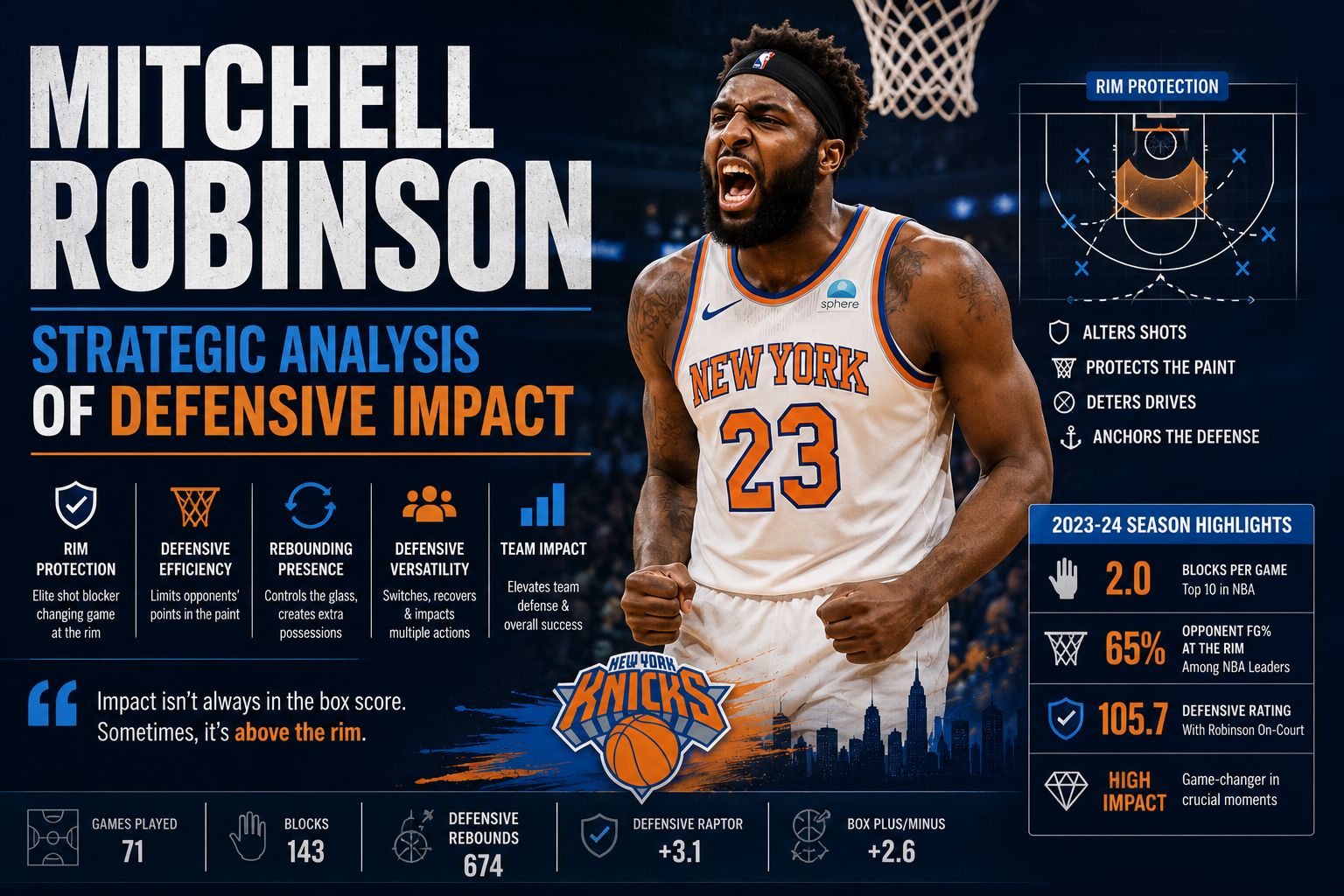
💡 Mitchell Robinson: Strategic Analysis of Defensive Impact
A professional analysis of Mitchell Robinson's defensive metrics, rim protection mechanics, and his strategic value to the New York Knicks.
Executive Summary
Mitchell Robinson remains one of the most specialized and impactful defensive assets in the National Basketball Association (NBA). As the anchor of the New York Knicks' interior defense, Robinson provides a unique combination of elite rim protection and historic offensive rebounding. Statistical analysis shows that with Robinson on the floor, the Knicks' defensive rating improves significantly, often ranking in the top five league-wide. His 7-foot-4 wingspan and 9-foot-3 standing reach allow him to contest shots that most centers cannot reach. This report analyzes his defensive mechanics, his role in modern NBA schemes, and his comparative value against other elite rim protectors like Rudy Gobert and Brook Lopez.
Introduction: The Anchor of New York’s Defensive Identity
In the current NBA landscape, the value of a traditional rim-protecting center has undergone a significant transformation. Mitchell Robinson, the longest-tenured player on the New York Knicks roster, represents the pinnacle of high-efficiency specialization. Unlike modern centers who prioritize floor spacing and three-point shooting, Robinson focuses exclusively on paint dominance and rebounding. His presence allows the Knicks to employ aggressive perimeter defense, knowing that an elite shot-blocker is patrolling the restricted area. This strategic analysis explores how Robinson’s specific skill set mirrors the high-level performance seen in other professional sports, such as the ground-game efficiency discussed in the Josh Jacobs NFL performance analysis.
The Mechanics of Elite Rim Protection: A Practical Explanation
Robinson’s defensive impact is not merely a product of his height; it is a result of refined mechanics and timing. Professional scouts highlight three core components of his defensive game:
- Verticality and Discipline: Robinson has mastered the NBA’s verticality rule, which allows a defender to jump straight up to contest a shot without being whistled for a foul. His ability to maintain a straight vertical plane while absorbing contact is rare for players of his size.
- Recovery Speed: Despite his frame, Robinson possesses the lateral quickness to recover after a pick-and-roll hedge. This allows the Knicks to play multiple defensive coverages without being exploited by fast guards.
- Shot Alteration: Beyond blocked shots, Robinson’s primary value lies in shot alteration. Opponents often choose to kick the ball out to the perimeter rather than challenge him at the rim, effectively shrinking the floor for the offense.
Strategic Use Cases: Defensive Schemes and Pick-and-Roll Coverage
The New York Knicks, under head coach Tom Thibodeau, utilize a heavy drop coverage scheme. In this system, the center drops back toward the basket during a pick-and-roll to prevent easy layups. Robinson is arguably the most effective practitioner of this scheme. By staying between the ball-handler and the hoop, he forces mid-range jumpers, which are statistically the least efficient shots in basketball. This level of tactical discipline is similar to the strategic frameworks analyzed in corporate governance and strategy, where specialized roles are optimized to protect the core interests of the organization.
Comparison Table: Mitchell Robinson vs. Elite NBA Rim Protectors
To understand Robinson’s standing in the league, we must compare his production to other top-tier defensive centers using per-36-minute metrics and advanced tracking data.
| Player | Blocks Per 36 Min | Offensive Rebound % | Defensive Impact Type |
|---|---|---|---|
| Mitchell Robinson | 2.3 | 18.5% | Pure Rim Protection / Putbacks |
| Rudy Gobert | 2.5 | 12.8% | Defensive Gravity / Positioning |
| Brook Lopez | 2.8 | 3.2% | Drop Coverage / Floor Spacing |
| Myles Turner | 2.6 | 4.5% | Weakside Help / Perimeter Threat |
Actionable Insights: Lessons in High-Efficiency Specialization
Robinson’s career offers a masterclass in professional specialization. In an era where players are encouraged to be generalists, Robinson’s commitment to being the best in the world at two things, rim protection and offensive rebounding, has made him indispensable. For professionals in any industry, the takeaway is clear: dominating a specific niche can often provide more job security and organizational value than being average at multiple tasks. This philosophy of focused impact is also evident in the careers of other high-stakes athletes, such as the specialized offensive contributions found in the Nick Castellanos MLB strategic analysis.
Advantages vs. Limitations: Analyzing the Trade-offs
While Robinson’s defensive ceiling is among the highest in the league, his profile includes specific trade-offs that teams must manage. His offensive range is limited to dunks and putbacks, meaning he does not provide the spacing required for certain high-octane offensive systems. Furthermore, his aggressive style of play has led to a history of lower-body injuries, specifically involving his ankles and feet. Strategic management of his minutes is essential to ensure he is available for high-pressure postseason environments.
Expert Tips: Maximizing Defensive IQ in High-Pressure Environments
For aspiring athletes and analysts, Robinson’s game provides several key lessons in defensive intelligence:
- Watch the Hips: Robinson tracks the ball-handler’s hips rather than the ball, allowing him to anticipate changes in direction before the shot attempt.
- Prioritize Positioning: Effective defense starts before the ball reaches the paint. Robinson uses his frame to deny easy entry passes and seal off driving lanes.
- Controlled Aggression: High-level rim protection requires a balance between hunting blocks and staying grounded to avoid foul trouble.
FAQ: Contract Status, Injury History, and Career Trajectory
What is Mitchell Robinson’s current contract status?
Robinson signed a four-year, 60 million dollar contract with the New York Knicks in 2022. This deal is widely considered one of the best value contracts in the NBA for a starting-caliber center.
How do injuries impact his long-term value?
Robinson has dealt with several stress-related injuries in his feet. While these are concerns for a player of his size, his impact when healthy remains high enough that teams are willing to manage his workload carefully.
Is Mitchell Robinson a candidate for Defensive Player of the Year?
When he plays a full season with sufficient minutes, Robinson consistently ranks in the top tier of defensive metrics. His candidacy usually depends on his total games played and the Knicks' overall team defensive ranking.
How does he contribute to the Knicks' offense?
His primary offensive contribution is through second-chance points. He frequently leads the league in offensive rebound percentage, giving the Knicks extra possessions that compensate for lower shooting percentages.
Will the Knicks look to trade Robinson for a floor-spacing center?
While trade rumors occasionally surface, Coach Thibodeau’s system relies heavily on a traditional rim protector. Robinson’s specific skill set is currently more valuable to the Knicks' identity than a shooting center would be.
Expert Verdict and Future Outlook
The future of the New York Knicks' interior strategy is inextricably linked to Mitchell Robinson’s health and availability. As the NBA continues to trend toward positionless basketball, Robinson stands as a vital outlier. His ability to negate the league’s most efficient shots makes him a defensive cornerstone. If he can maintain a consistent presence on the floor, he will remain the primary reason why the Knicks are a perennial threat in the Eastern Conference defensive rankings. Strategically, he is the insurance policy that allows the rest of the roster to take the risks necessary to win at the highest level.
Conclusion
Mitchell Robinson is a rare defensive specialist whose value is defined by elite rim protection and offensive rebounding. While injury risks persist, his strategic impact on the New York Knicks' defensive identity is undeniable, proving that high-level specialization remains a primary driver of success in the modern NBA.




Comments 0
Leave a Reply
Your email address will not be published. Required fields are marked *
Be the first to share your thoughts!