
Executive Summary
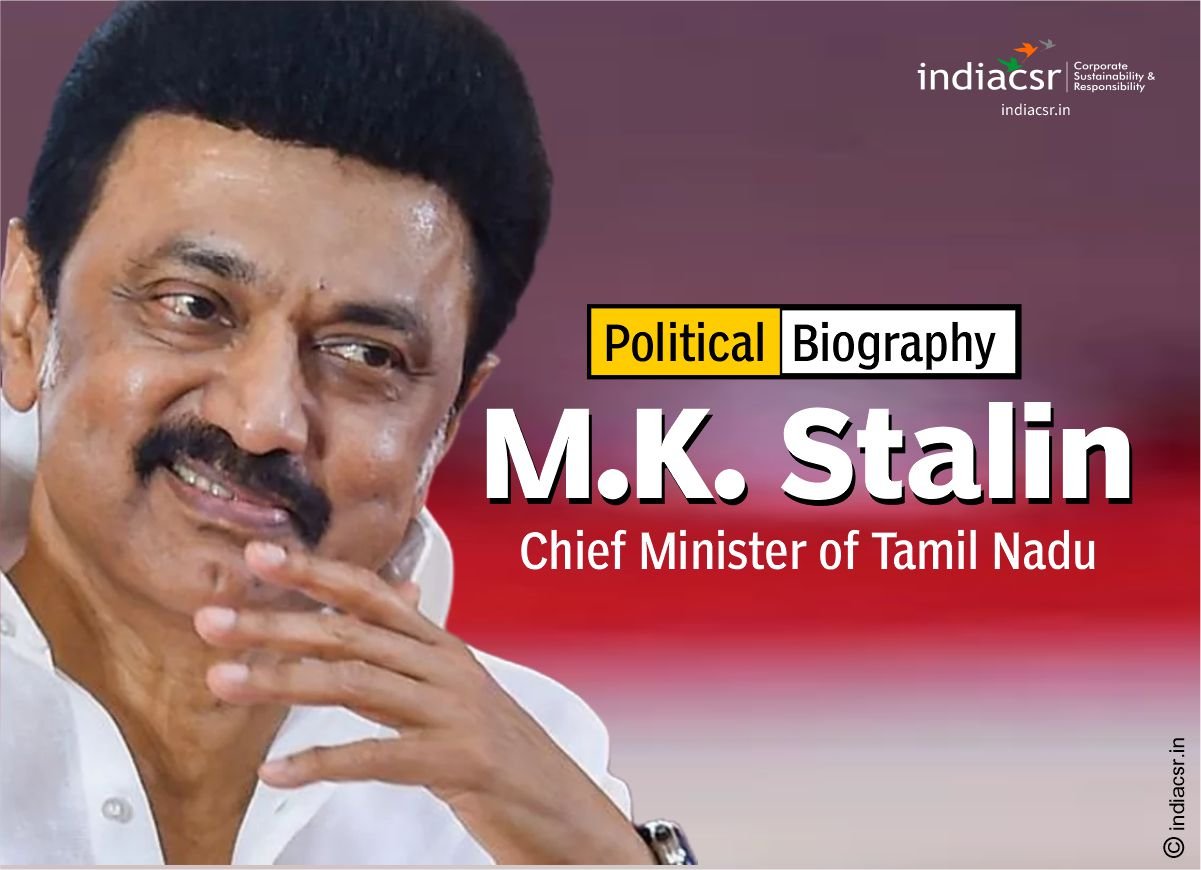
M. K. Stalin, the 8th Chief Minister of Tamil Nadu, represents an important figure in the political and economic landscape of Southern India. Since assuming office in May 2021, his administration has emphasized the Dravidian Model, a governance approach that combines economic development with social welfare, social justice, and inclusive growth. This analysis highlights several key developments, including the ambitious goal of transforming Tamil Nadu into a 1 trillion dollar economy by 2030, the state's efforts to attract large-scale industrial investment, and the expansion of major welfare programs benefiting millions of residents. By examining Stalin's approach to industrialization, social policy, infrastructure, and federalism, this report provides an overview of his leadership and its impact on Tamil Nadu's economic and political position.
Introduction
The political trajectory of M. K. Stalin is a study in patience, persistence, and political evolution. Having spent decades in the political sphere and following the legacy of his father, the late M. Karunanidhi, Stalin has developed a leadership style that combines traditional Dravidian political principles with an emphasis on industrial development, investment, infrastructure, and welfare delivery. He became Chief Minister of Tamil Nadu in May 2021.
His leadership comes at a time when Tamil Nadu is seeking to strengthen its position as one of India's leading manufacturing and investment destinations, competing with major industrial states such as Maharashtra and Gujarat. To understand his current governance approach, one must examine how his administration has presented the Dravidian Model as a broader framework that combines social justice with economic development. This transition reflects broader trends in Ministerial Leadership: A Strategic Analysis of Governance, where the focus shifts from political rhetoric toward measurable administrative and economic outcomes.
THE DEEP DIVE: Strategic Pillars of Governance
1. The Economic Vision: The 1 Trillion Dollar Goal
The cornerstone of the Stalin administration's economic vision is the goal of transforming Tamil Nadu into a 1 trillion dollar economy by 2030. The Tamil Nadu government has positioned this target as a long-term economic objective supported by industrial investment, infrastructure development, manufacturing expansion, and a skilled workforce.
The 2024 Tamil Nadu Global Investors Meet (GIM) was an important component of this investment strategy. The event resulted in 631 Memorandums of Understanding (MoUs) with investment commitments of ₹6,64,180 crore, covering sectors including advanced electronics manufacturing, green energy, non-leather footwear, motor vehicles, electric vehicles, aerospace and defence, data centres, global capability centres, and information technology.
This strategy is closely aligned with global Investment Strategies: A Strategic Analysis of Market Growth, with Tamil Nadu seeking to attract investment into high-value and employment-intensive industries. Companies and investors across sectors such as electronics, automobiles, renewable energy, and advanced manufacturing have continued to expand their presence in the state.
2. The Dravidian Model: Social Equity as an Economic Engine
Stalin's administration describes the Dravidian Model as a framework centred on inclusive growth, social justice, and equality. This approach is reflected in several flagship welfare and human-development initiatives.
- Pudhumai Penn Scheme: Provides ₹1,000 per month to eligible girl students from government schools who pursue higher education. According to the Tamil Nadu Budget 2025–26, around 4.06 lakh girl students were receiving this assistance.
- Kalaignar Magalir Urimai Thittam: Provides ₹1,000 per month directly to eligible women heads of households. The 2025–26 Budget states that approximately 1.15 crore women receive the monthly assistance.
- Chief Minister's Breakfast Scheme: Designed to support children's nutrition and encourage regular school participation, the scheme is one of the administration's major school-based welfare initiatives. The Tamil Nadu government has continued to allocate funding for the programme as part of its broader human-development strategy.
By investing in education, nutrition, women's economic support, and human capital, the administration aims to create conditions for broader participation in Tamil Nadu's economic development.
3. Federalism and Political Strategy
On the national stage, M. K. Stalin has emerged as a vocal advocate for state autonomy, fiscal federalism, and greater consideration of state-level interests. His administration has raised concerns about the distribution of financial resources between the Union and state governments, particularly issues involving tax devolution and the fiscal implications of population-based criteria.
This approach reflects the broader political philosophy of the DMK, which emphasizes state rights and federalism. Rather than describing Stalin simply as a "kingmaker," it is more accurate to view him as a significant regional political voice whose positions on federalism and state autonomy contribute to national political debates.
This political positioning requires continued engagement with India's constitutional and democratic institutions, including the Election Commission of India: Strategic Analysis of Democratic Integrity. His emphasis on federalism has helped keep Tamil Nadu's economic and fiscal interests prominent in discussions surrounding Centre–state relations.
4. Infrastructure and Urban Development
The modernization of Chennai and the development of Tier-2 cities such as Coimbatore, Madurai, and Tiruchirappalli are important elements of Tamil Nadu's broader development strategy. The Singara Chennai 2.0 initiative focuses on improving urban infrastructure and addressing issues such as flood management, waste management, and public amenities.
Significant investment is also being directed toward Chennai Metro Rail Phase II, which is one of the state's largest ongoing urban transportation projects. The Tamil Nadu Budget 2025–26 includes a substantial allocation for the Chennai Metro Rail Project – Phase II.
These infrastructure investments are intended to improve connectivity, support economic activity, and strengthen the state's ability to attract businesses, investment, and skilled workers.
WHAT THIS MEANS FOR YOU
For citizens and investors, Stalin's governance model places significant emphasis on industrial development, infrastructure, education, and social-support programs. Investors can identify particular opportunities in sectors such as electronics, automobiles, renewable energy, advanced manufacturing, and information technology, while residents benefit from expanded welfare and human-development initiatives.
The emphasis on education and skill development is also important for Tamil Nadu's future workforce. By combining industrial investment with human-capital development, the state is attempting to strengthen its position in India's increasingly competitive digital and manufacturing economy.
Expert Verdict / Future Outlook
The future outlook for Tamil Nadu under Stalin will depend heavily on the administration's ability to translate investment commitments into completed projects, maintain fiscal discipline, and sustain economic growth while continuing major welfare programmes.
The ₹6.64 lakh crore investment commitments announced through 631 MoUs at the 2024 Global Investors Meet represent a significant pipeline of potential investment, but MoU commitments should not automatically be treated as completed investments. Their eventual conversion into operational projects, employment, and production will be an important measure of the administration's economic performance.
At the same time, Tamil Nadu will need to balance infrastructure spending, social-welfare commitments, industrial expansion, and fiscal sustainability. Stalin's ability to manage these competing priorities, while maintaining Tamil Nadu's position as a major industrial and economic centre, will play an important role in shaping his longer-term political and economic legacy.
FAQ
What is the Dravidian Model of governance?
The Dravidian Model is a governance framework promoted by the Tamil Nadu government that emphasizes inclusive growth, social justice, and equality. It combines economic and industrial development with welfare initiatives in areas such as education, nutrition, women's empowerment, and social protection.
How has M. K. Stalin influenced industrial growth in Tamil Nadu?
Under Stalin's administration, Tamil Nadu has focused on attracting investment across multiple sectors, including advanced electronics, electric vehicles, renewable energy, automobiles, aerospace and defence, data centres, and information technology. The 2024 Global Investors Meet resulted in 631 MoUs with investment commitments of ₹6.64 lakh crore.
What are the key social welfare schemes introduced by Stalin?
Major initiatives include the Chief Minister's Breakfast Scheme, Kalaignar Magalir Urimai Thittam, and Pudhumai Penn. These programmes focus respectively on children's nutrition and education, financial assistance for women heads of households, and support for girls pursuing higher education.
How does Stalin's leadership impact national politics?
Stalin has become an important regional political voice on issues involving federalism, state autonomy, fiscal devolution, and Centre–state relations. His positions have contributed to the wider national debate over the balance of powers between the Union and state governments.
What are the main challenges facing his administration?
Key challenges include converting investment commitments into operational projects, managing the state's fiscal position, completing major infrastructure projects efficiently, maintaining industrial competitiveness, and balancing economic expansion with social-welfare expenditure and environmental sustainability.
Conclusion
M. K. Stalin's tenure as Chief Minister represents an attempt to combine Tamil Nadu's established Dravidian political tradition with an increasingly investment-oriented and industrial development strategy. His administration's 1 trillion dollar economy target, investment-attraction efforts, infrastructure programmes, and welfare initiatives form the central pillars of this approach.
By placing human-capital development alongside industrial modernization, the government aims to strengthen Tamil Nadu's economic resilience while maintaining its emphasis on social justice and inclusive growth. The strategic takeaway is that sustainable regional development requires a balance between private investment, public infrastructure, human-capital development, and effective social-welfare delivery.





Comments 0
Leave a Reply
Your email address will not be published. Required fields are marked *
Be the first to share your thoughts!