
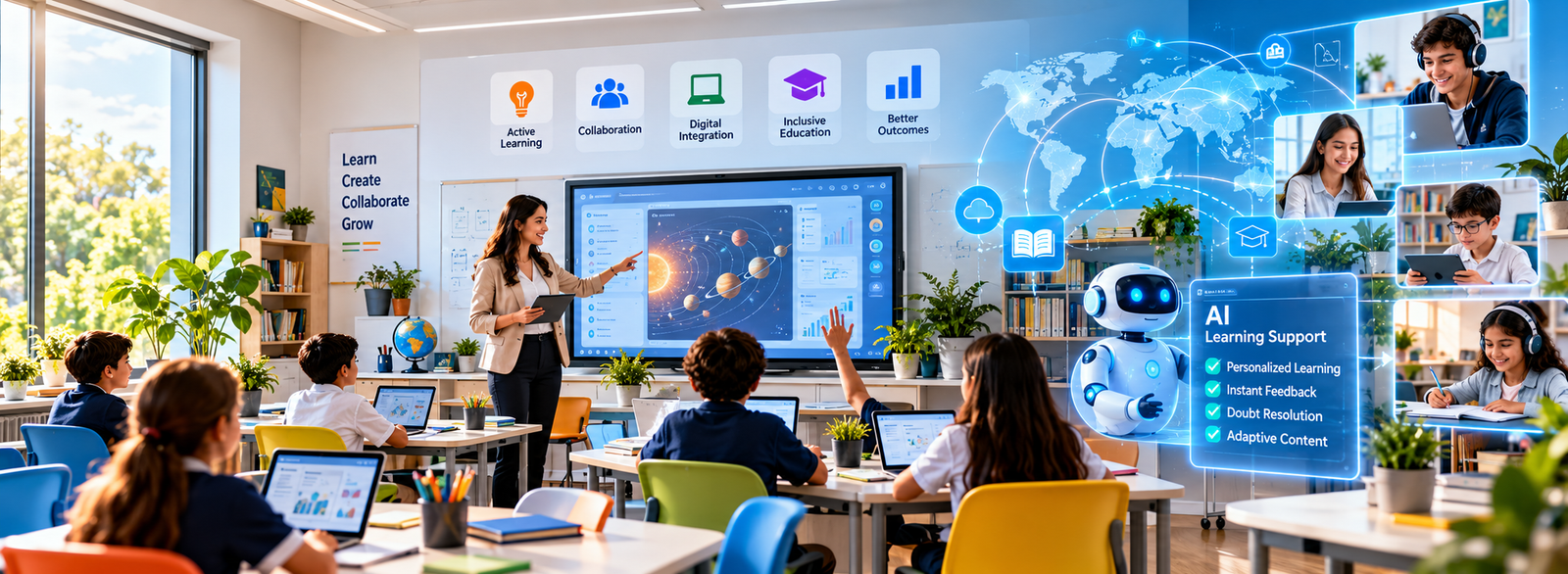
💡 The Modern Classroom: Strategic Analysis of Educational Infrastructure
A comprehensive analysis of classroom evolution, examining the intersection of physical design, digital integration, and pedagogical efficiency in 2025.
Executive Summary
The modern classroom is evolving from a fixed physical space into a learning environment that combines physical design, digital infrastructure, collaborative teaching methods, and increasingly sophisticated educational technologies.
Research indicates that the physical learning environment can influence student learning outcomes. For example, the University of Salford's HEAD (Holistic Evidence and Design) Project, which studied 3,766 primary-school pupils across 153 classrooms, found that differences in classroom design were associated with approximately 16% of the variation in pupils' learning progress over a school year. The research examined factors including light, air quality, temperature, colour, flexibility, and classroom layout.
The education technology market has also expanded rapidly. A 2022 industry forecast from Arizton projected that the global EdTech market could reach approximately $605.4 billion by 2027, representing a projected CAGR of more than 15.52% during 2021–2027. Because this is a historical industry forecast rather than a current 2026 measurement, it should be interpreted as a projection from that period rather than as the latest market-size estimate.
At the same time, digital learning platforms, cloud infrastructure, learning-management systems, and artificial intelligence are changing how educational content is delivered and how teachers support students. The OECD's 2026 Digital Education Outlook notes that generative AI can support learning when it is used with clear pedagogical intent, while simply outsourcing cognitive tasks to general-purpose AI tools does not necessarily produce genuine learning gains.
The strategic challenge for educational institutions is therefore not simply to add more technology. It is to create learning environments in which physical design, technology, teaching practice, accessibility, human interaction, and responsible AI use work together.
Introduction
For centuries, classrooms were primarily defined by physical elements such as walls, desks, blackboards, books, and face-to-face instruction.
That model has not disappeared, but it has changed significantly.
Modern classrooms can include interactive displays, laptops and tablets, learning-management systems, cloud applications, digital collaboration tools, assistive technologies, online resources, and AI-powered learning tools.
However, technology alone does not create an effective learning environment.
A well-designed classroom must support concentration, collaboration, communication, movement, accessibility, and student well-being. At the same time, its digital infrastructure must provide reliable access to educational resources without creating unnecessary barriers or replacing important human interactions.
The modern classroom should therefore be viewed as an integrated system consisting of:
- Physical learning spaces
- Digital infrastructure
- Teaching and assessment practices
- Accessibility and inclusion
- Student well-being
- Data and privacy protections
- Emerging technologies such as AI
This analysis examines these elements and their strategic importance for schools, universities, educators, students, parents, and education policymakers.
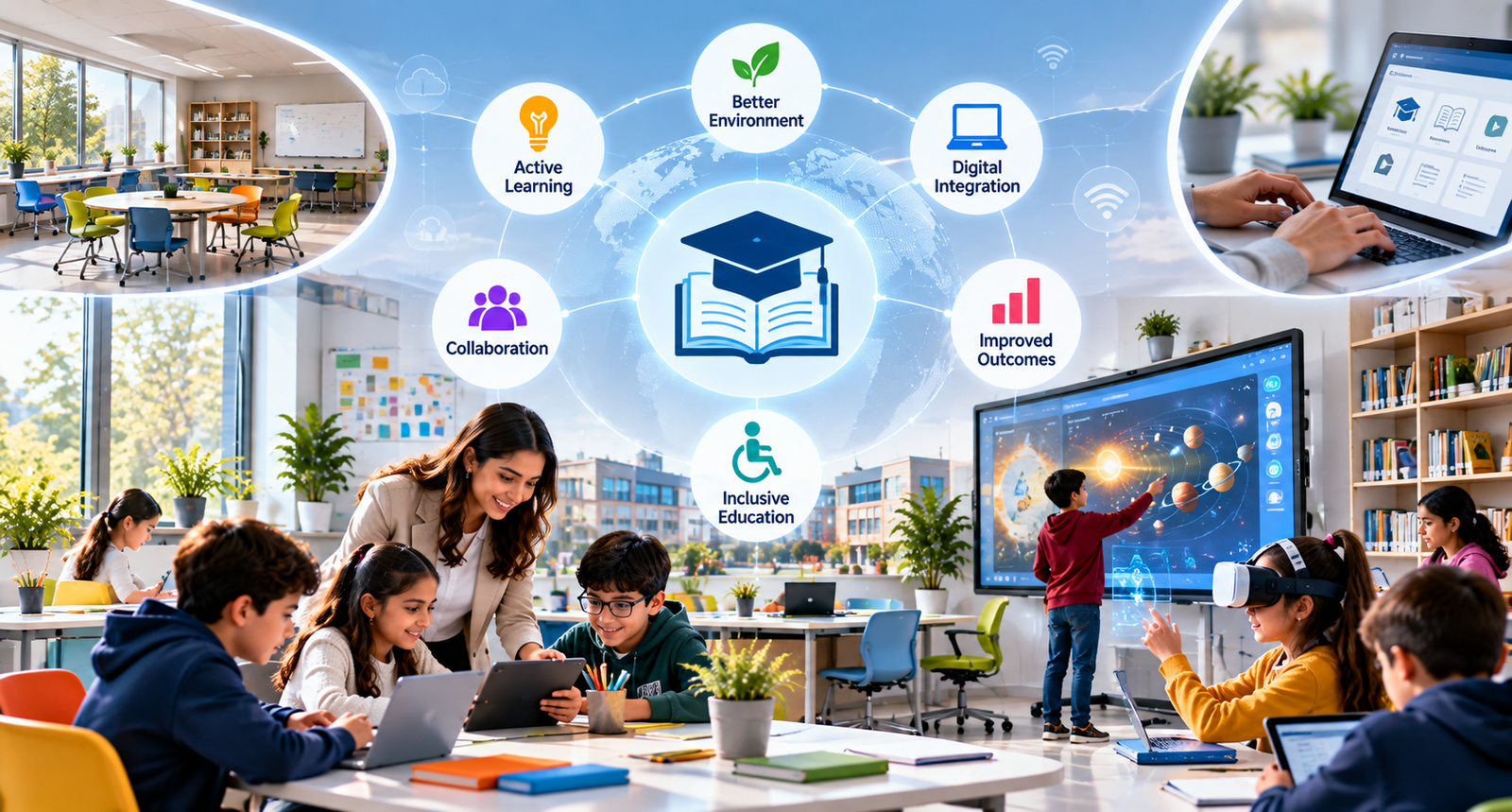
THE DEEP DIVE: Strategic Pillars of the Modern Classroom
1. Environmental Psychology and Spatial Design
The physical classroom continues to influence how students experience learning.
Lighting, temperature, acoustics, air quality, classroom layout, furniture, colour, and flexibility can all affect how a learning space is used.
The University of Salford's HEAD Project examined 3,766 primary-school pupils in 153 classrooms and found that classroom design characteristics were associated with approximately 16% of the variation in pupils' learning progress over one year. Importantly, this finding should not be interpreted as meaning that redesigning a classroom automatically increases every student's performance by 16%. It refers to the variation in learning progress associated with the measured design factors in that study.
Indoor Air Quality
Ventilation is another important consideration.
A systematic review of indoor air quality in naturally ventilated primary schools examined 125 studies and found substantial variation in classroom CO₂ levels. The review reported a median CO₂ concentration of 1,487 ppm across 2,444 classrooms and found that 81% exceeded a commonly referenced 1,000-ppm threshold. The review also reported associations between elevated CO₂ concentrations and factors including fatigue, respiratory symptoms, and academic performance, while emphasizing the complexity of indoor-air-quality management.
Recent university-classroom research has also found an association between higher classroom CO₂ concentrations and lower cognitive-test scores over the measured exposure range. The researchers explicitly noted that the study identified an association rather than proving a causal relationship.
For school administrators, this means ventilation should not be treated simply as a comfort issue. Indoor-air quality, thermal comfort, noise, energy consumption, and outdoor pollution all need to be considered together.
Flexible Classroom Design
Traditional rows of desks may work well for some activities, but modern teaching often requires multiple configurations.
A flexible classroom can support:
- Individual study
- Small-group collaboration
- Whole-class instruction
- Project-based learning
- Presentations
- Discussions
- Practical activities
Movable furniture and adaptable layouts can allow educators to change the physical environment according to the learning objective.
2. Digital Infrastructure and Cloud Integration
The modern classroom is increasingly connected to a wider digital ecosystem.
Learning-management systems, cloud applications, digital libraries, collaboration platforms, online assessment tools, and educational software allow learning resources to extend beyond the physical classroom.
Digital infrastructure can support:
- Access to online learning resources
- Digital assignment submission
- Learning-management systems
- Online assessments
- Collaboration between students
- Teacher communication
- Progress monitoring
- Personalized learning activities
- Remote and blended learning
The OECD notes that digitalisation is transforming education and that data and technology are increasingly being used to support teachers, learners, institutions, and education systems.
However, digital infrastructure should not be treated as automatically beneficial.
Technology is valuable when it supports a clear educational objective. Poorly designed digital systems can create distractions, increase administrative complexity, introduce accessibility barriers, or create unnecessary data-privacy risks.
The strategic priority should therefore be purposeful technology adoption rather than technology adoption for its own sake.
3. Pedagogical Shifts and Assessment Models
Technology is also changing how teachers and students interact with educational content.
Traditional teaching often places the teacher at the center of information delivery. Modern approaches increasingly combine direct instruction with active learning, collaboration, projects, discussions, experimentation, and problem-solving.
One example is the flipped classroom.
In a flipped model, students may review instructional material before class and use classroom time for activities such as:
- Problem-solving
- Discussions
- Group projects
- Practical exercises
- Teacher feedback
- Application of concepts
The objective is not simply to move lectures online. Instead, classroom time can be redesigned to emphasize interaction and application.
Assessment models are also evolving.
Rather than relying exclusively on memorization-based examinations, educators can combine:
- Projects
- Presentations
- Practical assignments
- Formative assessments
- Collaborative work
- Written examinations
- Digital assessments
The appropriate balance depends on the subject, educational level, curriculum, and learning objectives.
4. The Economics of Classroom Technology
Technology adoption requires more than purchasing devices.
A 1:1 device program, for example, can involve:
- Hardware purchases
- Software licenses
- Network upgrades
- Device management
- Repairs and replacement
- Teacher training
- Cybersecurity
- Technical support
- Accessibility requirements
- Ongoing maintenance
Therefore, educational institutions should evaluate the total cost of ownership, rather than focusing only on the initial purchase price.
The potential benefits may include improved access to digital resources, stronger technology familiarity, more flexible learning opportunities, and new ways to support instruction.
However, these benefits are not automatic.
A successful technology program depends on factors such as:
- Teacher preparation
- Reliable connectivity
- Appropriate educational content
- Student access
- Technical support
- Effective classroom implementation
- Data protection
- Continuous evaluation
The financial and educational return should therefore be measured against clearly defined objectives.
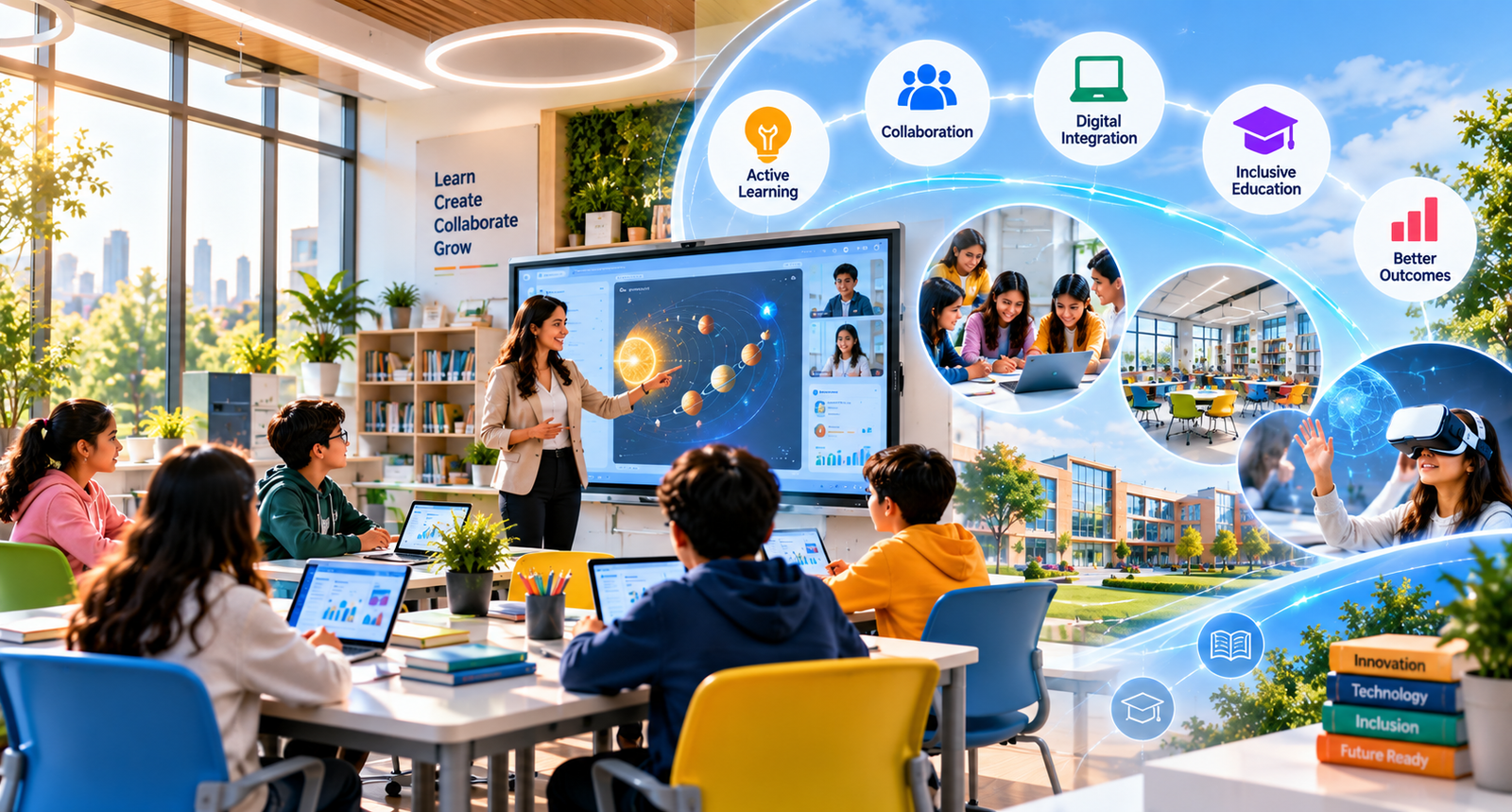
5. Inclusion and Universal Design for Learning
Modern classroom design must also consider the diversity of learners.
Universal Design for Learning (UDL) is an educational framework developed to help create learning environments that reduce barriers and provide meaningful opportunities for participation.
CAST's current UDL Guidelines 3.0, released in 2024, organize the framework around multiple means of engagement, representation, and action and expression. The guidelines emphasize flexible approaches that allow learners to access information, participate, communicate, and demonstrate what they know in different ways.
In a modern classroom, inclusion can involve:
- Accessible physical spaces
- Flexible seating
- Assistive technologies
- Captioning and transcripts
- Screen-reader compatibility
- Multiple forms of instructional material
- Alternative methods of assessment
- Flexible methods of communication
- Accessible digital platforms
CAST also emphasizes the importance of flexible physical-space design and access to assistive technologies as part of reducing barriers to learning.
The objective is not to create a completely different classroom for every student. Instead, thoughtful design can provide multiple pathways for learners to participate and demonstrate their understanding.
6. Artificial Intelligence in the Modern Classroom
Artificial intelligence is becoming one of the most significant developments in educational technology.
AI can support education in areas such as:
- Personalized learning
- Tutoring
- Feedback
- Lesson planning
- Content creation
- Administrative tasks
- Learning analytics
- Research assistance
- Accessibility
- Student support
The OECD's Digital Education Outlook 2026 reports that generative AI can support learning when used with clear pedagogical intent. It also warns that simply using general-purpose AI to outsource cognitive tasks can improve task performance without necessarily producing genuine learning gains.
This distinction is important.
If an AI system simply provides an answer to a student's homework question, the student may complete the assignment without developing the underlying skill.
A better educational use can involve AI acting as a tutor or learning partner that:
- Asks questions
- Provides hints
- Explains concepts
- Gives feedback
- Encourages reasoning
- Helps students identify mistakes
- Supports practice
The OECD also emphasizes that AI should augment teachers rather than remove the human role from education.
7. Data Privacy, Cybersecurity, and Responsible Technology
The growth of digital education also creates new responsibilities.
Educational institutions collect and process significant amounts of information, potentially including:
- Student identities
- Academic records
- Attendance information
- Assessment results
- Learning activity
- Communication records
- Device information
When AI and cloud systems are introduced, institutions must consider how this information is collected, stored, processed, shared, and protected.
UNESCO's guidance on generative AI in education emphasizes the importance of a human-centred approach, including privacy protection, age-appropriate use, ethical considerations, equity, and appropriate policy frameworks.
A responsible digital classroom should therefore include:
- Strong access controls
- Appropriate data-retention policies
- Secure authentication
- Privacy-aware technology selection
- Teacher and student training
- Cybersecurity awareness
- Clear policies for AI use
- Human oversight of important decisions
Technology should expand educational opportunity without compromising student privacy or safety.
WHAT THIS MEANS FOR YOU
The transformation of the classroom affects different stakeholders in different ways.
For Educators
Teachers need to understand how digital tools and AI can support learning without replacing important teaching practices.
The priority should be on tools that improve:
- Engagement
- Feedback
- Collaboration
- Accessibility
- Problem-solving
- Learning support
For Administrators
Administrators should evaluate classroom improvements across both physical and digital infrastructure.
Important priorities include:
- Indoor air quality
- Lighting
- Acoustics
- Flexible furniture
- Reliable connectivity
- Device management
- Cybersecurity
- Teacher training
- Accessibility
- Technology costs
For Parents
Parents can evaluate whether a school provides a healthy balance between:
- Technology
- Teacher interaction
- Social development
- Physical activity
- Collaboration
- Academic support
- Digital safety
More technology does not automatically mean better education.
For Students
Students increasingly need skills that help them learn effectively in technology-rich environments.
These include:
- Digital literacy
- Critical thinking
- Self-regulation
- Collaboration
- Information evaluation
- Problem-solving
- Responsible AI use
Students also need to understand that AI-generated information should be evaluated rather than automatically accepted as correct.
Expert Outlook and Future of the Classroom
The classroom of the future is unlikely to be entirely physical or entirely virtual.
Instead, education is likely to continue combining physical learning environments with digital resources, cloud platforms, online collaboration, adaptive technologies, and AI-assisted tools.
AI may increasingly support tutoring, feedback, lesson preparation, administrative workflows, and personalized learning. However, the evidence available today suggests that educational AI works best when it is intentionally designed around learning goals and used with appropriate teacher guidance.
The OECD's 2026 analysis also highlights the importance of maintaining human agency, foundational skills, and teacher involvement while integrating AI into education.
The physical classroom is therefore unlikely to disappear simply because digital learning is expanding.
Instead, its role may evolve.
Classrooms can increasingly become environments designed for:
- Collaboration
- Discussion
- Practical learning
- Social interaction
- Project-based work
- Mentorship
- Creative problem-solving
Digital environments can complement these activities by providing access to information, practice, feedback, and learning resources.
The future classroom will therefore be defined less by a specific device or piece of furniture and more by how effectively the entire learning ecosystem works together.
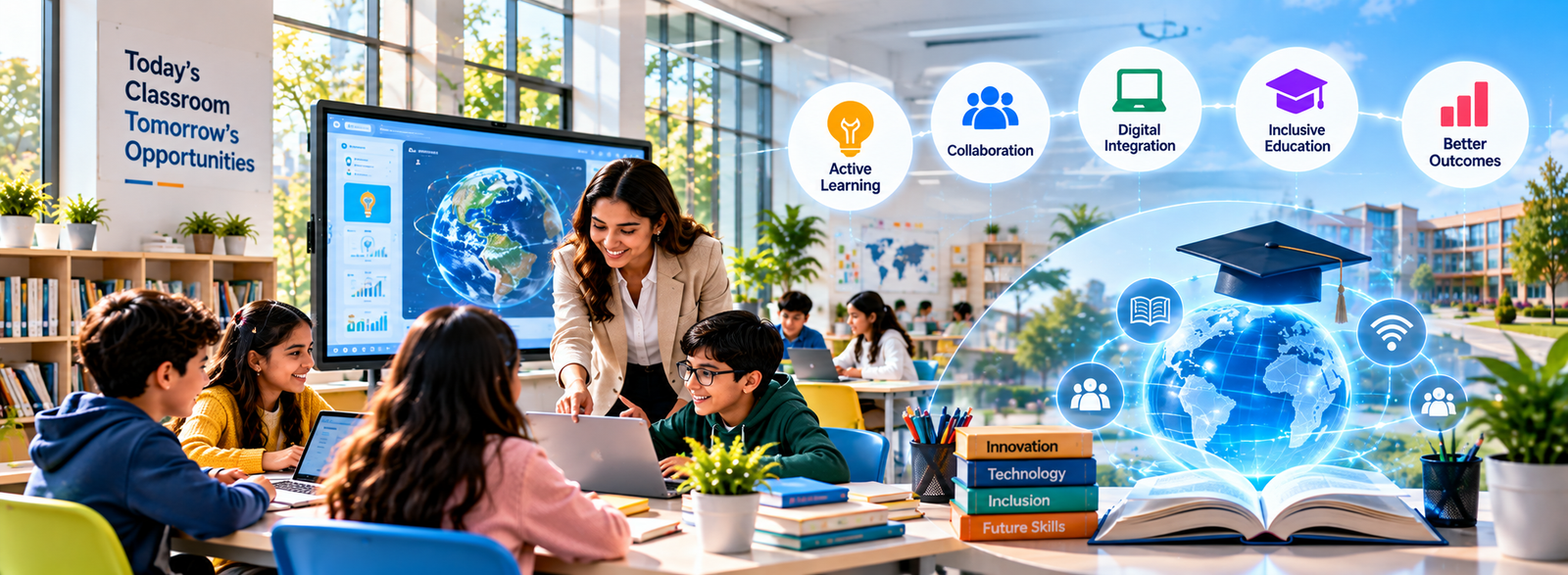
FAQ
How does classroom design affect learning?
Classroom design can influence the learning environment through factors such as lighting, air quality, temperature, acoustics, layout, and flexibility. The University of Salford's HEAD Project found that classroom design characteristics were associated with approximately 16% of the variation in learning progress among the primary-school pupils studied. This should not be interpreted as a guaranteed 16% improvement for every student.
Does classroom ventilation affect students?
Research indicates that indoor air quality and ventilation are associated with aspects of student health, comfort, cognitive performance, and academic performance. However, the magnitude and mechanisms of these effects vary across studies. Recent research has found associations between higher classroom CO₂ concentrations and lower cognitive-test scores, but such associations should not automatically be interpreted as proof of direct causation.
What is the role of AI in the modern classroom?
AI can support tutoring, feedback, personalized learning, lesson preparation, administrative work, accessibility, and learning analytics. However, the OECD's 2026 research indicates that simply using general-purpose AI to complete tasks does not necessarily produce learning gains. AI is more useful educationally when its use is guided by clear pedagogical objectives.
Is technology making the physical classroom obsolete?
No. Digital tools can extend learning beyond the classroom, but physical environments continue to provide opportunities for collaboration, social interaction, practical activities, discussion, and teacher-student relationships.
The balance between physical and digital learning depends on the educational context.
What are the biggest challenges in classroom digital transformation?
Important challenges include unequal access to devices and connectivity, teacher training, technology costs, cybersecurity, data privacy, accessibility, infrastructure reliability, and ensuring that technology genuinely improves learning rather than simply increasing screen time.
What is Universal Design for Learning?
Universal Design for Learning is a framework for designing learning experiences that reduce barriers and provide multiple ways for learners to engage, access information, and express what they know. CAST's current UDL Guidelines 3.0 emphasize engagement, representation, and action and expression.
How can old classroom buildings be modernized?
Existing classrooms can be improved through measures such as better ventilation, improved lighting, acoustic improvements, flexible furniture, accessible layouts, reliable network infrastructure, and energy-efficient building systems.
Modernization should be based on the building's condition, educational requirements, local climate, budget, accessibility needs, and available infrastructure.
What should schools consider before adopting AI?
Schools should consider educational purpose, student age, privacy, security, accessibility, teacher training, accuracy, bias, transparency, academic integrity, and how AI affects student learning.
UNESCO recommends a human-centred approach to AI in education, including appropriate safeguards, privacy protection, ethical considerations, and capacity building.
Conclusion
The modern classroom is no longer defined only by desks, walls, and teaching boards. It is an interconnected learning environment where physical design, digital infrastructure, teaching methods, accessibility, data, and emerging technologies increasingly work together.
Research from the University of Salford demonstrates that classroom design can be meaningfully associated with learning progress, while research on indoor air quality highlights the importance of healthy and well-ventilated learning environments.
At the same time, digital technologies and AI are creating new opportunities for personalized learning, tutoring, collaboration, accessibility, and educational administration. Current OECD research suggests that these technologies are most valuable when they are used with clear educational objectives and do not replace the cognitive effort or human relationships central to learning.
The strategic goal should therefore not be to build the most technologically advanced classroom possible.
It should be to build a healthy, inclusive, flexible, secure, and human-centred learning environment where technology supports teachers and students rather than becoming the purpose of education itself.
The classroom of the future will not simply be a smarter room.




Comments 0
Leave a Reply
Your email address will not be published. Required fields are marked *
Be the first to share your thoughts!