
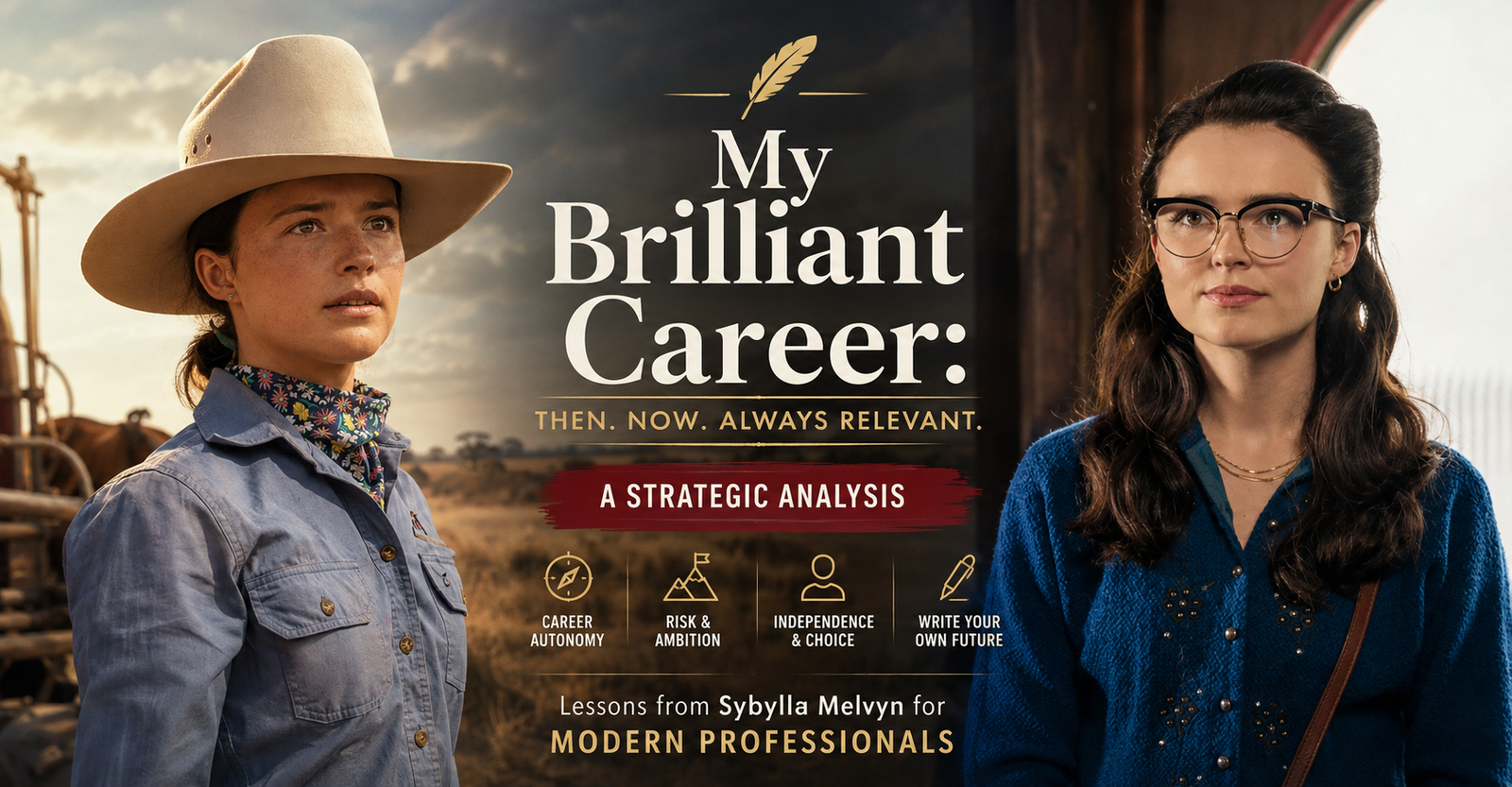
💡 My Brilliant Career Netflix: Strategic Analysis of Professional ROI
An analytical examination of My Brilliant Career, its themes of professional autonomy and creative independence, and the lessons its story offers to modern professionals navigating career choices.
Quick Take: High-Level Summary of Strategic Relevance
My Brilliant Career has returned to the spotlight on Netflix in 2026 through a new six-part adaptation of Miles Franklin's classic novel, while the acclaimed 1979 film remains an important reference point in the story's cinematic history. The original film, directed by Gillian Armstrong and starring Judy Davis as Sybylla Melvyn, is recognized as a major work of Australian cinema and for its exploration of female independence, social expectations, and artistic ambition. The new Netflix adaptation brings these themes to a contemporary streaming audience.
For modern professionals, Sybylla's story can be interpreted as a case study in career autonomy. Her determination to become a writer rather than simply accept the conventional path expected of her raises questions that remain relevant today: How much financial security should someone trade for creative freedom? When should a professional reject an attractive opportunity because it conflicts with long-term goals? And how can individuals build career value that extends beyond a single employer?
Microsoft's 2021 Work Trend Index found that 41 percent of workers surveyed were considering leaving their employer, illustrating the scale of career reassessment during the post-pandemic workplace transition. The statistic is historical rather than a current 2026 measurement, but it provides useful context for understanding the broader shift toward flexibility, career mobility, and personal priorities.
Introduction: The Cultural Resurgence of My Brilliant Career
The 1979 My Brilliant Career, directed by Gillian Armstrong and starring Judy Davis and Sam Neill, is based on Miles Franklin's celebrated 1901 novel. The film follows Sybylla Melvyn, a young woman from rural Australia who dreams of becoming a writer while confronting the social and economic expectations placed on women in the late nineteenth century. The Australian Centre for the Moving Image describes the film as a key work of the Australian New Wave and highlights its themes of independence and resistance to patriarchal expectations.
The story has gained renewed relevance through Netflix's 2026 six-part adaptation, which premiered globally on August 13, 2026. The new series stars Philippa Northeast as Sybylla and reinterprets the original story for a contemporary television audience while retaining its central conflict between personal ambition, relationships, and social expectations.
Rather than assuming that Netflix's release reflects a specific commercial strategy that has not been publicly disclosed, the more useful strategic question is why the story remains relevant. Its central themes—creative identity, independence, social pressure, and career choice—can be applied to modern discussions about entrepreneurship, freelancing, personal branding, and professional autonomy.
The Sybylla Melvyn Framework: Applying Historical Autonomy to Modern Careers
The Sybylla Melvyn Framework can be understood as a modern analytical model built around the idea of strategic refusal. Sybylla's ambition is not simply to obtain a comfortable life; she wants the freedom to determine the direction of her own creative work.
In the story, her relationship with Harry Beecham creates a conflict between emotional and financial security and her desire to become a writer. The 1979 film presents this conflict as part of Sybylla's struggle against conventional expectations surrounding marriage, class, gender, and personal ambition.
Applied to the modern workplace, this can be interpreted through three strategic principles:
- Radical Self-Awareness: Understand your strengths, interests, and the type of work you want to build a career around.
- Calculated Risk-Taking: Evaluate whether short-term uncertainty can create stronger long-term professional opportunities.
- Ownership of Career Assets: Build portable skills, reputation, intellectual property, relationships, and professional credibility that can remain valuable beyond a single employer.
The key lesson is not that professionals should reject every secure opportunity. Instead, it is that career decisions should be evaluated according to long-term objectives rather than salary or status alone.
Real-Life Use Cases: Independence-First Strategies
Modern professionals can apply the underlying principles of Sybylla's story in several ways. A designer may build an independent portfolio while working full-time. A developer may create software products outside employment. A consultant may develop specialized expertise that allows them to work across multiple organizations. A creator may build an audience and intellectual property that are not entirely dependent on one platform.
These strategies do not guarantee financial success, but they can increase professional flexibility. Personal reputation, specialized skills, intellectual property, and professional networks can become career assets that complement traditional employment income.
The broader lesson is similar to other forms of brand-equity strategy: professionals can increase their long-term options by building assets that remain useful when their role, employer, industry, or economic conditions change.
Actionable Insights: Building Your Brilliant Career
Building a strong career does not require rejecting traditional employment. Instead, it requires understanding which opportunities contribute to long-term professional value.
Key steps include:
- Audit Your Current Role: Identify the skills, relationships, reputation, and experience you are gaining.
- Build Portable Skills: Prioritize capabilities that remain valuable across employers and industries.
- Create a Financial Runway: Maintain sufficient savings before taking significant career risks.
- Develop Professional Identity: Build a portfolio, reputation, or body of work that demonstrates your expertise.
- Evaluate Opportunity Cost: Consider what you give up when accepting an opportunity, not just what you receive.
- Protect Creative Independence: Where appropriate, understand ownership rights surrounding your work, content, inventions, and intellectual property.
The strategic goal is not maximum independence at any cost. It is greater control over the direction and value of your career.
Comparison Table: Traditional Career Security vs. Career Autonomy Model
| Metric | Traditional Career Security | Career Autonomy Model |
|---|---|---|
| Risk Profile | Low to Medium | Medium to High initially |
| Income Structure | Salary + Benefits | Multiple or variable income sources |
| Brand Equity | Often associated with employer | Can be developed independently |
| Market Agility | Moderate | Potentially High |
| Skill Development | Role-dependent | Deliberately portable |
| Primary Driver | Stability and predictability | Independence and professional alignment |
| Long-Term Upside | More predictable | Potentially nonlinear, but uncertain |
The autonomy model should therefore be viewed as a risk-management framework, not as a promise of higher financial returns.
Expert Tips: Using Stories for Cultural Intelligence
Streaming content can provide more than entertainment when viewed analytically. Stories such as My Brilliant Career allow professionals to examine how ideas about work, gender, class, ambition, and social expectations have changed over time.
The 1979 film is particularly useful because its historical setting makes the constraints surrounding Sybylla's choices visible. Its continuing relevance demonstrates how stories created in one social and economic environment can generate new interpretations decades later. The 2026 Netflix adaptation further demonstrates how classic literary material can be reinterpreted for contemporary audiences.
For professionals, the practical lesson is to use cultural content as a source of perspective. Understanding how people in different historical periods viewed work and identity can help modern leaders question assumptions that otherwise appear normal or inevitable.
Advantages vs. Limitations of the Sybylla Approach
The primary advantage of prioritizing professional autonomy is greater control over the direction of one's career. Building independent skills, reputation, and intellectual property can create opportunities that extend beyond a conventional employment structure.
However, the limitations are significant. Independent career paths can involve irregular income, weaker benefits, greater administrative responsibility, and periods of uncertainty. Not every professional has the financial resources or personal circumstances required to accept these risks.
Sybylla's story should therefore not be interpreted as an argument against stability. Instead, it illustrates the importance of understanding the trade-off between security and autonomy. The right balance will differ according to an individual's financial position, responsibilities, skills, industry, and long-term ambitions.
FAQ: Authoritative Insights
1. Why is My Brilliant Career receiving attention on Netflix in 2026?
Netflix released a new six-part adaptation of My Brilliant Career globally on August 13, 2026. The series brings Miles Franklin's story to a contemporary streaming audience, while also renewing interest in the original novel and the acclaimed 1979 film.
2. What is the 1979 My Brilliant Career film about?
The 1979 film follows Sybylla Melvyn, a young woman who dreams of becoming a writer while facing social and family expectations surrounding marriage, class, and conventional female roles. It was directed by Gillian Armstrong and stars Judy Davis and Sam Neill.
3. What are the key career lessons from Sybylla?
The strongest lessons are the importance of understanding personal ambition, making deliberate career choices, protecting creative identity, and evaluating opportunities according to long-term goals rather than immediate financial rewards.
4. How does the film's ending apply to modern career decisions?
In the 1979 film, Sybylla ultimately chooses to pursue her writing ambitions rather than accept the conventional path expected of her. This can be interpreted as a metaphor for modern professionals who choose entrepreneurship, creative work, freelancing, or another independent path instead of automatically prioritizing traditional career security.
5. Is the Sybylla approach viable during an economic downturn?
It can be, but it requires careful risk management. Professionals considering a major career change should evaluate savings, demand for their skills, alternative income sources, and the availability of future employment before giving up a stable position.
6. Is the 2026 Netflix version the same as the 1979 film?
No. The 2026 Netflix production is a new six-part adaptation of Miles Franklin's novel, while the 1979 version is Gillian Armstrong's feature film starring Judy Davis. Both tell the story of Sybylla Melvyn but are separate screen adaptations created in different eras.
Conclusion
My Brilliant Career remains relevant because its central question is larger than the historical setting of the story: How much control should an individual have over the direction of their own life and work?
The 1979 film transformed Miles Franklin's novel into an influential Australian cinematic work centered on independence, creativity, and resistance to social expectations. The 2026 Netflix adaptation introduces those themes to a new generation and demonstrates the continuing cultural relevance of Sybylla Melvyn's story.
For modern professionals, the most valuable lesson is not to reject stability or pursue independence blindly. It is to build a career deliberately—developing portable skills, maintaining financial resilience, protecting valuable creative assets, and choosing opportunities that align with long-term goals.
A truly brilliant career is therefore not defined simply by salary, title, or status. It is defined by the combination of capability, autonomy, resilience, and the freedom to determine what kind of professional life you want to build.




Comments 0
Leave a Reply
Your email address will not be published. Required fields are marked *
Be the first to share your thoughts!