
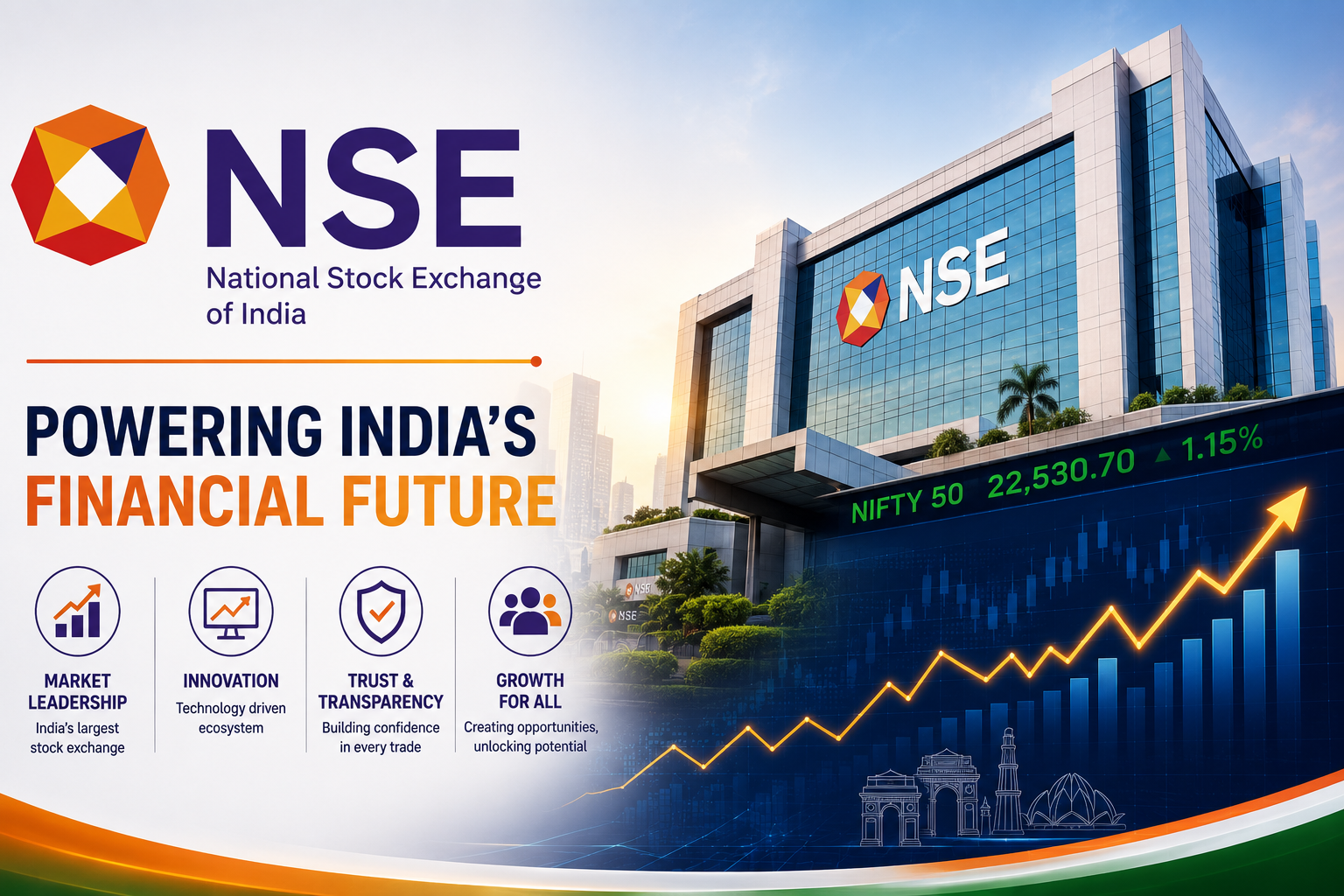
💡 NSE (National Stock Exchange)
A comprehensive strategic analysis of the National Stock Exchange (NSE), its market dominance, technological infrastructure, and its role in the global financial landscape.
Executive Summary
The National Stock Exchange of India (NSE) stands as the cornerstone of the Indian capital markets, representing the world largest derivatives exchange by trading volume for five consecutive years as of 2023. This strategic analysis highlights the NSE growth trajectory, which saw its market capitalization cross the 5 trillion dollar milestone in May 2024. Key findings indicate that the NSE handles over 90 percent of the equity cash market share in India, driven by its flagship index, the Nifty 50. The exchange technological prowess, characterized by its low-latency trading systems and robust risk management frameworks, has positioned it as a global leader. This report examines the exchange operational excellence, regulatory compliance under the Securities and Exchange Board of India (SEBI), and its future role in the international financial ecosystem via initiatives like the NSE IX in GIFT City.
Introduction
The National Stock Exchange was incorporated in 1992 and commenced operations in 1994, fundamentally altering the landscape of Indian finance. Before its inception, the Indian markets were characterized by floor-based trading and physical settlements, which often led to inefficiencies and lack of transparency. The NSE introduced the first electronic screen-based trading system in the country, democratizing access to capital markets for retail and institutional investors alike. While its peer, the Bombay Stock Exchange, holds the title of the oldest exchange in Asia, the NSE has rapidly overtaken it in terms of liquidity and daily turnover. For a broader context on the competitive landscape, one might examine a BSE Strategic Analysis: The Future of Indian Capital Markets to understand the historical rivalry and current market dynamics. Today, the NSE is not just a national institution but a global powerhouse that influences international investment flows into emerging markets.
The Deep Dive: Strategic Pillars of NSE Success
The dominance of the NSE is built upon several critical pillars: technological innovation, product diversification, and institutional trust. Each of these elements contributes to a market environment that supports high-frequency trading and massive retail participation.
Market Capitalization and Trading Volume
In mid-2024, the combined market capitalization of companies listed on the NSE exceeded 5 trillion dollars, reflecting the robust growth of the Indian economy. The exchange sees a daily turnover in the equity segment that often exceeds 10 billion dollars, while the derivatives segment records astronomical figures, sometimes surpassing 400 trillion rupees in notional value on peak expiry days. This liquidity is essential for price discovery and risk mitigation. The Nifty 50 index, which tracks the performance of the top 50 companies across various sectors, serves as the primary benchmark for Indian equity. Heavyweights like HDFC Bank play a pivotal role in these indices, and understanding their individual performance is crucial for market participants. For instance, a detailed HDFC Bank Share: Strategic Analysis of Financial Performance reveals how banking sector stability directly correlates with the overall health of the NSE indices.
Technological Infrastructure
The NSE operates on a highly sophisticated trading platform known as NEAT (National Exchange for Automated Trading). This system is designed to handle millions of orders per second with microsecond latency. The exchange investment in technology extends beyond the trading engine to include surveillance systems that monitor market manipulation in real-time. By utilizing artificial intelligence and machine learning, the NSE identifies suspicious trading patterns, ensuring a fair and transparent marketplace. This commitment to technology has allowed the NSE to maintain a near-monopoly in the derivatives space, where speed and reliability are paramount.
The Derivatives Market Leadership
According to data from the Futures Industry Association (FIA), the NSE has consistently ranked as the world largest derivatives exchange by the number of contracts traded. The introduction of weekly expiries for index options has led to a surge in retail participation. While this has raised concerns regarding market volatility, the NSE has implemented stringent margin requirements and stress testing to protect the system. The exchange offers a wide array of products including currency derivatives, interest rate futures, and commodity derivatives, allowing investors to hedge risks across different asset classes.
Regulatory Framework and Corporate Governance
Operating under the watchful eye of SEBI, the NSE adheres to some of the strictest regulatory standards globally. The transition from a T plus 2 to a T plus 1 settlement cycle in 2023 was a landmark achievement, making India one of the fastest markets for trade settlement in the world. This move reduced the risk of default and freed up capital for investors more quickly. Furthermore, the NSE has been proactive in enhancing corporate governance among its listed entities, mandating detailed disclosures and independent board oversight.
What This Means For You
For the average investor or market participant, the NSE provides a secure and liquid platform to grow wealth. The high volume of trading ensures that you can enter or exit positions with minimal slippage. Here is a breakdown of what the NSE ecosystem offers:
- Access to Diversified Assets: Investors can trade equities, ETFs, mutual funds, and debt instruments on a single platform.
- Security of Funds: The National Securities Clearing Corporation Limited (NSCCL) acts as the central counterparty, guaranteeing the settlement of all trades.
- Transparency: Real-time price updates and historical data allow for informed decision-making.
- Innovation: New products like Social Stock Exchanges and ESG-themed indices provide opportunities for value-based investing.
Expert Verdict and Future Outlook
The future of the NSE is closely tied to the internationalization of the Indian rupee and the growth of the GIFT City International Financial Services Centre (IFSC). The NSE IX, a subsidiary located in GIFT City, allows international investors to trade Nifty products in US dollars, effectively bridging the gap between Indian and global markets. Industry experts anticipate that the NSE will eventually proceed with its long-awaited Initial Public Offering (IPO), which would further enhance its corporate profile and provide a valuation benchmark against global peers like the CME Group or the London Stock Exchange. However, the exchange must navigate challenges such as cybersecurity threats and the need for continuous infrastructure upgrades to handle the exponential growth in retail trading accounts, which recently surpassed the 150 million mark in India.
Frequently Asked Questions
What is the difference between Nifty and Sensex?
Nifty is the flagship index of the National Stock Exchange (NSE) consisting of 50 stocks, while Sensex is the index of the Bombay Stock Exchange (BSE) consisting of 30 stocks. Nifty is generally considered a broader representation of the Indian market due to its larger constituent base.
How does the NSE ensure the safety of my trades?
The NSE utilizes a clearing corporation that acts as a guarantor for every trade. This means that even if a buyer or seller defaults, the clearing corporation ensures that the other party receives their funds or securities, virtually eliminating counterparty risk.
What are the trading hours for the NSE?
The equity market is open from 9:15 AM to 3:30 PM IST, Monday through Friday. There is a pre-open session from 9:00 AM to 9:15 AM. Trading is closed on national holidays and weekends.
Can foreign investors trade on the NSE?
Yes, foreign investors can participate through the Foreign Portfolio Investment (FPI) route. They must be registered with SEBI and follow specific regulatory guidelines regarding investment limits and reporting.
What is the T plus 1 settlement cycle?
T plus 1 means that the transfer of shares and funds happens within one business day after the trade is executed. This is one of the fastest settlement cycles in the world, enhancing market efficiency and liquidity.
Conclusion
The National Stock Exchange is more than just a trading venue; it is a vital engine of the Indian economy. Through its relentless focus on technology and market integrity, it has earned its place as a global leader in the financial sector. As India continues its journey toward becoming the world third-largest economy, the NSE will remain at the forefront, facilitating capital formation and providing a robust platform for wealth creation. For stakeholders, the strategic takeaway is clear: the NSE is a resilient, innovative, and indispensable institution that defines the future of Indian capital markets.
Important Note: Financial Disclaimer: This content is for educational purposes only and does not constitute professional financial advice. Always consult with a certified financial planner before making investment decisions.





Comments 0
Leave a Reply
Your email address will not be published. Required fields are marked *
Be the first to share your thoughts!