
💡 Pep Guardiola: Strategic Analysis of Tactical Innovation
An authoritative deep dive into Pep Guardiola’s tactical systems, leadership philosophy, and his unprecedented impact on modern football history.
Executive Summary
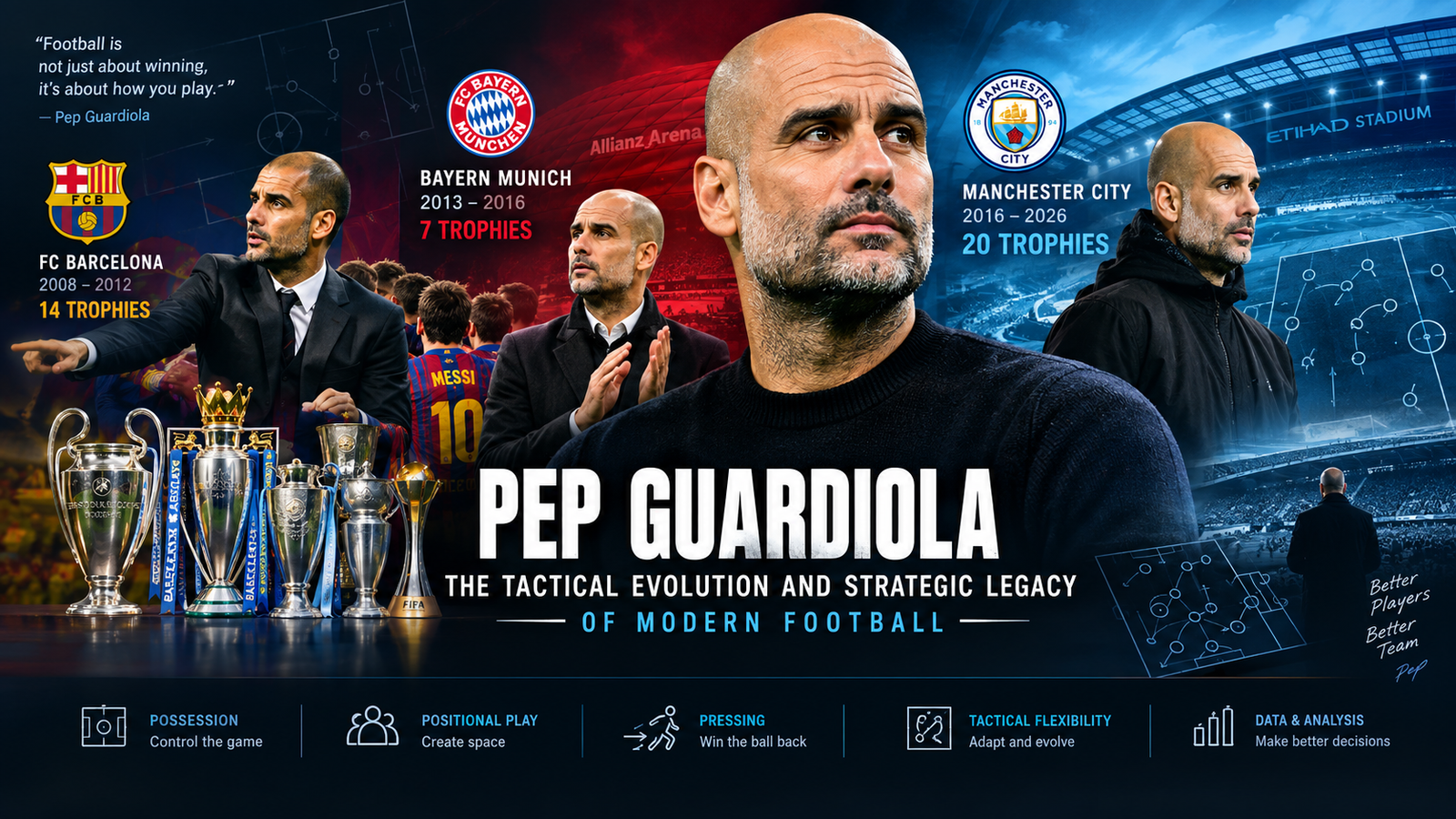
Pep Guardiola has built one of the most decorated managerial careers of the modern era, winning major honours with FC Barcelona, Bayern Munich and Manchester City. His coaching career has been defined not only by trophies but also by a tactical philosophy centered on positional play, space, ball control, pressing and continual adaptation.
At Barcelona, Guardiola developed a possession-oriented team that won 14 trophies during his four seasons in charge, including two UEFA Champions League titles. At Bayern Munich, he continued to develop his positional ideas while adapting them to German football. At Manchester City, he produced a decade of sustained success that included six Premier League titles, a historic 100-point campaign, four consecutive league titles, the 2022/23 continental Treble and a total of 20 major trophies during his City tenure.
Guardiola's Manchester City era ended after the 2025/26 campaign. His final season included victories in both the League Cup and FA Cup, taking his Manchester City trophy total to 20.
His career provides a useful case study in how tactical principles, squad construction, player development and organizational planning can work together at the highest level of professional sport.
Introduction: The Architect of a Tactical Era
Pep Guardiola began his senior managerial career with Barcelona B in 2007 before becoming FC Barcelona's first-team manager in 2008. His appointment marked the beginning of one of the most successful periods in the club's history.
Guardiola's Barcelona team emphasized possession, positional structure, short passing combinations and coordinated pressing. Rather than treating formation as a fixed shape, his approach emphasized the relationship between players, space and the movement of the ball.
The philosophy was heavily influenced by the footballing ideas associated with Johan Cruyff and Barcelona's broader footballing tradition. Guardiola subsequently adapted those principles in Germany and England rather than simply reproducing the same system at every club.
That adaptability became one of the defining characteristics of his managerial career.
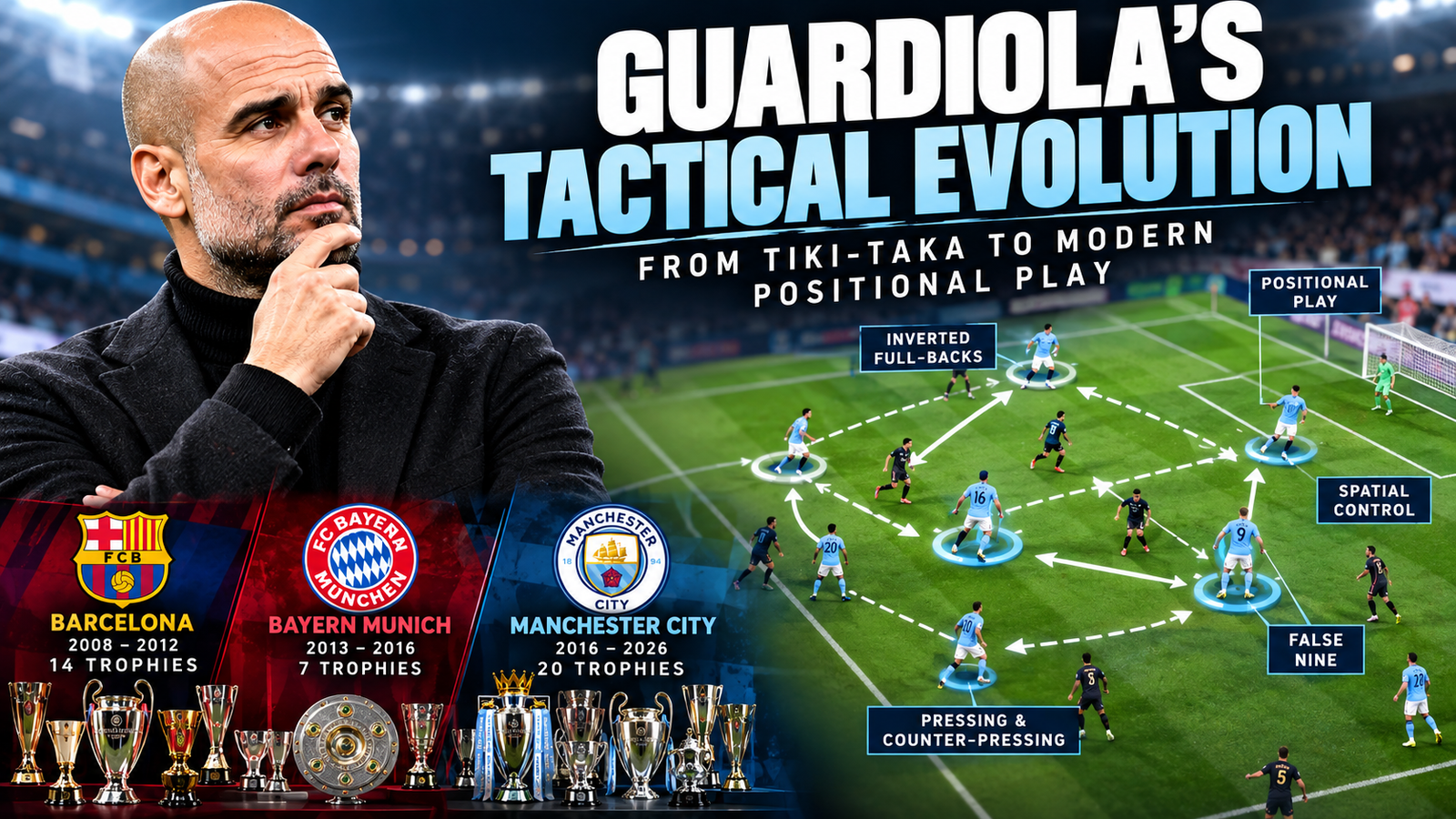
The Deep Dive: Guardiola's Tactical Evolution
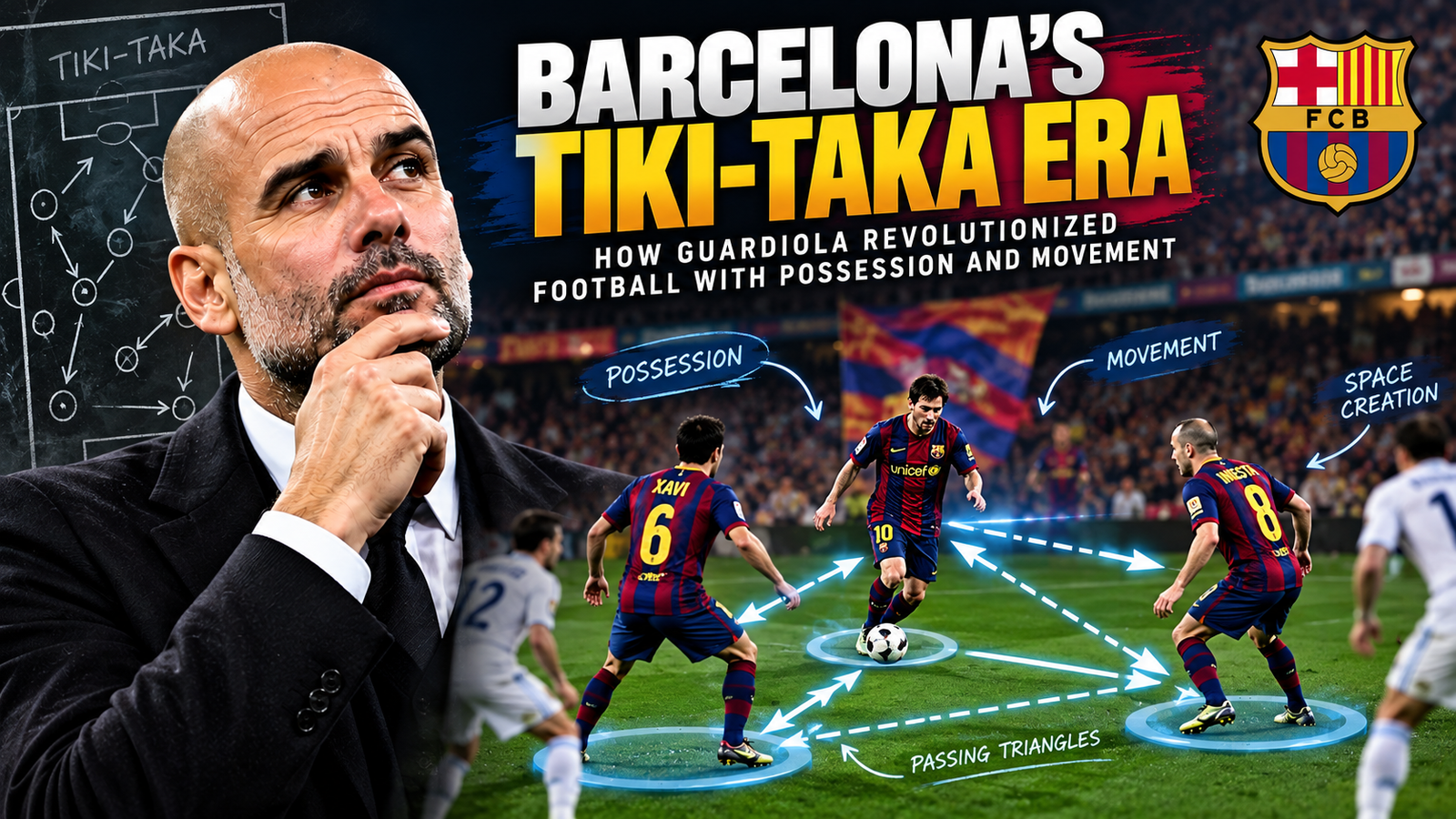
1. Barcelona: Positional Play and Possession
Guardiola's four-season spell as Barcelona's first-team manager lasted from 2008 to 2012.
During that period, Barcelona won 14 trophies from 19 available competitions. The haul included three La Liga titles, two Copa del Rey titles, two UEFA Champions League titles, three Spanish Super Cups, two UEFA Super Cups and two FIFA Club World Cups.
The 2008/09 season was particularly significant. Barcelona won La Liga, the Copa del Rey and the UEFA Champions League to complete a historic Treble. The club then won three additional trophies in 2009, completing a six-trophy calendar year.
Core tactical characteristics
Guardiola's Barcelona emphasized:
- Maintaining possession to control the game.
- Creating passing angles around the ball.
- Positioning players across different zones of the pitch.
- Using width to stretch defensive structures.
- Pressing immediately after losing possession.
- Moving players into spaces that created numerical or positional advantages.
The system relied on players understanding not only their own position but also how their movement affected teammates.
This was one reason players such as Xavi Hernández, Andrés Iniesta, Sergio Busquets and Lionel Messi became so important to the system.
2. Bayern Munich: Adapting the Philosophy
Guardiola moved to Bayern Munich in 2013 after taking a break from management.
His Bayern side continued to emphasize possession and positional control, but the tactical environment was different from Spain. The Bundesliga required Guardiola to adapt his methods to a different league, opponent profile and squad.
UEFA records that Guardiola won the Bundesliga and German Cup in his first season, while Bayern also won the UEFA Super Cup and FIFA Club World Cup during that campaign. Bayern won the Bundesliga in each of Guardiola's three seasons, although the club reached the Champions League semi-finals in all three campaigns rather than winning the competition.
One of the notable tactical developments associated with Guardiola during this period was the use of defenders such as Philipp Lahm in midfield-oriented roles during possession.
The broader principle was more important than a particular player's position: Guardiola wanted his team to create additional options in central areas while maintaining control of possession and protecting against transitions.
This period demonstrated that his philosophy was not dependent on a single formation.
3. Manchester City: From Possession to Positional Flexibility
Guardiola joined Manchester City in 2016.
His first Premier League season ended without a major trophy, but the following campaign produced a dramatic transformation. Manchester City won the 2017/18 Premier League title with 100 points, setting records for points, wins and goals during the campaign.
The 2018/19 season brought another major tactical and competitive milestone. City became the first English men's team to win the domestic league, FA Cup and League Cup in the same season.
Guardiola subsequently developed different variations of his positional system, including:
- Inverted full-backs.
- Full-backs moving into midfield.
- Central defenders participating heavily in build-up.
- Midfielders changing positions during possession.
- Wingers maintaining width.
- Centre-forwards creating different types of attacking reference points.
- More flexible defensive structures depending on the opponent.
Rather than relying on one permanent formation, Manchester City's shape could change significantly between possession and defensive phases.
The 2022/23 Treble
The 2022/23 season represented one of the most significant achievements of Guardiola's Manchester City career.
City won:
- Premier League
- FA Cup
- UEFA Champions League
The Champions League victory was Guardiola's third as a manager: two with Barcelona and one with Manchester City. UEFA lists him among the coaches to have won the European Cup/Champions League three times.
The Treble also demonstrated how Guardiola had evolved from the Barcelona possession model into a more physically and tactically flexible Manchester City side.
Four Consecutive Premier League Titles
Manchester City's domestic consistency reached another landmark between 2020/21 and 2023/24.
Guardiola's team won the Premier League in four consecutive seasons:
- 2020/21
- 2021/22
- 2022/23
- 2023/24
The Premier League identifies this as a record-breaking four-title sequence. Guardiola ultimately won six Premier League titles during his decade at Manchester City.
The achievement was particularly significant because maintaining tactical and competitive superiority over several seasons requires more than a successful formation. It involves recruitment, player development, squad rotation, injury management and continual tactical adjustments.
Guardiola's Final Manchester City Season
Guardiola's Manchester City tenure ended after the 2025/26 season, bringing his time at the club to approximately ten years.
His final season ended with City winning both the League Cup and FA Cup. The FA Cup victory gave Guardiola his 20th major trophy as Manchester City manager.
Manchester City's official records list Guardiola's 20 trophies at the club as:
- 6 Premier League titles
- 5 League Cups
- 3 FA Cups
- 3 Community Shields
- 1 UEFA Champions League
- 1 UEFA Super Cup
- 1 FIFA Club World Cup
That makes 20 major honours during his Manchester City tenure.
His final match as City manager came against Aston Villa on 24 May 2026. City lost the match 2–1, but Guardiola's decade at the club ended with a total of 20 major trophies.
The Economics and Infrastructure Behind Success
Guardiola's achievements cannot be understood purely through tactics.
Elite football success also depends on:
- Recruitment.
- Sporting leadership.
- Coaching staff.
- Player development.
- Medical and performance departments.
- Training facilities.
- Financial resources.
- Long-term squad planning.
- Organizational stability.
Manchester City's decade under Guardiola illustrates how a manager's tactical philosophy can operate within a broader sporting structure.
Rather than simply purchasing individual star players, the club has repeatedly recruited players who can perform specific tactical functions within its overall model.
This is particularly important for positional football because players must understand spatial relationships, pressing triggers, build-up responsibilities and transitions.
Strategic Pillars of the Guardiola Method
1. Positional Play
Players occupy different zones to create passing options, maintain spacing and manipulate opposition defensive structures.
The objective is not simply to keep possession. Possession is used to create advantageous positions.
2. Spatial Control
Guardiola's teams attempt to control important areas of the pitch by positioning players at different heights and widths.
When opponents move toward one area, space can potentially become available elsewhere.
3. Pressing and Counter-Pressing
After losing the ball, Guardiola's teams often attempt to recover possession quickly rather than immediately retreating into a deep defensive block.
The exact pressing structure can change according to the opponent and the players available.
4. Flexible Player Roles
Players may perform different functions depending on whether their team has possession.
A full-back can move into midfield, a midfielder can drop into the defensive line, and an attacking player can move into central or wide areas.
5. Continuous Adaptation
One of Guardiola's defining characteristics has been his willingness to modify his team's structure.
The Barcelona system was not simply copied at Bayern, and the Bayern approach was not simply copied at Manchester City.
The False Nine
The false nine is an attacking role in which a nominal centre-forward drops deeper into midfield rather than remaining permanently on the defensive line.
This movement can create several tactical effects.
When the centre-forward drops:
- A defender may follow him.
- Space can open behind the defensive line.
- Wingers or attacking midfielders can attack that space.
- The team can gain an additional passing option in midfield.
Lionel Messi's role for Guardiola's Barcelona became one of the most famous examples of this concept.
However, the false nine should not be treated as a fixed formation. It is primarily a description of how the forward operates within a particular tactical structure.
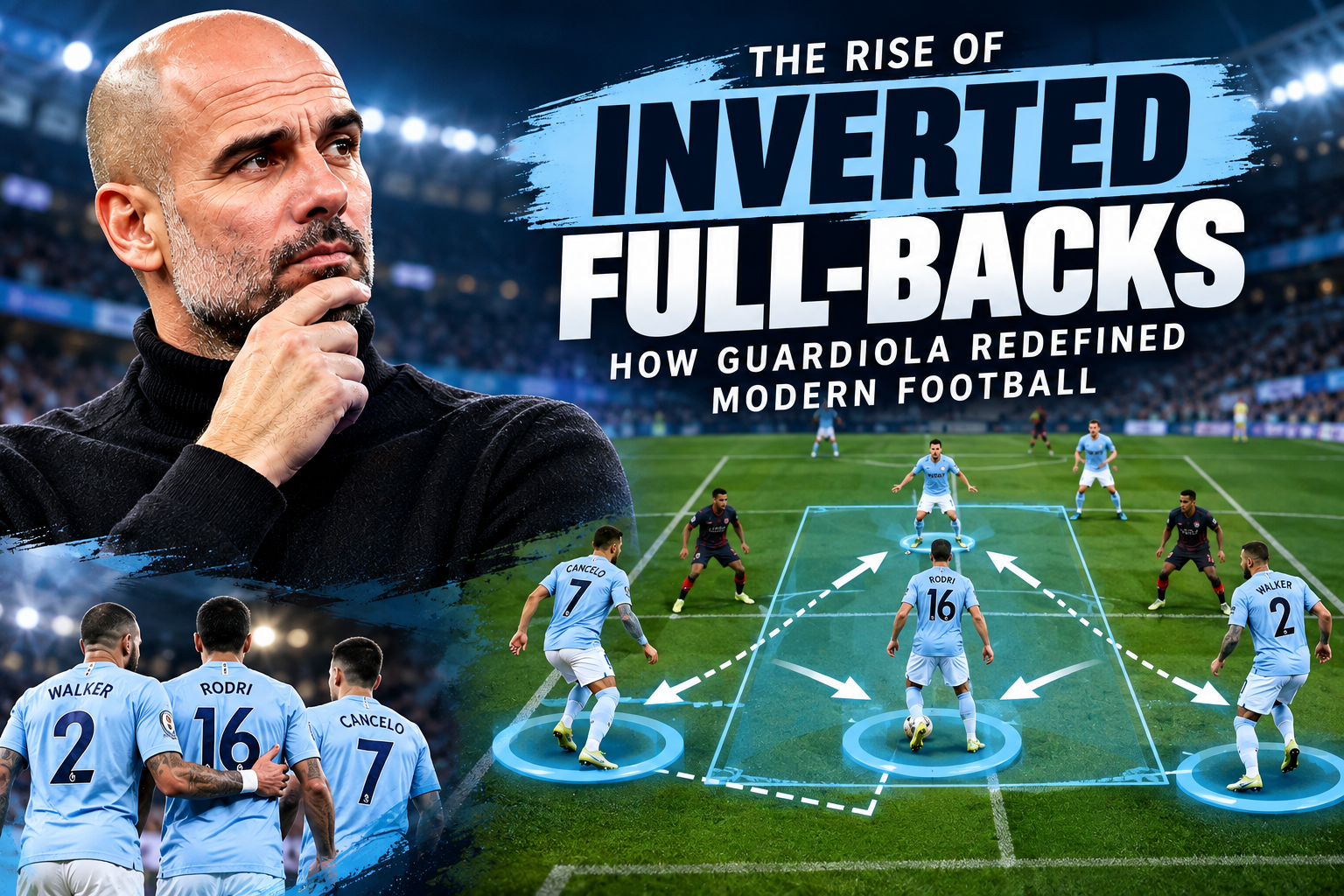
Inverted Full-Backs
The inverted full-back became another important concept associated with Guardiola's football.
Instead of remaining near the touchline during possession, a full-back can move into a central or half-space position.
This can provide:
- An additional central passing option.
- Greater midfield control.
- Better protection against counter-attacks.
- More flexibility during build-up.
- Additional numerical support around the ball.
Players such as Philipp Lahm at Bayern and several Manchester City full-backs have performed variations of this role.
The exact positioning depends on the team's structure and the opponent.
Data and Performance Analysis
Modern elite football increasingly combines traditional tactical analysis with data.
Metrics such as:
- Expected Goals (xG)
- Expected Assists (xA)
- Progressive Passes
- Possession
- Field Tilt
- Shot locations
- Pressing statistics
- Ball recoveries
- Defensive actions
can help coaching staffs evaluate performance.
However, data should be viewed as one component of the decision-making process rather than a replacement for tactical observation.
Guardiola's career demonstrates the broader trend toward combining video analysis, tactical preparation, physical performance data and player-specific analysis.
What Guardiola's Career Demonstrates
Adaptability
Guardiola has maintained recognizable tactical principles while changing their implementation.
Barcelona, Bayern Munich and Manchester City did not play identical football.
System and Individual Quality
Individual talent remains extremely important, but Guardiola's teams are structured so that players operate within a collective framework.
The system defines responsibilities while allowing elite players to exploit spaces and situations.
Continuous Innovation
Success at the highest level creates a new challenge: opponents study successful teams.
Guardiola's response has frequently been tactical modification.
This has included changes to:
- Build-up structures.
- Full-back positioning.
- Midfield roles.
- Defensive organization.
- Attacking movements.
- Pressing structures.
Long-Term Squad Construction
Sustained success requires players who can understand and execute complex tactical instructions.
Recruitment therefore becomes closely connected to the manager's tactical requirements.
Guardiola's Statistical and Historical Benchmarks
Several figures illustrate the scale of Guardiola's managerial career:
| Achievement | Figure |
|---|---|
| Barcelona trophies | 14 |
| Barcelona managerial period | 2008–2012 |
| Manchester City major trophies | 20 |
| Manchester City Premier League titles | 6 |
| Manchester City consecutive Premier League titles | 4 |
| Manchester City's 2017/18 points | 100 |
| UEFA Champions League titles as manager | 3 |
| Manchester City managerial period | 2016–2026 |
Barcelona officially records Guardiola's four-season spell as 14 trophies. Manchester City records 20 major trophies during his ten-year City tenure, while UEFA records three Champions League titles as a manager.
Frequently Asked Questions
How many trophies did Pep Guardiola win with Barcelona?
Guardiola won 14 trophies during four seasons as Barcelona's first-team manager from 2008 to 2012.
How many Premier League titles did Guardiola win?
He won six Premier League titles with Manchester City: 2017/18, 2018/19, 2020/21, 2021/22, 2022/23 and 2023/24.
Did Guardiola win the Champions League with Manchester City?
Yes. Manchester City won the UEFA Champions League in 2023. It was Guardiola's third Champions League title as a manager, following his two victories with Barcelona.
What was Manchester City's 100-point season?
Manchester City reached 100 points in the 2017/18 Premier League season, winning 32 matches, drawing four and losing two. The 100-point total remains the Premier League record.
Did Guardiola win four consecutive Premier League titles?
Yes. Manchester City won four consecutive Premier League titles from 2020/21 through 2023/24.
How many trophies did Guardiola win at Manchester City?
Manchester City records 20 major trophies during Guardiola's ten-year tenure, including six Premier League titles, five League Cups, three FA Cups, three Community Shields, one Champions League, one UEFA Super Cup and one FIFA Club World Cup.
Is Guardiola still Manchester City's manager?
No. Guardiola's Manchester City tenure ended after the 2025/26 campaign. His final match as City manager was against Aston Villa on 24 May 2026.
Will Guardiola manage a national team?
There have been discussions and speculation about Guardiola potentially managing a national team, but a future international appointment should not be presented as a confirmed fact unless an official announcement is made.
Conclusion
Pep Guardiola's managerial career represents a long-term evolution rather than a single tactical formula.
At Barcelona, he developed a highly successful possession-based system that produced 14 trophies in four seasons. At Bayern Munich, he adapted his positional principles to a different footballing environment. At Manchester City, he developed an increasingly flexible tactical model that produced six Premier League titles, four consecutive league championships, a 100-point season, a historic Treble and 20 major trophies during his decade at the club.
His Manchester City chapter concluded in 2026 after a final season that included League Cup and FA Cup victories.
The most important aspect of Guardiola's legacy is therefore not simply the number of trophies. His career demonstrates how a clearly defined footballing philosophy can evolve through different leagues, players and competitive environments.
His methods have made concepts such as positional play, inverted full-backs, flexible formations and coordinated pressing central topics in modern football analysis.
For coaches, analysts and football enthusiasts, Guardiola's career offers an extensive case study in tactical adaptation, organizational structure, player development and the pursuit of continuous improvement.



Comments 0
Leave a Reply
Your email address will not be published. Required fields are marked *
Be the first to share your thoughts!