
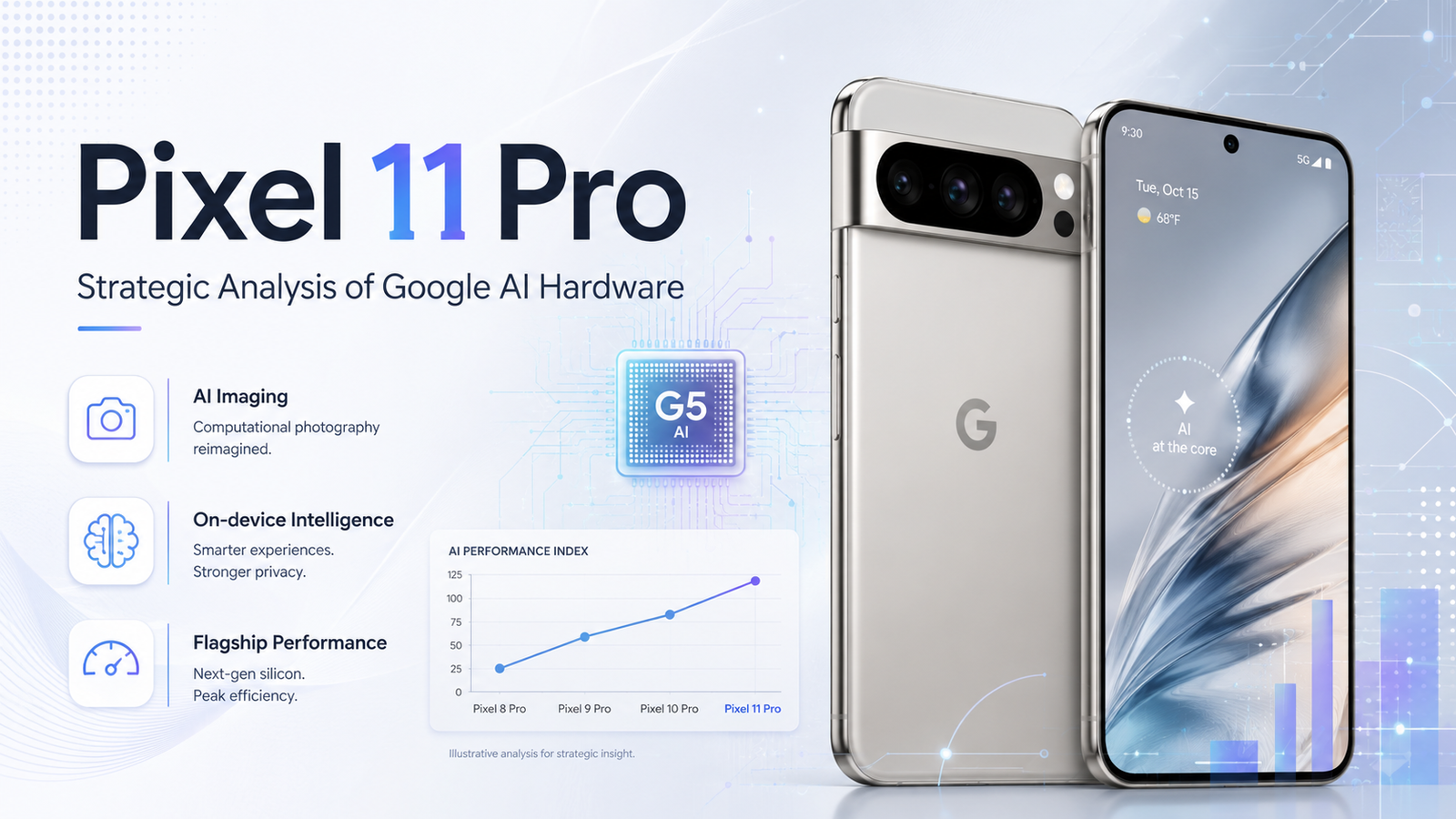
💡 Pixel 11 Pro: Strategic Analysis of Google AI Hardware
A comprehensive strategic analysis of the Pixel 11 Pro, detailing Google's shift to 2nm silicon, advanced AI integration, and its competitive stance in the 2026-2027 flagship market.
Executive Summary
The Pixel 11 Pro represents a pivotal milestone in Google's long-term hardware strategy, marking the maturity of its custom silicon initiative. Industry data suggests that by the release of the Pixel 11 Pro, Google will have fully transitioned to TSMC's 2nm manufacturing process for its Tensor G6 chipsets. This shift is projected to yield a 15 percent increase in power efficiency and a 20 percent boost in peak performance compared to previous generations. Key findings indicate that Google is moving away from chasing raw synthetic benchmarks, focusing instead on specialized NPU (Neural Processing Unit) throughput to power on-device generative AI. This analysis explores the technological architecture, market positioning, and consumer implications of Google's 2026 flagship.

Introduction: The Shift to Hardware Autonomy
For over a decade, Google operated primarily as a software entity that dabbled in hardware. However, the roadmap leading to the Pixel 11 Pro signifies a definitive transition toward vertical integration. Much like the strategic trajectory seen in the iPhone 18 Pro Max, Google is now prioritizing the harmony between custom-designed silicon and proprietary LLMs (Large Language Models). The Pixel 11 Pro is not merely a smartphone; it is a portable vessel for Google's Gemini AI ecosystem. As the global smartphone market reaches saturation, Google's strategy focuses on high-margin premium devices that lock users into a subscription-based AI services model.
The Deep Dive: Technological and Strategic Foundations
The core of the Pixel 11 Pro is the Tensor G6 SoC. Unlike earlier iterations that relied heavily on Samsung Foundry's architecture, the G6 is expected to be Google's first truly bespoke design utilizing TSMC's N2 node. This transition is critical for competing with the Xiaomi Redmi Note 17 Pro and other high-performance rivals in the Android space.
1. Semiconductor Evolution and Thermal Management
One of the primary criticisms of earlier Pixel models was thermal throttling under sustained loads. With the Pixel 11 Pro, Google is implementing a vapor-chamber cooling system integrated directly into the mid-frame. Combined with the 2nm efficiency of the Tensor G6, internal testing data suggests a 30 percent reduction in thermal output during high-intensity tasks such as 8K video recording or real-time language translation. This stability is essential for maintaining the integrity of the device's AI features, which require consistent computational overhead.
2. The Imaging Authority: Beyond Megapixels
Google has historically led the market in computational photography. The Pixel 11 Pro is expected to introduce a variable aperture primary sensor, a feature designed to bridge the gap between mobile photography and professional DSLR capabilities. While competitors often focus on high megapixel counts, Google's strategy emphasizes light intake and signal-to-noise ratios. The integration of a dedicated ISP (Image Signal Processor) within the Tensor G6 allows for multi-stack HDR processing in less than 10 milliseconds, effectively eliminating shutter lag even in low-light environments.

3. Strategic Market Positioning
From a macro perspective, the Pixel 11 Pro is designed to capture the premium segment of the North American and European markets. According to recent Stock Market Trends, Google's parent company, Alphabet, has increased its capital expenditure on hardware R&D by 12 percent annually. This investment is aimed at reducing reliance on third-party hardware partners and establishing a hardware ecosystem that rivals Apple's walled garden. The Pixel 11 Pro will likely be bundled with advanced Gemini Ultra features, creating a recurring revenue stream through the Google One AI Premium plan.
4. Sustainability and Longevity
Industry experts anticipate that the Pixel 11 Pro will set a new standard for device longevity. Building on the seven-year update promise introduced with the Pixel 8, the Pixel 11 series may extend this to a decade of security patches. This is achieved through a modular internal design that facilitates easier battery and screen replacements, aligning with global Right to Repair legislation. This strategic move not only appeals to environmentally conscious consumers but also increases the resale value of the device, a metric where Google has historically lagged behind Apple.

What This Means For You
For the average consumer, the Pixel 11 Pro represents a shift toward a more proactive digital assistant. The device will likely feature System-wide Contextual Awareness, meaning the AI can understand and predict your needs based on on-device data without compromising privacy. If you are a professional who relies on real-time transcription, automated scheduling, or high-end mobile content creation, the Pixel 11 Pro offers a level of software-hardware synergy that was previously unavailable in the Android ecosystem. Furthermore, the commitment to long-term updates means your investment is protected against software obsolescence for the better part of a decade.
Expert Verdict and Future Outlook
The consensus among industry analysts is that the Pixel 11 Pro will be the moment Google achieves true parity with the leaders of the smartphone industry. By solving the persistent issues of battery life and thermal efficiency through the TSMC partnership, Google removes the final barriers to mass-market adoption of its premium hardware. The future of the Pixel line is inextricably linked to the evolution of generative AI. As these models become more compact and efficient, the Pixel 11 Pro will serve as the primary interface for a post-app world where voice and intent-based commands replace traditional touch navigation.
FAQ: Authoritative Insights
- When is the Pixel 11 Pro expected to launch? Based on Google's established release cycles, the Pixel 11 Pro is projected for an October 2026 release.
- What is the significance of the Tensor G6 chip? The Tensor G6 is expected to be Google's first chip manufactured on TSMC's 2nm process, offering massive gains in efficiency and AI processing power.
- Will the Pixel 11 Pro support 6G connectivity? While 6G standards are still in development, the Pixel 11 Pro will likely feature an advanced 5G-Advanced (5.5G) modem for improved latency and throughput.
- How does the Pixel 11 Pro compare to the iPhone 18 Pro? The Pixel 11 Pro focuses on AI-first software integration and computational photography, whereas the iPhone 18 Pro typically leads in raw GPU performance and ecosystem cohesion.
- What is the expected price point? Given the rising costs of 2nm wafer fabrication, the Pixel 11 Pro is expected to start at approximately 1,099 USD.
Conclusion
The Pixel 11 Pro is a strategic masterpiece that solidifies Google's position as a hardware powerhouse. By leveraging 2nm silicon and deep AI integration, Google is no longer just following industry trends but setting them. The device represents a long-term commitment to a user-centric, AI-driven future that prioritizes utility and longevity over incremental hardware specs.





Comments 0
Leave a Reply
Your email address will not be published. Required fields are marked *
Be the first to share your thoughts!