
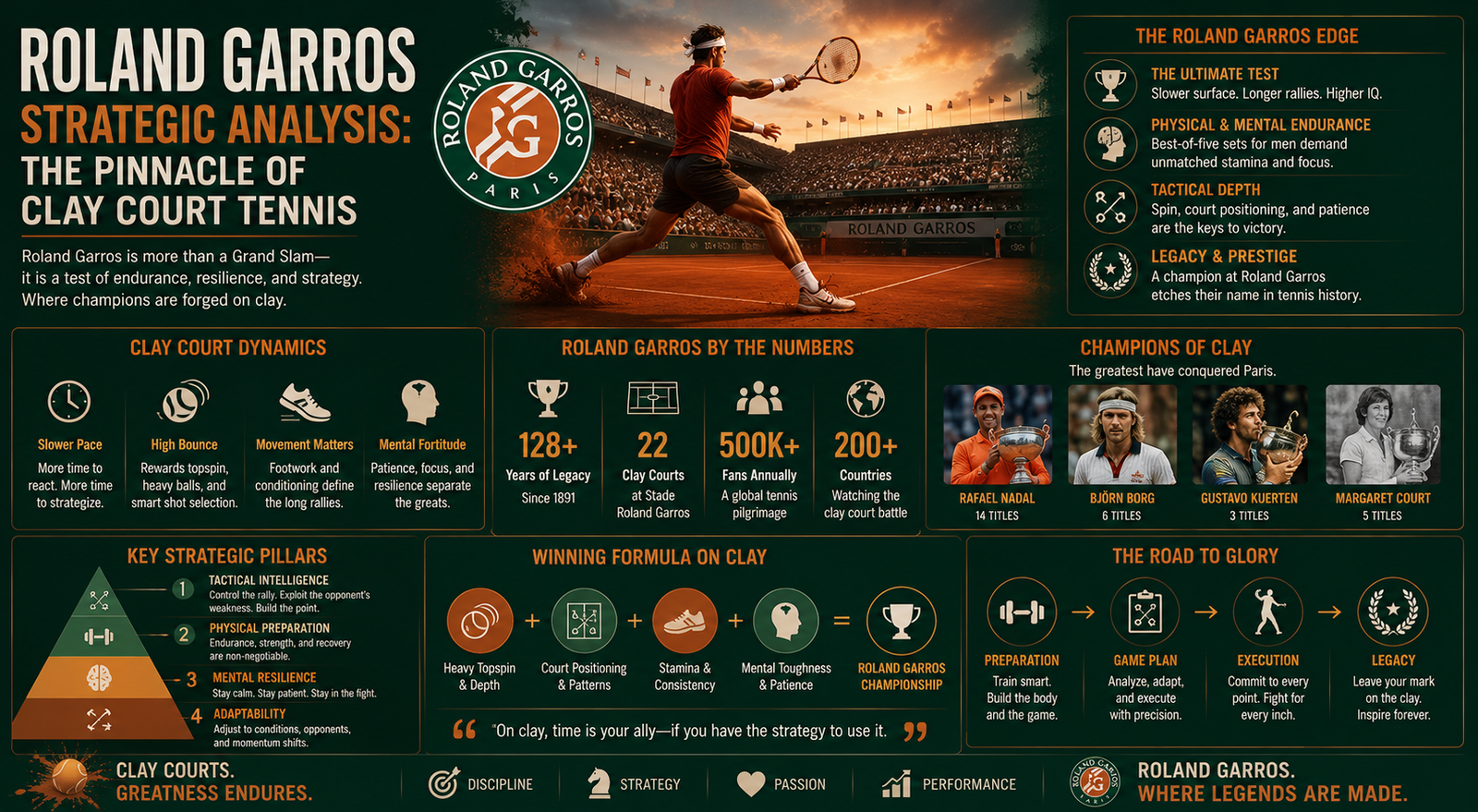
💡 Roland Garros Strategic Analysis: The Pinnacle of Clay Court Tennis
An authoritative analysis of the French Open, examining its economic impact, technical surface dynamics, and the strategic evolution of elite clay court performance.
Executive Summary
Roland Garros, also known as the French Open, represents the ultimate test of physical endurance and mental fortitude in professional tennis. In 2024, the tournament announced a record-breaking total prize pool of 53.5 million Euros, a 7.8 percent increase from the previous year. This strategic analysis examines the technical composition of the red clay surface, which reduces ball speed by approximately 20 to 25 percent compared to grass or hard courts, and the shifting commercial landscape of the French Tennis Federation (FFT). Key findings indicate a transition toward power-baseline strategies and the integration of advanced stadium technology, including retractable roofs on both Court Philippe-Chatrier and Court Suzanne-Lenglen, to mitigate the financial risks associated with adverse weather conditions.
Introduction
The French Open stands as the second Grand Slam of the calendar year and the only one contested on red clay. Established in 1891, the tournament has moved beyond its historical roots to become a multibillion-dollar commercial entity. Unlike the fast-paced grass of Wimbledon or the predictable bounce of the US Open, Roland Garros demands a unique tactical approach characterized by heavy topspin, sliding movement, and extended rally lengths. As the sport moves into a post-legend era, the tournament serves as a critical barometer for the future of global tennis viewership and sponsorship engagement.
The Engineering of the Red Clay Surface
The iconic red clay of Roland Garros is not actually made of clay in the traditional sense. It is a sophisticated engineering feat consisting of five distinct layers. The foundation begins with a layer of large stones for drainage, followed by crushed gravel, a layer of clinker (residue from volcanic rock), and a thick layer of white limestone. The final visible surface is a thin coating of crushed brick, approximately 1 to 2 millimeters thick. This specific composition creates a high-friction environment that significantly alters ball physics.
- Ball Speed Reduction: The surface absorbs a substantial portion of the ball's horizontal velocity.
- Higher Bounce: The vertical component of the bounce is accentuated, often pushing the ball above the opponent's shoulder height.
- Movement Mechanics: Players must master the art of sliding into shots, a technique that requires specific footwear and core stability.
The environmental conditions play a decisive role in match outcomes. On hot, dry days, the clay becomes faster and the bounce more pronounced. Conversely, humidity makes the clay damp and heavy, slowing the game further. Understanding the impact of these variables is as much about science as it is about sport, similar to how meteorologists evaluate weather dynamics to predict atmospheric changes. When the air is heavy, the ball picks up moisture from the clay, becoming heavier and harder to hit for winners.
Economic Impact and Commercial Strategy
The French Tennis Federation (FFT) has executed a masterful commercial strategy over the last decade. The modernization of the Porte d'Auteuil site, which cost an estimated 380 million Euros, has allowed the tournament to increase its hospitality capacity and media production value. Broadcasting rights remain the primary revenue driver, with partnerships spanning Amazon Prime Video, France Télévisions, and international networks ensuring a global reach of over 200 territories.
The 2024 prize money distribution reflects the tournament's commitment to supporting lower-ranked players. While the men's and women's singles champions each receive 2.4 million Euros, the most significant percentage increases were seen in the early rounds. First-round losers now receive 73,000 Euros, a move designed to sustain the professional ecosystem. This financial structure mirrors the valuation models seen in other sectors, such as market pricing and valuation, where long-term stability is prioritized over short-term concentration of wealth.
Tactical Evolution: Power vs. Patience
Historically, Roland Garros was the domain of the patient counter-puncher. However, data from the last five years indicates a shift. The average speed of the forehand has increased, and players are now using heavy topspin not just for safety, but as an offensive weapon. For example, a Mirra Andreeva strategic analysis highlights how the new generation of players utilizes aggressive court positioning to take time away from opponents, even on the slower red dirt.
Top-tier athletes like Alexander Zverev have demonstrated that a powerful serve and dominant baseline game can be effective on clay if paired with lateral movement efficiency. The strategic use of the drop shot has also increased by 15 percent in the men's game over the last three tournaments, serving as a vital tool to exploit the deep court positioning typical of clay-court rallies.
Modernization and Sustainability
The introduction of night sessions in 2021 marked a significant shift in the tournament's scheduling strategy. By offering a marquee match at 8:15 PM local time, Roland Garros has captured prime-time television audiences and increased ticket revenue. However, this has introduced new challenges regarding player recovery and local noise ordinances. From a sustainability perspective, the tournament has implemented a zero-plastic policy for fans and utilizes 100 percent renewable energy for its operations, aligning with global ESG (Environmental, Social, and Governance) standards.
What This Means For You
For the casual observer or the professional analyst, understanding Roland Garros requires looking beyond the scoreline. The tournament is a case study in resilience and adaptation. If you are following the event, pay attention to the length of the rallies; any match averaging more than six shots per point indicates a high-intensity physical battle. For those interested in the business of sports, the French Open demonstrates how a heritage brand can modernize without losing its traditional identity. Actionable takeaways include observing how players manage their energy over five sets and noting the strategic importance of the second serve return, which is more critical on clay than any other surface.
Expert Verdict / Future Outlook
The future of Roland Garros is intrinsically linked to technological integration and the global diversification of the player pool. We expect to see the implementation of Electronic Line Calling (ELC) on clay within the next two years, a move that has been delayed due to the technical difficulty of tracking ball marks on a shifting surface. Furthermore, as the tournament continues to expand its digital footprint, the use of AI-driven analytics for real-time fan engagement will become standard. The French Open will remain the ultimate physical test, but it will increasingly be won by those who can combine raw power with data-driven tactical precision.
FAQ
Why is the French Open played on red clay?
The use of clay originated in 1880 when the Renshaw brothers used powdered terracotta to protect grass courts from the heat in Cannes. The tradition stuck because it provided a unique challenge and became the signature of French tennis culture.
How much does the winner of Roland Garros earn?
As of 2024, the winners of the men's and women's singles titles each receive 2.4 million Euros. The total prize pool for the entire tournament is 53.5 million Euros.
Is there a roof at Roland Garros?
Yes, Court Philippe-Chatrier has a retractable roof that can close in approximately 15 minutes. Additionally, Court Suzanne-Lenglen was equipped with a retractable roof starting in 2024 to ensure play continues during rain.
Who has won the most Roland Garros titles?
Rafael Nadal holds the record for the most men's singles titles with 14. Chris Evert holds the record for the most women's singles titles with 7.
How does clay affect the ball compared to grass?
Clay is much slower and produces a higher bounce. On grass, the ball skids and stays low, favoring short points. On clay, the ball grip is higher, favoring long rallies and tactical construction of points.
Conclusion
Roland Garros remains a vital pillar of the sporting world, combining rigorous physical demands with sophisticated commercial evolution. As the tournament continues to modernize through infrastructure and prize money equity, its status as the premier test of tennis endurance is secure. The strategic shift toward aggressive baseline play and the integration of weather-mitigation technology ensure that the French Open will continue to set the standard for clay-court excellence in the decades to come.





Comments 0
Leave a Reply
Your email address will not be published. Required fields are marked *
Be the first to share your thoughts!