
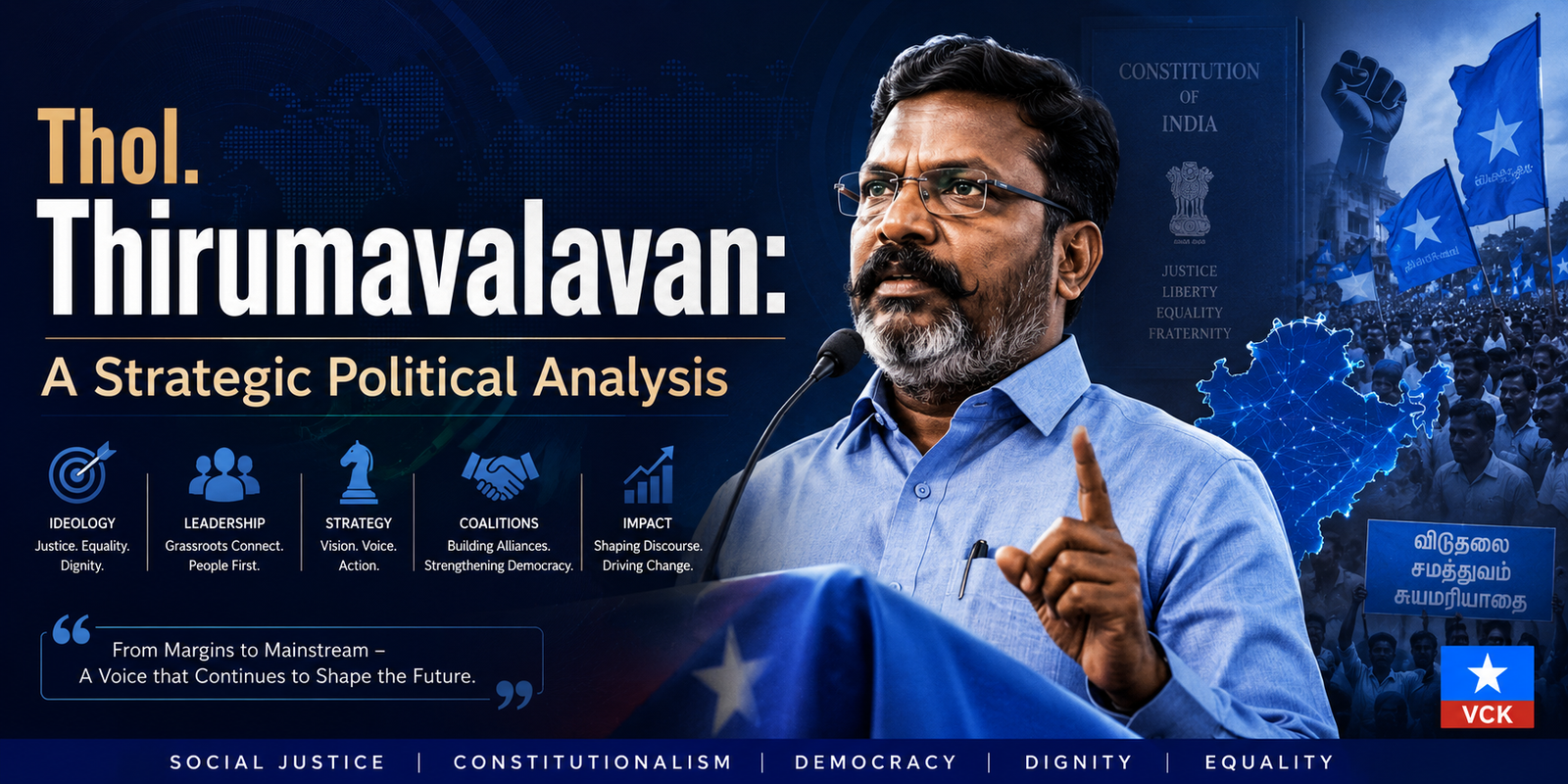
💡 Thol. Thirumavalavan: A Strategic Political Analysis
A comprehensive strategic analysis of Thol. Thirumavalavan, his leadership of the VCK, and his impact on Tamil Nadu social and political landscape.
Executive Summary
-
Thol. Thirumavalavan is the founder-president of the Viduthalai Chiruthaigal Katchi (VCK) and one of the most influential political leaders in Tamil Nadu and South India.
-
His political journey reflects a major shift in the socio-political structure of Tamil Nadu, especially in representing marginalized communities within mainstream politics.
-
Before entering politics, Thirumavalavan worked in the government forensic department. Later, he moved into activism during the politically active environment of the 1980s.
-
Over the years, he transformed the VCK from a protest-oriented movement into a recognized electoral and political force.
-
In the 2024 Lok Sabha elections, the VCK achieved a 100 percent success rate in the seats contested using its own party symbol. This highlighted the party’s growing voter support and stronger political identity.
-
His leadership combines Ambedkarite, Periyarist, and Marxist ideologies, making him an important figure in regional and national coalition politics.
-
Today, Thirumavalavan plays a major role not only in Dalit politics but also in shaping alliance strategies within the INDIA bloc and Tamil Nadu’s broader political framework.
Introduction
-
The political rise of Thol. Thirumavalavan is considered an important example of how marginalized communities can gain institutional and democratic representation in India.
-
Born in Anganoor, he initially pursued a stable government career before entering social activism and politics.
-
Through consistent activism and political engagement, he emerged as one of the leading Dalit voices in India.
-
Apart from politics, he is also known for his academic achievements and intellectual contributions. He holds a Ph.D. and frequently uses research and public discourse to address social inequality.
-
His influence extends beyond the Dalit community and impacts state-level governance, public policy, and national political alliances.
-
Thirumavalavan’s political methods focus on social justice, representation, coalition-building, and ideological consistency.
-
His leadership style has made him a significant figure in Tamil Nadu politics and an important participant in national political discussions.
The Deep Dive: Strategic Evolution and Electoral Impact
-
To understand Thirumavalavan’s current political position, it is important to examine the strategic transformation of the VCK over the past three decades.
-
The organization originally operated as the Dalit Panthers of India (DPI), which was mainly known as a militant protest movement focused on social justice issues.
-
Under Thirumavalavan’s leadership, the movement gradually evolved into the Viduthalai Chiruthaigal Katchi (VCK) during the late 1990s and formally entered electoral politics.
-
This transition was challenging because the party needed to maintain its activist roots while adapting to the realities of alliance-based electoral politics in Tamil Nadu.
-
A major turning point came during the 2024 General Elections when Thirumavalavan insisted that VCK candidates contest using the party’s own “Pot” symbol instead of the symbols of larger alliance partners like the DMK.
-
This decision was seen as a calculated political strategy aimed at strengthening the independent identity and visibility of the VCK among voters.
-
The strategy proved successful as Thirumavalavan won from the Chidambaram constituency, while D. Ravikumar secured victory in Villupuram.
-
These victories strengthened the VCK’s position within the DMK-led alliance and increased its ideological influence in Tamil Nadu politics.
-
The party’s growing importance also highlighted the need for stronger cooperation between ideological allies to maintain social balance and representative governance in the state.
-
Another important aspect of Thirumavalavan’s leadership is his focus on intellectual and cultural influence.
-
He has authored several books, participated in international forums, and consistently promoted discussions on caste census, equality, and social justice.
-
His support for a self-enumeration census reflects his belief in data-driven governance and equitable distribution of public resources.
-
By combining activism, electoral politics, academic engagement, and policy advocacy, Thirumavalavan has built connections with civil society groups and international human rights organizations.
-
This multidimensional political strategy has helped him expand his influence beyond traditional electoral politics and establish himself as a major socio-political leader in India.
Data Points and Statistical Overview
- Electoral Growth: In the 2021 Tamil Nadu Assembly elections, the VCK contested 6 seats and won 4, achieving a significant presence in the state legislature.
- 2024 Performance: The party secured over 1.5 million votes across the two constituencies it contested, showcasing a high concentration of voter mobilization.
- Demographic Influence: VCK’s core strength lies in the northern and coastal districts of Tamil Nadu, where the Dalit population is substantial and politically active.
- Legislative Activity: As a Member of Parliament, Thirumavalavan has consistently raised issues regarding the Prevention of Atrocities Act and the rights of Sri Lankan Tamils, maintaining a 75 percent plus attendance record in several sessions.
What This Means For You
For the general observer and the politically engaged citizen, the rise of Thol. Thirumavalavan signifies a broadening of the democratic space in India. It suggests that identity-based movements can successfully integrate into the parliamentary system without losing their core advocacy goals. For businesses and policy analysts, his influence means that social justice and affirmative action will remain central themes in Tamil Nadu’s legislative agenda. Understanding his priorities is essential for anyone looking to navigate the regulatory and social environment of the state.
Expert Verdict and Future Outlook
Industry experts and political scientists view Thirumavalavan as a stabilizing force in Tamil Nadu politics. His ability to channel grassroots anger into democratic participation has likely prevented more radicalized forms of social unrest. Looking ahead, the challenge for Thirumavalavan will be the 2026 State Assembly elections. There is growing pressure from within his party to demand a share in the state power structure, potentially seeking cabinet positions. His success will depend on whether he can convince the DMK leadership that the VCK brings enough value to the table to warrant a formal coalition government model, a concept currently foreign to Tamil Nadu’s major Dravidian parties.
FAQ
1. What is the significance of Thol. Thirumavalavan winning on the Pot symbol?
Winning on an independent symbol rather than a major ally's symbol proves the VCK's inherent strength and ensures that the party's identity is not subsumed by the larger coalition partner.
2. How does Thirumavalavan balance Tamil Nationalism with Dalit rights?
He argues that the liberation of the Tamil people is incomplete without the liberation of the Dalits, effectively merging the two ideologies into a unified struggle for social and regional autonomy.
3. What is his stance on the National Education Policy (NEP)?
Thirumavalavan has been a vocal critic of the NEP, arguing that it centralizes power and could potentially marginalize students from rural and underprivileged backgrounds.
4. Why is his role in the INDIA bloc important?
As a prominent Dalit face from the South, he provides the national alliance with ideological depth and helps consolidate the marginalized vote bank against the centralizing tendencies of the ruling national parties.
5. What are the primary challenges facing the VCK today?
The primary challenges include expanding the party's footprint into Southern Tamil Nadu and managing the high expectations of a youth base that is increasingly demanding a greater share of administrative power.
-
Thol. Thirumavalavan has transformed the meaning and role of Dalit leadership in modern Indian politics.
-
Through a combination of academic knowledge, grassroots activism, and strategic political alliances, he has successfully brought the VCK from the margins of politics into a position of significant influence.
-
His political journey demonstrates how regional leaders can balance the interests of marginalized communities while also participating in broader democratic governance and coalition politics.
-
Thirumavalavan’s leadership style reflects a mix of social justice advocacy, intellectual engagement, and practical political strategy.
-
Over the years, he has strengthened the VCK’s identity and expanded its role within Tamil Nadu’s political structure.
-
His growing influence suggests that the future of regional politics in India may increasingly depend on leaders who can connect community-based concerns with larger state and national political agendas.
-
As Tamil Nadu approaches its next major electoral phase, the political decisions and alliance strategies of Thirumavalavan are expected to play an important role in shaping the state’s social and political direction.





Comments 0
Leave a Reply
Your email address will not be published. Required fields are marked *
Be the first to share your thoughts!