
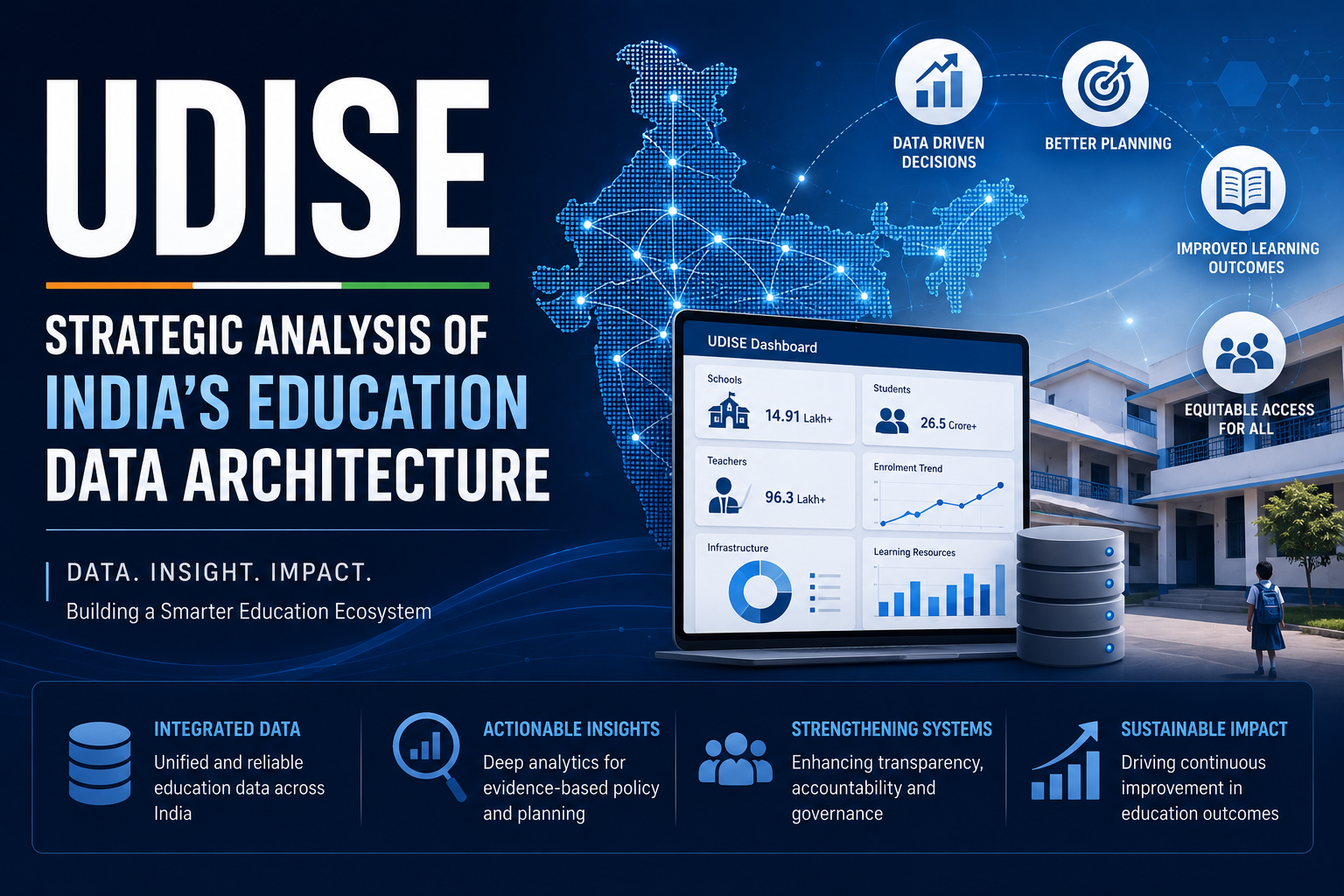
💡 UDISE: Strategic Analysis of India's Education Data Architecture
A comprehensive deep dive into the Unified District Information System for Education (UDISE+), analyzing its impact on Indian policy, infrastructure, and student outcomes.
Executive Summary
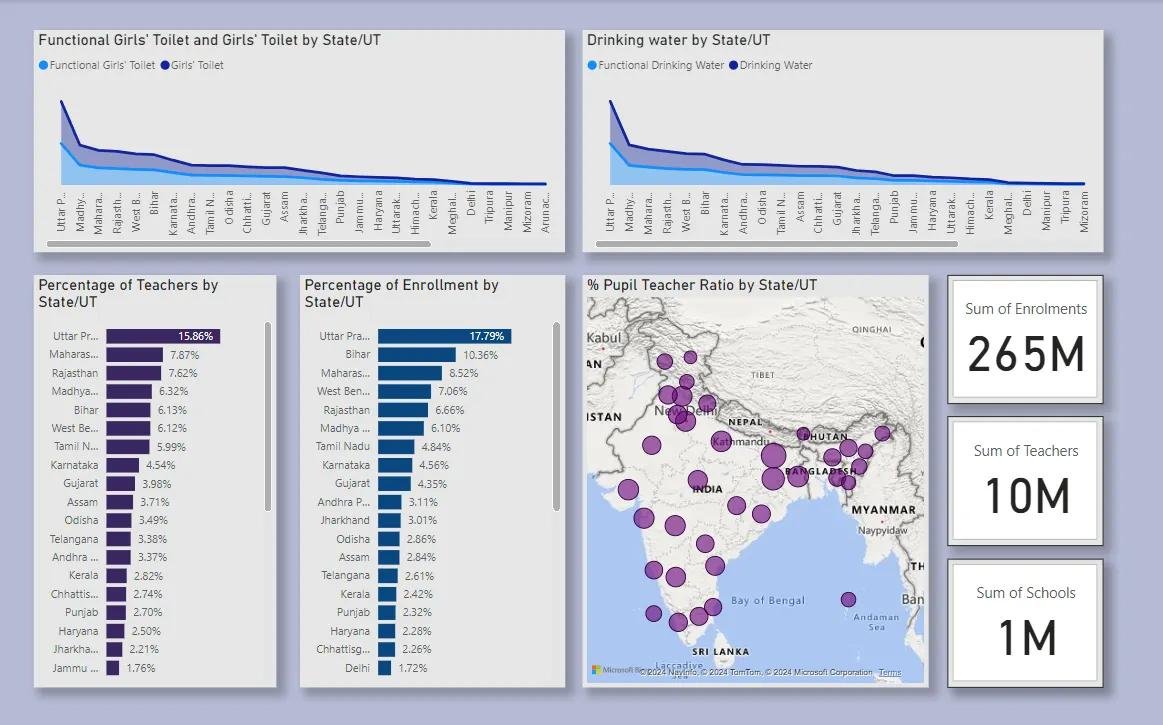
The Unified District Information System for Education, commonly known as UDISE, represents one of the largest Management Information Systems in the global educational landscape. Managed by the Department of School Education and Literacy under the Ministry of Education, India, this system tracks data across more than 1.48 million schools, 9.5 million teachers, and 265 million students. Recent data from the UDISE plus 2021-22 report indicates a significant stabilization in the Gross Enrolment Ratio (GER) at the primary level, which remains above 100 percent, signifying universal access. This analysis highlights the transition from traditional data collection to the UDISE plus digital ecosystem, which utilizes real-time tracking to eliminate data silos and improve resource allocation across 28 states and 8 union territories.
Introduction
In the framework of national development, data serves as the foundational architecture for reform. The Unified District Information System for Education (UDISE) was initiated in 2012-13 by integrating the District Information System for Education (DISE) for primary schooling and the Secondary Education Management Information System (SEMIS). However, the real transformation occurred with the launch of UDISE plus in the 2018-19 academic year. This shift moved the system from a paper-based, slow-moving reporting mechanism to an online, real-time platform designed to provide a single source of truth for the Indian education sector. By capturing data on school infrastructure, teacher profiles, and student enrollment, UDISE allows for a granular understanding of the challenges facing the worlds second-largest education system. This system is not merely a database; it is a strategic tool for achieving the goals outlined in the National Education Policy (NEP) 2020.
The Deep Dive: Architectural Integrity and Data Accuracy
The core of UDISE plus lies in its Data Capture Format (DCF), which collects information on over 1,000 variables. These variables range from basic school identification to complex indicators such as the availability of functional toilets, drinking water, electricity, and digital hardware. One of the most critical aspects of the current system is the implementation of the SDMS (Student Database Management System), which tracks individual student progress through a unique Permanent Education Number (PEN). This level of tracking is essential for addressing the high dropout rates observed in transition years, particularly between the primary and upper primary levels.
Statistical evidence from recent cycles shows a marked improvement in school infrastructure. For instance, the percentage of schools with functional electricity has risen to nearly 89 percent, up from 73 percent in 2018-19. Furthermore, the Pupil-Teacher Ratio (PTR) has seen a steady improvement, now standing at approximately 26:1 for primary schools, which is well within the norms established by the Right to Education (RTE) Act. These improvements are not accidental; they are the result of data-driven budgeting where funds are directed toward districts identified as lagging by UDISE metrics. This systematic approach to development is similar to how urban centers manage growth, as seen in the Ahmedabad: Strategic Analysis of India's Industrial Hub report, where data infrastructure supports industrial scaling.
Digital transformation within UDISE plus also includes GIS mapping of schools. By mapping the coordinates of nearly 1.5 million institutions, the government can identify unserved habitations. This spatial data is crucial for the Samagra Shiksha scheme, ensuring that no child has to travel more than the prescribed distance to reach a school. The integration of such high-level technology requires significant investment, mirroring the capital flows and infrastructure developments often discussed in Stock Market Trends: Strategic Analysis of Global Equities, where technological adoption is a key indicator of long-term value.
What This Means For You
For the general public, parents, and educators, UDISE plus is a tool for transparency and accountability. Here is a breakdown of its practical implications:
- School Choice and Verification: Parents can use the UDISE code of a school to verify its recognition status and infrastructure claims, ensuring a safe environment for their children.
- Policy Advocacy: Researchers and NGOs use UDISE data to advocate for better facilities in specific districts, using hard evidence to push for legislative change.
- Resource Allocation: For school administrators, accurate UDISE reporting ensures they receive the correct amount of government funding for mid-day meals, uniforms, and textbooks.
- Career Tracking: For teachers, the system provides a digital identity that tracks their qualifications and service history, simplifying transfers and promotions.
Expert Verdict and Future Outlook
The future of UDISE lies in the integration of Artificial Intelligence and Machine Learning to predict dropout patterns before they occur. By analyzing historical data on attendance and socio-economic factors, the system could alert authorities to schools where student retention is likely to fall. Experts suggest that the next phase of UDISE will involve a tighter integration with the National Digital Education Architecture (NDEAR), creating a seamless flow of data between state-level systems and the central repository. The ultimate goal is to move from descriptive analytics (what happened) to prescriptive analytics (what we should do). As India continues to refine its educational data, the focus must remain on data privacy and the security of student information to maintain public trust in this massive digital exercise.
FAQ: Authoritative Insights
Question: What is a UDISE Code and why is it important?
Answer: A UDISE Code is a unique 11-digit identifier assigned to every school in India. It is mandatory for all recognized schools and is used for all official correspondence, funding requests, and tracking school performance across national databases.
Question: How often is UDISE data updated?
Answer: Data is collected annually. The reference date for data collection is typically September 30th of the academic year, ensuring that enrollment figures reflect the start of the session.
Question: Is UDISE plus data accessible to the public?
Answer: Yes, the Ministry of Education provides a public portal where stakeholders can access School Report Cards and district-level snapshots, though individual student data is kept confidential for privacy reasons.
Question: How does UDISE plus ensure data accuracy?
Answer: The system employs a multi-layered verification process. Data entered at the school level must be verified by the Cluster Resource Coordinator (CRC), followed by the Block Education Officer (BEO) and the District Education Officer (DEO).
Question: Does UDISE cover private schools?
Answer: Yes, UDISE plus is a mandatory reporting system for all schools, including government, government-aided, private unaided, and other recognized categories like Madrasas.
Conclusion
The UDISE plus system stands as a testament to India's commitment to a data-driven educational future. By centralizing information for 265 million students, the platform provides the empirical evidence necessary to bridge the gap between policy intent and classroom reality. While challenges in data entry speed and rural internet connectivity remain, the strategic transition to a fully digital ecosystem has already yielded significant dividends in infrastructure parity and enrollment tracking. For the system to reach its full potential, continued focus on data integrity and real-time intervention is essential. The evolution of UDISE is not just a technical update; it is a fundamental shift in how a nation envisions the growth of its future generations.





Comments 0
Leave a Reply
Your email address will not be published. Required fields are marked *
Be the first to share your thoughts!