
💡 USDC: Strategic Analysis of Stablecoin Market Authority
A comprehensive strategic analysis of USDC, examining its reserve transparency, regulatory compliance, and role in the global digital economy.
Executive Summary
USD Coin (USDC) has established itself as one of the leading regulated stablecoins in the digital asset ecosystem. Currently maintaining a market capitalization exceeding 35 billion dollars, USDC represents a critical bridge between traditional finance and decentralized protocols. This analysis highlights that USDC is backed 100 percent by highly liquid assets, including cash and short-term U.S. Treasuries, held in the custody of regulated U.S. financial institutions. Key data points indicate that Circle, the issuer of USDC, provides monthly reserve attestation reports reviewed by a leading independent accounting firm, ensuring a high standard of transparency. The strategic shift toward institutional adoption and integration with major payment processors like Visa and Stripe positions USDC as a foundational pillar of the future financial infrastructure.
Introduction: The Evolution of the Digital Dollar
The rise of stablecoins has transformed the landscape of digital finance, moving the conversation from speculative volatility to functional utility. USDC was launched in 2018 through a collaboration between Circle and the CENTRE consortium, with Coinbase as an early strategic partner, designed to provide a price-stable digital asset that functions like a dollar on the blockchain. Unlike early iterations of digital currencies, USDC was built with a compliance-first mindset. This strategic orientation has allowed it to establish itself as a major stablecoin despite market downturns and regulatory scrutiny affecting other projects. Modern investment strategies often prioritize assets that mitigate volatility while maintaining the speed of blockchain technology. As the global economy moves toward 24/7 settlement cycles, the role of a programmable, regulated dollar becomes increasingly important for institutional participants.
Quick Take: 5 Key Pillars of USDC Stability
- Full Reserve Backing: Every USDC token in circulation is backed by an equivalent value of highly liquid U.S. dollar-denominated reserve assets.
- Regulatory Compliance: Circle operates within a regulated framework and maintains regulatory registrations and licenses across multiple jurisdictions.
- Monthly Attestations: Transparency is maintained through regular third-party reserve attestations, providing public information about the assets backing USDC.
- Multi-Chain Ubiquity: USDC operates natively across multiple blockchain networks, including Ethereum, Solana, and Avalanche, ensuring broad liquidity and accessibility.
- Institutional Integration: Partnerships and integrations with major financial institutions and payment companies provide USDC with growing utility across payments, settlement, trading, and digital financial infrastructure.
Practical Explanation: How USDC Maintains its 1:1 Peg
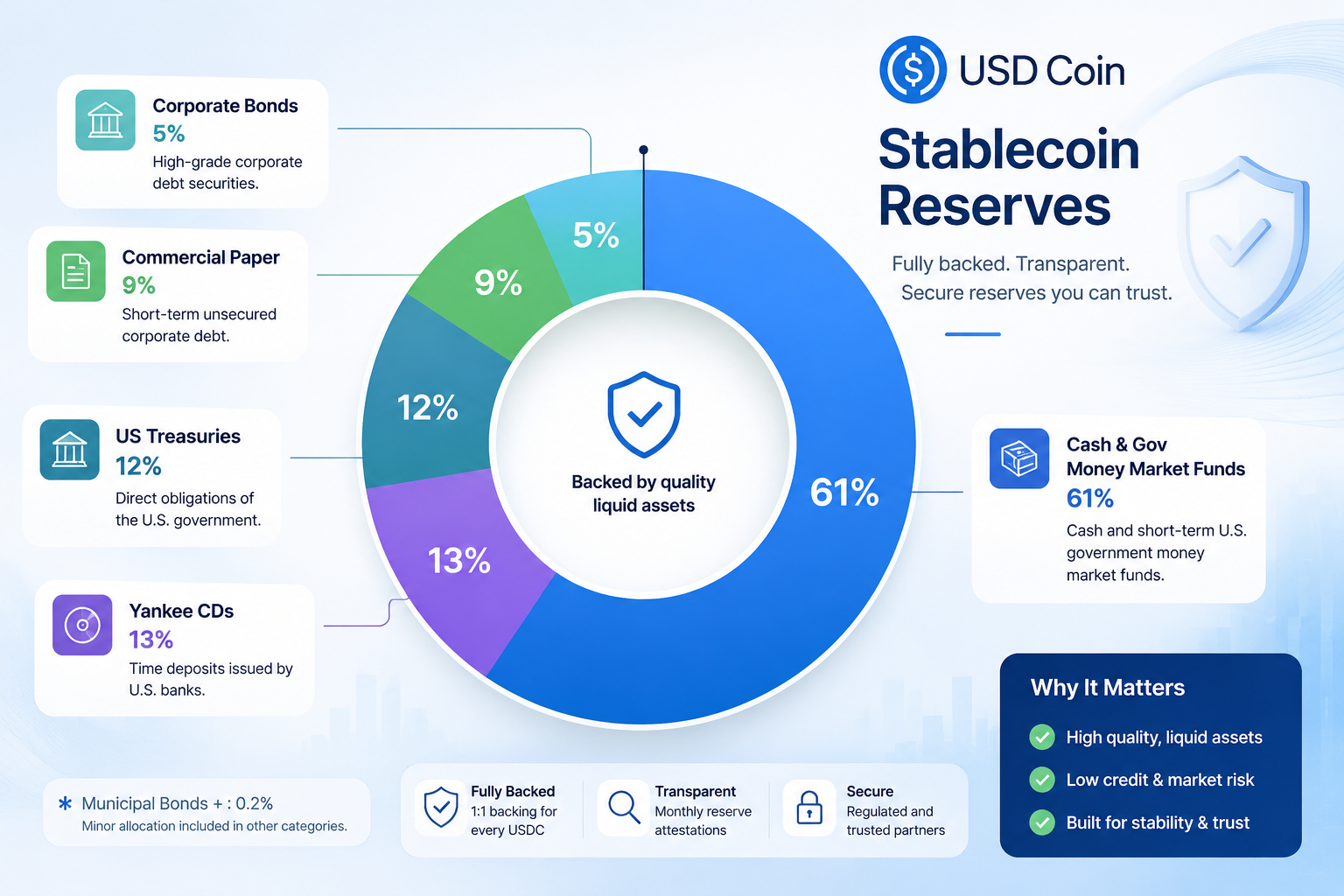
The stability of USDC relies on a simple yet rigorous minting and burning mechanism. When an eligible institutional user wants to acquire USDC through Circle Mint, they send U.S. dollars to Circle’s designated bank accounts. Once the fiat is received and verified, Circle mints the corresponding amount of USDC and sends it to the user’s digital wallet. Conversely, when an eligible user wants to redeem USDC for fiat, they return the tokens through Circle’s redemption process, where the corresponding USDC is burned and the equivalent amount of U.S. dollars is returned to the user’s bank account. This mechanism helps maintain USDC’s 1:1 redeemability with the U.S. dollar. To manage the reserve requirements, Circle utilizes the Circle Reserve Fund, a government money market fund managed by BlackRock. The fund is structured as a 2a-7 money market fund and is subject to applicable SEC regulations.
Real-life Use Cases: Institutional Settlement and Global Remittances
USDC has moved beyond the realm of crypto trading and into real-world applications. In the sector of global remittances, USDC allows individuals and businesses to transfer value across borders, potentially reducing the cost and settlement time associated with traditional wire transfers. In institutional finance, the asset can be used for atomic settlement. Instead of waiting for traditional settlement periods, firms can settle certain blockchain-based transactions in seconds, potentially reducing counterparty and settlement risk. Just as hardware manufacturers establish mobile authority through iterative updates and ecosystem integration, Circle maintains USDC adoption by embedding it into the core software of fintech companies. This enables businesses to accept payments in USDC and automatically convert them to local currency, or vice versa, streamlining international commerce.
Comparison Table: USDC vs. USDT vs. DAI
| Feature | USDC (USD Coin) | USDT (Tether) | DAI (Sky Protocol) |
|---|---|---|---|
| Issuer | Circle | Tether | Decentralized Protocol |
| Backing | Cash & Treasuries | Diversified Reserves | Over-collateralized Crypto & Real-World Assets |
| Transparency | Monthly Attestations | Quarterly Reports | On-chain Transparency |
| Regulatory Status | Regulated Framework | Varies by Jurisdiction | Decentralized Protocol |
| Primary Use | Institutional/DeFi | Trading Liquidity | DeFi Native |
Expert Tips: Navigating Regulatory Shifts and Yield Opportunities
Investors and corporate treasurers should keep a close eye on the shifting regulatory landscape. The implementation of the Markets in Crypto-Assets (MiCA) regulation in Europe has set a new benchmark for stablecoin issuers, and Circle was among the first major global stablecoin issuers to achieve MiCA compliance through its French Electronic Money Institution (EMI) license. For those seeking yield, USDC offers several avenues. While direct holdings do not pay interest, users can deploy USDC into decentralized finance (DeFi) lending protocols or centralized yield products. However, it is vital to distinguish between the safety of the USDC token itself and the risk of the platform where it is deposited. Always prioritize platforms with proven security track records and high total value locked (TVL).
Advantages vs. Limitations: The Strategic Trade-offs of Centralization
The primary advantage of USDC is its predictability and legal recourse. Because it is issued by a centralized entity, users have a point of contact for large-scale redemptions and a clear legal framework for dispute resolution. However, this centralization is also its main limitation. Circle has the authority to block or freeze USDC addresses when required by applicable law or under its policies. This capability is a necessary feature for regulatory compliance but is viewed by some decentralization purists as a trade-off against the core tenets of blockchain technology. Furthermore, the reliance on the traditional banking and financial system means that USDC remains exposed to risks associated with its reserve infrastructure, as demonstrated by the banking turmoil surrounding Silicon Valley Bank in early 2023.

What This Means for Your Portfolio
For the average participant, USDC can serve as a digital stable asset. During periods of high market volatility, moving assets into USDC can help preserve value relative to more volatile crypto assets without the need to exit the blockchain ecosystem entirely. It provides a stable unit of account for calculating gains and losses and can act as a liquid reserve for entering new positions quickly. The interaction between private issuers and leadership and governance bodies will help shape the next decade of finance. Incorporating USDC into a portfolio can be a strategic way to participate in the digitization of the dollar while maintaining a focus on risk management and transparency.
Expert Verdict: The Future of USDC in a Regulated Digital Economy
The strategic trajectory of USDC suggests it could become one of the leading standards for a regulated digital dollar. Circle's public-market status and increased regulatory scrutiny have strengthened the company's focus on transparency and compliance. The integration of the Cross-Chain Transfer Protocol (CCTP) allows USDC to move between supported blockchains without relying on traditional third-party token bridges, addressing an important security challenge in cross-chain transfers. USDC could play a significant role in the development of digital-dollar infrastructure, providing blockchain-based efficiency alongside private-sector regulatory compliance.
FAQ
Is USDC safer than USDT?
From a regulatory and transparency perspective, USDC is generally viewed as having a strong compliance and reserve-transparency framework. However, the relative safety of USDC and USDT depends on factors such as jurisdiction, use case, liquidity, and individual risk tolerance. USDT currently has greater overall market capitalization and trading liquidity.
Can USDC lose its peg?
While USDC is designed to maintain a 1:1 value with the U.S. dollar, a temporary de-peg can occur because of market conditions or concerns about reserves or financial institutions. USDC briefly traded below $1 in March 2023 following the collapse of Silicon Valley Bank, before returning to its intended value after Circle announced measures to ensure full redemption of USDC.
Who manages the USDC reserves?
USDC reserves are held in a combination of cash and highly liquid assets, including the Circle Reserve Fund managed by BlackRock and deposits held with financial institutions. The exact composition of reserves can change over time.
Is USDC a CBDC?
No, USDC is a private stablecoin issued by Circle. A CBDC would be a digital form of central-bank money issued by a central bank, such as the Federal Reserve in the United States.
How can I use USDC for business?
Businesses can use USDC for applications such as cross-border B2B payments, treasury operations, digital commerce, and other blockchain-based payment use cases through services and infrastructure provided by Circle and other providers.
Important Note: Financial Disclaimer: This content is for educational purposes only and does not constitute professional financial advice. Always consult with a certified financial planner before making investment decisions.
Conclusion
USDC represents the integration of traditional financial infrastructure with blockchain-based efficiency. By prioritizing transparency, regulatory compliance, and institutional partnerships, it has established a significant position in the stablecoin market. As the digital economy matures, the role of USDC could continue to expand, potentially serving as important infrastructure for the global movement of digital value.





Comments 0
Leave a Reply
Your email address will not be published. Required fields are marked *
Be the first to share your thoughts!