
💡 VVAN: Strategic Analysis of Value-Added Networks
A comprehensive strategic analysis of Value-Added Networks (VVAN), exploring their role in global B2B communication, data security, and supply chain efficiency.
Executive Summary
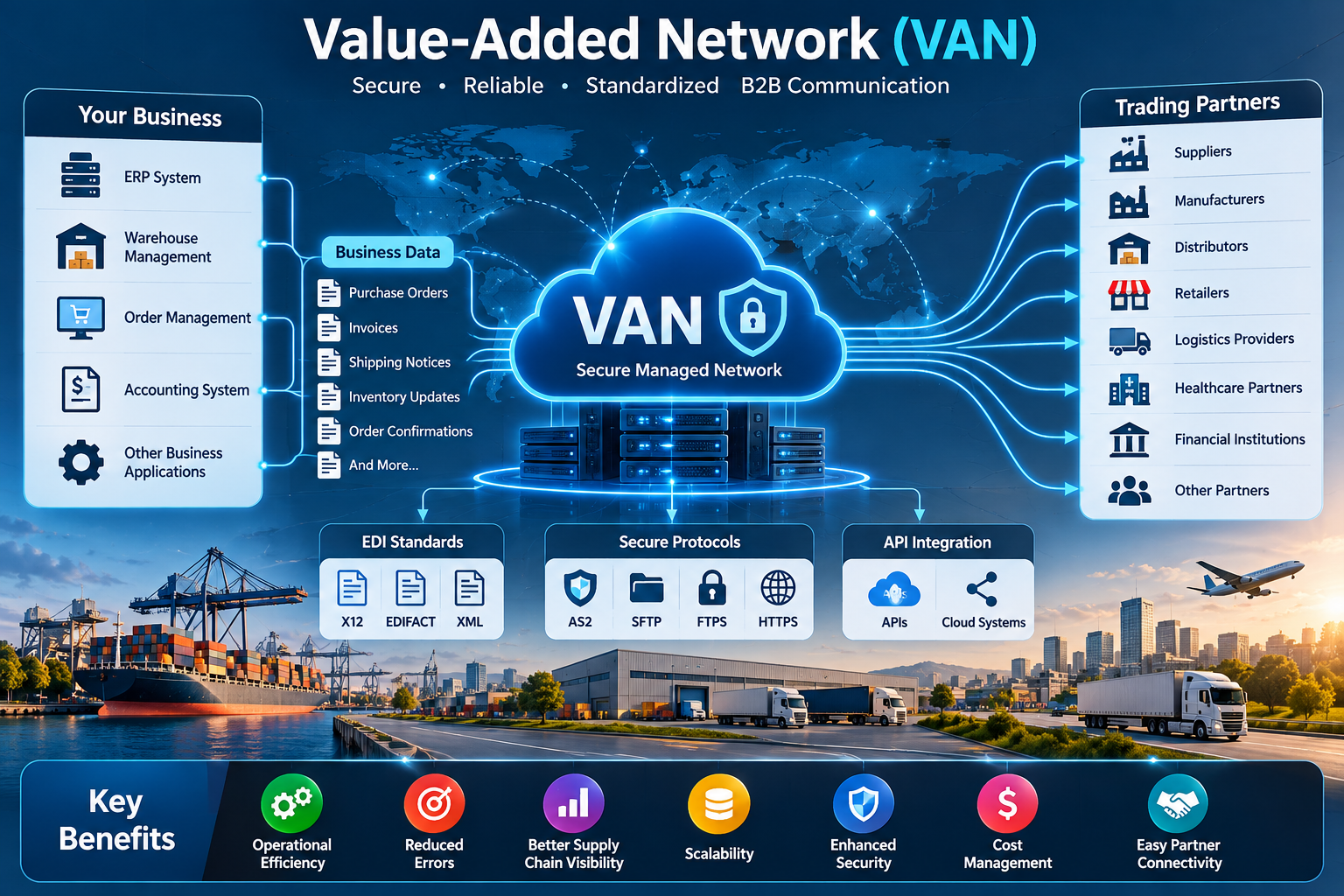
Value-Added Networks (VANs) are managed communication and integration services that help organizations exchange Electronic Data Interchange (EDI) documents and other business information with trading partners. Rather than requiring every business to build and maintain individual connections with every partner, a VAN can provide centralized connectivity, message routing, protocol support, monitoring, and transaction visibility.
VANs have historically played an important role in industries where standardized B2B document exchange is critical, including retail, manufacturing, logistics, healthcare, and financial services. They can support common EDI standards and communication methods while helping businesses connect different enterprise systems and trading partners.
At the same time, the B2B integration landscape is evolving. APIs, cloud platforms, managed integration services, and hybrid architectures are increasingly being used alongside traditional EDI. Modern VAN solutions are therefore moving beyond simple message exchange toward broader integration capabilities that can connect legacy systems with cloud applications and modern APIs.
The strategic value of a VAN ultimately depends on the organization's trading-partner requirements, transaction volumes, security needs, existing technology environment, and integration strategy.

Introduction
In modern global commerce, businesses depend on the reliable exchange of information between customers, suppliers, logistics providers, manufacturers, distributors, and other trading partners.
Purchase orders, invoices, shipping notices, order confirmations, inventory information, and other business documents often need to move between systems operated by different organizations. These systems may use different technologies, data formats, communication protocols, and security requirements.
A Value-Added Network (VAN) provides a managed environment for exchanging this information.
Instead of requiring organizations to create and maintain separate connections with every trading partner, a VAN can centralize connectivity and provide services such as message routing, document handling, protocol conversion, monitoring, acknowledgments, and transaction tracking.
This makes VAN technology particularly relevant to businesses that operate large and complex B2B ecosystems.
The Strategic Role of VANs in B2B Communication
The primary purpose of a VAN is to simplify and manage business-to-business data exchange.
Consider a manufacturer that works with dozens or hundreds of suppliers and customers. Each organization may use a different ERP, accounting system, warehouse-management platform, or integration technology.
Without a managed integration layer, maintaining individual connections can become complex.
A VAN can act as an intermediary between these systems.
For example:
ERP System → VAN → Trading Partner
The VAN can receive an EDI document, validate or process it according to the configured workflow, route it to the appropriate trading partner, and provide transaction visibility.
Common documents exchanged through EDI environments include:
- Purchase Orders
- Invoices
- Advance Shipping Notices
- Purchase Order Acknowledgments
- Shipment Information
- Inventory Updates
- Remittance Information
- Product and Catalog Data
This structured exchange reduces the need for businesses to manually enter information from one system into another.
How a Value-Added Network Works
A typical VAN-based EDI environment involves several components:
1. Business Application
The organization's ERP, warehouse-management system, order-management platform, or other business application generates the required business information.
2. EDI Translation
The business information may need to be converted into a standardized format such as ANSI X12, EDIFACT, XML, or another supported format.
3. VAN Connectivity
The VAN receives the document and manages the configured communication and routing process.
4. Trading Partner Delivery
The document is delivered to the appropriate trading partner using a supported communication method.
5. Acknowledgment and Monitoring
Depending on the implementation, organizations can receive acknowledgments and monitor transaction status.
6. Processing by the Receiving System
The receiving organization can translate the message into a format understood by its ERP or other business application.
This process helps businesses automate document exchange while reducing the amount of manual intervention required.
VAN and EDI: Understanding the Relationship
VAN and EDI are closely related, but they are not the same thing.
EDI is a standardized method for electronically exchanging structured business documents.
VAN is a managed network or service that can provide connectivity and additional services for exchanging those documents.
In simple terms:
EDI defines how business information is structured, while a VAN can provide the managed infrastructure and services used to exchange that information.
Organizations can also exchange EDI documents through direct connections or internet-based protocols without using a traditional VAN.
This means businesses should evaluate their integration requirements rather than assuming that a VAN is required for every EDI implementation.
Security and Compliance Considerations
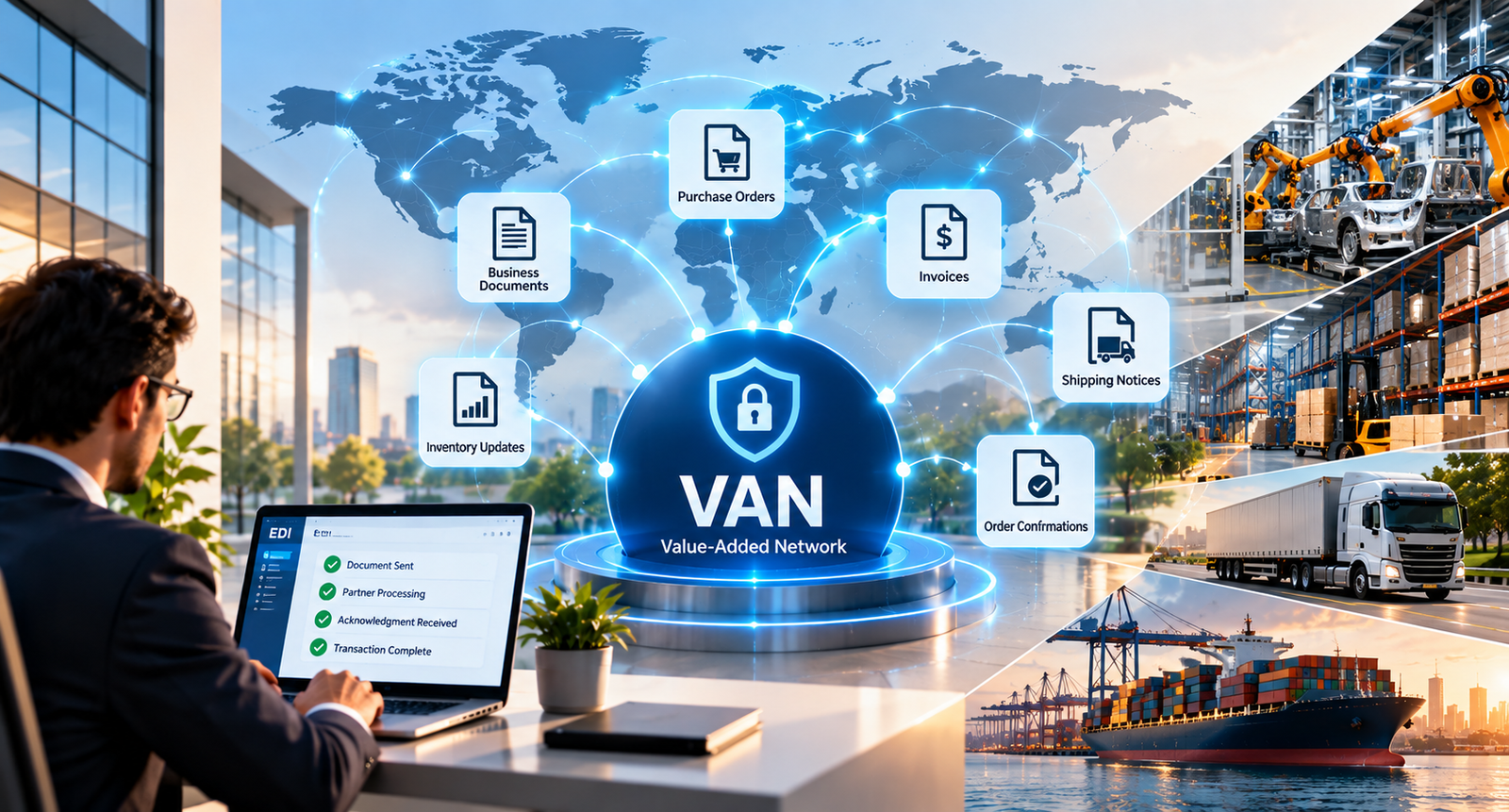
Security is an important consideration in B2B data exchange because business documents can contain commercially sensitive information.
Depending on the provider and implementation, VAN environments can support capabilities such as:
- Authentication
- Encryption
- Secure data transmission
- Access controls
- Message monitoring
- Transaction logging
- Delivery tracking
- Audit information
- Data-retention controls
Common communication technologies used in EDI environments include AS2, SFTP, FTPS, HTTPS, and other secure protocols, depending on the trading-partner requirements and VAN provider.
A VAN should not automatically be considered secure simply because it is a VAN. Organizations should evaluate the provider's security architecture, encryption practices, authentication mechanisms, access controls, monitoring capabilities, data retention policies, compliance certifications, and incident-response procedures.
VANs in Healthcare and HIPAA Environments
Healthcare organizations frequently exchange standardized electronic transactions involving health plans, providers, clearinghouses, and other participants.
When electronic protected health information (ePHI) is involved, organizations must consider applicable HIPAA requirements and security safeguards.
The HIPAA Security Rule requires covered entities and business associates to implement appropriate administrative, physical, and technical safeguards for protecting ePHI. These requirements include controls related to confidentiality, integrity, availability, access, authentication, audit controls, and transmission security.
A VAN or EDI provider may support secure transmission and transaction management, but using a VAN by itself does not make an organization HIPAA compliant. Compliance depends on the overall technology environment, policies, contracts, safeguards, and risk-management practices.
When a cloud or technology provider acts as a business associate and handles ePHI, appropriate contractual arrangements such as a Business Associate Agreement (BAA) may also be required.
The Importance of Audit Trails and Transaction Visibility
One of the important benefits of managed B2B integration is transaction visibility.
Businesses may need to know:
- When a document was sent
- When it was received
- Whether delivery succeeded
- Whether an acknowledgment was returned
- Whether a transaction failed
- Which trading partner received the document
- Whether a message requires further investigation
Maintaining transaction records can help organizations with operational troubleshooting, compliance reviews, reconciliation, and dispute resolution.
For large organizations processing thousands or millions of transactions, this visibility can become an important operational capability.
VANs and Supply Chain Efficiency
Supply chains depend on timely and accurate information.
A delayed purchase order can affect production. A missing shipping notification can affect warehouse planning. An incorrect invoice can delay payment.
By automating the exchange of structured business documents, EDI and VAN-based integration can help reduce manual processing and improve information flow between trading partners.
For example:
Customer Order → Purchase Order → Supplier Confirmation → Shipment Notification → Invoice → Payment
When these steps are electronically integrated, organizations can reduce repetitive manual data entry and improve the consistency of information moving between business systems.
The actual efficiency gains will depend on the organization's processes, integration architecture, transaction volume, trading-partner requirements, and level of automation.
The Shift Toward Cloud and API Integration
The traditional VAN model is evolving as businesses adopt cloud applications and API-driven architectures.
Modern organizations may operate a combination of:
- Legacy ERP systems
- Cloud ERP platforms
- SaaS applications
- EDI systems
- APIs
- Data platforms
- Warehouse-management systems
- Transportation-management systems
- Partner portals
This creates a need for integration platforms that can connect both traditional and modern technologies.
Modern VAN and B2B integration platforms increasingly support hybrid environments where traditional EDI transactions can coexist with APIs and cloud-based applications.
For example:
Legacy ERP → EDI/VAN → Trading Partner
can exist alongside:
Cloud Application → API → Integration Platform → Trading Partner
This hybrid approach allows organizations to modernize their integration architecture without necessarily replacing every existing business system at once.
VAN vs API Integration
VAN and API integration solve related but different problems.
| Feature | VAN / EDI | API Integration |
|---|---|---|
| Primary use | Structured B2B document exchange | Application-to-application integration |
| Common formats | X12, EDIFACT, XML | JSON, XML, other formats |
| Trading partners | Well suited to established EDI ecosystems | Well suited to API-enabled partners |
| Integration style | Document/message based | Request/response or event driven |
| Legacy system support | Often strong | Depends on integration architecture |
| Partner onboarding | Can simplify established EDI relationships | Requires API availability and agreement |
| Transaction tracking | Common in managed VAN environments | Depends on API platform |
| Real-time capability | Depends on implementation | Often suitable for near-real-time use cases |
| Best fit | Complex B2B/EDI ecosystems | Modern application integration |
The choice does not always have to be VAN or API.
Many enterprises use both.
Benefits of a Value-Added Network
1. Operational Efficiency
Automating business-document exchange can reduce repetitive manual processes and allow employees to focus on higher-value activities.
2. Reduced Manual Data Entry
Electronic document exchange reduces the need to manually re-enter information between systems, potentially reducing transcription errors.
3. Trading-Partner Connectivity
A managed B2B integration service can simplify connectivity with multiple trading partners that have different technical requirements.
4. Transaction Visibility
Monitoring and transaction records can make it easier to identify successful, failed, delayed, or rejected transactions.
5. Standardization
EDI standards provide structured formats for exchanging common business documents.
6. Scalability
Organizations can use managed integration services to support growing transaction volumes and expanding trading-partner networks.
7. Security Controls
Depending on the provider, VAN services can support encryption, authentication, secure protocols, monitoring, and access controls.
8. Legacy-System Integration
VAN and EDI platforms can help organizations continue using established enterprise systems while connecting them with external trading partners and newer applications.
Potential Challenges of VAN Technology
Despite its advantages, VAN technology also has limitations.
Cost
VAN services can involve subscription, setup, transaction, connectivity, or partner-related costs depending on the provider and service model.
Vendor Dependency
Organizations may become dependent on a particular provider's infrastructure, tooling, and pricing model.
Legacy Complexity
Older EDI implementations can involve complicated mappings, custom business rules, and partner-specific requirements.
Partner Onboarding
Adding new trading partners may require testing, mapping, certification, configuration, and coordination between multiple organizations.
Modernization Requirements
Businesses with rapidly changing digital architectures may need additional API, cloud, event-driven, or integration-platform capabilities alongside traditional VAN services.
Therefore, organizations should evaluate both current requirements and long-term integration strategy before selecting a VAN provider.
What This Means for Business Leaders
For procurement teams, IT leaders, supply-chain managers, and business executives, the strategic question is not simply whether to use a VAN.
The more important question is:
What integration architecture best supports the organization's trading partners, business processes, security requirements, and future technology strategy?
A VAN may be appropriate when an organization:
- Works with many EDI trading partners
- Needs standardized B2B document exchange
- Has significant legacy-system dependencies
- Requires centralized transaction monitoring
- Needs managed partner connectivity
- Processes large volumes of structured business documents
An API-centric architecture may be more appropriate for certain modern application-integration use cases.
In many enterprises, the practical solution is a hybrid integration strategy combining EDI, VAN services, APIs, cloud applications, and other integration technologies.
How to Evaluate a VAN Provider
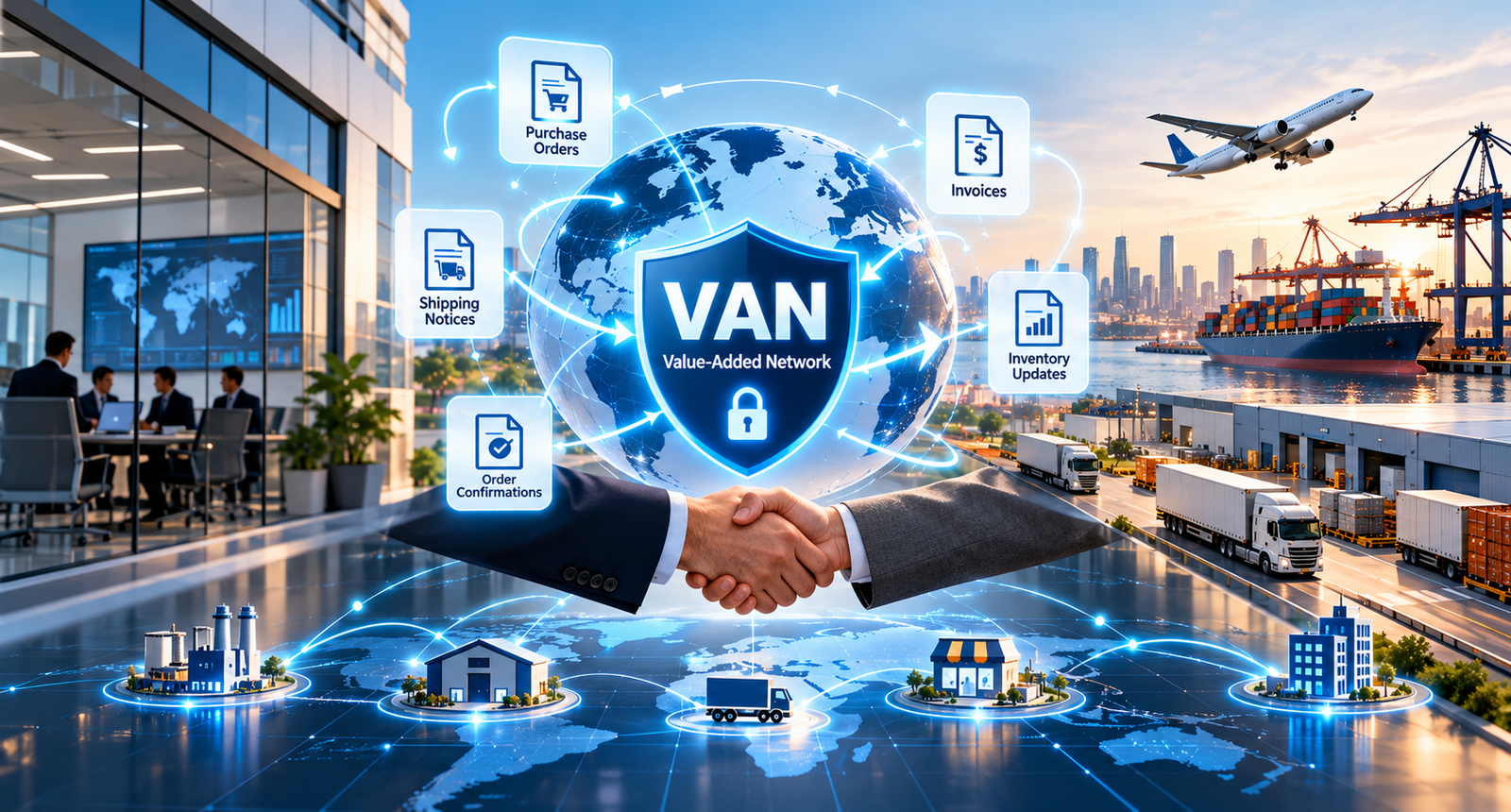
Organizations considering a VAN should evaluate providers against several factors.
Connectivity
Does the provider support the protocols and standards required by your trading partners?
EDI Standards
Does the platform support the document formats and versions required by your ecosystem?
Security
Evaluate encryption, authentication, access controls, monitoring, incident response, and security certifications.
Partner Onboarding
Consider how easily new suppliers, customers, logistics providers, and other trading partners can be added.
Monitoring and Reporting
Look for transaction tracking, alerts, error management, reporting, and searchable transaction histories.
Scalability
The platform should be capable of handling increasing transaction volumes and expanding partner networks.
API and Cloud Support
If your organization is modernizing its architecture, determine whether the provider supports APIs, cloud applications, and hybrid integration.
Pricing
Understand all applicable costs, including implementation, monthly service charges, transaction fees, partner fees, support, and additional integration services.
The Future of VAN Technology
The future of VAN technology is likely to involve greater integration between traditional EDI infrastructure and modern cloud-based technologies.
Organizations are increasingly looking for integration platforms that can connect:
ERP + EDI + VAN + APIs + Cloud Applications + Supply Chain Platforms
Automation, analytics, workflow management, API connectivity, and AI-assisted capabilities may further expand the role of B2B integration platforms.
Artificial intelligence could eventually assist with areas such as transaction anomaly detection, mapping assistance, error classification, partner onboarding, document processing, and supply-chain analytics.
However, these capabilities should complement—not replace—the fundamental requirements of reliable connectivity, security, interoperability, monitoring, and transaction management.
FAQ: Value-Added Networks
What is a Value-Added Network?
A Value-Added Network (VAN) is a managed service that facilitates electronic data exchange between organizations, commonly supporting EDI transactions and trading-partner connectivity.
What is the difference between VAN and EDI?
EDI is a standardized method for exchanging structured business documents, while a VAN is a managed network or service that can provide connectivity, routing, monitoring, and other services for that exchange.
Are VANs still relevant?
Yes. VAN-based services remain relevant for organizations that operate established EDI ecosystems and require managed B2B connectivity, transaction monitoring, standardized document exchange, and support for multiple trading partners.
At the same time, APIs and cloud integration platforms are increasingly used alongside VAN and EDI technologies.
Are VANs secure?
A VAN can provide security capabilities such as encryption, authentication, secure communication protocols, access controls, monitoring, and transaction logging. However, security depends on the specific provider, configuration, and broader organizational controls.
What protocols can be used with VAN and EDI environments?
Depending on the provider and trading-partner requirements, common technologies can include AS2, SFTP, FTPS, HTTPS, and other secure communication methods.
Can small businesses use VAN services?
Yes. Cloud-based B2B integration services can make managed EDI connectivity accessible to organizations of different sizes. The suitability depends on transaction volume, trading-partner requirements, budget, and technical needs.
Are VANs better than APIs?
They serve different integration needs. VAN/EDI environments are commonly used for structured B2B document exchange, while APIs are often used for application-to-application and near-real-time integrations.
Many businesses use both technologies as part of a broader hybrid integration strategy.
How do VAN providers charge?
Pricing varies by provider and implementation. Common models may include setup fees, subscription charges, transaction-based fees, document or data-volume charges, partner-related costs, and integration services.
Businesses should evaluate the complete pricing structure rather than comparing only the monthly subscription price.
Conclusion
Value-Added Networks remain an important component of the B2B integration landscape, particularly for organizations that depend on EDI and maintain complex networks of suppliers, customers, manufacturers, distributors, logistics providers, and other trading partners.
Their value extends beyond simply moving electronic documents. Modern VAN and B2B integration platforms can provide managed connectivity, document transformation, routing, monitoring, transaction visibility, security controls, and integration with both traditional and modern business applications.
At the same time, the technology landscape is changing. APIs, cloud platforms, automation, analytics, and AI-assisted integration are creating new possibilities for B2B communication.
The future is therefore unlikely to be based on a single integration technology. Instead, organizations will increasingly combine EDI, VAN services, APIs, cloud platforms, and intelligent automation according to their specific business and technical requirements.
For companies operating complex B2B ecosystems, the strategic priority should be to select an integration architecture that provides reliable connectivity today while remaining flexible enough to support future modernization.





Comments 0
Leave a Reply
Your email address will not be published. Required fields are marked *
Be the first to share your thoughts!