
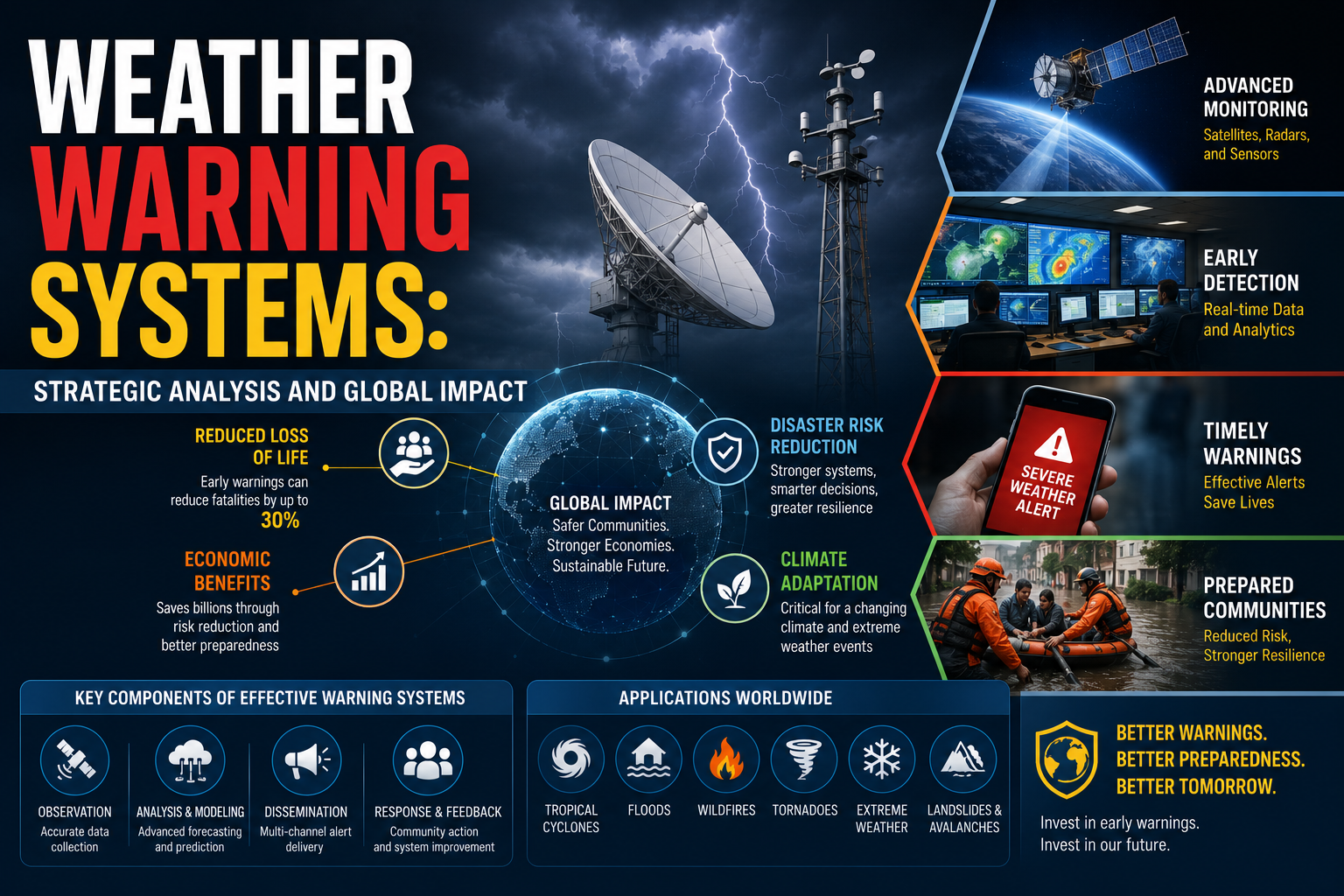
💡 Weather Warning Systems: Strategic Analysis and Global Impact
A comprehensive analysis of global weather warning systems, economic benefits, and technological advancements in meteorology and safety.
Executive Summary
Weather warning systems have transitioned from basic forecasting tools to critical components of national security and economic stability. Recent data from the World Meteorological Organization (WMO) indicates that early warning systems provide a tenfold return on investment, where spending 800 million dollars on such systems in developing nations could prevent losses of 3 to 16 billion dollars annually. This analysis examines the strategic frameworks of multi-hazard warning systems, the integration of artificial intelligence in predictive modeling, and the shift toward impact-based forecasting. Key findings suggest that while technological capabilities have reached unprecedented heights, the last mile delivery of information remains the primary challenge for global disaster risk reduction.
Introduction: The Strategic Necessity of Early Warnings
The global climate landscape is experiencing a period of intense volatility. According to the United Nations, the number of weather-related disasters has increased fivefold over the past 50 years, driven by rising global temperatures and shifting atmospheric patterns. In this context, a weather warning is no longer a mere public service announcement; it is a strategic data point that influences global supply chains, urban planning, and public safety protocols. The effectiveness of these warnings depends on a sophisticated chain of events involving data acquisition, numerical weather prediction, and rapid communication. Understanding the physics behind these events, as explored in Thunder: A Strategic Analysis of Atmospheric Physics and Safety, is essential for building resilient infrastructure that can withstand the increasing frequency of extreme weather events.
The Deep Dive: Technological and Economic Frameworks
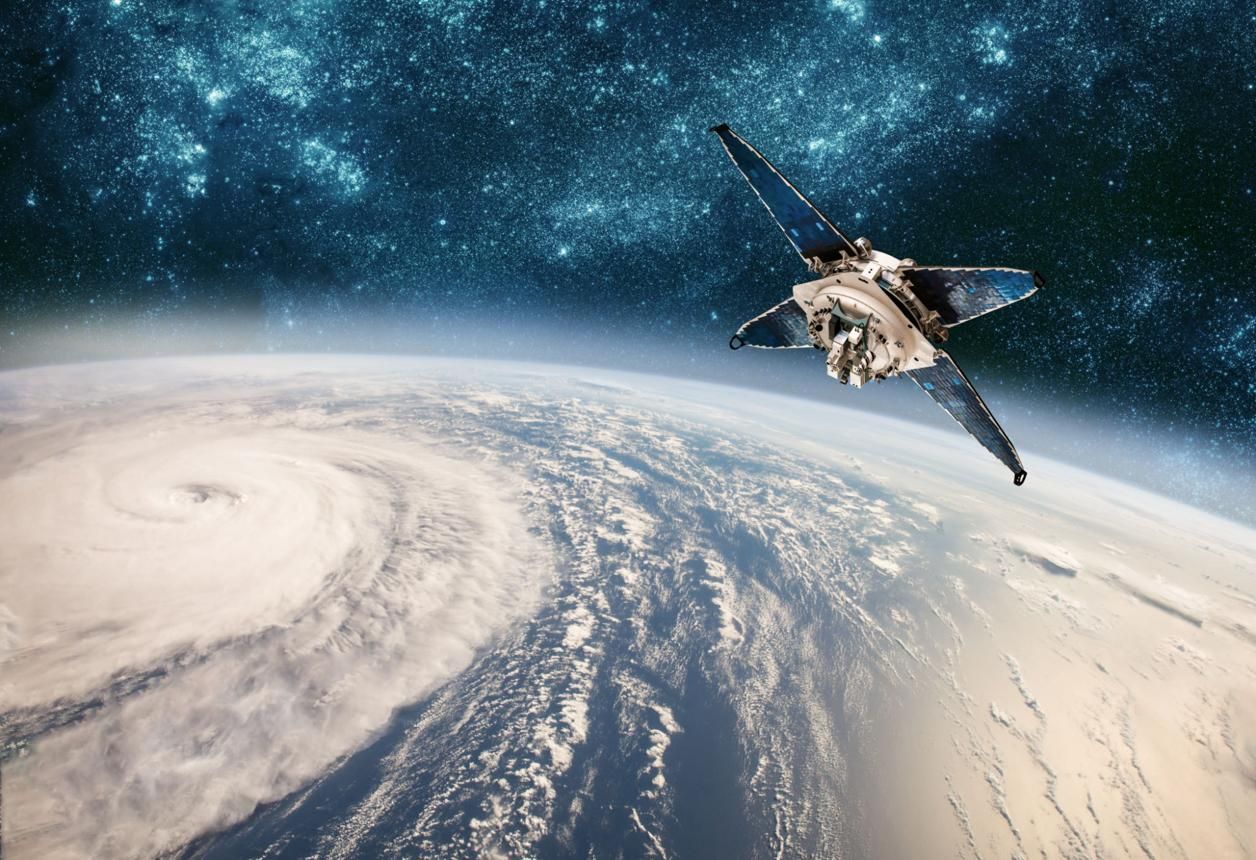
The architecture of modern weather warning systems relies on a Global Observing System that integrates thousands of surface stations, weather balloons, and over 300 satellites. This massive data inflow is processed by supercomputers capable of performing quadrillions of calculations per second. However, the raw data is only the beginning. The strategic value lies in the interpretation and the speed of dissemination.
One of the most significant shifts in the industry is the move toward Impact-Based Forecasting. Traditional warnings focused on what the weather would be, such as 50 millimeters of rain. Modern systems focus on what the weather will do, such as predicting that 50 millimeters of rain will lead to the flooding of specific arterial roads. This approach is vital for sectors like transportation. For instance, strategic integration with Urban Traffic Management: A Strategic Global Analysis allows municipal authorities to reroute public transport and emergency services hours before a storm hits, significantly reducing the risk of gridlock and accidents.
From an economic perspective, the Global Commission on Adaptation found that giving just 24 hours notice of a coming storm or heatwave can cut the ensuing damage by 30 percent. In the United States alone, the National Weather Service estimates that its forecasts and warnings provide approximately 30 billion dollars in economic value annually to households. The private sector is also increasingly relying on hyper-local weather data to optimize operations. Energy companies use precision forecasting to manage grid loads, while the transition to CNG and Sustainable Energy Solutions requires detailed atmospheric data to ensure the safety and efficiency of energy distribution during extreme temperature fluctuations.
The Role of Artificial Intelligence and Machine Learning
Artificial Intelligence (AI) is currently disrupting traditional numerical weather prediction. Conventional models use complex mathematical equations to simulate the atmosphere, which requires massive computational power and time. New AI models, trained on decades of historical weather data, can generate accurate 10-day forecasts in seconds on a single desktop computer. Companies like Google DeepMind and NVIDIA have introduced models such as GraphCast and FourCastNet, which have demonstrated the ability to predict the track of hurricanes and the onset of extreme heatwaves with higher precision than traditional models in certain scenarios.
This technological leap is crucial for the United Nations Early Warnings for All initiative, which aims to ensure that every person on Earth is protected by early warning systems by 2027. Currently, only half of the countries worldwide have adequate multi-hazard early warning systems. The gap is particularly wide in Least Developed Countries and Small Island Developing States, where the lack of infrastructure leads to mortality rates eight times higher than in developed regions during similar weather events.
What This Means For You: Actionable Insights
- For Individuals: Prioritize official government weather apps over third-party social media reports. Official warnings are backed by rigorous data validation and legal accountability.
- For Business Owners: Incorporate weather risk assessments into your continuity plans. A 48-hour lead time on a storm warning can allow for the relocation of inventory and the implementation of remote work protocols.
- For Urban Residents: Understand the specific terminology used by local meteorological departments. A warning usually implies that a weather event is imminent or occurring, whereas a watch indicates that conditions are favorable for an event to develop.
- For Investors: Monitor how climate volatility affects sectors like agriculture, insurance, and energy. Companies with robust weather-mitigation strategies are often more resilient in the long term.
Expert Verdict and Future Outlook
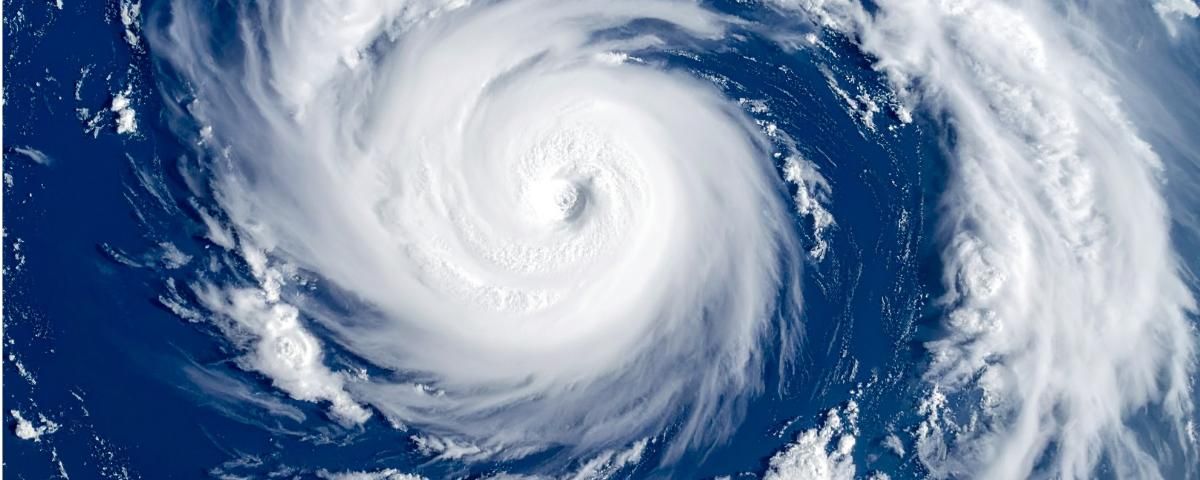
The future of weather warning systems lies in the democratization of data and the improvement of the last mile communication. While we can now predict a cyclone track with remarkable accuracy, the warning is useless if it does not reach a coastal fisherman in time or in a language they understand. The integration of satellite-based emergency messaging directly to mobile phones, even without cellular service, represents the next frontier in safety technology. We expect to see a global standardization of warning colors and symbols to ensure that travelers and residents alike can immediately grasp the severity of a situation regardless of linguistic barriers. The focus will shift from global models to hyper-local, street-level forecasting enabled by IoT sensors and crowdsourced data.
Frequently Asked Questions
What is the difference between a weather watch and a weather warning?
A weather watch indicates that the risk of a hazardous weather event has increased significantly, but its occurrence, location, or timing is still uncertain. A weather warning is issued when a hazardous weather event is occurring, imminent, or has a very high probability of occurring, posing a threat to life and property.
How accurate are 7-day weather forecasts today?
Modern 7-day forecasts are approximately 80 percent accurate, which is the same level of accuracy that a 5-day forecast had in the year 2000. However, accuracy decreases significantly as the timeframe extends beyond 10 days due to the chaotic nature of the atmosphere.
Why do weather warnings sometimes fail to predict the exact location of a storm?
Atmospheric dynamics involve small-scale variables that can cause a storm to shift its path by several kilometers within minutes. While large-scale patterns are predictable, micro-local impacts are influenced by terrain, urban heat islands, and sudden pressure changes.
Can AI replace human meteorologists?
AI is a powerful tool for data processing and pattern recognition, but human meteorologists remain essential for interpreting complex situations, communicating risk to the public, and making final calls on issuing life-saving warnings based on local nuances that AI might overlook.
How can I receive weather warnings if the internet goes down?
Battery-powered or hand-cranked NOAA Weather Radios (in the US) or similar terrestrial radio services globally are the most reliable backup. Many modern smartphones are also being equipped with satellite-to-cell capabilities for emergency alerts.
Conclusion
The strategic implementation of weather warning systems is a cornerstone of modern disaster risk reduction. By bridging the gap between advanced satellite data and local community action, society can significantly mitigate the economic and human costs of a changing climate. Investment in these systems is not merely a scientific endeavor but a fundamental economic and humanitarian imperative for the next decade.





Comments 0
Leave a Reply
Your email address will not be published. Required fields are marked *
Be the first to share your thoughts!