
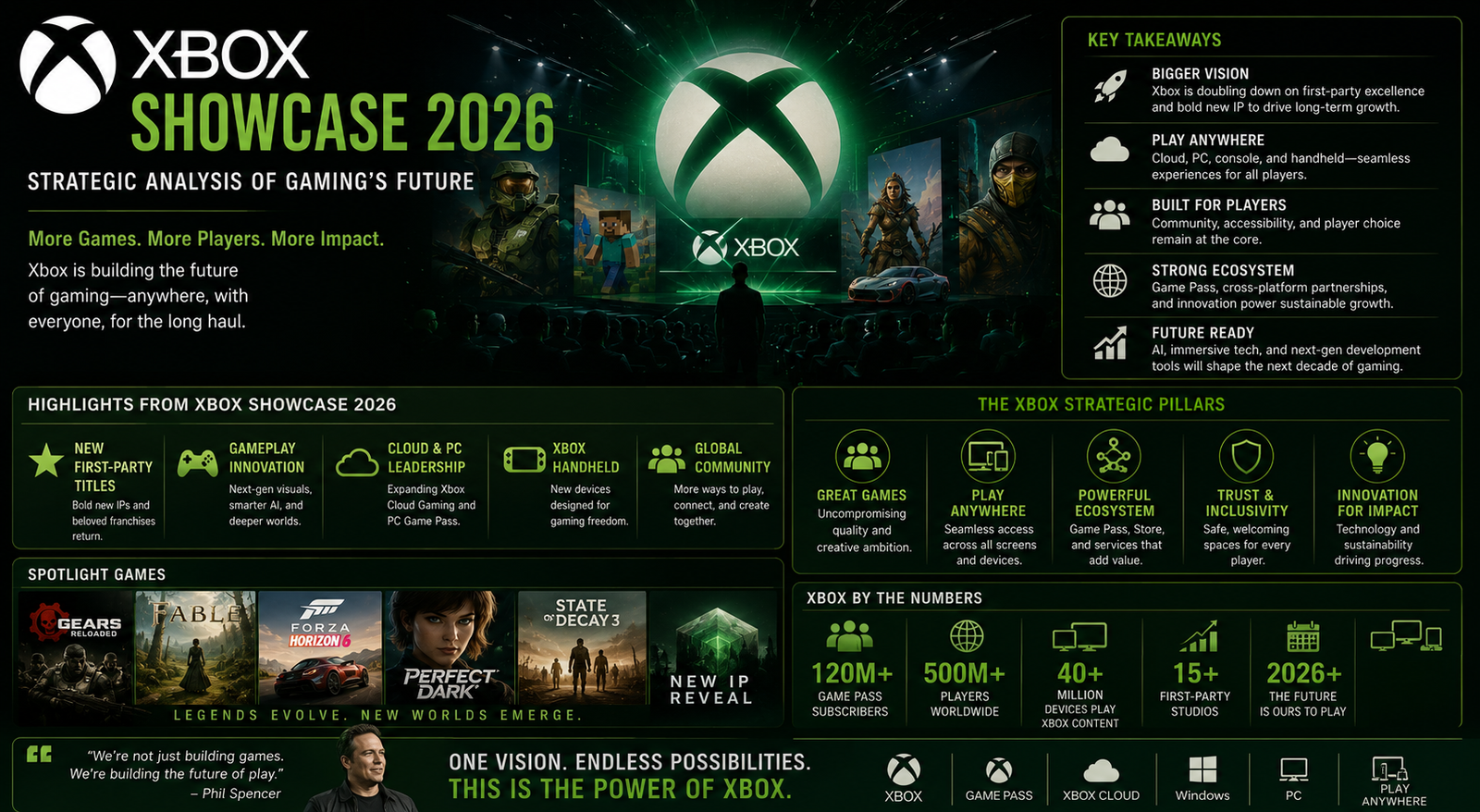
💡 Xbox Showcase 2026: Strategic Analysis of Gaming's Future
An expert analysis of the Xbox Showcase 2026, examining hardware roadmaps, the Activision-Blizzard integration, and the strategic shift toward a handheld gaming ecosystem.
Executive Summary
The Xbox Showcase 2026 represents a pivotal moment in the history of Microsoft Gaming. As the industry moves away from traditional console cycles toward a platform-agnostic ecosystem, this event is expected to reveal the most significant hardware leap in the company's history. Key findings suggest a dual-pronged strategy: the introduction of a high-performance next-generation console alongside a dedicated Xbox handheld device. With Game Pass reaching a reported 34 million subscribers as of early 2024, the 2026 strategy focuses on content density, leveraging the 68.7 billion dollar acquisition of Activision Blizzard to secure long-term market dominance. This analysis explores the technical specifications, software roadmaps, and market positioning that define the 2026 Xbox outlook.
Introduction: The Ecosystem Pivot
For decades, the success of a gaming brand was measured solely by hardware units sold. However, Microsoft has fundamentally rewritten this playbook. The Xbox Showcase 2026 is not merely a product reveal; it is a manifestation of a cloud-first, subscription-heavy business model. By 2026, the Xbox Series X and Series S will have been on the market for six years, placing them at the end of the traditional five-to-seven-year lifecycle. The context of this showcase is framed by the intense competition from Sony and the rising influence of mobile gaming platforms. Microsoft aims to bridge the gap between high-fidelity home gaming and portable convenience, creating a unified experience that transcends the living room.
THE DEEP DIVE: Hardware, Software, and Strategy
The Next-Generation Hardware Leap
Industry consensus and leaked internal documents suggest that Microsoft is targeting 2026 for its next hardware iteration. Sarah Bond, President of Xbox, has publicly stated that the next generation will deliver the largest technical leap ever seen in a hardware generation. This is expected to involve a custom silicon solution focused on Neural Processing Units (NPUs) to handle AI-driven upscaling and frame generation. While the current Xbox Series X offers 12 teraflops of GPU power, experts anticipate the 2026 flagship could target 25 to 30 teraflops, utilizing RDNA 5 architecture and advanced ray-tracing capabilities. This technological progression mirrors the shifts seen in other high-stakes digital environments, such as the rapid evolution of trading platforms discussed in the Upstox: Strategic Analysis of the Digital Trading Era, where speed and reliability are the primary drivers of user retention.
The Handheld Revolution
The most anticipated announcement for the 2026 showcase is the Xbox Handheld. Following the success of the Steam Deck and Asus ROG Ally, Microsoft is positioned to launch a native handheld device that runs a optimized version of Windows or a dedicated Xbox OS. This device is projected to offer 1080p gaming at 60 frames per second for most Game Pass titles. Strategically, this allows Microsoft to capture the portable market without relying on third-party hardware. The integration of cloud saves and cross-play ensures that the transition from a home console to a handheld is seamless, reinforcing the concept of Xbox as a service rather than a box.

First-Party Software and the Activision-Blizzard Factor
By 2026, the integration of Activision Blizzard King (ABK) will be fully realized. The showcase is expected to feature the first Call of Duty title developed entirely under the Microsoft umbrella, potentially as a day-one Game Pass exclusive. Furthermore, long-gestating projects like Fable, Perfect Dark, and the next iteration of Halo are likely to be the centerpieces of the software lineup. Microsoft is focusing on narrative-driven experiences that rival the emotional depth found in competing franchises. For instance, the industry has seen how deep character development can sustain a franchise, as analyzed in the God of War Laufey: Strategic Narrative and Character Analysis. Xbox aims to replicate this prestige through its expanded studio system, which now includes over 30 internal developers.
Subscription Growth and Digital Boundaries
Game Pass remains the cornerstone of the Xbox strategy. However, with growth slowing in the console segment, Microsoft is looking toward PC and mobile to hit its internal targets of 100 million subscribers by 2030. The 2026 showcase will likely introduce new tiers of service, perhaps including an ad-supported version for emerging markets. As the platform expands, the importance of digital safety and content moderation becomes paramount. The company must navigate the complexities of online communities, a challenge similar to the one explored in the Not Suitable for Work: Strategic Analysis of Digital Boundaries, ensuring that the ecosystem remains accessible yet secure for a global audience.
WHAT THIS MEANS FOR YOU
- For Gamers: Expect a shift toward portability. If you have been waiting to upgrade your Series S or X, 2026 will likely be the year to invest in new hardware that offers significantly better AI-enhanced visuals.
- For Subscribers: Game Pass value is set to increase with the inclusion of the full Activision Blizzard catalog, but be prepared for potential price adjustments as the service matures.
- For Investors: Microsoft Gaming is transitioning from a hardware-loss-leader model to a high-margin software and services model. Watch for hardware attachment rates and subscription churn data.
Expert Verdict: The Future Outlook
The Xbox Showcase 2026 will be the moment Microsoft either solidifies its position as the Netflix of Gaming or faces a critical identity crisis. The strategic focus on AI and portability is the correct move in a market where hardware performance is hitting diminishing returns. By leveraging its cloud infrastructure, Microsoft can reach the 3 billion gamers worldwide who do not own a console. The success of this showcase depends on two factors: the reliability of the new handheld device and the consistent delivery of high-quality first-party titles. If Microsoft can deliver on its promise of the greatest technical leap, it will redefine the parameters of the industry for the next decade.
FAQ: Authoritative Insights
Will the 2026 Xbox be a mid-gen refresh or a new generation?
Current industry indicators suggest it will be the start of a new generation, likely skipping a traditional mid-gen Pro model in favor of an early leap to the next architecture to catch competitors off guard.
Is an Xbox handheld confirmed for 2026?
While not officially confirmed, multiple leaks from reputable industry insiders and Microsoft's own hardware teases point to a 2026 release for a native handheld device.
Will Game Pass prices increase by 2026?
Given the addition of high-value Activision Blizzard content and inflation, analysts predict a tiered pricing structure where the Ultimate tier may see a moderate increase, while a lower-cost, ad-supported tier is introduced.
How will AI impact games shown in 2026?
AI will primarily be used for Super Resolution (upscaling) and more sophisticated Non-Player Character (NPC) interactions, allowing for more immersive and reactive game worlds without taxing the hardware excessively.
Can I play my existing Xbox library on the 2026 hardware?
Yes, backward compatibility is a core pillar of the Xbox brand. Microsoft has committed to ensuring that games from previous generations remain playable on future hardware.
Conclusion: Strategic Takeaway
The Xbox Showcase 2026 is poised to be a transformative event that marks the end of the console wars as we know them and the beginning of the platform wars. By focusing on a high-performance console, a versatile handheld, and a robust subscription service, Microsoft is building a resilient ecosystem. The strategic integration of massive intellectual properties and cutting-edge AI technology positions Xbox to lead the next era of interactive entertainment. For the consumer, this means more choices in how, where, and when they play, provided Microsoft can maintain the delicate balance between technical innovation and service affordability.




Comments 0
Leave a Reply
Your email address will not be published. Required fields are marked *
Be the first to share your thoughts!