
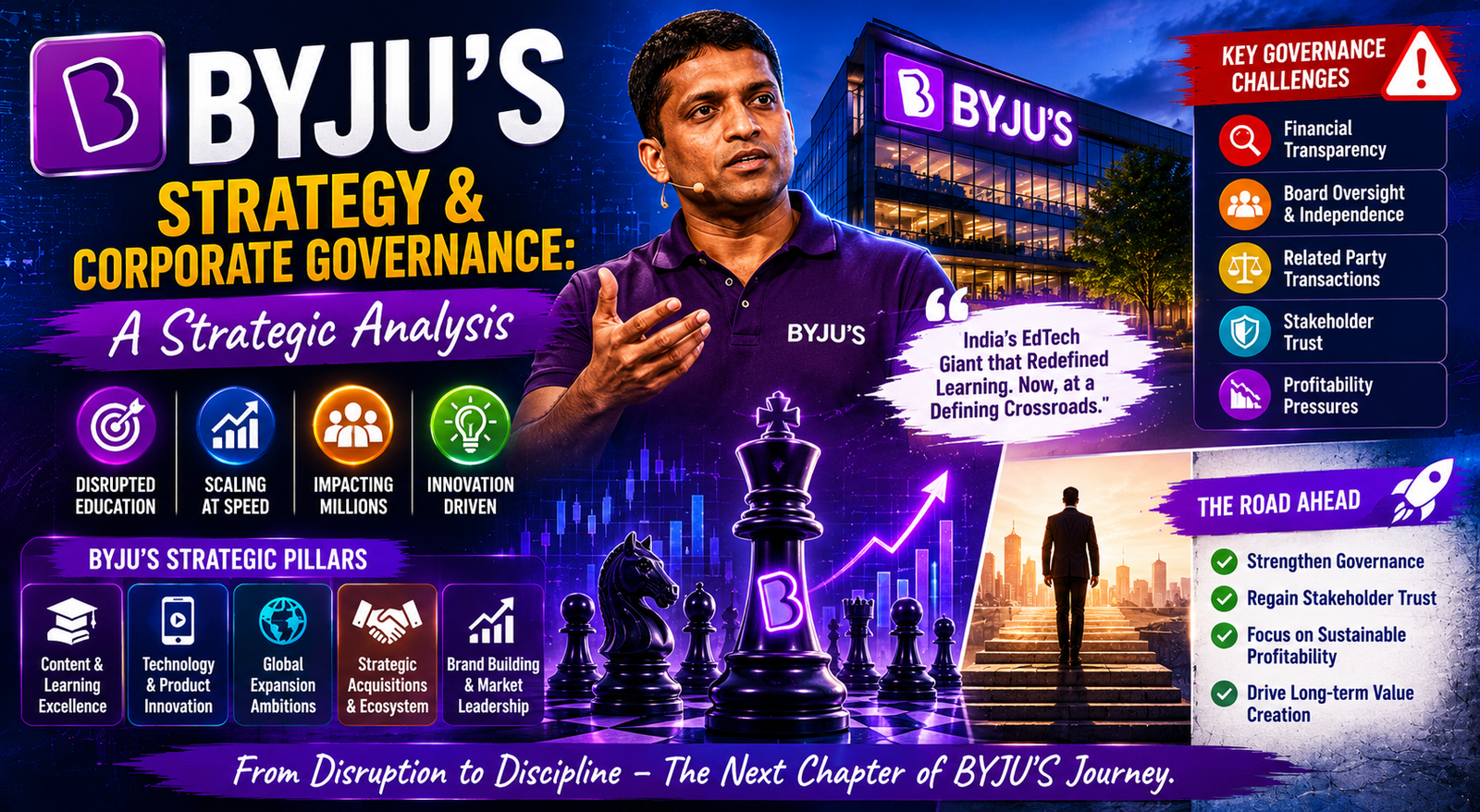
💡 Byju's Strategy and Corporate Governance: A Strategic Analysis
An in-depth analysis of Byju's aggressive expansion strategy, the subsequent corporate governance crisis, and the lessons for the global edtech industry.
Executive Summary
Byju's, once the crown jewel of the Indian startup ecosystem with a peak valuation of 22 billion dollars, currently faces a critical survival phase. This analysis examines the strategic shifts from aggressive blitzscaling to a liquidity crisis, underscored by significant corporate governance failures. Key data points include the 8,245 crore rupee loss reported in FY22, the resignation of statutory auditor Deloitte, and the ongoing legal battles over a 1.2 billion dollar Term Loan B. This report provides an authoritative look at the systemic issues within the company and the broader implications for stakeholders in the edtech sector.
Introduction
The rise of Byju's (Think & Learn Pvt. Ltd.) was nothing short of meteoric. Founded by Byju Raveendran, the platform capitalized on the digital shift in education, accelerated by the global pandemic. However, the transition from a high-growth startup to a sustainable corporate entity has been fraught with challenges. The company's story serves as a primary case study in how aggressive market capture, when decoupled from robust corporate governance, can lead to institutional instability. To understand the current state of Byju's, one must look beyond the marketing spend and examine the underlying financial structures and leadership decisions that defined its trajectory.
The Deep Dive: Strategic Ambition vs. Governance Reality
1. The Aggressive Acquisition Strategy
Byju's followed a strategy known as blitzscaling, prioritizing speed over efficiency. Between 2020 and 2022, the company spent approximately 2.5 billion dollars on acquisitions. Notable purchases included Aakash Educational Services for nearly 950 million dollars, WhiteHat Jr for 300 million dollars, and US-based Epic for 500 million dollars. While these acquisitions were intended to create a global education conglomerate, they resulted in massive integration hurdles and a high cash burn rate. The acquisition of WhiteHat Jr, in particular, became a point of contention due to high customer acquisition costs and regulatory scrutiny regarding advertising practices.
2. Corporate Governance and Transparency Issues
The most significant blow to Byju's reputation came from its internal governance. In June 2023, Deloitte Haskins & Sells resigned as the company's statutory auditor, citing a significant delay in the filing of financial statements for the year ending March 31, 2022. Simultaneously, three key board members representing prominent investors like Peak XV Partners and Prosus resigned, leaving the board primarily composed of the founding family. This lack of independent oversight is a major red flag for institutional investors. Similar to the scrutiny seen in other high-profile legal reviews, such as those discussed in the Justice Swarana Kanta Sharma: A Strategic Legal Analysis, the legal and regulatory framework surrounding corporate accountability is now tightening around the edtech giant.
3. Financial Performance and Debt Crisis
The financial health of Byju's has been a subject of intense debate. When the FY22 results were finally released, they revealed a staggering loss of 8,245 crore rupees, a significant increase from the previous year. The company's reliance on a 1.2 billion dollar Term Loan B (TLB) became a liability when interest rates rose and the company missed reporting deadlines. This led to a protracted legal battle with lenders in US courts. The economic pressure on tech companies is often influenced by broader market trends, much like the fluctuations analyzed in the Petrol Price in Delhi: A Strategic Economic Analysis, where external costs impact operational sustainability.

4. Shift to a Hybrid Model
In response to the decline in online engagement post-pandemic, Byju's attempted to pivot to a hybrid model through 'Byju's Tuition Centres' (BTC). The goal was to establish 500 centres across India. However, this move required heavy capital expenditure at a time when the company was already facing a liquidity crunch. The transition highlighted the difficulty of moving from a pure-play digital asset to a physical infrastructure model while managing a distressed balance sheet.
5. Geopolitical and Global Market Context
Byju's expansion into international markets like the US and the Middle East was part of a larger geopolitical strategy to diversify revenue streams. However, global economic shifts and the tightening of venture capital funding have made such expansions risky. Understanding these global moves requires a perspective similar to analyzing the Iran Geopolitical Strategy: Power, Proxies, and Policy, where strategic positioning is often met with unforeseen systemic resistance.
What This Means For You
- For Investors: The Byju's case highlights the importance of due diligence and the risks associated with founder-led boards that lack independent directors. Valuation is not a proxy for stability.
- For Employees: The ongoing restructuring and layoffs emphasize the need for professional diversification and an understanding of the financial health of one's employer.
- For Students and Parents: The shift toward hybrid learning suggests that while digital tools are valuable, the demand for physical oversight remains high. Users should be cautious about long-term financial commitments to platforms facing legal uncertainty.
- For the Edtech Industry: There is a clear shift from 'growth at all costs' to 'profitable growth.' Future startups will face much stricter reporting requirements.

Expert Verdict and Future Outlook
The future of Byju's depends entirely on its ability to restructure its debt and restore trust with the regulatory authorities. Industry experts suggest that the company may need to sell off its prized assets, such as Aakash Educational Services, to settle its 1.2 billion dollar debt. The 'house of brands' strategy has effectively failed, and the company must now return to its core competency: high-quality content delivery. If Byju's can successfully navigate the NCLT (National Company Law Tribunal) proceedings and appoint a stable, independent board, it may survive as a much smaller, leaner entity. However, the era of the 22 billion dollar valuation is over.
FAQ: Frequently Asked Questions
1. Why did Byju's valuation drop so significantly?
The drop was caused by delayed financial reporting, the resignation of auditors and board members, and a general cooling of the edtech market. Investors like Prosus and BlackRock marked down their holdings to reflect the company's liquidity crisis and governance issues.
2. Is Byju's currently in legal trouble?
Yes, the company faces several legal challenges, including insolvency proceedings in the NCLT initiated by creditors and the BCCI, as well as litigation in the United States regarding the 1.2 billion dollar Term Loan B.
3. What happened to the 1.2 billion dollar loan?
Byju's took out a Term Loan B from international lenders. Due to missed financial reporting deadlines and other technical defaults, the lenders demanded immediate repayment, leading to a legal standoff that is still being resolved in court.
4. Can students still use Byju's services?
As of now, the platform remains operational. However, the company has closed several physical tuition centres and reduced its staff, which may impact the quality of customer support and service delivery.
5. Who is currently running Byju's?
The company is still led by founder Byju Raveendran, though his control has been challenged by a group of investors seeking to remove him from the leadership role due to allegations of mismanagement.
Conclusion
The strategic failure of Byju's is not a failure of edtech as a concept, but rather a failure of corporate governance and financial over-extension. The company’s journey from a beloved educational app to a cautionary tale of the startup world underscores the necessity of transparency and sustainable scaling. For the tech ecosystem to move forward, the lessons from Byju's must be integrated into the foundational DNA of future unicorns: prioritize accountability as much as growth.
Important Note: Financial Disclaimer: This content is for educational purposes only and does not constitute professional financial advice. Always consult with a certified financial planner before making investment decisions.





Comments 0
Leave a Reply
Your email address will not be published. Required fields are marked *
Be the first to share your thoughts!