
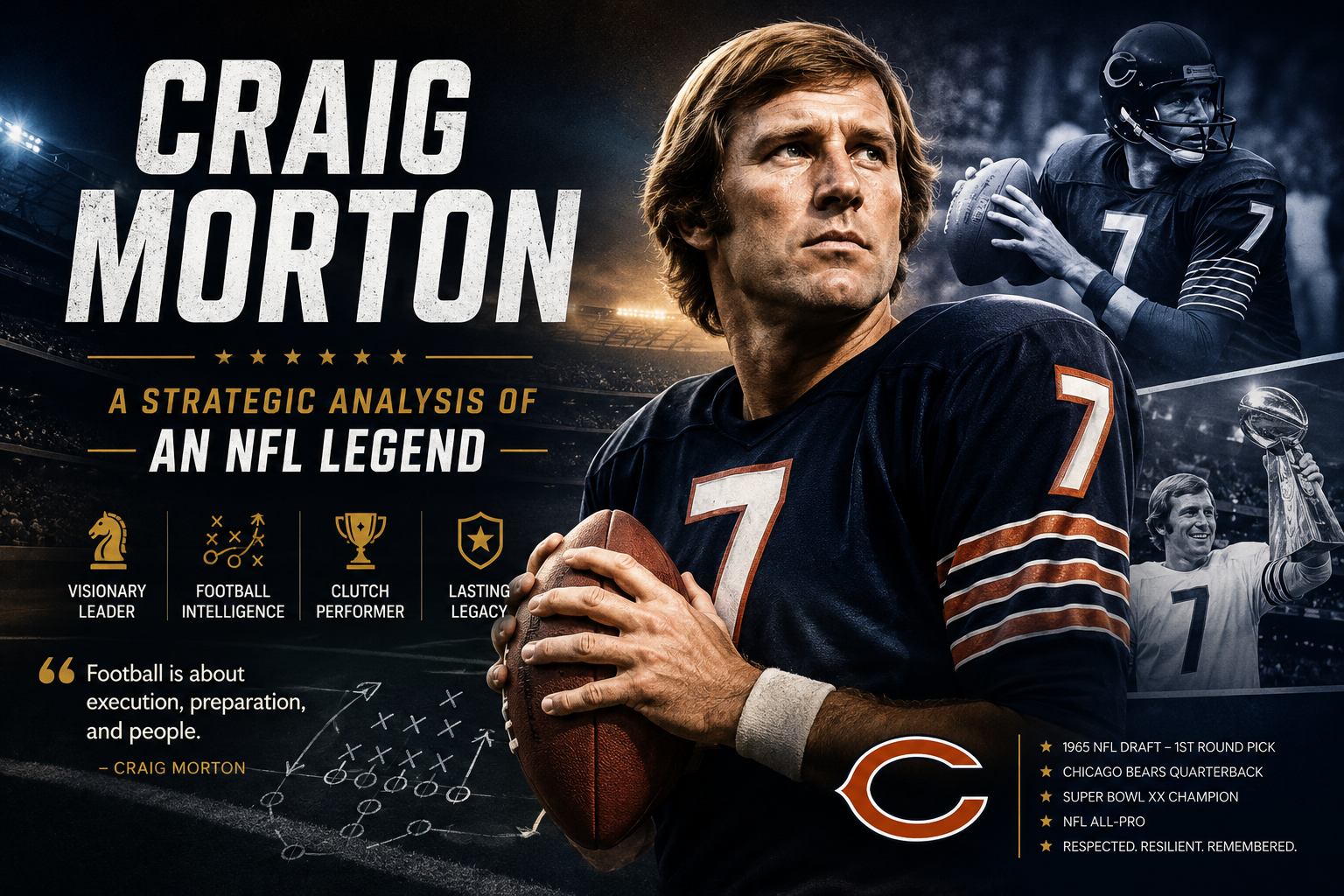
💡 Craig Morton: A Strategic Analysis of an NFL Legend
An in-depth strategic analysis of Craig Morton's 18-season NFL career, his leadership in Dallas and Denver, and his impact on the 1970s passing game.
Executive Summary
Craig Morton remains one of the most strategically significant figures in the history of the National Football League. Spanning 18 seasons from 1965 to 1982, Morton's career provides a masterclass in professional resilience and organizational adaptability. He holds the distinct honor of being the first quarterback to lead two different franchises, the Dallas Cowboys and the Denver Broncos, to the Super Bowl. This analysis highlights his 27,908 career passing yards, his 183 touchdowns, and his pivotal role in transforming the Denver Broncos from perennial underdogs into a championship caliber organization. Key data points indicate that Morton's 1977 season, where he earned AFC Offensive Player of the Year honors, serves as a primary case study for late career resurgence in professional sports.
Quick Take: Key Career Milestones and Strategic Impact
- First overall draft pick (5th) by the Dallas Cowboys in 1965 out of UC Berkeley.
- Led the Dallas Cowboys to Super Bowl V, passing for 2,619 yards in the 1970 season.
- Architect of the 1977 Denver Broncos resurgence, leading the team to a 12-2 record and Super Bowl XII.
- Recipient of the 1977 NFL Comeback Player of the Year award.
- Inducted into the Denver Broncos Ring of Fame in 1988.
Introduction: The Architect of the 1970s Passing Game
The 1970s was an era defined by defensive dominance and a grueling ground game. Within this landscape, Craig Morton emerged as a cerebral field general who mastered the complexities of the pocket. Unlike the mobile quarterbacks who would follow, Morton relied on elite field vision and a quick release to navigate the increasingly sophisticated defensive schemes of the era. To understand Morton is to understand the strategic evolution of the quarterback position from a mere ball distributor to a primary decision maker. His career trajectory mirrors the growth of the NFL itself, moving through the merger and into the modern commercial era. Much like the Giants: A Strategic Analysis of Market and Cultural Powerhouses, Morton occupied a space of immense influence within his industry, setting benchmarks for performance under pressure.
Practical Explanation: Analyzing Morton’s Pocket Presence and Field Vision
Morton’s strategic value was rooted in his ability to process information pre-snap. In Tom Landry’s complex Multiple Offense in Dallas, Morton was required to memorize hundreds of formations and shifts. This intellectual rigor prepared him for the high stakes environment of the NFL playoffs. His pocket presence was characterized by a rhythmic drop back and a refusal to panic when the pocket collapsed. Statistically, Morton’s ability to maintain a high completion percentage during the Dead Ball Era of the mid-1970s, where defensive backs were allowed significantly more physical contact, is a testament to his precision. In 1970, he maintained a 7.3 yards per attempt average, a figure that placed him among the elite efficient passers of the time.

Real-life Use Cases: Navigating the Dallas-Denver Transition and the Orange Crush Era
The transition from Dallas to Denver in 1977 is perhaps the most significant strategic move of Morton’s career. At age 34, many analysts considered his peak years to be behind him. However, his arrival in Denver catalyzed a roster that possessed defensive talent but lacked veteran leadership at the quarterback position. Morton’s synergy with the Orange Crush defense created a balanced team dynamic that had been missing in previous seasons. By focusing on ball security and high percentage throws to receivers like Haven Moses, Morton maximized the defensive advantages provided by teammates like Randy Gradishar and Tom Jackson. This period demonstrates how a veteran leader can alter the culture of an entire organization, a theme also explored in the analysis of Ryan Miller: A Strategic Analysis of an NHL Goaltending Icon, where individual excellence stabilizes a team framework.
Actionable Insights: What This Means for You (Leadership and Resilience)
For professionals in any field, Morton’s career offers several strategic takeaways regarding longevity and career pivots:
- Adaptability: Morton successfully transitioned from the rigid, coach-centric system of Tom Landry to the more fluid offensive schemes in Denver.
- Resilience under Competition: His years spent competing with Roger Staubach for the starting role in Dallas highlight the importance of maintaining professional standards even when facing internal rivalry.
- Value Reinvention: When his physical mobility decreased, Morton increased his reliance on tactical knowledge and defensive reading, extending his career into his late 30s.
Comparison Table: Craig Morton vs. Roger Staubach (Strategic Performance Metrics)
| Metric | Craig Morton | Roger Staubach |
|---|---|---|
| Primary Playing Style | Traditional Pocket Passer | Mobile Scrambler |
| Super Bowl Starts | 2 (Cowboys, Broncos) | 4 (Cowboys) |
| Career Passing Yards | 27,908 | 22,700 |
| Touchdown Passes | 183 | 153 |
| Strategic Advantage | System Adherence & Longevity | Improvisation & Mobility |

Expert Tips: Lessons in Professional Longevity and Organizational Adaptability
To achieve a career spanning nearly two decades in a high impact industry like the NFL, an individual must prioritize physical maintenance and continuous learning. Morton was an early adopter of advanced film study, often spending hours analyzing defensive tendencies before such practices were standardized. For modern leaders, the lesson is clear: technical skills get you in the door, but the ability to analyze and predict market (or defensive) shifts is what ensures long term relevance. Furthermore, Morton’s ability to remain a productive asset despite a significant trade late in his career highlights the importance of maintaining a positive professional reputation across the league.
Advantages vs. Limitations: The Traditional Pocket Passer in a Developing League
Morton’s style provided distinct advantages, specifically in terms of offensive timing and the ability to execute complex playbooks. A pocket passer provides a stable target for the offensive line and predictable routes for wide receivers. However, the limitation of this style became apparent as the league evolved toward more athletic defensive ends and faster linebackers. In Super Bowl XII, the pressure from the Dallas Cowboys defensive front highlighted the vulnerability of a stationary quarterback. Despite these limitations, Morton’s strategic use of the play-action pass and his deep ball accuracy allowed him to remain competitive against more athletic opponents for years.

FAQ: 5 Key Questions About Craig Morton’s Legacy
1. Why is Craig Morton considered a strategic pioneer for the Denver Broncos?
Morton was the first quarterback to bring a winning culture to Denver, leading them to their first ever playoff appearance and Super Bowl berth in 1977. He provided the veteran leadership necessary to complement their elite defense.
2. How did the rivalry with Roger Staubach affect Morton's career?
The rivalry was one of the most famous in NFL history. While it eventually led to Morton’s departure from Dallas, it also pushed him to maintain a high level of performance and mental toughness that served him well in his later years with the Giants and Broncos.
3. What were Morton’s most impressive statistical achievements?
Beyond his 27,908 passing yards, Morton’s 1981 season at age 38 was remarkable, as he threw for 3,195 yards and 21 touchdowns, proving his enduring capability in an increasingly pass heavy league.
4. Is Craig Morton in the Pro Football Hall of Fame?
As of now, Morton is not in the Pro Football Hall of Fame, though he is a member of the Denver Broncos Ring of Fame and the College Football Hall of Fame. His candidacy is often debated based on his role in the success of two major franchises.
5. What can modern quarterbacks learn from Morton’s field vision?
Modern players can learn the importance of pre-snap recognition. Morton’s ability to identify blitz packages and adjust protections was ahead of its time and allowed him to survive in the pocket despite limited mobility.
Expert Verdict: Future Outlook
The legacy of Craig Morton is one of tactical excellence. While modern football emphasizes dual-threat capabilities, the fundamental requirement of the position remains the ability to process information and lead a huddle. Morton’s career serves as a historical benchmark for how a quarterback can leverage intellectual assets to overcome physical constraints. As the NFL continues to evolve, the strategic blueprints laid by veterans like Morton will continue to be studied by offensive coordinators looking to maximize the efficiency of the passing game.
Conclusion
Craig Morton’s career is a testament to the power of strategic positioning and mental fortitude. By leading two separate franchises to the Super Bowl and maintaining high levels of production over 18 seasons, he demonstrated that longevity in a competitive field is built on adaptability and a deep understanding of organizational systems. His impact on the Dallas Cowboys and the Denver Broncos remains a cornerstone of NFL history, offering timeless lessons in leadership and professional resilience.




Comments 0
Leave a Reply
Your email address will not be published. Required fields are marked *
Be the first to share your thoughts!