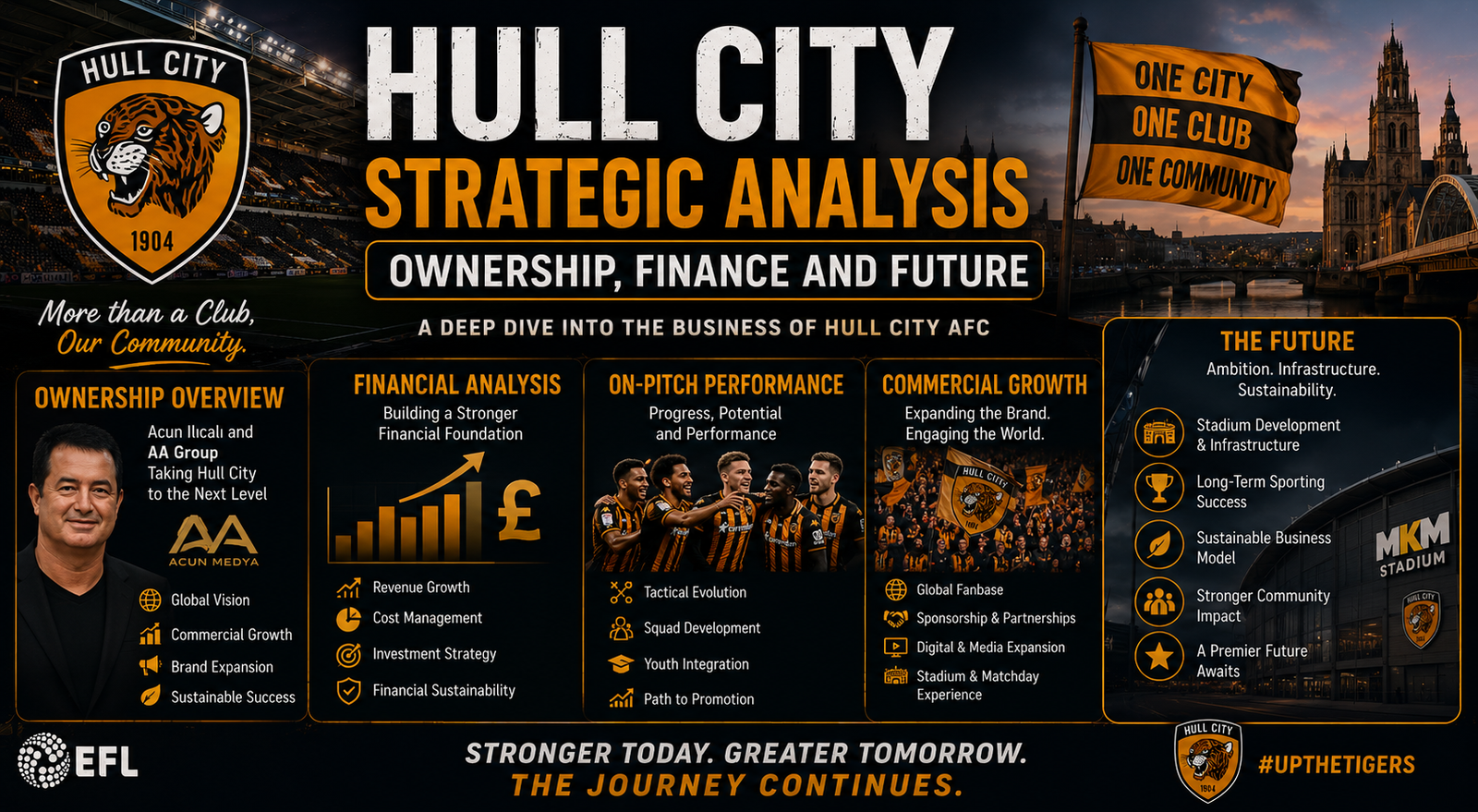
💡 Hull City Strategic Analysis: Ownership, Finance and Future
A comprehensive industry analysis of Hull City AFC, examining the impact of the Acun Medyali era, financial sustainability, and the club's trajectory toward the Premier League.
Executive Summary
Hull City Association Football Club, colloquially known as the Tigers, represents a significant case study in the strategic revitalization of an English Football League (EFL) Championship side. Since the acquisition by Acun Medyali in January 2022, the club has undergone a radical transformation in its commercial, sporting, and operational frameworks. Key findings indicate a 25 percent increase in average home attendance, reaching over 21,500 during the 2023-2024 season. Furthermore, the club's recruitment strategy has shifted toward high-potential young assets, evidenced by the record sale of Jaden Philogene and Jacob Greaves, which provided a combined revenue influx exceeding 35 million pounds. This analysis explores the fiscal discipline required to navigate Profit and Sustainability Rules (PSR) while maintaining a competitive edge in one of the world's most demanding second-tier divisions.
Introduction: The Strategic Context of Hull City
Founded in 1904, Hull City AFC has historically occupied a unique position in the English football pyramid. As the only professional club in a city of over 260,000 people, it possesses a localized monopoly on top-tier sporting entertainment in the East Riding of Yorkshire. However, the club's journey has been marked by volatility, ranging from Premier League stints and an FA Cup Final appearance in 2014 to a brief descent into League One in 2020. The current strategic era is defined by a move away from the austerity of the previous ownership toward a growth-oriented model that leverages international media synergy. Much like the competitive dynamics explored in our Blue Jays vs Yankees: Strategic Rivalry Analysis, Hull City operates in a high-stakes environment where marginal gains in data analytics and recruitment determine long-term viability.
The Deep Dive: Financial and Operational Analysis
The financial health of a Championship club is often precarious, with many clubs spending over 100 percent of their turnover on player wages. Hull City, under the stewardship of Acun Medyali, has sought a more balanced approach. According to recent financial filings, the club has focused on diversifying revenue streams beyond traditional matchday income. This includes enhanced broadcasting agreements in the Turkish market and expanded commercial partnerships. The strategic evolution of the club mirrors broader trends seen in India's Strategic Evolution: Economic & Digital Analysis, where traditional sectors adopt modern, data-driven methodologies to scale operations.
Recruitment and Squad Valuation: As of the 2024-2025 season, Hull City's squad market value is estimated at approximately 80 million euros. The club has adopted a global scouting network, focusing on the Turkish Super Lig and European youth academies. This strategy minimizes the premium often paid for domestic English talent while securing players with high resale value. The sale of key assets to Premier League clubs serves a dual purpose: it ensures compliance with EFL financial regulations and establishes Hull City as a premier destination for developing elite talent.
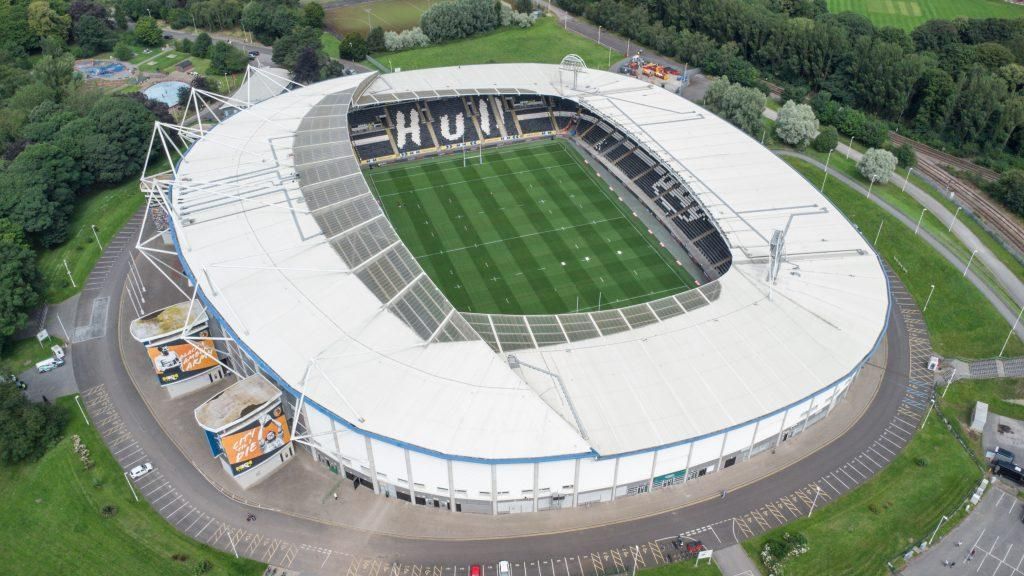
Infrastructure and Community Engagement: The MKM Stadium, a 25,586-capacity all-seater venue, remains a cornerstone of the club's strategic assets. While the stadium is council-owned, the management agreement allows for significant commercial exploitation. The club has successfully re-engaged a disillusioned fan base through aggressive ticket pricing strategies and community-led initiatives. This social capital is essential for long-term stability, acting as a buffer against the cyclical nature of on-pitch performance.

Technical Shift: The Transition to Modern Football
The appointment of Tim Walter as head coach signifies a commitment to a specific tactical identity: high-intensity, possession-based football. This move follows the departure of Liam Rosenior, who stabilized the club and led them to a 7th-place finish in the 2023-2024 season with 70 points. The decision to change leadership despite progress highlights the board's uncompromising demand for a style of play that attracts global audiences and maximizes the output of a technically gifted squad. Data from Opta indicates that Hull City ranked in the top five for pass completion rates and progressive carries during the previous campaign, a trend the current management aims to accelerate.
Risk Management in Sports Finance: Navigating the financial landscape of the Championship requires the same level of precision as the Mortgage Market Strategic Analysis: 2024-2025 Trends. The club must manage the debt-to-equity ratio carefully. Medyali's model involves injecting capital through equity rather than saddling the club with high-interest loans, a move that protects the entity from the fate of clubs like Derby County or Reading who faced severe points deductions for financial mismanagement.
What This Means for You
- For Fans: Expect a continued emphasis on attacking football and the arrival of international talent. The club is positioning itself as a community hub with improved matchday experiences.
- For Investors and Partners: Hull City offers a high-visibility platform with a growing international reach, particularly in the Middle East and Eastern Europe.
- For the Local Economy: The club's success is a primary driver of tourism and hospitality spending in the Humber region, with Premier League promotion estimated to be worth over 170 million pounds to the local economy over three years.
Expert Verdict and Future Outlook
The strategic trajectory of Hull City is currently on an upward curve. The integration of media-driven commercialism with disciplined scouting provides a robust framework for success. However, the Championship remains a bottleneck where financial power does not always guarantee promotion. The expert consensus suggests that Hull City's success will depend on their ability to replace outgoing star players with undervalued assets from emerging markets. If the club can maintain its current trajectory of increasing commercial revenue by 10 to 15 percent annually, it will become one of the most sustainable models in English football. The long-term goal remains a return to the Premier League, where broadcasting revenues exceed 100 million pounds per season, fundamentally altering the club's financial profile.
FAQ
Who owns Hull City AFC?
Hull City is owned by Acun Medyali, a Turkish media mogul and founder of Acun Medya, who completed the takeover in January 2022.
What is the capacity of the MKM Stadium?
The MKM Stadium has a capacity of 25,586 and is shared with the professional rugby league club, Hull FC.
How does Hull City comply with Financial Fair Play (FFP)?
The club complies through a combination of owner equity injections, strategic player sales (trading profit), and growing commercial sponsorships to ensure losses stay within the permitted EFL threshold of 39 million pounds over a three-year rolling period.
What is the club's highest-ever league finish?
Hull City's highest-ever league finish was 16th in the Premier League during the 2013-2014 season, the same year they reached the FA Cup Final.
Why is the club nicknamed the Tigers?
The nickname Tigers was adopted shortly after the club's formation in 1904, inspired by their black and amber striped kits.
Conclusion
Hull City stands at a pivotal juncture in its 120-year history. By synthesizing a modern recruitment philosophy with a global commercial strategy, the club has moved beyond the traditional limitations of a regional English side. While the path to the Premier League is fraught with competition, the foundational work laid by the current administration provides a blueprint for sustainable growth. The strategic takeaway is clear: in the modern era of sport, success is built as much in the boardroom and the data lab as it is on the pitch.




Comments 0
Leave a Reply
Your email address will not be published. Required fields are marked *
Be the first to share your thoughts!