
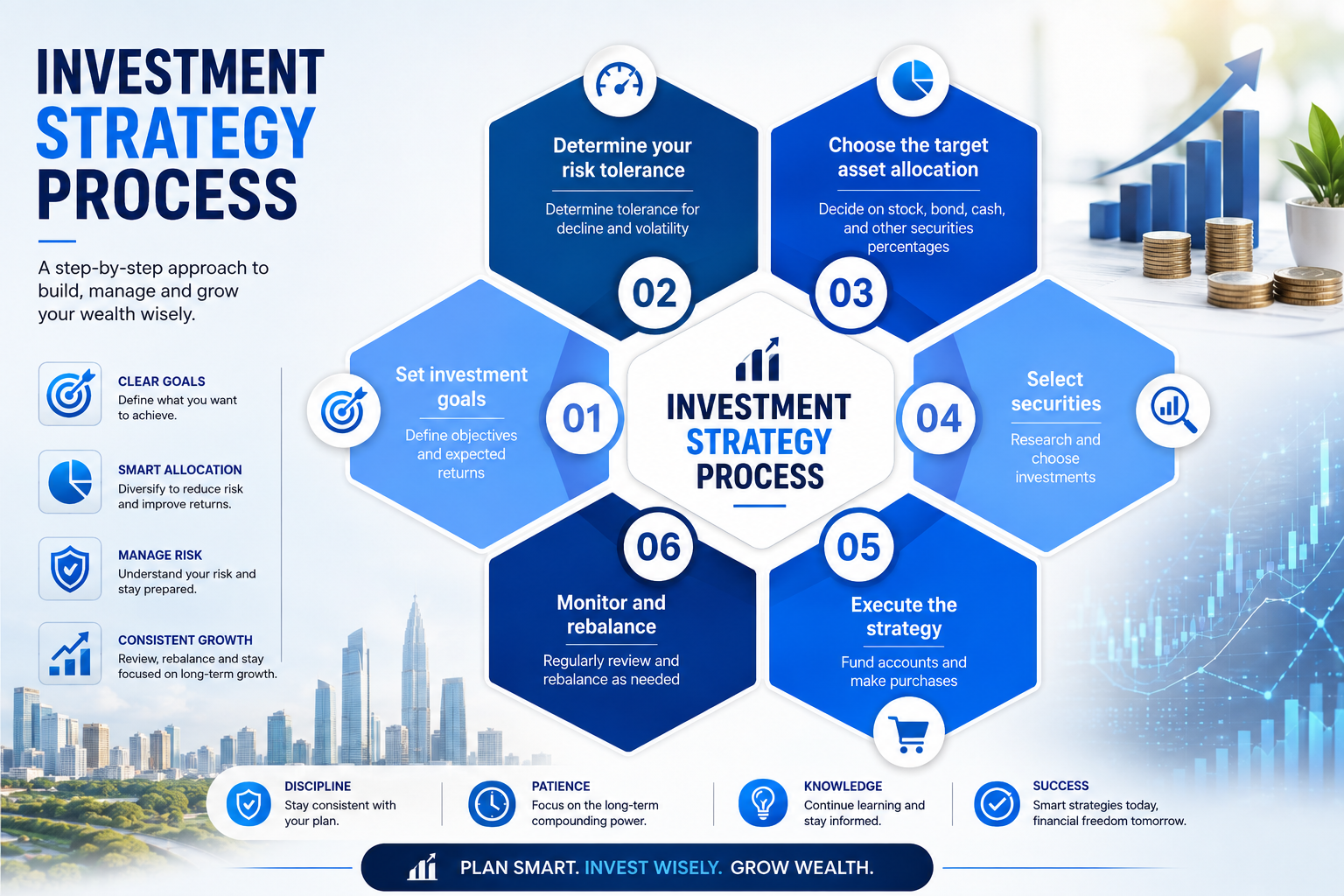
💡 Investment Strategies: A Strategic Analysis of Market Growth
An authoritative guide to modern investment strategies, asset allocation, and market analysis for long-term financial growth.
Executive Summary
Investment is the strategic allocation of capital to assets with the expectation of generating income, preserving purchasing power, or achieving capital appreciation over time. A diversified portfolio can help reduce concentration risk and manage the impact of volatility across different asset classes.
The S&P 500 has historically delivered strong long-term returns, although annual performance has varied significantly across market cycles and past performance does not guarantee future results. Long-term market participation has also expanded beyond institutional investors, with retail investors becoming an increasingly important part of U.S. equity-market activity.
This report examines the role of equities, fixed income, real estate, commodities, and other alternative assets in portfolio construction. It also considers major macroeconomic factors—including inflation, economic growth, and central-bank interest-rate policy—that can influence investment performance and asset valuations.
Introduction
The concept of investing has evolved from an activity dominated by institutional investors into an important component of personal financial planning and long-term wealth creation. At its core, investing involves putting capital to work today with the expectation of generating a financial benefit in the future.
This process requires an understanding of risk management, investment time horizons, asset allocation, valuation, and the fundamental drivers of asset prices. Whether an investor is evaluating established blue-chip companies or high-growth technology businesses, the underlying principles of risk and return remain important.
By examining historical market data, current economic conditions, and long-term market trends, investors can develop a more structured approach to navigating financial markets.
The Deep Dive: Analyzing Asset Classes and Market Drivers
To build a robust investment framework, investors need to understand the characteristics of different asset classes. Each asset class has its own risk profile, return potential, liquidity characteristics, and relationship with broader economic conditions.
Equities represent ownership in a company and have historically been an important source of long-term portfolio growth. Technology and semiconductor companies, for example, can offer significant growth opportunities but may also experience higher volatility. Investors may examine companies such as Marvell Technology to understand trends within the semiconductor industry, as discussed in our MRVL Stock: Marvell Technology Strategic Market Analysis.
Growth-oriented investments can also be balanced with companies operating in more cyclical or value-oriented sectors. Tata Steel, for example, provides exposure to the steel and materials industry and can offer insights into infrastructure demand, industrial activity, and global commodity cycles, as explored in the Tata Steel: Strategic Analysis of Global Market Leadership.
Fixed income, including government and corporate bonds, can provide income and help diversify equity exposure. Bond prices generally move inversely to market interest rates: when prevailing interest rates rise, the prices of existing fixed-rate bonds generally decline, while falling rates can have the opposite effect.
Inflation and monetary policy are important drivers of interest rates. The Federal Reserve's longer-run inflation objective is 2 percent, measured using the Personal Consumption Expenditures (PCE) price index. This objective influences monetary-policy decisions and, indirectly, borrowing costs and financial-market valuations.
Beyond stocks and bonds, alternative investments can include real estate, commodities, private equity, infrastructure, and private credit. These assets may provide additional diversification, although their correlation with public markets can change over time and they can involve higher fees, lower liquidity, valuation uncertainty, and additional risks.
The development of alternative economic and ownership models, including cooperative economic structures, may also influence how investors think about community-focused and sustainable forms of capital allocation, as discussed in Cooperative Economics: A Strategic Analysis of Global Impact.
The Role of Modern Portfolio Theory
Modern Portfolio Theory (MPT), developed by economist Harry Markowitz, emphasizes that investors should evaluate assets not only by their individual risk and expected return but also by how those assets interact within a portfolio.
Diversification can reduce portfolio-specific risk when assets do not move perfectly together. In other words, the overall risk of a diversified portfolio can be lower than simply averaging the individual risks of its holdings because correlations between assets also influence total portfolio risk.
The traditional 60/40 portfolio, consisting of approximately 60 percent equities and 40 percent bonds, has long been used as a simple framework for balancing growth potential with portfolio stability. However, its effectiveness can vary depending on the economic environment.
Periods of elevated inflation and rising interest rates can create challenges because stocks and bonds may sometimes decline simultaneously. As a result, some investors consider additional asset classes—including real estate, commodities, infrastructure, and other alternatives—to diversify their portfolios.
There is no universally appropriate 10–15 percent allocation to alternative assets. The appropriate allocation depends on an investor's financial objectives, investment horizon, liquidity requirements, risk capacity, and tolerance for volatility. Alternative investments can provide diversification benefits, but they may also introduce additional liquidity, valuation, fee, and regulatory risks.

Risk tolerance is another critical factor. However, it is important to distinguish risk tolerance from the analytical measures used in financial models. The Capital Asset Pricing Model (CAPM) calculates the expected return of an asset based on factors including its beta, or sensitivity to market movements. A beta of 1.0 indicates that an asset has historically moved broadly in line with the market, while a beta higher than 1.0 indicates greater sensitivity to market movements. Understanding these metrics allows investors to better align their portfolios with their specific financial goals and risk tolerance.
What This Means for You
For the individual investor, the current market environment demands a shift from passive observation to active strategic planning. First, evaluate your time horizon. Those with a decade or more until retirement may have a greater ability to withstand short-term market fluctuations in pursuit of long-term growth. Second, prioritize low-cost index funds or Exchange-Traded Funds (ETFs) for core holdings to minimize management fees, which can significantly reduce long-term returns through compounding. Third, maintain an emergency fund covering approximately three to six months of living expenses in a high-yield savings account to reduce the need to liquidate investments during a market downturn.
-
Assess your current debt-to-income ratio before increasing investment contributions.
-
Rebalance your portfolio at least once a year to maintain your desired asset allocation.
-
Utilize tax-advantaged accounts like 401(k)s or IRAs to maximize potential after-tax returns.
-
Stay informed on geopolitical events that could trigger market volatility.
Expert Verdict and Future Outlook
The future of investment is increasingly defined by two major forces: Artificial Intelligence (AI) and Environmental, Social, and Governance (ESG) criteria. AI is revolutionizing the way data is processed, allowing for real-time sentiment analysis and algorithmic trading that was previously difficult for retail investors to access. Meanwhile, ESG assets were projected by Bloomberg Intelligence to exceed $53 trillion by 2025. This projection reflected expectations for continued growth in sustainable investing and capital allocation toward companies that demonstrate long-term sustainability and ethical governance. While the core principles of value investing remain valid, the tools and metrics used to define and evaluate value are undergoing a significant transformation.

We anticipate that the next decade will see greater integration of decentralized finance (DeFi) and tokenized real-world assets. This could potentially lower barriers to accessing certain high-value assets, such as commercial real estate and fine art, while providing additional opportunities for diversification. However, rigorous strategic analysis will become increasingly important as the number of available investment vehicles continues to grow.
Frequently Asked Questions
What is the difference between investing and speculating?
Investing generally involves a systematic approach based on fundamental analysis and a longer-term time horizon, often with the goal of generating long-term growth and income. Speculating generally involves taking higher risks in pursuit of potentially significant short-term gains, often based on market expectations, price movements, or other factors rather than an assessment of intrinsic value.
How much of my income should I invest?
The commonly cited 50/30/20 budgeting rule allocates 50 percent of income to needs, 30 percent to wants, and 20 percent to savings and investments. However, this is a general budgeting guideline rather than a universal investment recommendation. Individuals who start investing later in life may need to save and invest a larger percentage of their income to meet their long-term financial goals.
Is real estate a better investment than the stock market?
Both have advantages. Real estate can provide physical utility, potential rental income, and certain tax benefits, while stocks generally offer greater liquidity and lower barriers to entry. Historical returns vary depending on the period, market, property type, leverage, and whether costs and income are included in the comparison. A combination of both asset classes can provide additional diversification when appropriate for an investor's financial goals and risk tolerance.

How does inflation affect my investments?
Inflation reduces the purchasing power of money. To achieve a positive real return, an investment generally needs to grow at a rate higher than the inflation rate. Equities and real estate can sometimes provide protection against inflation over the long term, although neither is guaranteed to outperform inflation in every environment. Fixed-rate bonds can also lose purchasing power during periods of elevated inflation, particularly when their fixed interest payments do not keep pace with rising prices.
What is the Rule of 72?
The Rule of 72 is a simple formula used to estimate how long it may take for an investment to double in value. Divide 72 by the annual rate of return. For example, at an assumed annual return of 6 percent, an investment could double in approximately 12 years.
Conclusion
Strategic investment is not a one-time event but a continuous process of analysis, execution, and adjustment. By focusing on established asset allocation principles, understanding the nuances of different market sectors, and staying disciplined during periods of volatility, investors can work toward building long-term wealth. The integration of data-driven insights and a clear understanding of global economic trends will remain important to effective capital management. The ultimate takeaway is that maintaining a long-term investment strategy can generally be more effective than attempting to consistently time the market.
Important Note: Financial Disclaimer: This content is for educational purposes only and does not constitute professional financial advice. Always consult with a certified financial planner before making investment decisions.





Comments 0
Leave a Reply
Your email address will not be published. Required fields are marked *
Be the first to share your thoughts!