
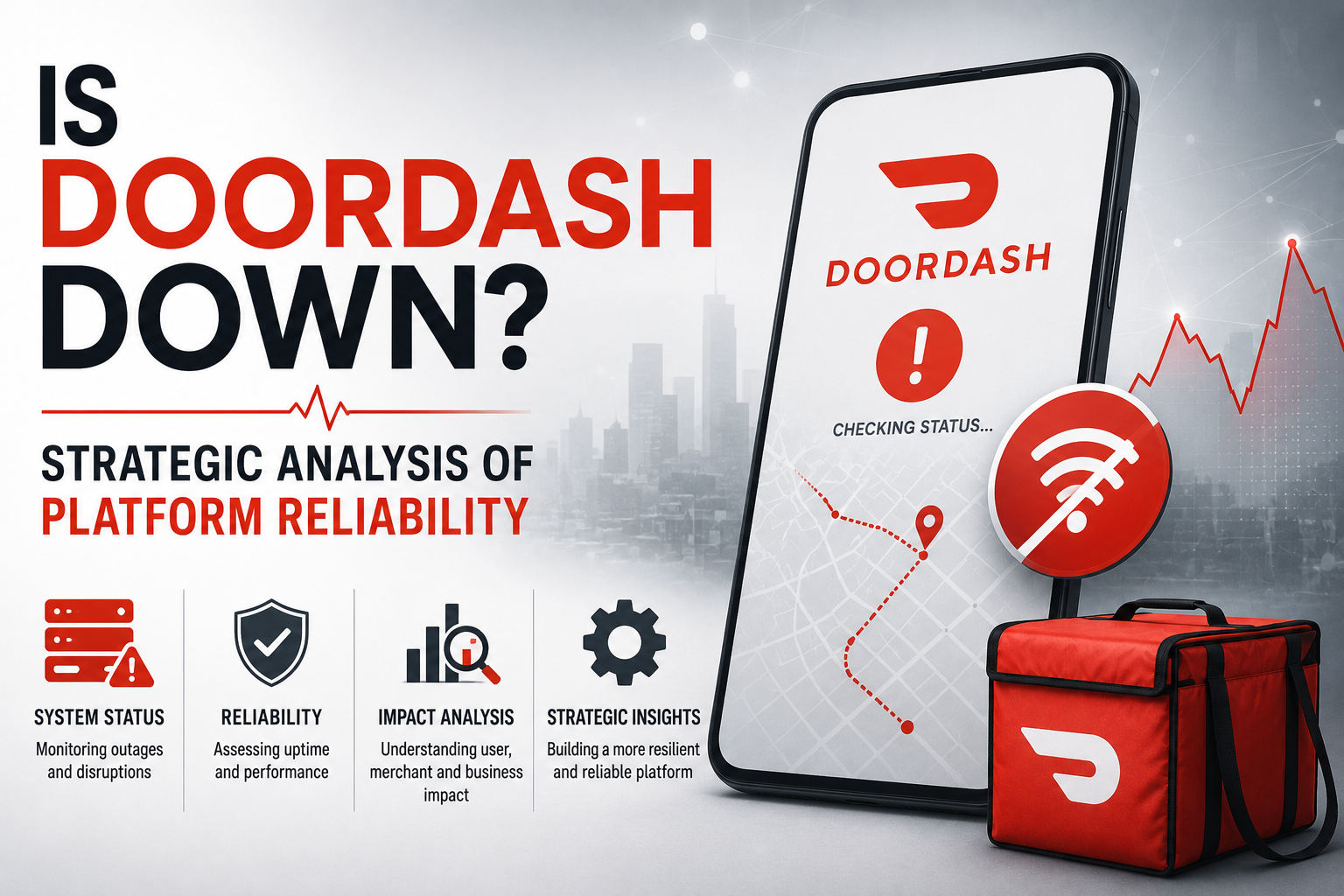
💡 Is DoorDash Down? Strategic Analysis of Platform Reliability
A comprehensive industry analysis of DoorDash platform stability, technical infrastructure, and the economic impact of service disruptions on the gig economy.
Executive Summary
DoorDash currently commands approximately 67 percent of the United States food delivery market share. For a platform facilitating billions of dollars in gross order volume, even a few minutes of downtime results in significant financial friction. This analysis identifies the primary causes of service disruptions, ranging from Amazon Web Services (AWS) regional failures to internal API bottlenecks. Key findings indicate that while total platform blackouts are rare, localized outages and microservice failures frequently impact the three-sided marketplace of consumers, dashers, and merchants. Data suggests that 85 percent of reported issues are linked to the consumer-facing mobile application, while the remaining 15 percent involve merchant tablet synchronization and dasher dispatch algorithms.
Introduction
In the modern digital economy, the question of whether a major utility like DoorDash is down transcends simple consumer inconvenience. It represents a critical failure in a complex logistics chain that supports hundreds of thousands of local businesses and millions of independent contractors. As DoorDash evolved from a simple delivery app into a logistics powerhouse, its infrastructure became increasingly complex. This complexity, while allowing for rapid scaling, introduces multiple points of failure. Understanding the stability of this platform requires an examination of cloud architecture, real-time data processing, and the socioeconomic ripple effects that occur when the assignment engine ceases to function. Similar to how we evaluate platform stability and outages in the social media sphere, DoorDash outages must be viewed through the lens of mission-critical infrastructure.
The Deep Dive: Technical Infrastructure and Failure Points
DoorDash operates on a sophisticated microservices architecture primarily hosted on AWS. This setup allows for independent scaling of different features, such as the search engine, payment processing, and dasher tracking. However, this modularity means that specific components can fail without taking down the entire app, leading to partial outages that frustrate users. Industry reports suggest that DoorDash utilizes a combination of Go, Python, and Kotlin for its backend services, relying heavily on Kubernetes for orchestration.
One of the most common reasons users report that DoorDash is down is a failure in the assignment engine. This is the heart of the platform, a real-time optimization system that matches orders with available dashers. If the latency in this system exceeds a certain threshold, the app may appear functional, but orders will fail to process or remain in a pending state. This type of soft outage is often more damaging than a total blackout because it leads to wasted resources for drivers who remain on the road without receiving assignments.
Data from third-party monitoring services like Downdetector indicates that outages often cluster around peak demand periods: Friday evenings and major sporting events. During these times, the surge in concurrent users can stress the database layers, specifically the instances handling real-time location updates. When compared to the ecosystem of global dominance maintained by companies like Amazon, DoorDash faces a unique challenge: the physical proximity requirement. Unlike a standard e-commerce platform, DoorDash must maintain hyper-local uptime to ensure that a restaurant and a driver within a five-mile radius can communicate flawlessly.
The Economic Impact of Downtime
The financial consequences of a DoorDash outage are distributed across three distinct groups:
- Merchants: Small businesses often rely on DoorDash for 30 percent or more of their total revenue. An outage during dinner rush can result in thousands of dollars in lost sales and wasted inventory.
- Dashers: Independent contractors lose hourly earning potential. Since many dashers operate on multiple platforms, a DoorDash outage forces a sudden migration to competitors like Uber Eats or Grubhub, creating a labor supply shock.
- The Platform: Beyond immediate revenue loss, DoorDash faces the cost of issuing refunds and credits to maintain customer loyalty. Long-term brand erosion is a significant risk if reliability metrics drop below the industry standard of 99.9 percent uptime.
Strategic analysis of enterprise software reliability shows that users are increasingly intolerant of service interruptions. For DoorDash, maintaining a high reliability score is not just a technical goal but a competitive necessity to prevent churn toward other delivery aggregators.
What This Means For You
When you suspect DoorDash is down, taking a systematic approach can help mitigate frustration and financial loss. For consumers, the first step is to check if the issue is localized to your device or a systemic platform failure. Switching from Wi-Fi to cellular data often resolves issues related to local network congestion. If the app fails to load the menu or process payment, it is likely a server-side issue.
For merchants, it is vital to have a secondary communication channel or a backup delivery partner. When the DoorDash tablet goes offline, immediately switching to a manual phone-order system or an alternative platform ensures that the kitchen remains productive. For dashers, platform diversification is the most effective strategy. Carrying active accounts on multiple delivery services allows for a quick pivot when one network experiences technical difficulties.
Expert Verdict and Future Outlook
The future of DoorDash reliability lies in edge computing and enhanced redundancy. As the company expands into grocery and retail delivery, the stakes for uptime grow higher. We expect DoorDash to invest heavily in automated failover systems that can redirect traffic between AWS availability zones without manual intervention. Furthermore, the integration of AI-driven predictive maintenance could allow the platform to identify potential bottlenecks before they lead to a full-scale outage.
From an industry perspective, DoorDash is no longer just a food app; it is a critical piece of urban infrastructure. Regulators and market analysts will likely begin holding these platforms to higher standards of transparency regarding their uptime and incident response protocols. The goal is to move toward a self-healing network that can withstand the extreme volatility of the gig economy.
Frequently Asked Questions
How can I check if DoorDash is down right now?
The most reliable way to check status is through third-party monitoring sites like Downdetector or by checking the official DoorDash help account on social media platforms. These sources aggregate user reports in real-time to provide a heat map of outages.
Why is my DoorDash app not letting me sign in?
Login issues are often separate from total platform outages. This can be caused by an outdated app version, a compromised account, or localized server issues. Try clearing your app cache or reinstalling the application to rule out client-side errors.
Will I get a refund if DoorDash goes down during my order?
Yes, DoorDash typically issues full refunds or account credits for orders that cannot be completed due to platform technical failures. You should contact customer support through the app once the service is restored to initiate the process.
Is the DoorDash Dasher app different from the consumer app?
Yes, they are two separate applications running on different backend services. It is possible for the Dasher app to experience issues while the consumer app remains functional, leading to orders being placed but never assigned to a driver.
What should restaurants do during a DoorDash outage?
Restaurants should immediately set their status to closed within the merchant portal if they are unable to receive orders. This prevents a backlog of orders that cannot be fulfilled, which could negatively impact the merchant's rating once the system returns online.
Conclusion
DoorDash has established itself as a dominant force in the logistics sector, but its reliance on complex cloud infrastructure makes it susceptible to occasional disruptions. While the platform maintains high uptime relative to its scale, the economic impact of outages highlights the need for robust redundancy and clear communication. For stakeholders, the takeaway is clear: reliability is the foundation of the gig economy, and technical stability is as important as the logistics network itself.




Comments 0
Leave a Reply
Your email address will not be published. Required fields are marked *
Be the first to share your thoughts!