
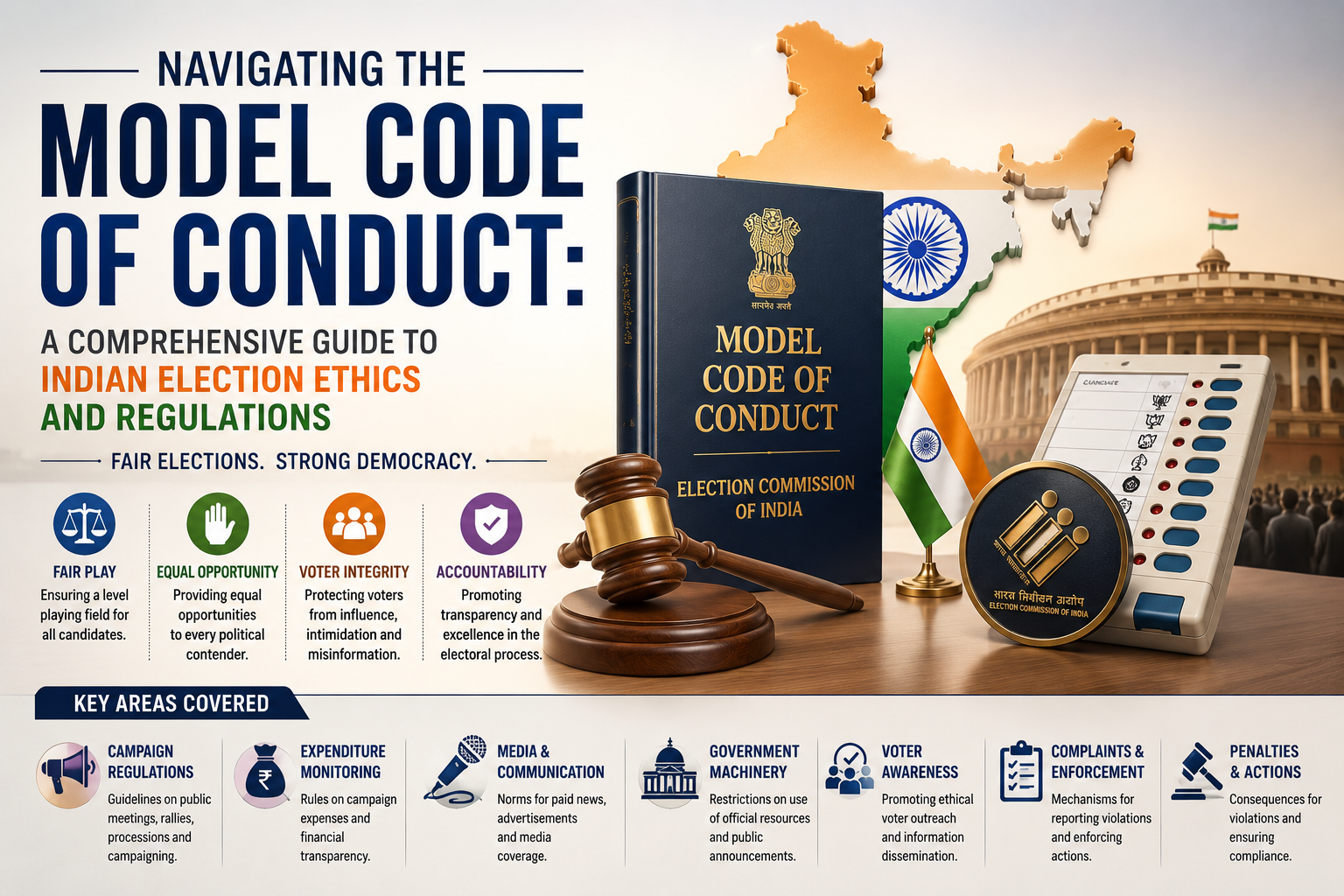
💡 Navigating the Model Code of Conduct: A Comprehensive Guide to Indian Election Ethics and Regulations
A detailed guide to the Model Code of Conduct (MCC) in India, covering its evolution, rules for political parties, and how the Election Commission ensures fair play.
The Model Code of Conduct (MCC) is a set of ethical guidelines issued by the Election Commission of India (ECI) to regulate the conduct of political parties and candidates during elections. Its primary purpose is to ensure that elections are free and fair by maintaining a level playing field, preventing the party in power from gaining an unfair advantage through the use of state resources, and ensuring that public discourse remains civil and non-discriminatory.
The Role of the Model Code of Conduct in Safeguarding Indian Democracy
At the heart of any vibrant democracy is the principle of fairness. In a country as vast and diverse as India, elections are a massive undertaking where the temptation to use money, muscle power, or official machinery can be high. The Model Code of Conduct acts as a moral and ethical compass for the entire electoral process. It isn't just a list of prohibitions; it is a consensus-based framework that ensures every candidate, regardless of their financial or political stature, has an equal opportunity to reach the voters.
By enforcing the MCC, the Election Commission prevents the distortion of the democratic process. It ensures that the transition of power or the renewal of a mandate happens through the genuine will of the people, untainted by bribery, intimidation, or the misuse of taxpayer money for partisan campaigning.
The Evolution and Legal Standing of the MCC: From Voluntary Agreement to Electoral Standard
The MCC has an interesting history. It didn't start as a law passed by Parliament. Instead, it originated in the 1960 Kerala Assembly elections when the state administration drafted a code for political parties. Recognizing its effectiveness, the Election Commission of India adopted it for the 1962 Lok Sabha elections. Over the decades, it has been refined and expanded through consultations with all major political parties.
Technically, the MCC does not have statutory binding—meaning it is not a law written in the Indian Penal Code. However, it derives its power from the Constitution of India under Article 324, which gives the Election Commission the power to supervise and conduct elections. Furthermore, many provisions of the MCC overlap with existing laws like the Representation of the People Act, 1951, and the Indian Penal Code, making certain violations legally punishable offenses.
Core Directives for Political Parties: Maintaining Decorum in Public Discourse and Campaigning
The MCC sets strict boundaries for how parties and candidates should behave during the campaign period. The goal is to keep the focus on policy and performance rather than personal attacks or communal polarization.
- No Appeals to Caste or Religion: Candidates are strictly forbidden from seeking votes based on religious or communal sentiments. Places of worship (temples, mosques, churches) cannot be used as forums for election propaganda.
- Criticism of Rivals: While parties can criticize the policies, programs, and past records of their opponents, they must avoid personal attacks that are not connected to public activities. Criticism based on unverified allegations is a violation.
- Prohibition of Corrupt Practices: Bribery, intimidation of voters, and impersonation are strictly prohibited.
Regulating Public Assemblies: Guidelines for Rallies, Processions, and Use of Loudspeakers
To maintain law and order, the MCC mandates that parties must inform the local police and district authorities well in advance about any planned rallies or processions. This allows the administration to manage traffic and ensure there are no clashes between rival groups.
The use of loudspeakers is also strictly regulated. Generally, they are not allowed between 10:00 PM and 6:00 AM to prevent public nuisance. Furthermore, political parties must obtain permission to use any public space, and these spaces must be shared fairly among all candidates on a first-come, first-served basis.
Strictures on the Party in Power: Preventing the Misuse of Official Machinery
One of the most critical aspects of the MCC is the restriction it places on the ruling party (both at the Center and in the States). The logic is simple: the party in power should not use the government's vast resources to promote its own election prospects.
- No New Projects: From the moment the election dates are announced, the government cannot announce new schemes, lay foundation stones, or make financial grants that could influence voters.
- Official Machinery: Ministers and officials are prohibited from combining official visits with electioneering work. Government transport, including aircraft and vehicles, cannot be used for campaigning.
- Publicity at Public Cost: The government cannot issue advertisements in newspapers or electronic media at the cost of the public exchequer to highlight its achievements during the election period.

Polling Day Protocols: Ensuring Transparency and Peace at the Booths
On the day of the election, the MCC shifts its focus to the polling booths. To ensure a peaceful environment, several rules come into play:
- The 100-Meter Rule: No campaigning is allowed within 100 meters of the polling station.
- Identity Slips: Candidates can provide identity slips to voters, but these slips must be on plain paper and cannot contain the candidate's name or party symbol.
- No Free Transport: It is an electoral offense to provide free transport to voters to and from the polling station.
The Role of Election Observers and the Mechanism for Reporting Violations
The Election Commission appoints various "Observers" to monitor the ground reality. These include General Observers, Expenditure Observers, and Police Observers. They act as the eyes and ears of the ECI, ensuring that the MCC is followed in letter and spirit.
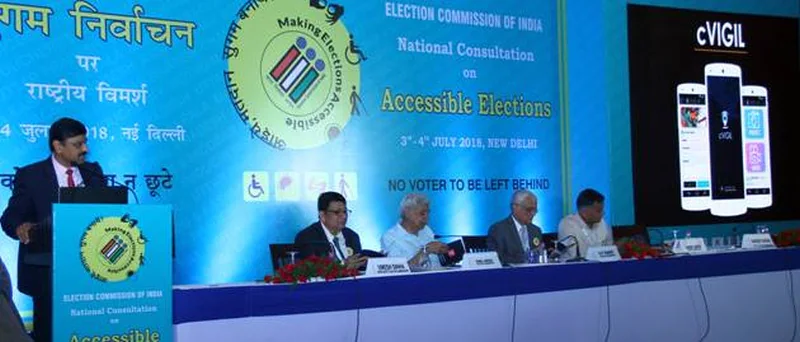
In the digital age, the ECI has introduced the cVIGIL app. This allows any citizen to report an MCC violation in real-time by uploading a photo or video. Once a complaint is lodged, the authorities are mandated to investigate and respond within a specific timeframe, usually 100 minutes.
Enforcement and Consequences: How the ECI Addresses Breaches of the Code
When a violation is reported, the Election Commission typically issues a "show-cause notice" to the candidate or party involved. Depending on the severity of the breach, the ECI can:
- Issue a formal warning or censure.
- Ban a candidate from campaigning for a specific period (e.g., 24 to 72 hours).
- Order the filing of an FIR (First Information Report) if the violation falls under criminal laws.
- In extreme cases, the ECI has the power to postpone or even cancel the election in a specific constituency if the atmosphere is deemed too corrupted by money or influence.
Frequently Asked Questions
Does the MCC apply to social media?
Yes, the MCC applies to social media just as it does to traditional media. Political advertisements on social media platforms require pre-certification from the Media Certification and Monitoring Committee (MCMC). Candidates must also include their social media accounts in their nomination papers.
Can the government launch a new welfare scheme during the MCC?
No. The government is prohibited from announcing new schemes, projects, or financial concessions once the MCC is in effect. However, ongoing projects and routine administrative work that do not influence voters can continue.
How long does the Model Code of Conduct last?
The MCC comes into effect immediately after the Election Commission announces the election schedule. It remains in force until the entire election process is completed and the results are officially declared.
Can a candidate use private property for campaign posters?
Yes, but only with the written permission of the property owner. Even then, local municipal laws regarding defacement of property must be followed.
Conclusion
The Model Code of Conduct is more than just a set of rules; it is the bedrock of electoral integrity in India. While it may not be a formal statute, its moral authority and the rigorous enforcement by the Election Commission have made it an essential tool for protecting the democratic rights of over 900 million voters. By keeping the party in power in check and ensuring civil discourse, the MCC ensures that the power to choose India's leaders remains firmly and fairly in the hands of its citizens.




Comments 0
Leave a Reply
Your email address will not be published. Required fields are marked *
Be the first to share your thoughts!