
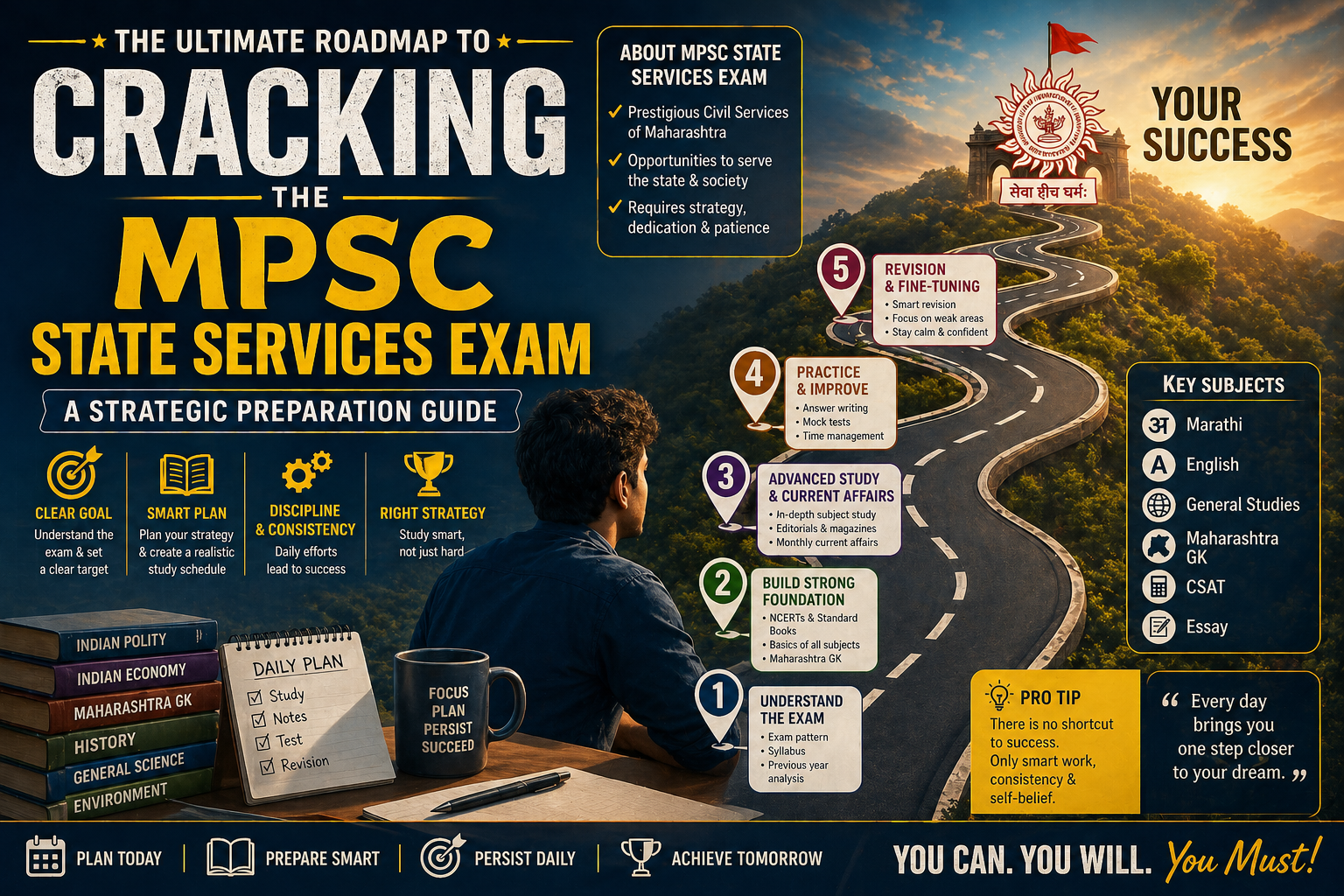
💡 The Ultimate Roadmap to Cracking the MPSC State Services Exam: A Strategic Preparation Guide
Master the MPSC State Services Exam with this comprehensive guide covering the descriptive pattern shift, essential resources, and strategic study plans for Maharashtra's civil services.
Cracking the MPSC State Services Exam requires a disciplined blend of deep conceptual understanding, a mastery of the Maharashtra-specific syllabus, and a strategic shift toward descriptive answer writing for the Mains. Success is built on a foundation of consistent General Studies (GS) revision, staying updated with regional and national current affairs, and rigorous practice through mock tests and previous year question papers. By aligning your preparation with the recent pattern changes that mirror the UPSC format, you can navigate the competitive landscape of Maharashtra's civil services effectively.
The Prestige and Challenge of the Maharashtra Public Service Commission
The Maharashtra Public Service Commission (MPSC) represents the pinnacle of administrative career opportunities within the state. For many, it is not just a job but a calling to serve the public and influence policy at the grassroots level. However, the prestige of becoming a Deputy Collector or a Deputy Superintendent of Police (DYSP) comes with a significant challenge. The exam is known for its vast syllabus and a high selection ratio that tests a candidate's patience as much as their intelligence. The journey from an aspirant to an officer often involves years of dedicated labor, requiring a mental fortitude that can withstand the pressures of a long examination cycle.
Navigating the MPSC Landscape: Understanding Exam Categories and Career Prospects
The MPSC conducts various examinations, but the State Services Exam (Rajyaseva) is the most sought-after. It serves as the gateway to Class I and Class II gazetted posts. Understanding the hierarchy and the roles available is crucial for setting clear goals. Positions like Tehsildar, Block Development Officer (BDO), and Finance and Accounts Officer offer diverse ways to contribute to the state's development. While the rewards include job security and social status, candidates should be aware that these roles often involve high-pressure environments and frequent rural postings, which require a genuine commitment to public service.
Decoding the Three-Tier Selection Process: Prelims, Mains, and the Personality Test
The MPSC follows a rigorous three-stage selection process designed to filter the most capable candidates:
- Preliminary Examination: This is a qualifying stage consisting of two objective papers: General Studies (GS) and the Civil Services Aptitude Test (CSAT). While CSAT is now qualifying in nature, the GS paper remains the deciding factor for moving to the next stage.
- Main Examination: This is the most critical phase. Following the recent shift, the Mains have moved toward a descriptive, UPSC-style pattern. This requires candidates to write long-form answers, testing their analytical depth rather than just factual recall.
- Personality Test (Interview): The final stage assesses the candidate’s personality, leadership qualities, and awareness of social issues. It is a conversation aimed at determining if the candidate possesses the temperament required for an administrative role.

Mastering the Syllabus: Core Subjects and Adapting to the Descriptive Pattern Shift
The transition to a descriptive pattern is perhaps the most significant change in recent MPSC history. Candidates can no longer rely solely on memorizing dates and names. The core subjects—History, Geography, Polity, Economy, and Science—now demand an understanding of 'why' and 'how' rather than just 'what'. For instance, when studying the history of Maharashtra, you must analyze the social impact of reform movements led by figures like Mahatma Jyotirao Phule and Dr. B.R. Ambedkar, rather than just noting the years they were active. This shift levels the playing field for those with strong analytical skills but requires a complete overhaul of traditional study methods.
Building a High-Yield Study Schedule: Balancing Static GS Subjects with Current Affairs
A successful MPSC aspirant manages their time like a professional. A high-yield schedule should allocate roughly 60% of the time to static subjects (History, Polity, etc.) and 40% to current affairs and answer writing.
Practical Example: If you study for 8 hours a day, spend the first 4 hours on a core subject like Indian Polity. Use the next 2 hours for reading a Marathi and English newspaper (like Loksatta or The Hindu) to stay updated on regional issues. Dedicate the final 2 hours to practicing one or two descriptive answers based on what you read that day. This integrated approach ensures that your knowledge is always being applied.
Curating Your Library: Essential Textbooks and Regional Resources
Your resource list should be concise but comprehensive. Overloading yourself with too many books leads to confusion.
- State Board Books: Maharashtra State Board (Balbharati) textbooks from Class 6 to 12 are the foundation for History and Geography.
- Standard References: M. Laxmikanth for Polity and Ramesh Singh or Nitin Singhania for Economy are indispensable.
- Regional Context: Books by K. Sagar or Deepstambh are often used for specific Maharashtra-related data.
While these resources are excellent, the limitation is that they can become outdated quickly regarding economic data or new government schemes. Always supplement them with official government websites and the Economic Survey of Maharashtra.
The Art of Answer Writing: Transitioning from Objective Recognition to Descriptive Excellence
In the new descriptive format, how you present your knowledge is as important as the knowledge itself. A good answer should have a clear introduction, a structured body with subheadings or bullet points, and a forward-looking conclusion.
To excel, start by deconstructing the question. If a question asks you to "Critically Analyze," you must present both the pros and cons of the topic. Use flowcharts and maps where possible to make your answer visually appealing to the examiner. Remember, the goal is to make the examiner's job easier by providing a legible, well-structured, and relevant response.
Leveraging Mock Tests and Previous Year Question Papers (PYQs)
Mock tests are the dress rehearsals for the actual exam. They help in time management and identifying weak areas. However, the real goldmine lies in Previous Year Question Papers. Even with the change in pattern, PYQs help you understand the themes the Commission prioritizes.
- Analyze at least the last 5 years of papers.
- Identify recurring topics like the Maratha Empire, the Cooperative movement in Maharashtra, and the Panchayati Raj system.
- Simulate exam conditions by taking full-length tests in a quiet environment without interruptions.
Maintaining Psychological Resilience and Consistency
The MPSC journey is a marathon. It is common to feel burnt out or discouraged, especially when results are delayed or expectations aren't met. Maintaining resilience involves setting small, achievable daily goals rather than obsessing over the final result. Surround yourself with a positive peer group and do not hesitate to take short breaks to recharge. Consistency is the bridge between goals and accomplishment; even studying for four hours on a 'bad' day is better than not studying at all.





Comments 0
Leave a Reply
Your email address will not be published. Required fields are marked *
Be the first to share your thoughts!