
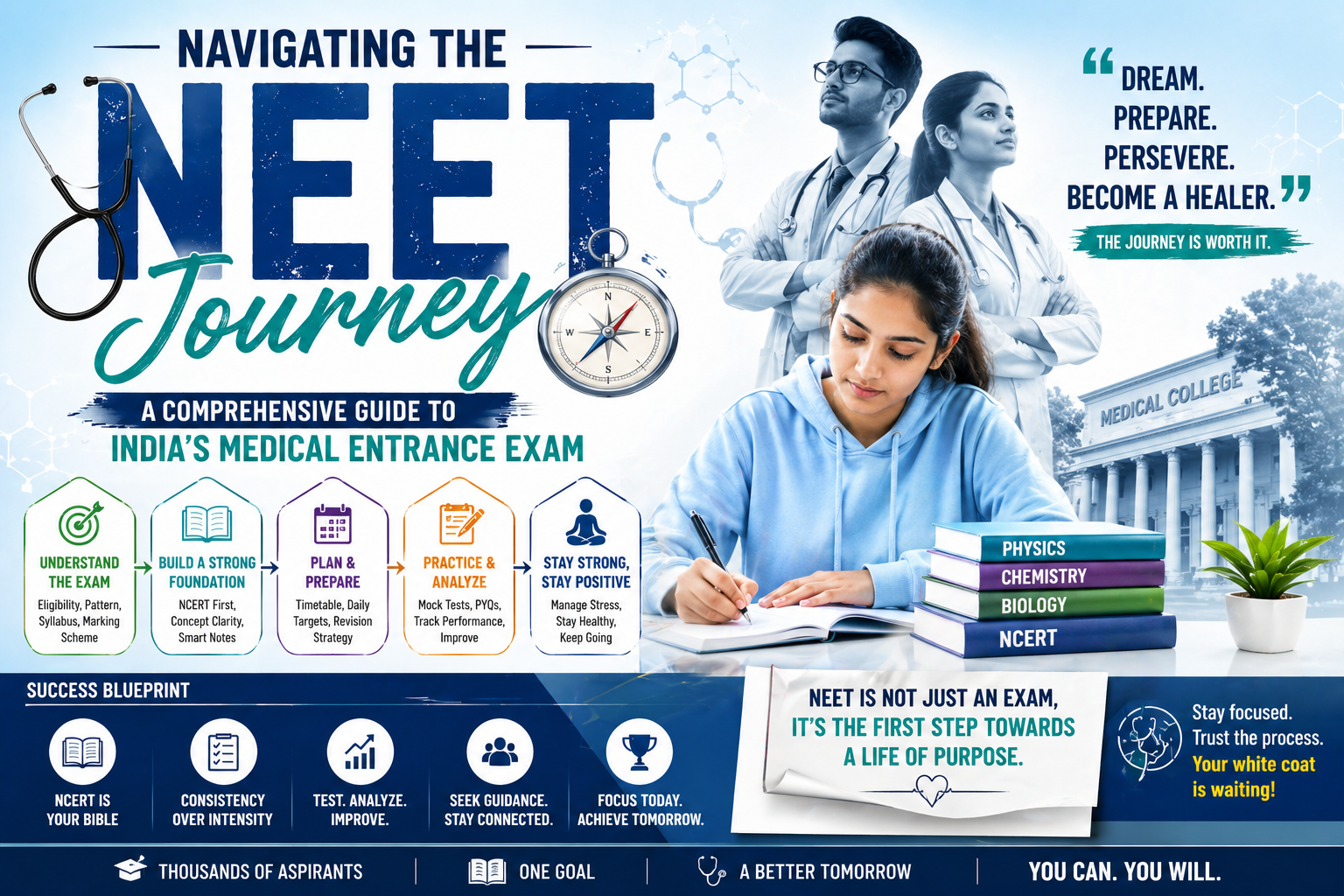
💡 Navigating the NEET Journey: A Comprehensive Guide to India’s Medical Entrance Exam
A complete guide to the NEET exam in India, covering eligibility, exam structure, syllabus, and preparation strategies for medical aspirants.
The National Eligibility cum Entrance Test (NEET) is the mandatory centralized entrance examination for students who wish to pursue undergraduate medical (MBBS), dental (BDS), and AYUSH (BAMS, BUMS, BHMS) courses in India. Conducted by the National Testing Agency (NTA), it serves as the single window for admission to all medical institutions across the country, including prestigious institutes like AIIMS and JIPMER. To qualify, candidates must demonstrate proficiency in Physics, Chemistry, and Biology through a high-stakes, pen-and-paper assessment.
Understanding the Framework of the National Eligibility cum Entrance Test
Before 2013, India had multiple medical entrance exams conducted by various states and individual colleges. This created a fragmented system that forced students to appear for dozens of tests. NEET was introduced to streamline this process, ensuring a uniform standard for medical education and reducing the mental and financial burden on aspirants. Today, the NTA manages the logistics, while the Medical Counselling Committee (MCC) and various state authorities handle the seat allotment based on the NEET All India Rank (AIR).

Academic and Age Requirements for Aspiring Medical Candidates
To sit for the NEET exam, candidates must meet specific eligibility criteria defined by the National Medical Commission (NMC). These requirements ensure that students possess the foundational knowledge necessary for the rigorous medical curriculum.
- Age Limit: Candidates must have completed 17 years of age at the time of admission or will complete that age on or before 31st December of the year of admission. Currently, there is no upper age limit for appearing in NEET.
- Educational Qualification: You must have passed Class 12 (or equivalent) with Physics, Chemistry, Biology/Biotechnology, and English as core subjects.
- Minimum Marks: For the General category, a minimum of 50% aggregate in Physics, Chemistry, and Biology is required in the qualifying exam. For SC/ST/OBC candidates, the requirement is 40%, and for PwD candidates, it is 45%.
- Nationality: Indian Citizens, Non-Resident Indians (NRIs), Overseas Citizens of India (OCIs), Persons of Indian Origin (PIOs), and Foreign Nationals are eligible to apply.
Decoding the NEET Exam Structure: Subjects, Marking, and Duration
The NEET UG exam is a 3-hour and 20-minute test consisting of 200 multiple-choice questions (MCQs), out of which candidates must answer 180. The exam is divided into two sections for each subject: Section A (35 mandatory questions) and Section B (15 questions, where you choose any 10 to answer).

The marking scheme is straightforward but penalizes guesswork. You receive 4 marks for every correct answer and lose 1 mark for every incorrect response. Unattempted questions result in zero marks. This makes accuracy just as important as speed.
Core Syllabus Breakdown: Mastering the NCERT Foundation
The NEET syllabus is vast, covering the curriculum of both Class 11 and Class 12. However, the most critical resource for any aspirant is the NCERT (National Council of Educational Research and Training) textbook series. Most questions, particularly in Biology and Chemistry, are either directly sourced or derived from NCERT concepts.
- Biology: This carries the highest weightage (360 marks). Focus heavily on Human Physiology, Genetics, Plant Physiology, and Ecology.
- Chemistry: Split into Physical, Organic, and Inorganic. While Physical Chemistry requires problem-solving skills, Inorganic Chemistry is largely memory-based, and Organic Chemistry requires a deep understanding of reaction mechanisms.
- Physics: Often considered the toughest section by medical students. It requires a strong grasp of concepts in Mechanics, Electrodynamics, and Modern Physics. Practicing numerical problems is essential here.
Strategic Preparation Techniques for High-Percentile Results
Success in NEET is not just about hard work; it is about strategic planning. High-percentile scorers typically follow a disciplined routine that balances learning with testing.
One effective method is the Active Recall technique, where you test yourself on a topic immediately after reading it, rather than just passively re-reading. Additionally, solving previous years' question papers (PYQs) is non-negotiable. It helps you understand the "flavor" of questions the NTA prefers.
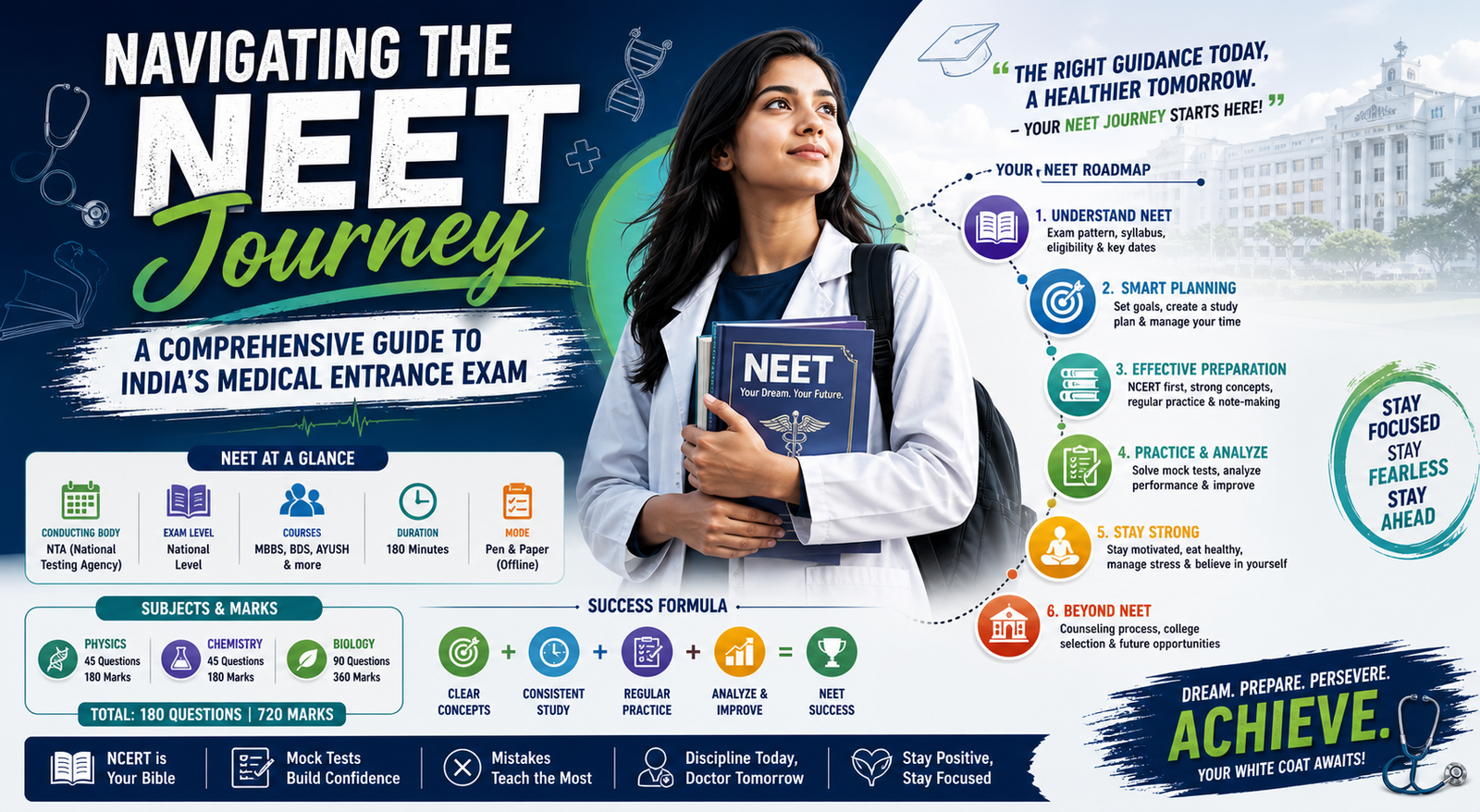
During the final months, focus on Mock Tests. Simulating the exam environment—sitting in a quiet room for 3 hours and 20 minutes without breaks—builds the mental stamina required for the actual day. Analyze your mistakes after every test to ensure you don't repeat them.
The Post-Exam Roadmap: Counseling, Seat Allotment, and Admissions
Once the results are declared, the journey moves from the examination hall to the counseling portal. The admission process is divided into two main categories:
- All India Quota (AIQ): 15% of seats in all government medical colleges across India are reserved for the AIQ, managed by the Medical Counselling Committee (MCC). Any student from any state can apply for these seats.
- State Quota: The remaining 85% of seats are reserved for students belonging to that particular state. Each state has its own counseling authority and merit list.
The process involves registration, choice filling (listing your preferred colleges), seat allotment based on rank, and finally, physical reporting to the college for document verification.
Frequently Asked Questions Regarding NEET Eligibility and Attempts
How many times can I attempt NEET?
As per current regulations, there is no limit on the number of attempts for the NEET exam, provided you meet the age eligibility criteria.
Is NEET mandatory for studying MBBS abroad?
Yes, Indian students who wish to pursue a medical degree outside India must qualify for NEET to be eligible to practice in India upon their return.
Can I clear NEET without coaching?
Absolutely. Many students clear NEET through self-study by utilizing online resources, NCERT books, and consistent practice. Discipline and a clear study plan are more important than expensive coaching.
In what languages is the NEET exam conducted?
NEET is conducted in 13 languages, including English, Hindi, Assamese, Bengali, Gujarati, Kannada, Malayalam, Marathi, Odia, Punjabi, Tamil, Telugu, and Urdu.
Conclusion
The journey to becoming a doctor in India is a marathon, not a sprint. While the NEET exam is undeniably competitive, it is a fair system designed to reward those who master the fundamentals and maintain composure under pressure. By focusing on the NCERT foundation, practicing consistently, and maintaining a resilient mindset, you can navigate this challenge successfully and secure your place in the medical fraternity.





Comments 0
Leave a Reply
Your email address will not be published. Required fields are marked *
Be the first to share your thoughts!