
💡 NFL Strategic Analysis: Media Rights and Global ROI
A comprehensive analysis of the NFL's business model, exploring the 110 billion dollar media rights deal, streaming pivots, and international expansion strategy.
Executive Summary
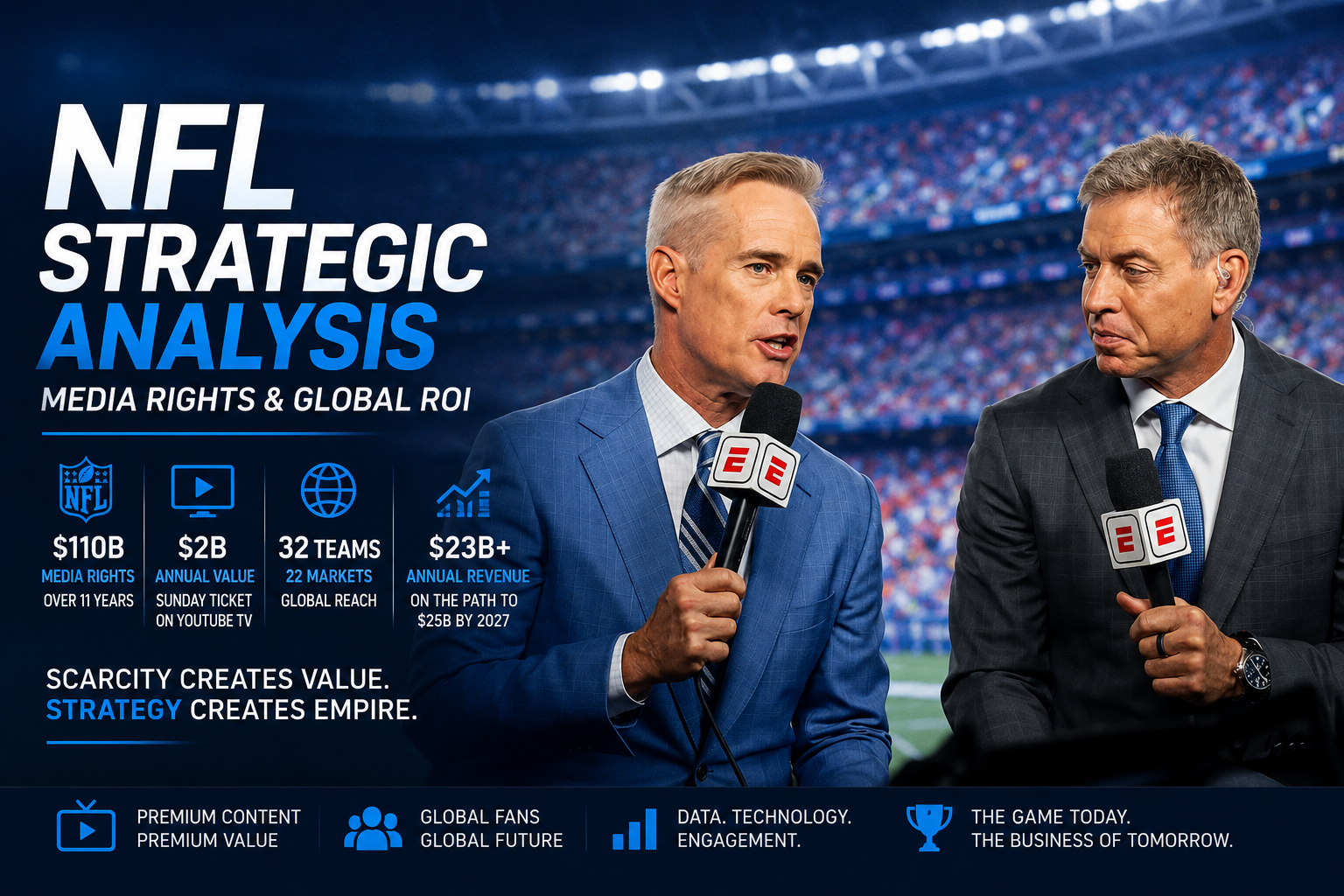
The National Football League (NFL) has evolved into one of the world's most powerful sports and entertainment businesses, with league-wide revenue surpassing $23 billion in the most recently reported fiscal year. Commissioner Roger Goodell's long-standing target of reaching $25 billion in annual revenue by 2027 is now within close reach.
The league's financial strength is built around several interconnected pillars: long-term media-rights agreements, premium advertising inventory, sponsorships, digital distribution, international expansion, and the scarcity created by a relatively short regular season. The NFL's current media agreements with major partners are worth nearly $110 billion over 11 years and run through the 2033 season.
At the same time, the league is expanding its digital footprint through NFL+, YouTube's NFL Sunday Ticket, Amazon Prime Video, Peacock, and Netflix. Internationally, the NFL's Global Markets Program now includes all 32 teams across 22 international markets, while the 2026 season features a record nine international regular-season games across seven countries.
This analysis examines how the NFL converts media attention into recurring revenue, how streaming is reshaping distribution, and why international expansion could become one of the league's most important long-term growth engines.
Introduction: The Economics of the Shield
The NFL is no longer simply a professional football competition. It is a sophisticated media, advertising, licensing, sponsorship, and entertainment ecosystem.
One of the league's greatest commercial advantages is scarcity. Unlike sports with much longer regular seasons, the NFL has a relatively limited number of games, making each matchup more valuable to broadcasters and advertisers. This creates appointment viewing around regular-season games, playoffs, and the Super Bowl.
The NFL's audience strength has also translated into extraordinary media leverage. In 2023, NFL games accounted for 93 of the 100 most-watched television programs in the United States, demonstrating the league's ability to dominate national television attention.
The strategic question for the NFL is no longer whether people will watch football. It is how the league can capture more of the value created by that attention while adapting to changing consumer habits.
THE DEEP DIVE: The Economics of the NFL
1. The Nearly $110 Billion Media-Rights Machine
Media rights represent the foundation of the NFL's business model.
In 2021, the league announced long-term distribution agreements with Amazon, CBS, ESPN/ABC, FOX, and NBC covering the 2023 through 2033 seasons. Industry estimates put the combined value of these agreements at approximately $110 billion over 11 years.
The strategic value of the deal is not simply its size. It is the diversification of distribution.
The NFL continues to work with traditional broadcasters while simultaneously expanding its presence on streaming platforms. Amazon Prime Video carries Thursday Night Football, while other games remain available through CBS, FOX, NBC, ESPN/ABC and digital services.
This structure gives the NFL several advantages:
- Guaranteed long-term media revenue
- Access to traditional television audiences
- Growing exposure to streaming audiences
- Multiple advertising ecosystems
- Greater distribution flexibility
- Stronger negotiating leverage for future rights deals
The current media package is also more than a simple television contract. It gives the NFL access to different consumer segments and allows the league to experiment with how premium sports content is distributed.
2. Streaming and the Digital Transformation
The NFL's digital strategy is not about completely replacing television. Instead, the league is building a hybrid distribution model in which traditional broadcasters and streaming platforms operate alongside one another.
NFL+ provides direct digital access to fans in the United States, while NFL Sunday Ticket is distributed through YouTube and YouTube TV. Google reportedly pays approximately $2 billion annually for the Sunday Ticket rights, making it one of the most important streaming deals in sports.
The league has also experimented with exclusive streaming events.
In January 2024, Peacock carried the NFL's first exclusively streamed playoff game. The Dolphins-Chiefs Wild Card matchup averaged approximately 23 million viewers and was reported by Comcast as consuming about 30% of U.S. internet traffic during the game.
The NFL has also expanded its relationship with Netflix. Netflix became the global home for the NFL's Christmas Day games in 2024, with the agreement extending to Christmas games in 2025 and 2026.
This demonstrates an important strategic shift: the NFL is increasingly willing to place selected premium games on major streaming platforms without abandoning its traditional broadcast partners.
3. Global Market Penetration
International expansion is becoming one of the NFL's most important long-term growth opportunities.
The league's Global Markets Program, launched in 2022, gives teams international marketing rights that allow them to develop local fan bases, partnerships, events and commercial opportunities.
As of 2026, all 32 NFL teams participate in the program across 22 international markets.
The international strategy has also moved beyond marketing.
The NFL is increasingly taking actual regular-season games overseas.
For the 2026 season, the league has scheduled nine international games across seven countries and four continents, with games taking place in Australia, Brazil, the United Kingdom, France, Spain, Germany and Mexico.
This is strategically important because international games create multiple revenue opportunities:
- Ticket sales
- International sponsorships
- Merchandise
- Local media rights
- Tourism
- Corporate hospitality
- Grassroots football development
- Long-term fan acquisition
The NFL's international strategy therefore goes beyond simply playing games abroad. The objective is to establish football as a recognizable global entertainment property.
4. Sponsorships and Commercial Integration
Sponsorship is another major component of the NFL's commercial ecosystem.
According to SponsorUnited, NFL team sponsorship revenue reached approximately $2.35 billion during the 2023–24 season, up 15% from the previous season. Importantly, this figure refers to team sponsorship revenue, rather than the NFL league office's sponsorship revenue alone.
The league has expanded its commercial relationships across categories including:
- Automotive
- Financial services
- Technology
- Food and beverage
- Telecommunications
- Gaming
- Sports betting
- Retail
- Travel
Technology has also become increasingly important.
The NFL's Next Gen Stats, powered by AWS, provides advanced player and game data that can be incorporated into broadcasts, fantasy football, analytics and digital experiences.
This creates a valuable commercial flywheel:
Live Games → Data → Digital Engagement → Advertising → Sponsorship → Revenue
The more fans interact with NFL content, the more valuable the league becomes to advertisers and technology partners.
5. Franchise Valuation and Shared Economics
The NFL's commercial success is reflected in the extraordinary valuations of its franchises.
The old estimate that the average NFL team was worth $5.1 billion in 2024 should not be used as the primary current benchmark.
Forbes reported in 2024 that all 32 NFL franchises were worth at least $4 billion, while the Dallas Cowboys became the first sports franchise valued at more than $10 billion, at an estimated $10.1 billion.
This valuation model is supported by the NFL's revenue-sharing structure, national media contracts and league-wide commercial partnerships.
The result is an unusual combination:
Individual team brands + centralized league economics = enormous franchise value.
That structure helps smaller-market teams participate in a league where the overall media and sponsorship machine is substantially centralized.
6. The Scarcity Advantage
One of the NFL's most powerful strategic assets is something the league cannot simply manufacture: limited supply.
An NFL team plays only a limited number of regular-season games. That scarcity makes individual games commercially valuable.
Compare this with sports leagues where teams play hundreds of games in a season. The NFL's limited schedule means that:
- Every regular-season matchup carries greater attention.
- National broadcasts become premium inventory.
- Advertising slots become more valuable.
- Fans have fewer opportunities to watch their team live.
- Playoff qualification creates additional urgency.
- The Super Bowl becomes one of the world's largest annual media events.
This is a classic example of scarcity economics being used to strengthen pricing power.
7. The International Game as a Business Platform
An international NFL game should not be viewed simply as a football match.
It is effectively a multi-day commercial activation.
Before the game, teams can organize fan events, sponsor activations and youth football programs. During the game, the league generates ticketing, hospitality, broadcasting and advertising revenue. After the game, teams can continue marketing to the newly developed fan base.
This makes an international game a customer-acquisition strategy rather than simply an event.
The 2026 international schedule demonstrates how seriously the league is pursuing this strategy. Australia, Brazil, France, Germany, Mexico, Spain and the United Kingdom are all part of the current international slate.
WHAT THIS MEANS FOR YOU
For Fans
The biggest change is the increasing number of platforms involved in NFL distribution.
Fans may encounter NFL content through traditional broadcast television, Amazon Prime Video, Netflix, YouTube, NFL+ and other regional services depending on the game and location.
The advantage is greater accessibility. The disadvantage is that watching every game can require multiple subscriptions or packages.
For Investors and Businesses
The NFL demonstrates the value of owning premium intellectual property.
Its strategy combines:
Content + Scarcity + Distribution + Data + Sponsorship + Global Expansion
That combination creates multiple monetization opportunities from the same underlying product.
For Technology Companies
The NFL's move toward streaming, analytics and personalized digital experiences demonstrates the increasing importance of technology in sports.
The opportunity is no longer limited to broadcasting games. Technology companies can participate through:
- AI
- Data analytics
- Streaming infrastructure
- Fan engagement
- Sports betting technology
- Advertising technology
- Wearables
- Fantasy sports
- Venue technology
For International Markets
The NFL's international expansion creates opportunities for tourism, hospitality, retail, sponsorships and local sports development.
The long-term objective is not simply to sell tickets to international games. It is to convert international viewers into year-round NFL fans.
Expert Verdict and Future Outlook
The NFL enters the next phase of its development from a position of exceptional financial strength.
Revenue has already surpassed $23 billion, putting Roger Goodell's long-standing $25 billion revenue target for 2027 within reach.
However, maintaining this growth rate will become increasingly difficult.
The league's next growth opportunities are likely to come from:
- International expansion
- New media-rights opportunities
- Streaming distribution
- Digital advertising
- Data monetization
- Premium sponsorships
- International merchandising
- New forms of fan engagement
The NFL's labor framework also provides relative stability. The current collective bargaining agreement expires in March 2031, rather than 2030.
Looking ahead, the league could also explore additional investments in technology, media and digital businesses. The strategic objective is increasingly clear: transform the NFL from a seasonal sports competition into a 365-day global entertainment ecosystem.
FAQ
How does the NFL make most of its money?
The NFL generates revenue through national media rights, sponsorships, licensing, ticket-related income, merchandising and other commercial activities. Media rights are one of the most important components of the league's financial model.
How much are the NFL's media rights worth?
The current major media agreements covering the 2023–2033 seasons are valued at approximately $110 billion over 11 years.
Why is the NFL moving some games to streaming platforms?
Streaming allows the NFL to reach younger and digitally oriented audiences while giving distribution partners access to valuable live sports content. The strategy is not necessarily to eliminate traditional television, but to expand the number of platforms through which fans can access NFL content.
How many international markets does the NFL currently target?
As of 2026, the NFL's Global Markets Program includes all 32 teams across 22 international markets.
How many international NFL games are scheduled for 2026?
The 2026 season includes a record nine international regular-season games across seven countries: Australia, Brazil, the United Kingdom, France, Spain, Germany and Mexico.
How valuable are NFL teams?
NFL franchise valuations have reached extraordinary levels. In Forbes' 2024 ranking, all 32 teams were valued at at least $4 billion, while the Dallas Cowboys were valued at $10.1 billion.
What is the NFL salary cap?
The NFL uses a salary-cap system tied to league economics. For the 2024 season, the salary cap was $255.4 million per team, up from $224.8 million in 2023.
Is Netflix part of the NFL's media strategy?
Yes. Netflix began carrying NFL Christmas Day games in 2024 and its agreement included Christmas games in 2025 and 2026.
Conclusion
The NFL's business strategy is built on a rare combination of scarcity, audience scale, premium media rights, centralized economics and global expansion.
Its nearly $110 billion media-rights structure provides long-term financial visibility, while streaming partnerships with platforms such as Amazon, YouTube and Netflix help the league adapt to changing viewing habits.
At the same time, the Global Markets Program and the record international schedule demonstrate that the NFL is no longer thinking exclusively about the U.S. market. With all 32 teams now participating in international marketing and 22 markets covered by the program, the league is building the foundation for a truly global sports brand.
The central strategic lesson is straightforward:
The NFL does not simply sell football. It monetizes attention, scarcity, data, media distribution and global fandom.
With revenue already above $23 billion and the $25 billion target approaching, the next phase of NFL growth will depend on how effectively the league converts its enormous American popularity into a sustainable global entertainment ecosystem.
Important Note: This article is for educational and informational purposes only. Financial figures, valuations and projections can change over time and should not be interpreted as professional investment advice.




Comments 0
Leave a Reply
Your email address will not be published. Required fields are marked *
Be the first to share your thoughts!