
💡 Petrol Price in Delhi: A Strategic Economic Analysis
An authoritative analysis of petrol pricing in Delhi, examining taxation structures, international crude oil impacts, and economic implications for the national capital.
Executive Summary
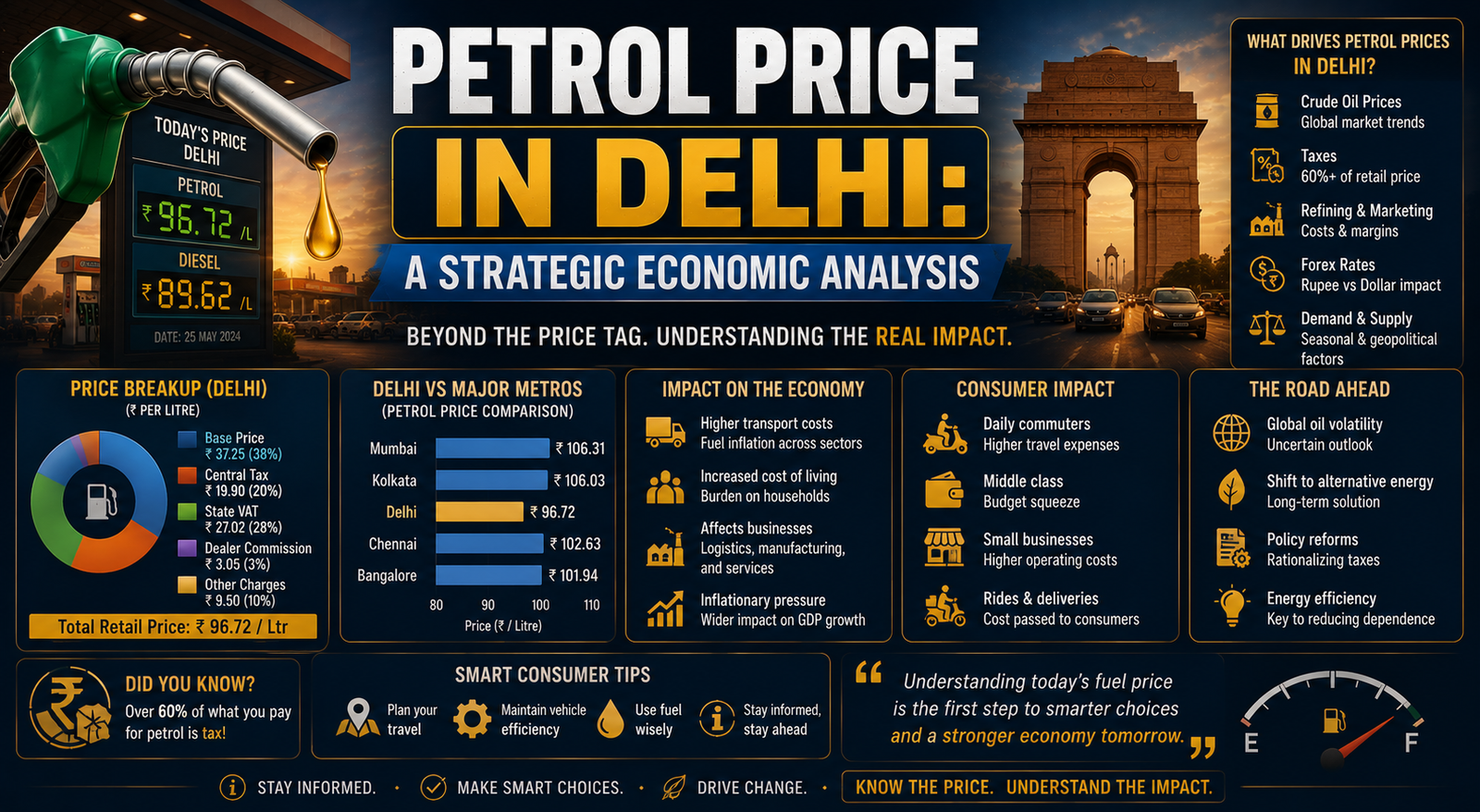
The retail selling price of petrol in Delhi serves as a critical barometer for the Indian economy. Currently hovering around 94.72 INR per liter, the price is a composite of international crude costs, refinery margins, and a heavy taxation framework. Key data indicates that taxes, comprising both Central Excise Duty and State Value Added Tax (VAT), account for nearly 45 percent of the final pump price. This analysis highlights the roles of Oil Marketing Companies (OMCs) and the impact of the Daily Dynamic Pricing model introduced in 2017. Strategic shifts in global energy supply chains and the strengthening of the USD against the INR remain the primary drivers of price volatility in the national capital territory.
Introduction
For the residents of Delhi, the daily fluctuation of petrol prices is more than just a logistical concern; it is a significant factor in household budgeting and micro-economic planning. As the political and administrative heart of India, Delhi's fuel pricing strategy often sets the tone for northern India. Unlike other commodities, petrol is subject to a complex pricing mechanism that operates outside the Goods and Services Tax (GST) regime. This exclusion allows for a unique interplay between central and state fiscal policies. To understand the current landscape, one must look at the broader India's Strategic Evolution, which provides the digital and economic framework for how energy is managed and distributed in a modernizing economy.
The Deep Dive: Deconstructing the Price Build-up
The final price a consumer pays at a petrol pump in Delhi is the result of a multi-layered calculation. Understanding this breakdown is essential for any authoritative analysis of the energy sector.
1. The Base Price and Freight
The journey begins with the price of international crude oil, typically benchmarked against Brent Crude. Oil Marketing Companies such as Indian Oil Corporation Limited (IOCL), Bharat Petroleum (BPCL), and Hindustan Petroleum (HPCL) import crude, which is then processed at refineries. The base price includes the cost of crude, ocean freight, and refinery processing charges. Currently, the base price represents roughly 50 to 55 percent of the total retail price. Fluctuations in the global market, influenced by OPEC+ production quotas and geopolitical tensions, directly affect this component.
2. Central Excise Duty
The Government of India levies a specific Central Excise Duty on every liter of petrol. This is a fixed amount rather than a percentage, providing a stable revenue stream for the union budget. This revenue is often redirected into infrastructure projects and social welfare schemes. The strategic allocation of these funds is a cornerstone of national policy, similar to how other regions manage their industrial growth, as seen in the Tamil Nadu: Strategic Analysis of economic powerhouses. While the central government has occasionally reduced excise duty to provide relief to consumers, it remains a significant portion of the price structure.
3. Delhi State VAT (Value Added Tax)
The Government of NCT of Delhi applies its own Value Added Tax. Delhi has historically maintained a competitive VAT rate compared to neighboring states like Uttar Pradesh or Haryana to prevent fuel smuggling and revenue loss. Currently, Delhi's VAT on petrol stands at approximately 19.40 percent. This percentage-based tax means that as the base price and excise duty rise, the absolute amount of VAT collected also increases, leading to a compounding effect on the final price.
4. Dealer Commission
Petrol pump owners receive a commission for every liter sold. This commission covers the operational costs of the fuel station, including electricity, staff salaries, and maintenance. While this is the smallest component of the price build-up, it is vital for the sustainability of the retail distribution network. In Delhi, where real estate and operational costs are high, the dealer commission is a frequent point of discussion between petroleum dealers' associations and the government.
5. Global Influence and Currency Fluctuations
Since India imports over 80 percent of its crude oil requirements, the USD-INR exchange rate is a decisive factor. A weakening Rupee makes oil imports more expensive, forcing OMCs to adjust retail prices upward. Global political shifts also play a role. For instance, changes in US energy policy or trade stances, as discussed in the Donald Trump: Strategic Analysis of Economic Policy, can lead to volatility in global supply chains that eventually reach the pumps in Delhi.
What This Means For You
The implications of petrol price movements in Delhi extend far beyond the fuel tank of a private car. Here is how it affects the average citizen:
- Logistics and Inflation: High petrol prices increase the cost of transporting essential goods, including fruits, vegetables, and milk, into the city. This often leads to retail inflation, affecting the purchasing power of the middle class.
- Public Transport Costs: While many of Delhi's public transport vehicles run on CNG, the overall increase in fuel costs puts pressure on taxi and auto-rickshaw aggregators to hike fares.
- Shift to EVs: Sustained high petrol prices are accelerating the adoption of Electric Vehicles (EVs) in Delhi. The state government’s EV policy, combined with the high cost of internal combustion engine (ICE) fuel, is making the switch more economically viable for daily commuters.
- Disposable Income: For the average commuter traveling 20 to 30 kilometers daily, a 5 INR increase in petrol prices can result in an additional monthly expenditure of 500 to 800 INR, reducing the budget available for discretionary spending.
Expert Verdict and Future Outlook
Industry experts suggest that petrol prices in Delhi are unlikely to see a drastic reduction in the near term. The global transition toward green energy and the ongoing geopolitical instability in oil-producing regions suggest a period of price consolidation rather than decline. However, the push for ethanol blending, where the government aims for 20 percent ethanol blending in petrol by 2025, could potentially stabilize prices by reducing the volume of imported crude required. Furthermore, the integration of more transparent pricing mechanisms and the potential future inclusion of petroleum products under GST remain the most anticipated reforms in the sector. For now, Delhi's petrol price remains a delicate balance between fiscal necessity and public affordability.
Frequently Asked Questions
1. Why is petrol cheaper in Delhi than in Mumbai?
The primary reason is the difference in state-level taxation. The Maharashtra government levies higher VAT and additional surcharges on fuel compared to the Government of NCT of Delhi. Furthermore, Mumbai's proximity to ports is offset by local municipal octroi or cess that Delhi does not apply in the same manner.
2. Does the petrol price change every day?
Yes, since June 2017, India has followed a Daily Dynamic Pricing model. Prices are revised at 6:00 AM every morning based on the 15-day rolling average of international benchmark prices and the foreign exchange rate. However, OMCs may occasionally freeze prices during periods of extreme volatility or significant national events.
3. How much of the petrol price is actually tax?
In Delhi, approximately 40 to 45 percent of the price you pay at the pump goes to the government in the form of Central Excise Duty and State VAT. This percentage fluctuates slightly based on the base price of crude oil.
4. Why is petrol not under GST?
Including petrol under GST would require a consensus between the Center and the States. Currently, both levels of government rely heavily on fuel taxes for immediate revenue. Bringing petrol under the highest GST slab of 28 percent would significantly reduce the total tax collected, leading to a revenue shortfall that many states are not yet ready to absorb.
5. How does the USD-INR rate affect Delhi's petrol price?
Oil is traded internationally in US Dollars. When the Indian Rupee depreciates against the Dollar, it costs more Rupees to buy the same barrel of oil. These increased costs are passed on to the consumer through the daily price revisions at the pump.
Important Note: Financial Disclaimer: This content is for educational purposes only and does not constitute professional financial advice. Always consult with a certified financial planner before making investment decisions.
Conclusion
The strategic analysis of petrol prices in Delhi reveals a complex dependency on international markets, currency health, and a rigid domestic tax structure. While the consumer remains vulnerable to global shocks, the move toward alternative fuels and potential tax reforms offer the only long-term path to price stability. For stakeholders and citizens alike, monitoring these economic levers is essential for navigating the financial landscape of the national capital.





Comments 0
Leave a Reply
Your email address will not be published. Required fields are marked *
Be the first to share your thoughts!