
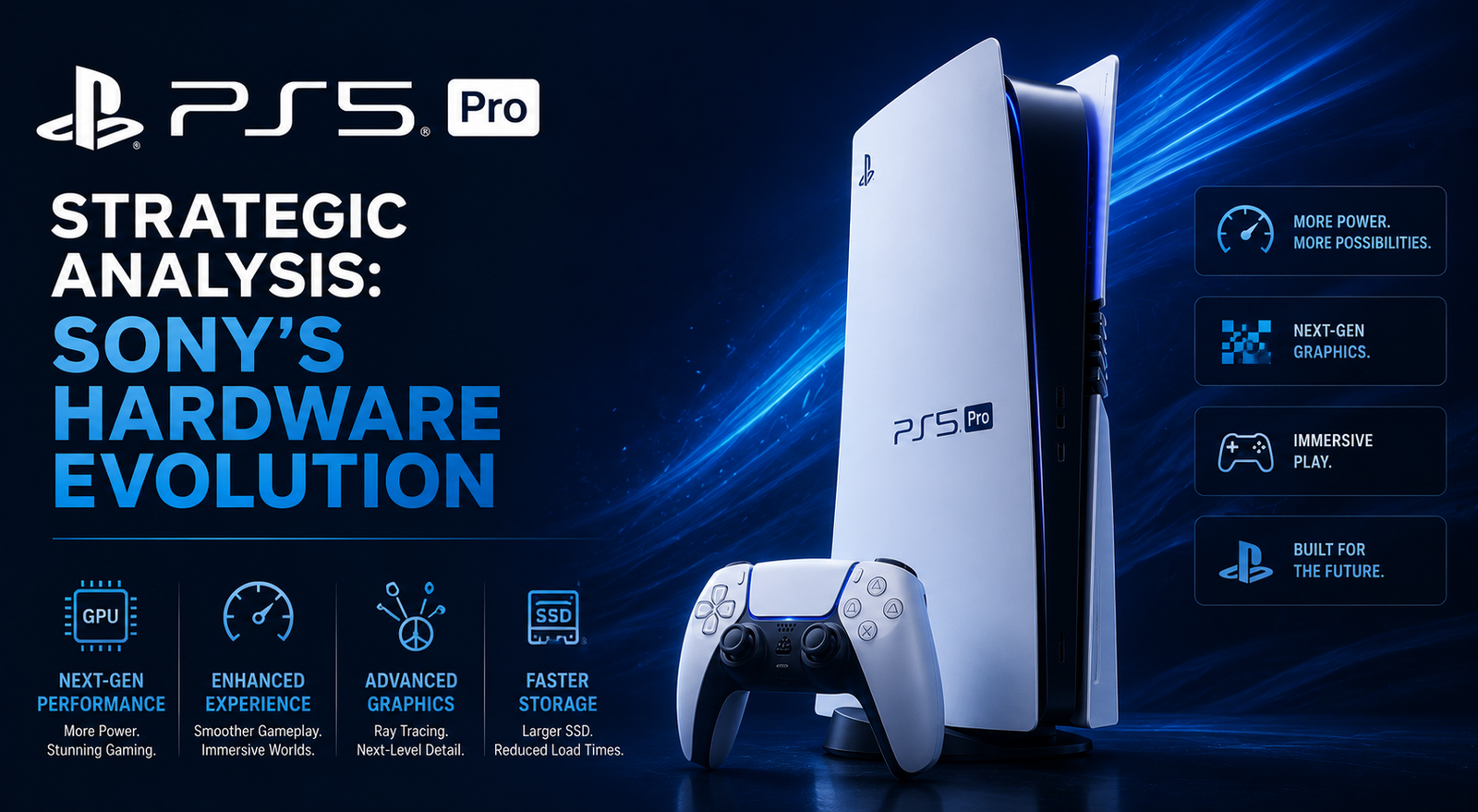
💡 PS5 Pro Strategic Analysis: Sony's Hardware Evolution
A deep dive into the technical specifications, market positioning, and strategic impact of Sony's upcoming PS5 Pro console refresh.
Executive Summary
The PlayStation 5 Pro, internally known as Project Trinity, represents Sony Interactive Entertainment's strategic mid-generation response to the increasing demand for high-fidelity performance. Key findings indicate a 45 percent increase in rendering speed and a significant leap in ray tracing capabilities, projected to be 2 to 3 times faster than the base model. The introduction of PlayStation Spectral Super Resolution (PSSR) marks Sony's first major foray into AI-driven upscaling, a move designed to compete with NVIDIA's DLSS. Data suggests that Sony aims to standardize 4K resolution at a consistent 60 frames per second, bridging the gap between current console limitations and high-end PC gaming performance.
Introduction
In the high-stakes landscape of interactive entertainment, hardware lifecycles are carefully managed to maintain consumer interest and software sales. The PlayStation 5 Pro is not merely a marginal upgrade but a calculated strategic pivot. Since the launch of the original PS5 in November 2020, the industry has seen a rapid shift in consumer expectations. Gamers are no longer satisfied choosing between Fidelity Mode (high resolution at 30fps) and Performance Mode (lower resolution at 60fps). Sony's objective with the Pro model is to eliminate this compromise. By analyzing the broader market, much like the Disney Strategic Analysis reveals how content ecosystems drive hardware adoption, we can see that Sony is positioning the PS5 Pro as the ultimate vessel for its prestige first-party titles.
THE DEEP DIVE: Technical Architecture and Market Strategy
The core of the PS5 Pro's value proposition lies in its upgraded Graphics Processing Unit (GPU) and the integration of specialized AI hardware. While the base PS5 utilizes a GPU with 10.28 Teraflops, the Pro model is reported to boast 33.5 Teraflops of single-precision floating-point performance. However, due to architectural changes in the RDNA 3.5 framework, the actual rendering throughput is expected to be approximately 45 percent faster. This is a critical distinction for industry analysts who understand that raw Teraflop counts do not always translate linearly to in-game performance.
The Central Processing Unit (CPU) remains based on the Zen 2 architecture but includes a High CPU Frequency Mode, boosting clock speeds by 10 percent to 3.85GHz. This modest increase ensures compatibility with existing software while providing the necessary overhead for more complex logic and physics calculations. Furthermore, the system memory bandwidth is seeing a 28 percent increase, moving from 448 GB/s to 576 GB/s. This allows for faster data streaming and supports the enhanced ray tracing features that are central to the Pro's identity.
Perhaps the most significant technological leap is PlayStation Spectral Super Resolution (PSSR). This proprietary AI upscaling technology uses machine learning to analyze images and add detail, similar to how the Steam Strategic Analysis highlights Valve's focus on software-driven performance enhancements for the Steam Deck. PSSR is designed to replace traditional temporal anti-aliasing (TAA) and upscaling methods, providing a cleaner, sharper image that rivals native 4K while requiring fewer system resources. This technology is essential for Sony's long-term goal of supporting 8K resolutions in future software updates.
From a market perspective, Sony is leveraging its massive install base to create a tiered ecosystem. By offering a premium hardware tier, they cater to the enthusiast segment that might otherwise migrate to PC gaming. This strategy mirrors the Amazon Prime Strategic Analysis regarding ecosystem stickiness: once a user is invested in a high-performance hardware platform with a deep library of digital content, the cost of switching to a competitor becomes prohibitively high. Sony's focus remains on maintaining its lead in the console space by providing the most powerful hardware available in a plug-and-play format.
WHAT THIS MEANS FOR YOU
For the average consumer, the PS5 Pro represents a choice between standard accessibility and premium performance. If you currently own a base PS5, the upgrade is primarily beneficial if you own a high-end 4K television with a 120Hz refresh rate. The Pro model will allow games to run at higher resolutions with more stable frame rates, meaning you will no longer have to sacrifice visual clarity for smooth gameplay. For those who have not yet entered the PS5 ecosystem, the Pro model will likely become the definitive way to experience upcoming blockbusters, though it will carry a higher price point, likely between 499 and 599 dollars.
- Consistent 60fps at 4K resolution across most major titles.
- Enhanced Ray Tracing for more realistic lighting, shadows, and reflections.
- Future-proofing for 8K displays and more demanding future software.
- Improved performance for PlayStation VR2 titles through higher sub-sampling.
Expert Verdict and Future Outlook
Sony's decision to release a Pro model in late 2024 is a masterclass in hardware lifecycle management. By refreshing the hardware four years into the cycle, they effectively reset the clock on consumer expectations. As silicon manufacturing becomes more expensive and Moore's Law slows down, the industry is shifting toward AI-driven solutions like PSSR to find performance gains. The PS5 Pro is the first major console to fully embrace this shift. Looking forward, the success of the PS5 Pro will depend heavily on the software lineup. While the hardware is impressive, its primary purpose is to serve as a showcase for Sony's technical prowess in the lead-up to the next generation of gaming.
FAQ
1. When is the PS5 Pro expected to be released?
Industry reports and supply chain data suggest a release window in November 2024, strategically timed for the holiday shopping season.
2. Will the PS5 Pro play all existing PS5 games?
Yes, the PS5 Pro is fully backward compatible with the entire PS5 library and the vast majority of PS4 titles. Many existing games will receive patches to take advantage of the Pro's increased power.
3. How much will the PS5 Pro cost?
While Sony has not officially announced pricing, analysts predict a retail price point of 499 to 599 dollars, depending on whether the console includes a disc drive.
4. Do I need a new TV to use the PS5 Pro?
You do not need a new TV, but to see the benefits of the Pro model, a 4K TV with HDR support is highly recommended. A 120Hz display will allow you to utilize the higher frame rate capabilities.
5. Is the PS5 Pro significantly larger than the original PS5?
Internal design documents suggest the PS5 Pro will maintain a similar footprint to the PS5 Slim model, though it may feature slightly different aesthetic vents to accommodate the increased heat output from the more powerful GPU.
Conclusion
The PS5 Pro is a strategic evolution designed to maintain Sony's dominance in the premium gaming market. By focusing on AI upscaling and enhanced ray tracing, Sony is addressing the two most significant technical hurdles of the current generation. While the base PS5 remains a highly capable machine, the Pro model offers a glimpse into the future of console gaming, where the lines between high-end PCs and home consoles continue to blur. For Sony, this is about more than just hardware; it is about securing the loyalty of its most dedicated users through a commitment to technical excellence.





Comments 0
Leave a Reply
Your email address will not be published. Required fields are marked *
Be the first to share your thoughts!