
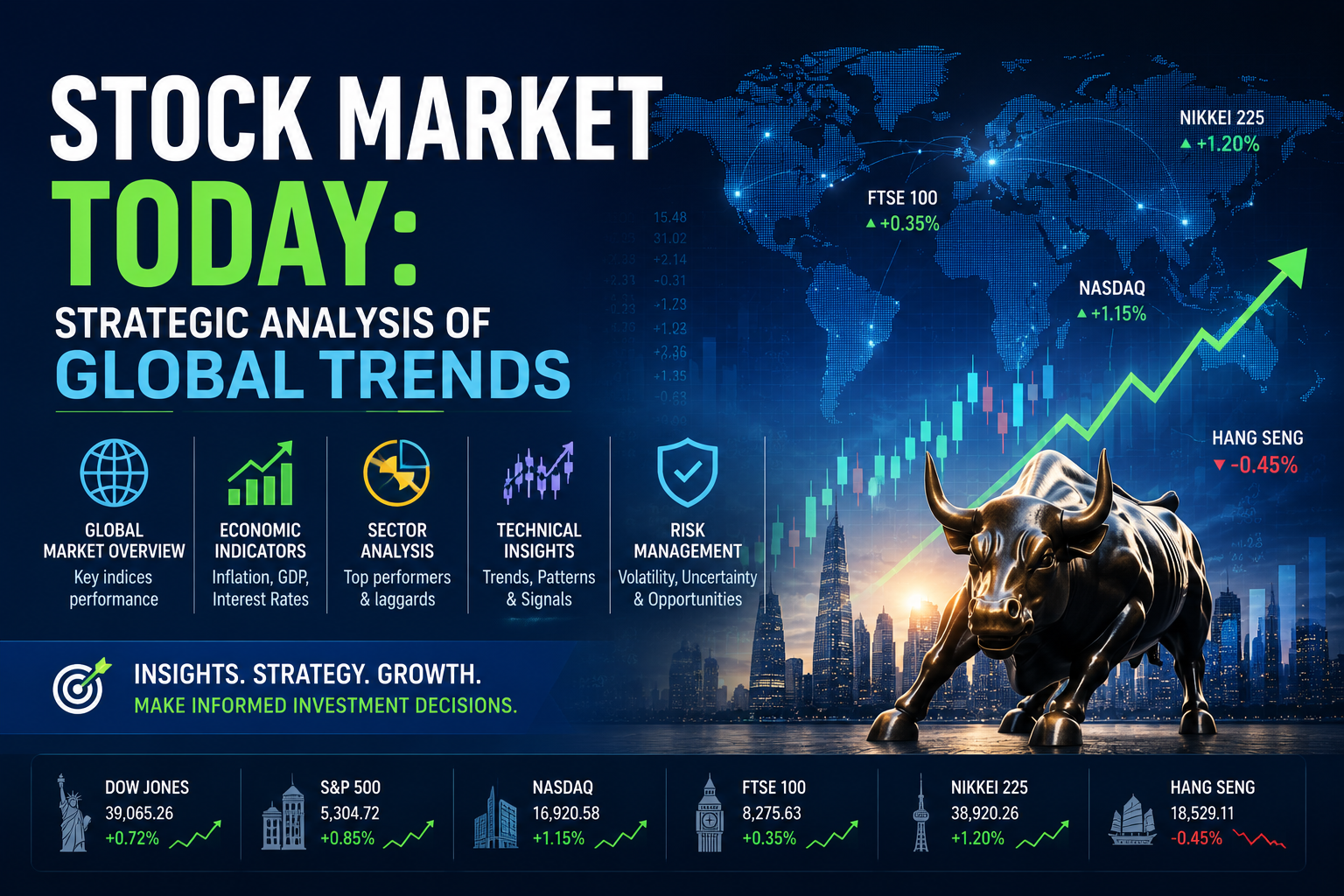
💡 Stock Market Today: Strategic Analysis of Global Trends
A professional analysis of current stock market performance, macroeconomic indicators, and strategic outlook for investors.
Executive Summary
The global equity markets are currently navigating a complex transition phase characterized by shifting monetary policies and the integration of artificial intelligence into core business models. Key data highlights indicate that the S&P 500 is maintaining a forward price-to-earnings (P/E) ratio of approximately 21.5, which is notably higher than the ten-year average of 17.8. This premium is largely driven by the technology sector, specifically the Magnificent Seven companies, which contribute nearly 30 percent of the index total market capitalization. Meanwhile, the 10-year Treasury yield remains a pivotal anchor, fluctuating between 4.0 percent and 4.4 percent as investors calibrate their expectations for Federal Reserve rate adjustments. This analysis provides a high-level overview of the catalysts driving price action and the structural risks inherent in the current financial ecosystem.
Introduction
Understanding the stock market today requires more than a cursory glance at daily percentage changes. It demands a rigorous evaluation of the underlying economic machinery. As we observe the current landscape, the primary narrative has shifted from the fear of a looming recession to the possibility of a soft landing. This scenario involves the Federal Reserve successfully curbing inflation without triggering a significant contraction in the labor market. Current Consumer Price Index (CPI) readings show a cooling trend toward the 2 percent target, yet service-sector inflation remains sticky. For the modern investor, navigating this environment involves balancing the pursuit of growth in high-valuation sectors with the defensive necessity of capital preservation. This report examines the data-driven realities of the current market and the strategic maneuvers required to maintain a resilient portfolio.

THE DEEP DIVE: Macroeconomic Drivers and Sector Rotation
The current market trajectory is heavily influenced by the Federal Open Market Committee (FOMC) and its stance on the federal funds rate. With the headline inflation rate moderating, the focus has moved to the real interest rate and its impact on corporate borrowing costs. High-interest environments typically weigh on small-cap stocks, yet we are seeing a divergence where large-cap firms with robust cash flows continue to thrive. This concentration of wealth and performance in the top tier of the market raises questions about long-term stability and the potential for a broader market rotation.
Sector performance reveals a significant divide. Information Technology and Communication Services continue to lead, fueled by the massive capital expenditures in AI infrastructure. However, we are also seeing a resurgence in the energy and utilities sectors. This is partly due to the increased energy demands of data centers and the ongoing geopolitical shifts. For instance, the Iran Geopolitical Strategy: Power, Proxies, and Policy analysis highlights how regional tensions in the Middle East can create sudden volatility in global oil prices, which in turn impacts transportation and manufacturing costs globally.
Corporate capitalization strategies are also evolving. In a high-rate environment, companies are increasingly looking at internal mechanisms to reward shareholders. A detailed look at Bonus Shares: Strategic Analysis of Corporate Capitalization shows how firms utilize equity restructuring to manage liquidity while signaling confidence to the market. Such moves are critical when traditional debt financing becomes prohibitively expensive. Furthermore, the importance of institutional integrity cannot be overstated. Recent history shows that even high-growth entities can face rapid devaluation if oversight fails, as evidenced in the Byju's Strategy and Corporate Governance: A Strategic Analysis, which serves as a cautionary tale for investors prioritizing growth over governance.
Technical Indicators and Market Sentiment
From a technical perspective, the market is showing signs of being overbought in specific segments. The Relative Strength Index (RSI) for the Nasdaq 100 has frequently touched the 70 level in recent months, suggesting a potential for short-term pullbacks. However, the moving average convergence divergence (MACD) remains in positive territory for most major indices, indicating that the primary trend is still bullish. Institutional sentiment, as measured by the Put/Call ratio and the CBOE Volatility Index (VIX), suggests a level of complacency. The VIX has remained largely below the 15 level, which historically precedes periods of increased market turbulence once a catalyst emerges.

WHAT THIS MEANS FOR YOU: Actionable Insights
For the individual investor, the current market environment necessitates a disciplined approach to asset allocation. It is no longer sufficient to simply track an index; one must understand the weightings and the risks associated with sector concentration. Here are the strategic takeaways:
- Rebalance Portfolios: Given the outperformance of tech, many portfolios may now be overweight in that sector. Rebalancing into undervalued sectors like healthcare or consumer staples can provide a buffer against volatility.
- Monitor the Yield Curve: The relationship between short-term and long-term interest rates remains a reliable predictor of economic health. An inverted yield curve still suggests caution, even if equity markets are at record highs.
- Focus on Quality: Prioritize companies with high interest-coverage ratios and low debt-to-equity ratios. These firms are best positioned to navigate a higher-for-longer interest rate environment.
- Diversify Geographically: While US markets have led the way, emerging markets and European equities often offer better value propositions in terms of dividend yields and lower P/E ratios.
Expert Verdict / Future Outlook
The outlook for the stock market today remains cautiously optimistic but is contingent on two major factors: the trajectory of corporate earnings and the timing of central bank pivots. If earnings growth continues to justify current valuations, the bull market has room to run. However, any sign of a significant slowdown in consumer spending or a spike in unemployment could trigger a rapid repricing of risk assets. We expect the remainder of the year to be characterized by heightened sensitivity to economic data releases. Investors should remain liquid and prepared for tactical entries during periods of market consolidation. The era of cheap money is over, and the new regime favors fundamental strength and strategic capital management over speculative growth.

Frequently Asked Questions
1. Why is the stock market rising despite high interest rates?
The market is currently buoyed by strong corporate earnings, particularly in the tech sector, and the expectation that inflation is under control. Investors are also pricing in future rate cuts, looking past the current high-rate environment.
2. What is the biggest risk to the stock market today?
The primary risks include a potential resurgence of inflation, geopolitical shocks that could disrupt energy supplies, and the risk of a policy error by the Federal Reserve if they keep rates high for too long.
3. Is now a good time to invest in AI stocks?
While AI has significant long-term potential, many stocks in this sector are trading at historical premiums. A strategic approach involves looking for companies that provide the essential infrastructure or those that can clearly demonstrate how AI is improving their bottom line.
4. How do geopolitical events affect my portfolio?
Geopolitical events can cause sudden spikes in commodity prices and disrupt global supply chains. This leads to increased volatility. Diversification across asset classes, including gold and energy, can help mitigate these risks.
5. Should I move my money to cash or bonds?
With Treasury yields at attractive levels, bonds currently offer a compelling risk-adjusted return compared to recent years. Cash is also a viable strategic tool for maintaining liquidity to capitalize on market dips.
Important Note: Financial Disclaimer: This content is for educational purposes only and does not constitute professional financial advice. Always consult with a certified financial planner before making investment decisions.
Conclusion
The stock market today is a reflection of a global economy in transition. While the dominance of technology and AI provides a strong growth narrative, the underlying macroeconomic indicators suggest a need for strategic caution. Success in this environment requires a data-driven approach, a focus on corporate governance, and a keen eye on geopolitical shifts. By maintaining a diversified and high-quality portfolio, investors can navigate the volatility and capitalize on the structural changes defining the modern financial era.





Comments 0
Leave a Reply
Your email address will not be published. Required fields are marked *
Be the first to share your thoughts!