
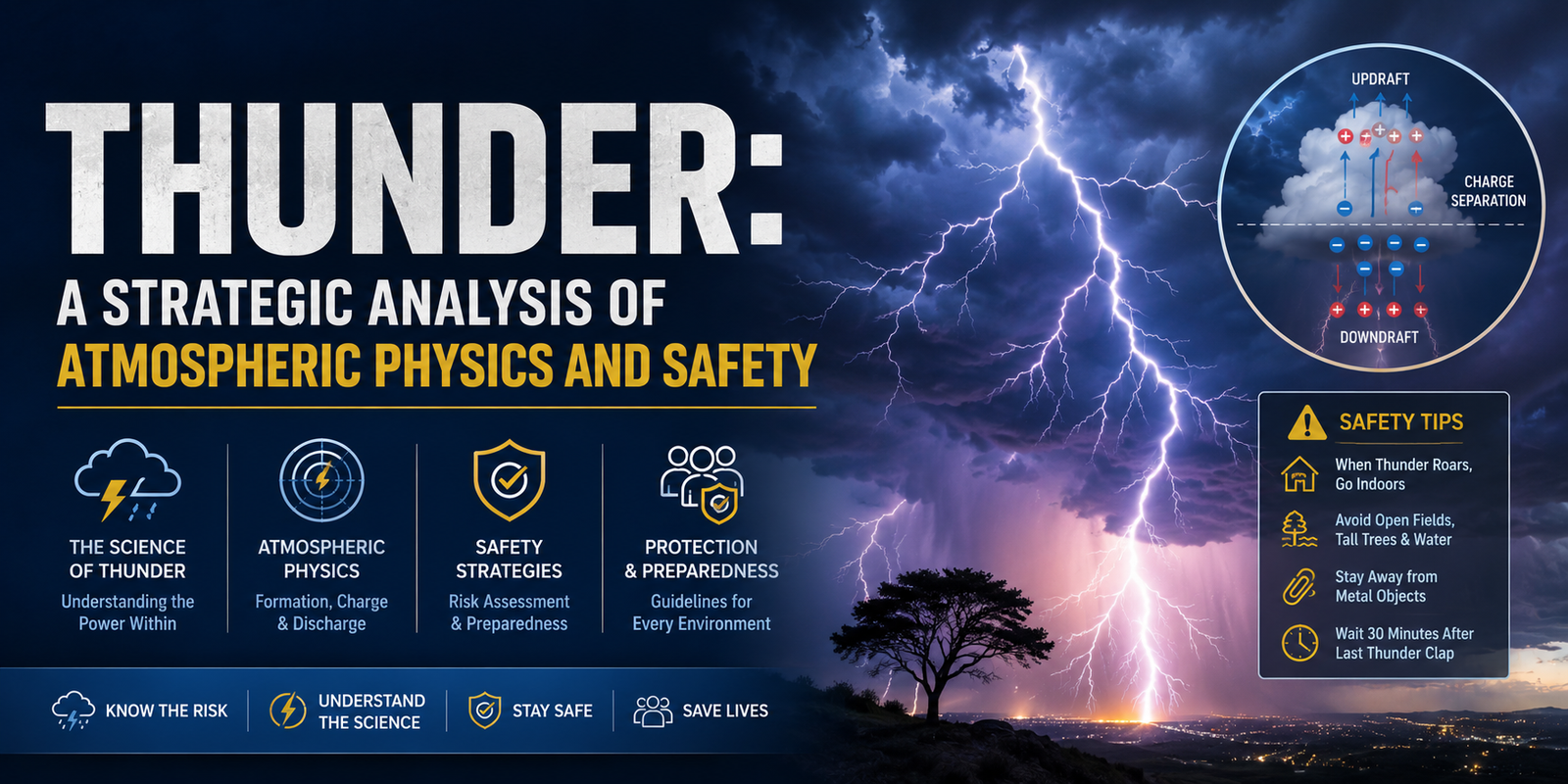
💡 Thunder: A Strategic Analysis of Atmospheric Physics and Safety
A comprehensive expert guide on the physics of thunder, its acoustic properties, and critical safety protocols for extreme weather events.
Executive Summary
Thunder is the acoustic result of rapid atmospheric expansion caused by lightning. This analysis examines the thermodynamic processes that generate sound waves exceeding 120 decibels. Key findings indicate that lightning heats the surrounding air to approximately 30,000 Kelvin (50,000 degrees Fahrenheit), creating a supersonic shockwave that transitions into the audible sound we identify as thunder. Data from the National Oceanic and Atmospheric Administration (NOAA) confirms that while thunder itself is not a direct physical threat, it serves as a primary warning indicator for lightning, which causes an average of 20 to 30 fatalities annually in the United States alone. This report provides a technical breakdown of sound propagation, the impact of atmospheric conditions on acoustic clarity, and strategic safety measures for individuals and industries.
Introduction
The roar of thunder is one of the most powerful acoustic phenomena on Earth. For centuries, it was viewed through the lens of mythology, yet modern meteorology reveals it to be a precise byproduct of plasma physics. When a lightning bolt strikes, it creates a channel of ionized gas. The sudden surge of energy causes the air to expand at speeds exceeding the speed of sound, creating a sonic boom. Understanding the mechanics of thunder is essential for outdoor safety, aviation planning, and even nature photography. For instance, capturing the perfect storm shot at Top Instagrammable Places in Kerala for Travel Photography requires a deep understanding of weather patterns to ensure both artistic success and physical safety. This guide examines the science behind the sound and the variables that dictate how we perceive it.
THE DEEP DIVE: The Physics of Acoustic Shockwaves
To understand thunder, one must first analyze the lightning stroke. A lightning bolt is roughly one to two inches in diameter but carries tens of thousands of amperes of current. As this current flows, it encounters resistance in the air, converting electrical energy into heat. This process happens in microseconds.
The Thermodynamic Process
The temperature within a lightning channel reaches five times the surface temperature of the sun. This extreme heat causes the pressure in the air column to rise instantly to between 10 and 100 atmospheres. The resulting expansion creates a cylindrical shockwave that moves outward. Initially, this wave travels faster than the speed of sound, but it quickly slows down and decays into an ordinary sound wave. This transition is why thunder sounds like a sharp crack when the strike is close, but a low rumble when it is far away.
Acoustic Propagation and the Five-Second Rule
Sound travels through the atmosphere at approximately 343 meters per second (about 1,100 feet per second) at 20 degrees Celsius. Light, conversely, travels at nearly 300,000 kilometers per second. This disparity allows observers to calculate the distance of a lightning strike. By counting the seconds between the flash and the sound of thunder and dividing by five, one can estimate the distance in miles. This calculation is vital for residents and travelers experiencing the monsoon season in coastal regions, a hallmark of the Goa Lifestyle Explained, where sudden afternoon thunderstorms are common.
Factors Influencing Sound Quality
- Distance: High-frequency sounds dissipate faster than low-frequency sounds. This is why distant thunder sounds like a low-pitched rumble.
- Atmospheric Inversions: When a layer of warm air sits above cool air, it can trap sound waves near the ground, causing thunder to sound much louder and travel further than usual.
- Terrain: Mountains and buildings can reflect sound waves, creating echoes that prolong the duration of the thunder roll.
Environmental and Industrial Impact
Thunder and lightning are not merely natural spectacles; they have significant implications for energy and infrastructure. The electrical discharge associated with thunder is a reminder of the massive energy potential in our atmosphere. As we look toward CNG and Sustainable Energy Solutions to power our world, researchers continue to study atmospheric electricity as a theoretical, though currently impractical, source of renewable energy. In the aviation industry, thunder serves as a critical signal for ground crews to cease operations, as lightning poses a severe risk to fueling and maintenance activities.
WHAT THIS MEANS FOR YOU
For the average person, thunder is nature’s primary warning system. If you can hear thunder, you are within striking distance of lightning. The most important takeaway is the 30-30 Rule. If the time between the lightning flash and the thunder is 30 seconds or less, you must seek shelter immediately. Furthermore, you should wait at least 30 minutes after the last sound of thunder before resuming outdoor activities.
When indoors, avoid using corded electronics and stay away from plumbing, as metal pipes and wires can conduct the electrical charge from a nearby strike. For those traveling or living in storm-prone areas, staying informed through weather apps and local alerts is the most effective way to mitigate risk.
Expert Verdict / Future Outlook
Meteorological experts suggest that as global temperatures rise, the frequency and intensity of thunderstorms are likely to increase. Higher temperatures lead to more evaporation and more convective energy in the atmosphere, providing the fuel necessary for lightning-rich storms. From a strategic standpoint, this necessitates better lightning protection systems for high-rise buildings and more robust early warning systems for public events. The future of atmospheric science lies in high-resolution modeling that can predict the exact timing of lightning initiation, potentially giving people more time to seek safety before the first clap of thunder is even heard.
FAQ
1. Can thunder occur without lightning?
No. Thunder is physically the sound produced by lightning. If you hear thunder, there is lightning present, even if it is obscured by clouds or distance.
2. Why does thunder sometimes sound like a long rumble?
This happens because the lightning bolt is not a single point; it is a long, jagged line. Sound from the parts of the bolt closer to you reaches your ears first, while sound from the further parts arrives later, creating a continuous rumbling effect.
3. Is it possible for thunder to be heard from 50 miles away?
Generally, no. Thunder is rarely heard more than 10 to 15 miles away due to the refraction of sound waves in the atmosphere and the presence of background noise.
4. What is thundersnow?
Thundersnow is a rare phenomenon where thunder and lightning occur during a snowstorm. It requires specific atmospheric instability where relatively warm air rises through very cold air above it.
5. Does thunder have any physical benefits?
While thunder itself is just sound, the lightning that causes it helps fix nitrogen in the atmosphere. This nitrogen falls with rain and acts as a natural fertilizer for plants.
Conclusion
Thunder is more than an atmospheric sound; it is a complex physical event that signals the presence of immense electrical energy. By understanding the relationship between the thermal expansion of air and the resulting acoustic shockwave, we can better appreciate the power of nature while taking the necessary steps to remain safe. Whether you are a photographer, a traveler, or an industry professional, respecting the warning of thunder is a fundamental aspect of weather safety and strategic planning.





Comments 0
Leave a Reply
Your email address will not be published. Required fields are marked *
Be the first to share your thoughts!