
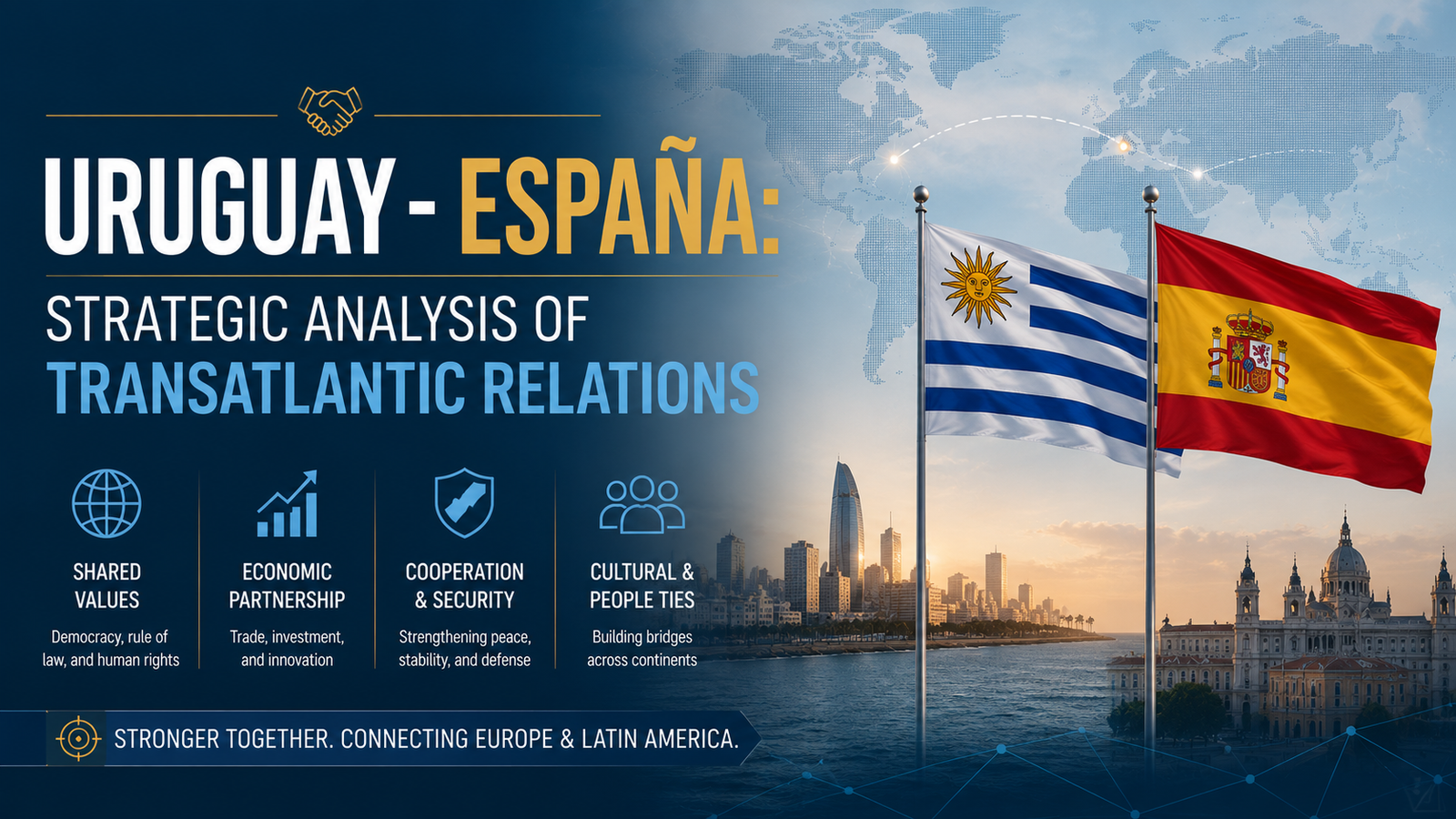
💡 Uruguay - España: Strategic Analysis of Transatlantic Relations
An in-depth expert analysis of the economic, diplomatic, and cultural synergy between Uruguay and Spain, highlighting trade data and investment trends.
Executive Summary
The relationship between Uruguay and Spain represents one of the most stable and productive bilateral partnerships in the Ibero-American sphere. This analysis highlights three primary pillars: a bilateral trade volume exceeding 470 million euros, Spain's position as the second-largest foreign investor in Uruguay, and a shared commitment to the EU-Mercosur agreement. Data from the Spanish Ministry of Economy and Uruguay XXI indicate that over 100 Spanish companies currently operate in Uruguay, providing critical infrastructure in banking, telecommunications, and renewable energy. The strategic outlook suggests a pivot toward green hydrogen and digital services as the next frontier for this transatlantic alliance.
Introduction
Uruguay and Spain share a bond that transcends simple diplomatic protocols. It is a relationship rooted in deep historical ties, yet it is increasingly defined by sophisticated economic interdependence. For Spain, Uruguay serves as a reliable, institutional gateway into the Southern Cone, offering a level of legal certainty that is rare in the region. For Uruguay, Spain remains its primary advocate within the European Union, acting as a bridge for trade and political dialogue. As global markets fluctuate, the Uruguay - España corridor remains a benchmark for how mid-sized economies can leverage cultural affinity to build robust financial and social frameworks.

The Deep Dive: Economic Synergy and Investment
The economic architecture of the Uruguay - España relationship is built on Foreign Direct Investment (FDI). According to the Central Bank of Uruguay, Spain has consistently ranked among the top three investors in the country. This investment is not merely speculative but is concentrated in vital sectors that form the backbone of the Uruguayan economy.
Financial Services and Banking
Spanish financial institutions, specifically Santander and BBVA, hold a dominant market share in Uruguay's private banking sector. Their presence ensures a flow of capital that supports local entrepreneurship and infrastructure projects. This level of institutional stability is comparable to the frameworks discussed in our Dividend Yield Strategies: A Strategic Financial Analysis, where long-term consistency is valued over short-term volatility. These banks have integrated Spanish risk management protocols with Uruguayan market needs, creating a resilient financial ecosystem.
Infrastructure and Telecommunications
Telefónica, operating under the Movistar brand, has invested hundreds of millions of dollars in Uruguay's digital infrastructure. This has positioned Uruguay as a leader in connectivity within South America. The strategic importance of this digital backbone cannot be overstated, as it allows for the implementation of advanced corporate tools. Much like the global reliance on enterprise systems explored in our analysis of Microsoft Outlook: Strategic Analysis of Enterprise Dominance, the Uruguayan corporate sector relies on Spanish-led telecommunications to maintain international competitiveness.
Trade Dynamics and the EU-Mercosur Agreement
Trade between the two nations is characterized by a high degree of complementarity. Uruguay exports high-quality beef, cellulose, and wood products to Spain. In return, Spain exports machinery, pharmaceutical products, and chemical components. However, the true potential of this trade relationship is currently tied to the ratification of the EU-Mercosur agreement. Spain has been the most vocal proponent of this deal within the European Council, arguing that it would eliminate tariffs on 91 percent of EU goods exported to Mercosur and 92 percent of Mercosur goods exported to the EU.

Migration and Human Capital
The flow of people between Uruguay and Spain remains a significant factor in their bilateral relations. There are currently over 67,000 Uruguayans residing in Spain, while Uruguay hosts a substantial community of Spanish expatriates and descendants. This demographic exchange creates a unique "circular migration" pattern where talent and remittances flow in both directions. In the context of shifting international regulations, understanding these movements is as critical as analyzing broader trends such as those found in our Deportation: Strategic Analysis of Global Policy Trends. The bilateral social security agreement between the two countries ensures that workers can migrate without losing their pension rights, a gold standard for international labor mobility.
Energy Transition and Green Hydrogen
Looking forward, the partnership is shifting toward sustainability. Uruguay has achieved a remarkable feat by generating nearly 98 percent of its electricity from renewable sources. Spanish companies like Enertis and Naturgy are now looking at Uruguay as a hub for green hydrogen production. The Uruguayan government's "Green Hydrogen Roadmap" aims to create a 2.1 billion dollar industry by 2030, and Spanish engineering expertise is expected to lead the construction of these facilities.
What This Means For You
- For Investors: Uruguay offers a stable environment with Spanish-led banking infrastructure, making it a low-risk entry point for South American markets.
- For Businesses: The eventual ratification of the EU-Mercosur deal will drastically reduce the cost of doing business between these two points.
- For Professionals: Reciprocal agreements in education and social security make the Spain-Uruguay corridor one of the easiest for professional relocation.
- For Exporters: There is a growing demand in Spain for sustainable and organic Uruguayan agricultural products.

Expert Verdict / Future Outlook
The strategic alliance between Uruguay and Spain is entering a phase of "Technological Maturity." While the historical relationship was based on migration and basic trade, the future will be defined by the export of services and renewable energy technology. Uruguay's role as a regional tech hub, combined with Spain's role as a European gateway, creates a powerful axis. Experts predict that if the EU-Mercosur deal is finalized in the next 24 months, bilateral trade could increase by as much as 30 percent. The primary challenge will be navigating the protectionist tendencies within other EU member states, but the Uruguay-Spain partnership remains the most resilient advocate for transatlantic free trade.
FAQ
Is Spain the largest investor in Uruguay?
Spain is consistently the second-largest investor in Uruguay, following the United States. In certain years, depending on specific infrastructure projects, Spain has occupied the top spot, particularly in the energy and banking sectors.
Do Uruguayans need a visa to visit Spain?
Currently, Uruguayan citizens do not need a visa to enter Spain for tourism or business stays of up to 90 days. However, they will eventually need to apply for the ETIAS (European Travel Information and Authorisation System) once it is fully implemented.
What are the main Uruguayan products sold to Spain?
The primary exports include frozen beef, chemical wood pulp (cellulose), soybeans, and leather goods. There is also a growing sector for Uruguayan software and IT services being exported to Spanish firms.
How many Spanish companies are in Uruguay?
There are over 100 major Spanish companies with a permanent presence in Uruguay, including global giants like Santander, BBVA, Movistar, Mapfre, and various hotel chains like Meliá and Barceló.
Can a Spaniard work in Uruguay easily?
Yes, thanks to bilateral agreements, Spanish citizens find it relatively straightforward to obtain residency and work permits in Uruguay. The process is significantly faster than for citizens of non-Ibero-American countries.
Conclusion
The relationship between Uruguay and Spain is a model of transatlantic cooperation. By combining historical trust with modern economic goals in green energy and digital services, both nations are securing a prosperous future despite global economic shifts.





Comments 0
Leave a Reply
Your email address will not be published. Required fields are marked *
Be the first to share your thoughts!