
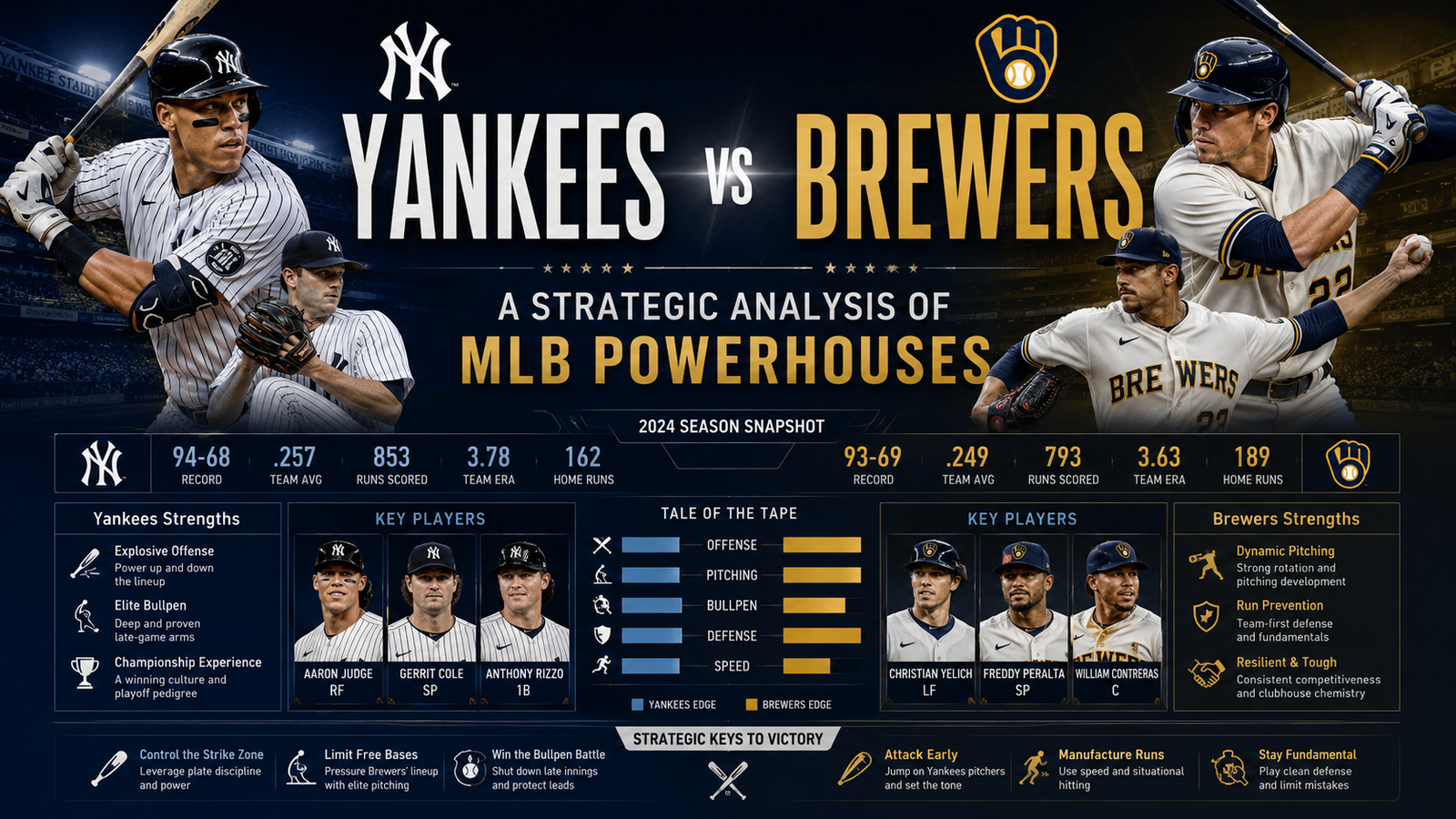
💡 Yankees vs Brewers: A Strategic Analysis of MLB Powerhouses
A comprehensive strategic breakdown of the New York Yankees and Milwaukee Brewers, focusing on roster construction, pitching metrics, and economic disparity.
Executive Summary
The rivalry and intermittent matchups between the New York Yankees and the Milwaukee Brewers offer a masterclass in contrasting Major League Baseball (MLB) philosophies. This analysis identifies three primary findings: first, the Yankees continue to leverage a top-three payroll to secure elite offensive production, centered around historic Exit Velocity metrics. Second, the Brewers have established a sustainable competitive advantage through a Pitching Lab model that consistently outperforms traditional scouting expectations. Third, the economic disparity between these two markets creates a unique strategic environment where the Brewers must prioritize defensive efficiency and base-running to counter the Yankees' raw power. Data from the 2024 season indicates that while the Yankees lead in Isolated Power (ISO), the Brewers maintain a superior Run Differential per dollar spent, highlighting two different paths to the postseason.

Introduction: The Clash of Market Philosophies
When the New York Yankees face the Milwaukee Brewers, the narrative often centers on the David versus Goliath dynamic. However, a professional strategic analysis reveals a much more nuanced interaction. The Yankees represent the pinnacle of the big-market, star-driven model, where financial might is converted into high-floor consistency. Conversely, the Milwaukee Brewers serve as the industry standard for small-market efficiency, utilizing advanced data analytics and player development to remain competitive in the National League Central. This matchup is not merely about wins and losses; it is a stress test for two distinct organizational blueprints. By examining the underlying metrics, from Adjusted OPS to FIP (Fielder Independent Pitching), we can understand how these teams navigate the complexities of a 162-game season.
THE DEEP DIVE: Strategic Roster Construction
The core of the Yankees' strategy is built upon the acquisition of generational talent. The presence of players like Aaron Judge and Juan Soto creates a lineup protection dynamic that forces opposing pitchers into high-stress situations. In 2024, the Yankees' offensive strategy focused heavily on the Three True Outcomes: home runs, walks, and strikeouts. This approach, while occasionally prone to volatility, ensures a high ceiling for run production. This focus on elite performance is similar to how other sports franchises manage their assets, as seen in the Karl-Anthony Towns: The Strategic Evolution of a Modern NBA Star, where individual talent is optimized within a specific team structure.
In contrast, the Milwaukee Brewers operate with a razor-thin margin for error. Their roster construction emphasizes versatility and defensive runs saved (DRS). The Brewers consistently rank in the top tier of MLB for pitching development, often taking mid-level prospects or veteran free agents and increasing their strikeout rates through grip changes and seam-shifted wake analysis. This analytical prowess allows them to maintain a competitive edge despite a payroll that is often less than half of the Yankees'. Their reliance on efficiency over raw spending power mirrors broader economic trends analyzed in the Strategic Analysis of Global Lending and Debt Markets, where resource allocation determines long-term viability.

Pitching Dynamics and Bullpen Management
The tactical battle between these two teams often hinges on bullpen usage. The Brewers have pioneered the bridge-to-the-closer methodology, utilizing high-leverage relievers in the sixth and seventh innings to neutralize the heart of the Yankees' order. Statcast data shows that the Brewers' bullpen frequently leads the league in average vertical break on sliders, a specific strategy designed to combat the high-launch-angle swings prevalent in the Yankees' lineup.
The Yankees' pitching strategy has evolved to include a more diverse mix of power arms and precision lefties. Their investment in Gerrit Cole provides a traditional ace foundation, but the emergence of their internal scouting has allowed them to find value in the margins. When analyzing the global impact of power hitters, it is useful to look at international comparisons, such as the metrics surrounding Kazuma Okamoto: The Analytical Breakdown of NPB’s Home Run King, to understand how exit velocity translates across different leagues and pitching styles.
Economic Context and Market Sustainability
The financial gap between New York and Milwaukee is a permanent fixture of their relationship. The Yankees operate with a budget exceeding 300 million dollars, inclusive of luxury tax penalties. This allows them to absorb the risk of long-term contracts that might fail. The Brewers, however, must be proactive in trading stars before they reach expensive free agency. This cycle of talent regeneration is the hallmark of the Milwaukee front office. They prioritize the accumulation of controllable assets, ensuring that they have a steady stream of league-minimum talent to supplement their core. This fiscal discipline is what allows a team in one of the smallest markets in baseball to consistently challenge for division titles.
WHAT THIS MEANS FOR YOU
- For the Enthusiast: Understanding the Yankees vs Brewers matchup requires looking beyond the box score to the defensive shifts and pitching sequences that define the game.
- For the Fantasy Manager: Yankees players provide high-volume counting stats, while Brewers pitchers often offer better value in terms of ERA and WHIP relative to their draft cost.
- For the Strategic Observer: This matchup illustrates how different organizational cultures can achieve similar levels of success through divergent resource management.
- For the Bettor: Pay close attention to the Brewers' home-field advantage at American Family Field, where the closed-roof environment can influence ball flight and pitching performance differently than the open-air Yankee Stadium.
Expert Verdict / Future Outlook
The long-term outlook for this interleague dynamic suggests a continued divergence in strategy. The Yankees are expected to remain aggressive in the free-agent market, especially as they seek to maximize the championship window of their current core. The Brewers are likely to continue their trend of aggressive scouting and technological integration in their pitching lab. As MLB continues to implement rule changes like the pitch clock and larger bases, the Brewers' emphasis on athleticism and speed may give them a slight tactical advantage in head-to-head matchups. However, the sheer offensive gravity of the Yankees' lineup remains the most significant hurdle for any opponent.
FAQ
- Which team has the historical advantage in head-to-head games? Historically, the Yankees have held a slight edge in win-loss percentage, though the Brewers have been highly competitive in recent series, particularly at home.
- How does the payroll difference affect on-field performance? While the Yankees can afford more elite individual talent, the Brewers compensate through superior depth and defensive efficiency metrics.
- What is the Brewers' Pitching Lab? It is a state-of-the-art facility where the Brewers use high-speed cameras and bio-mechanical sensors to optimize pitcher performance and health.
- Who are the key players to watch in this matchup? For the Yankees, Aaron Judge and Juan Soto are the primary threats. For the Brewers, the focus is often on their rotating cast of elite relievers and young outfielders like Jackson Chourio.
- How does the stadium environment impact the game? Yankee Stadium is known for its short right-field porch, favoring left-handed power hitters, while American Family Field in Milwaukee provides a more neutral environment but can favor pitchers when the roof is closed.
Conclusion
The strategic landscape of a Yankees vs Brewers matchup is a testament to the diversity of success in Major League Baseball. While the Yankees utilize financial strength to secure high-ceiling talent, the Brewers rely on analytical precision and developmental efficiency. Both models are valid, yet they require entirely different management styles. For the observer, these games provide a window into the future of sports management, where data and capital intersect to create a high-stakes competitive environment.





Comments 0
Leave a Reply
Your email address will not be published. Required fields are marked *
Be the first to share your thoughts!