
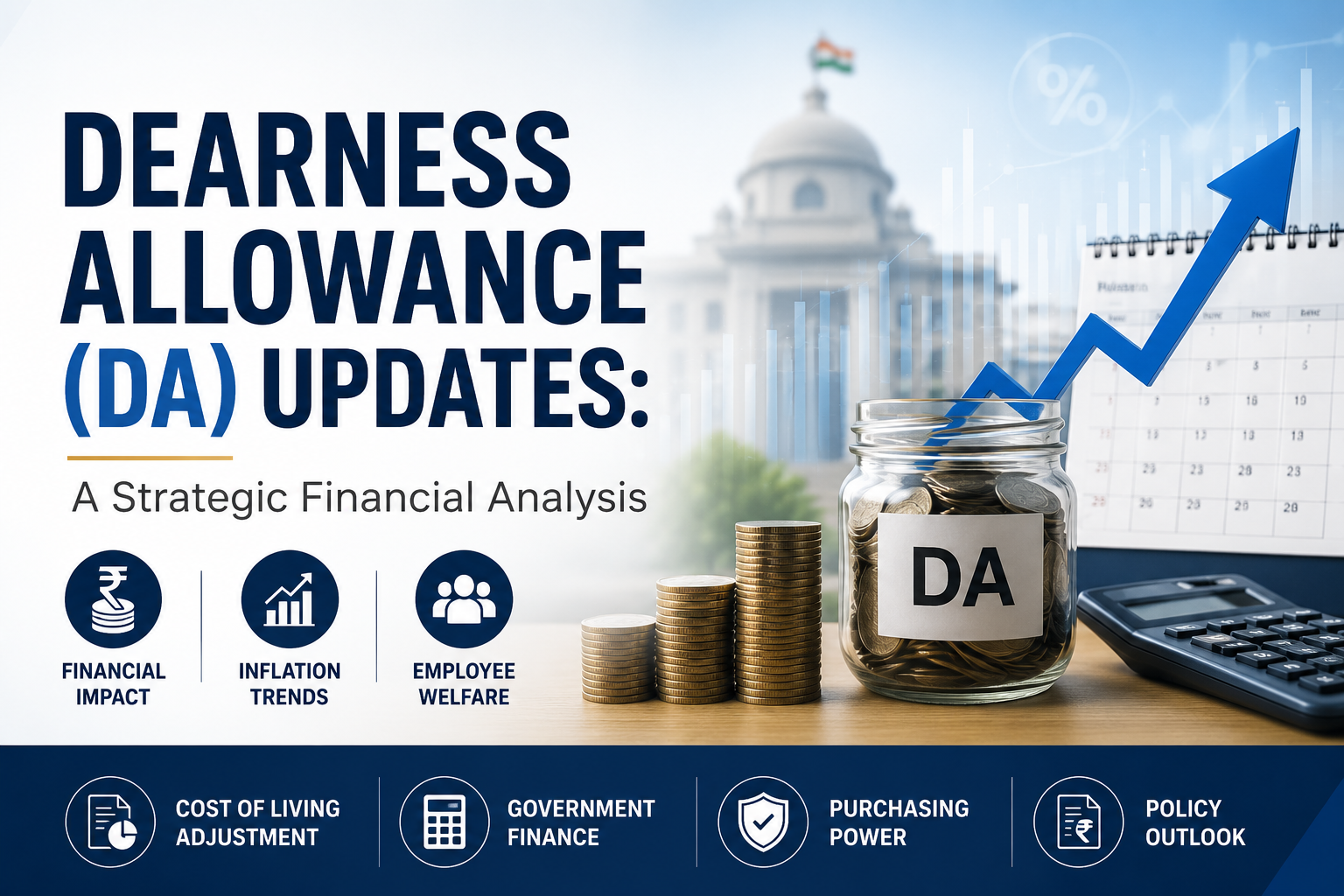
💡 Dearness Allowance (DA) Updates: A Strategic Financial Analysis
A comprehensive analysis of Dearness Allowance (DA) updates, focusing on AICPI data, the 50 percent threshold, and the strategic impact on the Indian economy.
Executive Summary
Dearness Allowance (DA) remains one of the most critical fiscal components for millions of central and state government employees in India. This strategic analysis highlights the recent transition of DA reaching the 50 percent threshold, a milestone that triggers significant adjustments in other salary components such as House Rent Allowance (HRA) and various special allowances. Based on the All India Consumer Price Index for Industrial Workers (AICPI-IW) data released by the Labour Bureau, the current trajectory suggests a continued upward trend in line with inflationary pressures. Key findings indicate that the 4 percent incremental hike has become a standard benchmark, reflecting the government's commitment to maintaining the purchasing power of its workforce amidst fluctuating market dynamics.
Introduction
In the complex landscape of public finance, Dearness Allowance serves as a vital hedge against inflation. It is a cost of living adjustment provided to government employees and pensioners to mitigate the impact of rising prices on their standard of living. Unlike fixed salary components, DA is dynamic, undergoing revisions twice a year in January and July. The calculation is rooted in the movement of the Consumer Price Index, making it a direct reflection of the retail inflation experienced by the average urban and semi-urban household. As global economic shifts influence domestic prices, understanding the strategic nuances of DA updates is essential for financial planning and macroeconomic forecasting.
The recent surge in essential commodity prices has placed the spotlight on the Labour Bureau's monthly reports. These reports serve as the primary data source for the Union Cabinet's decisions regarding DA hikes. For many, these updates are as significant as the performance of the NSE (National Stock Exchange), as they directly affect the disposable income of a vast segment of the population, subsequently influencing consumer spending and market liquidity.
THE DEEP DIVE: Mechanics and Strategic Implications
The calculation of Dearness Allowance is not arbitrary but follows a specific formula recommended by the 7th Pay Commission. For central government employees, the formula is based on the average of the AICPI-IW for the preceding twelve months. The base year for this index is currently 2016, which provides a more contemporary reflection of consumption patterns compared to previous iterations. When the average index rises, the DA percentage is adjusted upward to ensure that the real wages of employees do not erode.
One of the most significant strategic developments in recent months is the DA reaching the 50 percent mark of the basic pay. According to the recommendations of the 7th Pay Commission, once the DA reaches or crosses this 50 percent threshold, several other allowances are automatically revised upward. For instance, the House Rent Allowance (HRA) rates, which are categorized based on city tiers (X, Y, and Z), see a mandatory increase. This transition is a critical fiscal event, as it effectively raises the entire compensation structure without a formal change in the basic pay scale. This mechanism provides a buffer for employees, similar to how investors look for stability in HDFC Bank Share: Strategic Analysis of Financial Performance during volatile market cycles.

The impact of these updates extends beyond active employees to include millions of pensioners through the Dearness Relief (DR) scheme. The fiscal burden of these increases is substantial. Each 1 percent increase in DA and DR is estimated to cost the exchequer approximately 3,000 crore INR annually. Consequently, a 4 percent hike results in an additional annual expenditure of nearly 12,000 crore INR. From a strategic standpoint, the government must balance this social security obligation with the need to manage the fiscal deficit. The timing of these announcements often aligns with broader economic indicators, including the 24 Carat Gold Price Today: Strategic Market Analysis, which serves as a proxy for long-term inflationary expectations.
Furthermore, the talk of an 8th Pay Commission is gaining momentum as the DA hits the 50 percent ceiling. Historically, a new Pay Commission is established every ten years to overhaul the pay structure. With the 7th Pay Commission having been implemented in 2016, the year 2026 is viewed as the likely window for the next major revision. The current DA levels will likely be merged into the basic pay at that stage, resetting the DA cycle to zero percent. This strategic reset is essential for maintaining a sustainable wage bill while ensuring that government compensation remains competitive with the private sector.
WHAT THIS MEANS FOR YOU
For the individual employee or pensioner, the DA update is more than just a percentage; it is a tool for financial recalibration. Here is a breakdown of the actionable impacts:
- Enhanced Disposable Income: A 4 percent hike on a basic salary of 50,000 INR translates to an additional 2,000 INR per month. While seemingly modest, this cumulative increase helps offset the rising costs of fuel, healthcare, and education.
- HRA Revision: With DA at 50 percent, employees in Tier-X cities see their HRA increase from 27 percent to 30 percent, providing significant relief in high-rent urban centers.
- Retirement Planning: Since DA is a component of the last drawn salary used to calculate gratuity and pension, these updates directly enhance the long-term financial security of retiring personnel.
- Tax Implications: It is important to note that Dearness Allowance is fully taxable for salaried employees. Therefore, a portion of the hike will be redirected toward income tax, depending on the individual's tax bracket.

Expert Verdict and Future Outlook
The strategic outlook for Dearness Allowance remains tied to the trajectory of the Consumer Price Index. Experts suggest that as long as food and energy prices remain volatile due to geopolitical factors, the trend of 3 percent to 4 percent biannual hikes will persist. The government's reliance on the AICPI-IW ensures a data-driven approach, removing much of the political guesswork from the process. However, the real strategic challenge lies in the transition to the next Pay Commission. Analysts expect the government to carefully time the announcement of the 8th Pay Commission to align with fiscal targets and economic growth projections. The focus will likely shift toward performance-linked incentives, though the core protection offered by DA will remain a non-negotiable aspect of public sector employment.
FAQ: Authoritative Answers on DA
1. How is the DA hike percentage calculated?
The percentage is determined by taking the average of the AICPI-IW for the last 12 months, subtracting the base index, and then calculating the growth percentage as prescribed by the 7th Pay Commission formula.
2. Why did the HRA increase recently?
The 7th Pay Commission mandated that when the DA reaches 50 percent, the HRA rates must be revised from 27, 18, and 9 percent to 30, 20, and 10 percent for X, Y, and Z category cities respectively.
3. Is Dearness Allowance the same for all states?
No. While many state governments follow the central government's DA patterns, they are not legally bound to do so. Each state cabinet decides its own DA rates based on its fiscal health.
4. Does DA affect the National Pension System (NPS)?
Yes. For employees under the NPS, the government's 14 percent contribution is calculated on the sum of the Basic Pay and the Dearness Allowance. Therefore, a DA hike increases the monthly corpus contribution.
5. When can we expect the next DA announcement?
DA revisions are typically announced in March (retroactive to January) and September or October (retroactive to July) each year.
Important Note: Financial Disclaimer: This content is for educational purposes only and does not constitute professional financial advice. Always consult with a certified financial planner before making investment decisions.
Conclusion
The strategic management of Dearness Allowance is a cornerstone of India's economic stability for the public sector. By linking wages to the realities of inflation through the AICPI-IW, the government ensures a resilient workforce. As the 50 percent threshold is crossed, the focus now shifts toward the potential 8th Pay Commission and the long-term sustainability of the national wage bill.





Comments 0
Leave a Reply
Your email address will not be published. Required fields are marked *
Be the first to share your thoughts!