
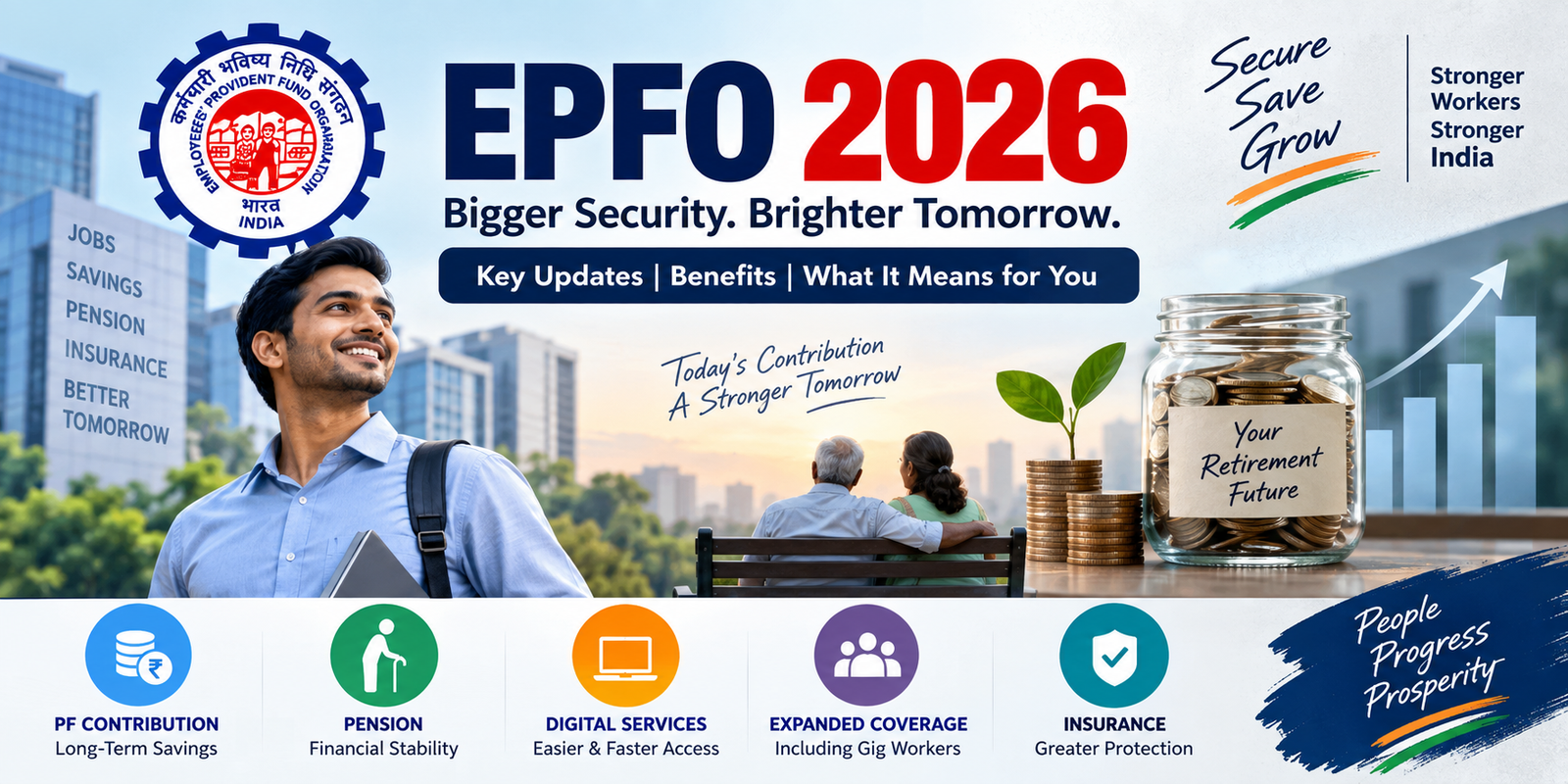
💡 EPFO 2026 Salaried Employee Benefits
An authoritative analysis of the 2026 EPFO benefit landscape, focusing on wage ceiling revisions, pension reforms, and digital infrastructure for salaried professionals.
EPFO 2026: Salaried Employee Benefits, Pension Reforms and Digital Transformation
Executive Summary
The Employees' Provident Fund Organisation (EPFO) remains one of India's most important social-security institutions for organised-sector employees. In 2026, EPFO's transformation is being shaped by digital service improvements, pension-payment modernization, changes aligned with the Code on Social Security, and efforts to expand social-security coverage.
The statutory EPF wage ceiling remains ₹15,000 per month under the existing EPF framework. Although an increase to ₹21,000 has been discussed and proposed over the years, it should not be presented as an implemented 2026 wage-ceiling revision. EPFO's official records continue to show ₹15,000 as the statutory wage ceiling.
EPFO's financial scale has also expanded significantly. Its consolidated corpus exceeded ₹28.34 lakh crore as of March 2025, according to information placed before the Central Board of Trustees.
For interest rates, EPFO declared an 8.25% interest rate for FY 2024-25, while the Central Board of Trustees recommended 8.25% for FY 2025-26 in March 2026.
The 2026 outlook therefore focuses less on a single wage-ceiling change and more on four major areas: digital transformation, pension-service modernization, social-security expansion under the Labour Codes, and improved member service delivery.
Introduction
The Employees' Provident Fund Organisation (EPFO) is a central pillar of India's retirement and social-security framework for eligible employees. It administers the Employees' Provident Fund (EPF), Employees' Pension Scheme (EPS) and Employees' Deposit Linked Insurance (EDLI) schemes.
India's social-security framework has undergone an important transition following the implementation of the four Labour Codes from 21 November 2025. The Code on Social Security, 2020 expands the framework for social protection across organised, unorganised, gig and platform workers.
At the same time, EPFO has continued to modernise its digital infrastructure and pension services. These changes are relevant to employees, employers, pensioners and workers entering the formal social-security system.
This report examines the major EPFO developments relevant to salaried employees in 2026 and explains what they mean for retirement savings, pension benefits, insurance protection and digital services.
THE DEEP DIVE: Major EPFO Developments in 2026
1. EPF Wage Ceiling: ₹15,000 Remains the Statutory Ceiling
The statutory EPF wage ceiling remains ₹15,000 per month under the existing EPF framework. EPFO records show that the ceiling was increased to ₹15,000 with effect from September 2014 and has remained at that level.
A possible increase to ₹21,000 has been discussed for several years and has been the subject of proposals and recommendations. However, it should not be described as a confirmed or implemented 2026 EPFO reform unless a new government notification changes the existing ceiling.
For an employee whose applicable PF contribution is calculated on the statutory ceiling, the employee contribution is generally 12% of the relevant PF wage, subject to the applicable rules. The employer also contributes under the EPF/EPS framework.
Employees earning more than ₹15,000 may have different PF treatment depending on their membership status, employer policy and applicable EPF rules. Therefore, the effect of any future wage-ceiling revision would depend on the employee's salary structure and contribution arrangement.
What this means for employees
For now, employees should not assume that the EPF contribution base has automatically increased to ₹21,000. Any future revision would require an official policy or notification.
2. EPS-95 and Pension Service Modernization
The Employees' Pension Scheme (EPS), 1995 provides pension-related benefits to eligible EPFO members. Pension eligibility and benefits depend on factors including pensionable service, pensionable salary and the applicable EPS rules.
One of the most important recent changes has been the modernization of pension payments through the Centralized Pension Payments System (CPPS).
Unlike the original decentralized system, CPPS enables pensioners to receive pension through any bank, any branch and anywhere in India, reducing dependence on the regional office where the pension was originally processed. EPFO completed the nationwide rollout of CPPS in December 2024.
The system also removes the need to transfer Pension Payment Orders (PPOs) between offices when pensioners move from one location to another or change their bank or branch.
Therefore, CPPS should not be described as a reform that EPFO is merely planning to introduce in 2026. It is an already implemented pension-payment modernization measure whose benefits continue into 2026.
3. Digital Transformation of EPFO Services
EPFO's digital transformation is continuing through centralized IT systems, online services and technology-enabled verification.
The organisation has introduced several digital initiatives, including online claim and transfer services, profile corrections, UAN-related services and facial-authentication-based services.
One notable development is the use of Facial Authentication Technology (FAT) through digital services for pensioners and members. EPFO has also introduced UAN activation and generation-related facilities through the UMANG application using face authentication.
In March 2026, the Central Board of Trustees also approved a pilot project for auto-initiation of claim settlement for certain inoperative EPFO accounts with unclaimed balances of ₹1,000 or less. The pilot covers more than 1.33 lakh accounts with nearly ₹5.68 crore.
These developments indicate a clear move toward greater automation, but claims such as "90% reduction in human intervention," "blockchain-secured documentation" or guaranteed 48–72-hour settlements should not be presented as official EPFO targets without a specific government source.
4. Gig and Platform Workers: Expansion of Social Security
The social-security framework has expanded beyond traditional employer-employee relationships.
The Code on Social Security, 2020 formally recognises gig workers and platform workers and provides for social-security measures covering areas such as life and disability protection, accident insurance, health and maternity benefits and old-age protection. The Code also provides for a Social Security Fund.
The Labour Codes came into force from 21 November 2025, strengthening the broader social-security framework for organised, unorganised, gig and platform workers.
The contribution mechanism for gig and platform workers is different from the conventional employer-employee EPF model. The Social Security Code provides for contributions from aggregators to the Social Security Fund, subject to the statutory framework. Government information has described the aggregator contribution as between 1% and 2% of annual turnover, subject to a cap linked to payments made to such workers.
Importantly, gig workers should not automatically be described as EPFO members or EDLI beneficiaries merely because they are recognised under the Social Security Code. Their benefits depend on the schemes and rules applicable to them.
5. EPF Interest Rate and Investment Management
EPFO's interest rate is determined through its institutional process and is influenced by the performance and income generated from its investment portfolio.
For FY 2024-25, the EPF interest rate was declared at 8.25%.
In March 2026, the Central Board of Trustees recommended an 8.25% interest rate for FY 2025-26. The government notification and subsequent crediting process determine the final implementation of the recommended rate.
EPFO invests member funds across permitted investment categories, including government securities, state development loans, PSU bonds and equity ETFs under its approved investment framework. The EPFO's 2026 financial discussions also included measures to improve investment management, including standard operating procedures relating to equity ETFs and other permitted investments.
However, it would be incorrect to state that EPFO has officially decided to increase its equity allocation to 20% in 2026 unless such a change is formally approved and notified.
WHAT THIS MEANS FOR YOU
1. Your EPF Contribution
The statutory wage ceiling remains ₹15,000 under the current framework. Therefore, employees should not assume that their mandatory PF contribution has automatically increased because of a ₹21,000 ceiling revision.
2. Retirement Savings
EPF continues to provide a long-term retirement savings mechanism. Contributions accumulate over the employee's working life and earn interest at the rate declared for the relevant financial year.
3. Pension Portability
Your UAN helps maintain continuity of EPF membership when changing employers. Pension-related service is also linked to the applicable EPS framework.
4. Faster and More Digital Services
EPFO continues to expand online services, digital verification and automated processes. However, processing time can vary depending on the claim, member records, employer information and verification requirements.
5. Pension Payment Portability
The Centralized Pension Payments System has already been rolled out nationwide, allowing EPS pensioners to receive pensions through any bank and branch across India without transferring the PPO when they move locations or change their bank/branch.
EDLI: Life Insurance Protection for EPFO Members
The Employees' Deposit Linked Insurance (EDLI) Scheme provides insurance protection to eligible EPFO members.
The maximum EDLI assurance is ₹7 lakh, while the applicable minimum assurance is ₹2.5 lakh under the relevant provisions. The enhanced benefits were introduced through amendments to the EDLI framework.
The EDLI contribution is made by the employer; employees do not separately pay an EDLI premium.
In 2025, further modifications to the EDLI framework improved protection in certain situations, including cases involving death after a short period of service and certain non-contributory periods.
Therefore, the ₹7 lakh figure can be used in the article, but it should be presented as the maximum applicable assurance under the scheme, rather than as a universal guaranteed payout for every death claim.
EPFO 2026: Key Digital and Administrative Reforms
Several developments show EPFO's broader shift toward technology-enabled administration:
-
Centralized Pension Payments System
-
Facial Authentication Technology for digital services
-
Online transfer and correction facilities
-
UAN-related digital services
-
Automated claim-processing initiatives
-
Improved handling of erroneous or fraudulent UAN linkages
-
Digital Life Certificate submission
-
Centralized data and IT infrastructure
-
Simplified compliance procedures for employers
EPFO's FY 2024-25 performance report also records more than 6 crore claims settled during the year, demonstrating the scale of its digital and administrative operations.
Expert Outlook for 2026
The major EPFO story in 2026 is not simply a proposed increase in the wage ceiling. The broader transformation is taking place through digital service delivery, pension-payment modernization, expanded social-security coverage and improved administrative systems.
The implementation of the Labour Codes has also created a broader framework for social-security protection covering organised, unorganised, gig and platform workers.
For salaried employees, the key priorities remain understanding their PF contribution structure, maintaining accurate UAN and KYC information, tracking their EPF balance, understanding EPS eligibility and keeping their nomination details updated.
Any future increase in the EPF wage ceiling or changes to contribution limits should be treated as a policy development only after an official government notification.
FAQ: EPFO 2026
1. Is the EPF wage ceiling ₹21,000 in 2026?
No. The statutory EPF wage ceiling remains ₹15,000 under the existing EPF framework. A ₹21,000 ceiling has been discussed as a possible policy change, but it should not be presented as an implemented 2026 revision without an official notification.
2. What is the EPF interest rate for 2025-26?
The Central Board of Trustees recommended an 8.25% annual interest rate for FY 2025-26 in March 2026. The recommendation is subject to the government's approval and notification process.
For FY 2024-25, the EPF interest rate was 8.25%.
3. What was the EPF interest rate for 2023-24?
EPFO credited 8.25% interest for FY 2023-24. Therefore, the original article's reference to 8.25% for 2023-24 was not itself wrong, but it was outdated for a 2026-focused article.
4. Can an employee opt out of EPF?
Eligibility and exclusion depend on the EPF Scheme, the employee's wage at the time of joining, previous EPF membership and other applicable conditions. Employees should not rely on a blanket "opt-out" rule. Where an employee is already covered or is required to be enrolled under the applicable rules, an employer cannot simply treat the employee as outside EPF.
5. What happens to EPF when I change jobs?
Your UAN provides continuity across employers. EPF membership and accumulated balances can be transferred/managed through the UAN-based system, subject to applicable procedures and verification.
EPS pension eligibility is based on the applicable pension rules and eligible pensionable service. In general, 10 years of eligible pensionable service is an important threshold for monthly EPS pension eligibility.
6. Is EDLI insurance free for employees?
Employees do not separately contribute toward EDLI. The employer makes the applicable EDLI contribution. The scheme provides insurance benefits to eligible EPFO members, with the maximum assurance currently reaching ₹7 lakh under the applicable provisions.
7. Are gig workers automatically covered by EPFO?
Not necessarily. Gig and platform workers are recognised under the Code on Social Security and are eligible for social-security measures under the applicable framework. Their coverage should not automatically be equated with conventional EPF/EDLI membership.
8. Is the centralized pension system still a future 2026 reform?
No. The Centralized Pension Payments System was already rolled out across EPFO's regional offices in December 2024. It allows pensioners to receive their pension from any bank and branch across India.
Important Note: Financial Disclaimer
This article is provided for general educational and informational purposes only. EPFO rules, government notifications, interest rates and social-security policies may change. Readers should verify their individual eligibility, contribution requirements and benefits with EPFO or a qualified financial professional before making financial decisions.
Conclusion
The EPFO landscape in 2026 is defined by modernization rather than a single confirmed wage-ceiling hike.
The statutory EPF wage ceiling remains ₹15,000 per month, while the long-discussed ₹21,000 revision remains a policy proposal unless and until officially notified. EPFO's financial scale has grown substantially, with a consolidated corpus exceeding ₹28.34 lakh crore as of March 2025.
At the same time, EPFO has made substantial progress in digital and pension-service modernization. The nationwide Centralized Pension Payments System, facial-authentication services, online claim and transfer facilities, and newer automation initiatives are gradually making EPFO services more technology-driven.
For employees, the practical focus should therefore be on maintaining accurate UAN and KYC information, understanding EPF and EPS contributions, keeping nominations updated and monitoring official EPFO notifications for future changes.
As India's Labour Codes expand the social-security framework to include organised, unorganised, gig and platform workers, EPFO and the broader social-security system are moving toward a more integrated and technology-enabled model of worker protection.




Comments 0
Leave a Reply
Your email address will not be published. Required fields are marked *
Be the first to share your thoughts!